
Whitehat / Sales Enablement / 2026
What are the best B2B sales tips to grow your business in 2026?
The best B2B sales tips in 2026 are simple: tighten your ideal customer profile, align sales and marketing around one definition of “qualified”, respond to inbound leads fast, use AI to remove admin, and build trust through social proof and helpful content. Do those consistently and growth follows.
Updated for modern buyer behaviour, AI-assisted selling, and UK B2B realities (long cycles, multiple stakeholders, and “please send me a deck” as a love language).
B2B buyers are doing more research without you, looping in more stakeholders, and expecting a smoother, more digital journey. In fact, 39% of B2B buyers are now willing to place orders over $500,000 through self-service digital commerce or remote online connections.[2] That means your sales “tips” can’t just be motivational posters and a new pitch deck—your process has to match reality.
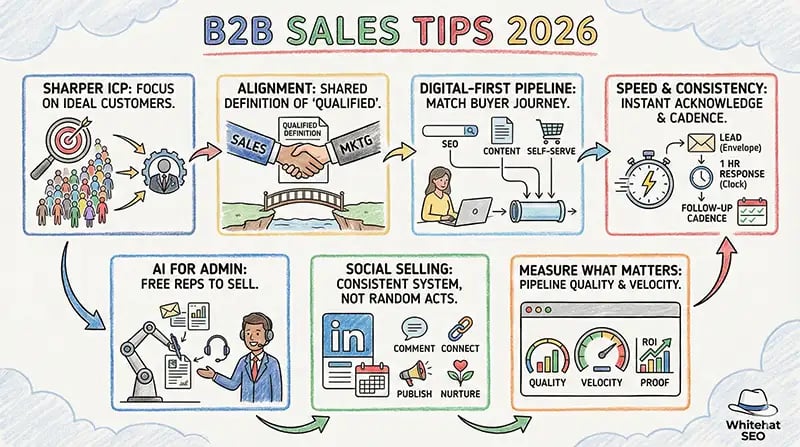
The good news: you don’t need a fancy, fragile sales machine. You need a clear ICP, consistent qualification, fast response, helpful assets, and ruthless measurement. Below is a practical playbook you can implement whether you’re a 3-person founder-led sales team or a 30-person revenue org.
Quick reality check: Salesforce research found 84% of sales reps missed quota last year, and reps report spending 70% of their time on non-selling tasks.[1] If your team feels “busy” but pipeline feels… suspiciously thin, you’re not alone.
1) Start with a sharper ICP (so you stop selling to everyone)
Your pipeline improves the moment you stop chasing “anyone with a budget” and start focusing on the accounts that can actually win with you. A strong ideal customer profile (ICP) is not a vibe—it’s a filter that prevents wasted demos, random proposals, and “we’re just exploring options” purgatory.
A practical ICP checklist
- Industry + sub-vertical (where you win repeatedly)
- Company size + complexity (who feels your pain most)
- Trigger events (new funding, hiring sprees, new regulation, platform change)
- Tech stack (what you integrate with / replace)
- “No-go” signals (price-only buyers, low data maturity, no sponsor)
Standalone rule (AEO/GEO-friendly)
If someone asks, “Who is this for?”, your answer should fit in one sentence without needing a 10-minute story. That one sentence becomes your website headline, your LinkedIn positioning, and your sales opener.
Want the fastest way to tighten ICP and messaging? Pair sales discovery insights with inbound research (keywords, competitor gaps, and intent signals). That’s exactly where inbound marketing supports sales—by making the right prospects show up already educated. If you need help joining those dots, start here: Inbound marketing services.
Key takeaway: A tighter ICP doesn’t reduce your market—it reduces wasted effort. Your team closes more by saying “no” earlier.
2) Align sales and marketing around one definition of “qualified”
Misalignment kills growth quietly. Marketing celebrates lead volume; sales complains about quality; everyone blames the CRM. Fix it with a simple agreement: what counts as a qualified lead, who owns it, and what happens next.
The three definitions that stop chaos
- MQL (Marketing Qualified Lead): shows intent + fits baseline ICP criteria.
- SQL (Sales Qualified Lead): confirms pain, urgency, and a credible path to purchase.
- SLA (Service Level Agreement): response time + minimum follow-up cadence + recycling rules.
When you define these, you unlock better reporting and better behaviour: marketing focuses on attracting the right people; sales follows up consistently; leadership can spot bottlenecks instead of guessing. If you want a deeper alignment framework, this is a solid starting point: How to align sales and marketing teams.
Key takeaway: “Qualified” is not a feeling. It’s a shared definition + a shared follow-up standard.
3) Build pipeline for how buyers actually buy (digital-first, self-serve, remote)
A modern B2B pipeline is omnichannel by default. Buyers might discover you through search, check reviews, lurk your LinkedIn, click a webinar replay, and only then reply to an email. McKinsey’s B2B Pulse research shows buyer comfort with remote and self-service spending increased in 2024—including high-value transactions.[3]
Pipeline isn’t “more leads”. It’s the right mix of:
- Demand capture: SEO + high-intent pages + comparison content (buyers already looking).
- Demand creation: thought leadership + networking + events + partnerships (buyers not yet ready).
- Conversion assets: case studies, pricing guidance, implementation plans, ROI calculators.
If your team needs a structured lead generation system (without duplicating effort), use an inbound-first framework that supports sales enablement. We’ve covered the full mechanics here: B2B lead generation (ultimate guide).
Key takeaway: Build a pipeline engine that works even when nobody is “in the mood” for cold calls.
4) Win on speed-to-lead and follow-up consistency
Speed matters because attention decays fast. If your lead response depends on one heroic rep seeing a notification, you’ll leak opportunities. Your goal is boring reliability: fast acknowledgement, correct routing, and a repeatable follow-up cadence.
The 1-hour inbound lead response playbook (simple, effective, measurable)
- Acknowledge instantly: auto-email + calendar link + “what happens next” in plain English.
- Route by fit: ICP match goes to the right owner; poor fit goes into nurture (not your pipeline).
- Personalise the first touch: reference their company + likely pain + one relevant resource.
- Use a multi-touch cadence: email + call + LinkedIn touch over 10–14 days.
- Recycle properly: no response ≠ dead. Tag reason, set reminders, feed marketing insights.
If you’re running HubSpot, this playbook is straightforward to automate with workflows, lead assignment rules, sequences, and meeting links. If your CRM setup is messy (or adoption is low), you’ll feel it here first. For teams that want Sales Hub set up properly and actually used, start with: HubSpot Sales Hub onboarding.
Key takeaway: You don’t need “more follow-up”. You need a follow-up system that happens even on chaotic weeks.
5) Use AI to free reps to sell (not to cosplay as admin)
AI works best in sales when it removes friction: summarising calls, drafting follow-ups, enriching contact data, scoring leads, and surfacing next-best actions. Salesforce reports that 81% of sales teams are experimenting with or have fully implemented AI—and teams using AI were more likely to report revenue growth (83% vs 66%).[1]
High-impact AI use cases (safe and practical)
- Call summaries + action items (auto-logged to CRM)
- Email drafts with guardrails (your tone + your proof points)
- Lead routing + enrichment (less “who is this?” time)
- Deal risk alerts (stalled stages, missing stakeholders)
A note on ROI (UK/EU lens)
UK and EU B2B revenue teams are already reporting meaningful ROI from AI adoption within the first year in many cases.[6] The pattern is consistent: faster responses, better reuse of knowledge, and less manual work.
AI won’t fix a broken sales process. It will, however, make a decent process far more consistent—especially when it’s integrated into your CRM. If you want help getting the foundations right (data model, lifecycle stages, automation, reporting), our practical starting point is: HubSpot onboarding services.
Key takeaway: Use AI to remove admin and improve consistency—then let humans do the human bit: discovery, trust, and decision-making.
7) Measure what matters: pipeline quality, velocity, and proof
Growth isn’t “more activity”. It’s improved conversion at each stage. And buyer experience matters more than most teams admit: Forrester reported that 81% of buyers are dissatisfied with their chosen providers, and 86% of B2B purchases stall during the buying process.[4] Translation: many deals die because the process is confusing, slow, or misaligned—not because your product is bad.
Track these 7 metrics (weekly, not “end of quarter panic”)
| Metric | Why it matters | Owner |
|---|---|---|
| Lead-to-meeting rate | Quality + speed-to-lead effectiveness | Sales |
| Meeting-to-opportunity rate | Discovery quality + ICP match | Sales |
| Opportunity win rate | Offer strength + process clarity | Sales leadership |
| Sales cycle length | Velocity + forecasting confidence | RevOps |
| Stage conversion rates | Pinpoints where deals stall | RevOps |
| Source-to-revenue | Stops vanity lead reporting | Marketing + RevOps |
| Content influence | Shows what assets accelerate deals | Marketing |
If you want a modern framework for tying inbound and sales outcomes together (with metrics that don’t lie), this updated guide is worth a read: Inbound marketing strategy that drives revenue (2026).
Want a cleaner, faster sales engine?
If you’d like help tightening ICP, aligning qualification, and automating follow-up inside HubSpot (without turning your CRM into a junk drawer), we can help you implement a practical system that your team will actually use.
Frequently Asked Questions
What is the biggest B2B sales mistake in 2026?
The biggest mistake is treating modern buyers like they haven’t already researched you—then responding slowly and inconsistently when they finally raise their hand.
How quickly should you respond to inbound B2B leads?
Aim for an instant acknowledgement and a meaningful first human touch within one hour during business hours—then follow a consistent multi-touch cadence for 10–14 days.
What’s the difference between an MQL and an SQL?
An MQL meets baseline fit and intent criteria, while an SQL has been validated by sales as having a real problem, urgency, and a credible path to purchase.
Do B2B buyers really want self-service options?
Yes—buyer comfort with remote and self-service buying has increased, including for high-value orders, so self-service tools and clear information can improve conversions and reduce stalls.
How can HubSpot help a B2B sales team grow?
HubSpot can improve growth by centralising CRM data, automating lead routing and follow-up, enabling sequences and reporting, and supporting AI-assisted productivity—if it’s configured well and adopted consistently.
References (verified live)
- Salesforce Newsroom (25 July 2024) — Sales teams using AI 1.3x more likely to see revenue increase (State of Sales stats)
- Digital Commerce 360 (12 Sep 2024) — More B2B buyers are willing to spend big bucks per online order
- McKinsey & Company (2024) — Five fundamental truths: how B2B winners keep growing (B2B Pulse)
- Forrester Press Release (4 Dec 2024) — The State of Business Buying 2024 (buyer dissatisfaction + stall rates)
- HubSpot Blog (2024) — Social selling statistics (2024) referencing State of Sales insights
- IT Pro (8 Jul 2025) — AI adoption is finally driving ROI for B2B teams in the UK and EU
- HubSpot Blog (Updated 26 Nov 2024) — State of AI in Business and Sales (2024 data)
Note: Stats and benchmarks are used to inform strategy; your results depend on ICP, offer, market conditions, and execution quality.
6) Make social selling and networking a system, not a random act
In long-cycle B2B, most of your future customers are watching, not buying today. That’s why consistent networking and helpful content outperform sporadic “big pushes”. If your team treats LinkedIn as a place to announce webinars and then disappear, you’re leaving relationships on the table.
What to do each week (20–30 minutes a day)
HubSpot research also notes that many sales pros use social media to discover and research prospects, and that self-service tools are increasingly effective in guiding buying decisions.[5]
If you want a structured approach (especially for UK B2B), this article breaks down a practical networking model and what to track: B2B sales and marketing networking.
Key takeaway: Social selling works when it’s consistent. Treat it like pipeline hygiene, not a personality trait.