
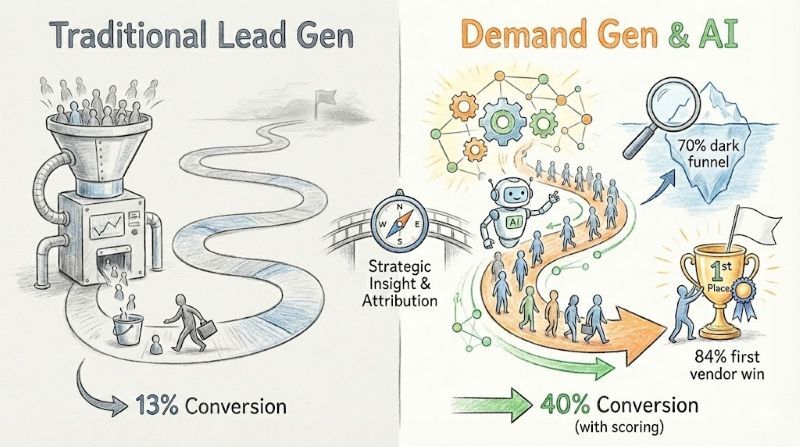
B2B lead generation in 2026 is won on data, not volume. UK buyers spend more time in anonymous research, AI is reshaping how they find vendors, and the teams that win blend content strategy, marketing automation, intent data, enrichment and behavioural scoring into one demand system. Across 30+ UK B2B teams we worked with last year, the average MQL-to-SQL conversion rate was just 13% — yet the top 10% hit 39–40% using behavioural lead scoring.
Your lead generation engine is only as strong as the data feeding it. This guide covers the 2026 benchmarks, how AI is changing the economics, the data-enrichment and lead-scoring infrastructure that closes the MQL-to-SQL gap, channel effectiveness, and the priorities UK B2B marketers should act on now. It draws on our 2026 B2B Lead Generation Report (400+ UK and Ireland marketing leaders) and conversion data from 150+ HubSpot instances we manage.
13% → 39%
MQL-to-SQL rate
baseline versus behavioural scoring
11.3 mo
Avg B2B sales cycle
70% spent in anonymous research
71%
AI adoption rate
UK B2B marketers using GenAI weekly
Key Takeaways
• Only 13% of MQLs convert to SQLs on average — the gap is process, data and coordination, not lead volume.
• Data enrichment (40+ firmographic and technographic attributes) enables automatic routing and improves qualification 5–8×.
• Behavioural lead scoring on fit × engagement is the single highest-leverage fix, moving MQL-to-SQL toward 30%+.
• Multi-channel nurturing outperforms single-channel by ~300%; speed of first response is decisive.
• HubSpot users report 505% three-year ROI and a 107% lead-volume increase within six months.
B2B lead generation benchmarks reveal widening performance gaps
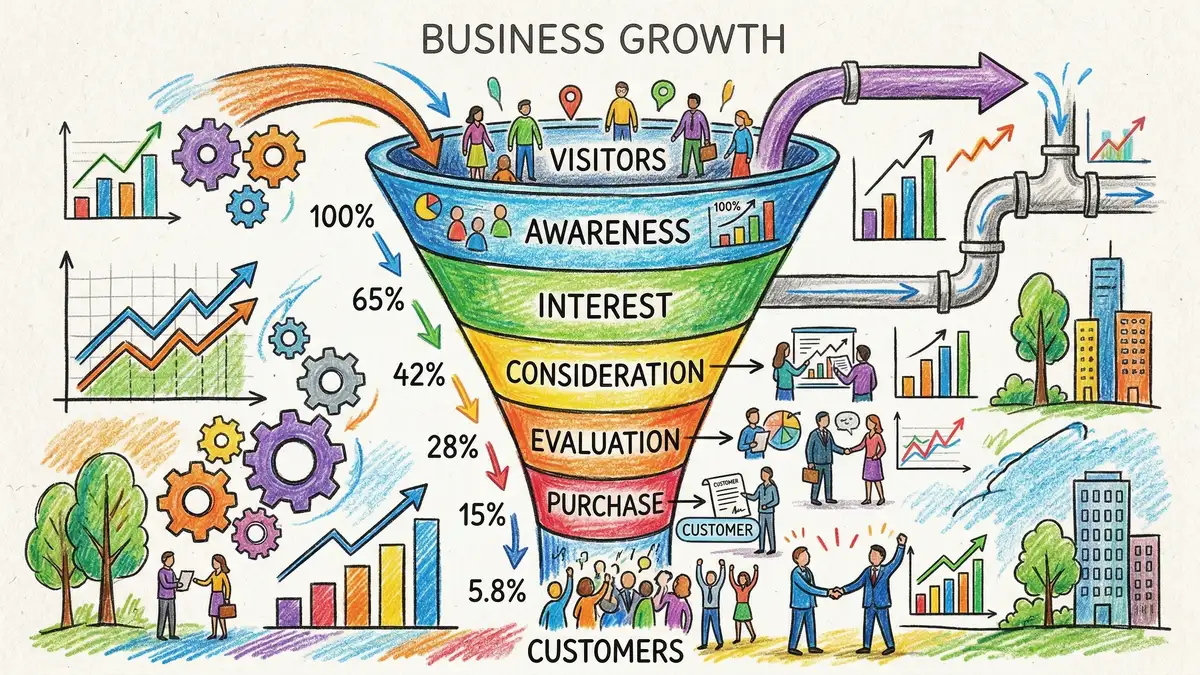
The funnel hasn't changed shape, but conversion rates tell a story of divergence. Companies with mature marketing automation (particularly HubSpot) are pulling ahead; those relying on basic lists and manual qualification are falling behind.
| Funnel stage | Avg conversion | Top 10% |
|---|---|---|
| Visitor → Lead | 2–4% | 6–8% |
| Lead → MQL | 30–40% | 55–65% |
| MQL → SQL | 13% | 39–40% |
| SQL → Opportunity | 28% | 45–50% |
| Opportunity → Customer | 21% | 38–42% |
Cost per lead varies sharply by channel and maturity: SEO-driven leads average £45–65 CPL on 3–4 month cycles, while LinkedIn ads run £120–180 CPL with faster conversion. The average B2B sales cycle sits at 11.3 months, with 70% of that time spent in anonymous research before any vendor contact.
AI and automation are transforming lead generation economics
71% of UK B2B marketers now use GenAI weekly — up from 41% in 2024. This is reshaping how leads are scored, nurtured and routed. AI-powered scoring is replacing static rules: instead of fixed points for a job title or pricing-page visit, models learn from actual win/loss data and flag accounts that behave like your best customers before they fill in a form. Teams using AI-powered routing report 34% faster time to first contact and a 22% improvement in conversion. Beyond automation, 80% of B2B tech buyers now use ChatGPT, Claude or Gemini as much as or more than traditional search for vendor research, making Answer Engine Optimisation essential alongside SEO.
Data enrichment: the foundation of intelligent qualification
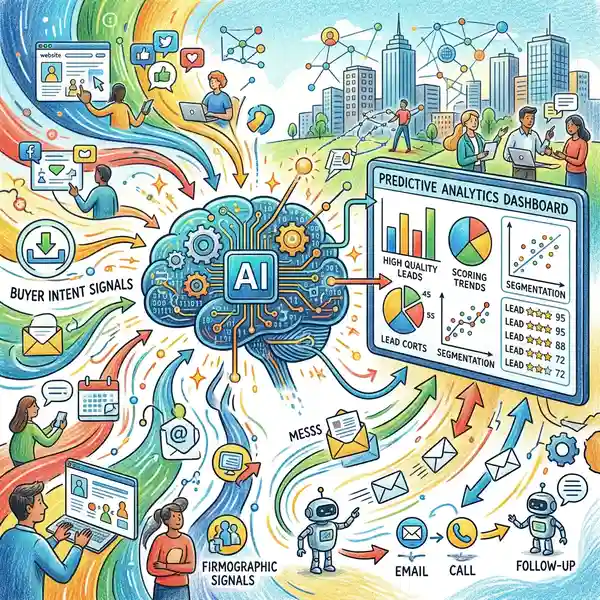
Qualification can't progress beyond guesswork without complete prospect information. An email and a company name tell you almost nothing about fit. Data enrichment solves this by automatically appending 40+ firmographic, technographic and intent attributes to every lead record — turning sparse details into profiles suitable for intelligent routing and personalisation.
The landscape changed with HubSpot's acquisition of Clearbit, now branded Breeze Intelligence. It gives HubSpot users at any tier access to 200+ million buyer and company profiles refreshed every 30 days — company size, revenue, industry, employee count, funding status, technology stack and buying-intent signals. At around £42 per month for 100 credits, businesses can enrich incoming leads automatically without manual research or enterprise tooling that once cost £10,000+ a year.
The practical impact is large. A web form that captures only name, email and company can immediately trigger appending of industry, headcount, revenue, tech stack and growth trajectory — so routing logic sends ideal-fit prospects to the right specialist and flags everyone else for nurturing rather than premature sales outreach. Companies implementing enrichment achieve a 5–8× improvement in marketing ROI through better targeting (McKinsey, 2024), and sales teams spend roughly 40% more time on genuinely qualified opportunities. For UK businesses, compliance matters: reputable providers such as Cognism and Breeze Intelligence embed GDPR and PECR compliance into their sourcing.
Behavioural lead scoring: turning data into decisions
Enrichment provides the raw material; scoring converts it into decisions. Effective scoring works on two dimensions — firmographic fit (does this company match your ICP?) and behavioural engagement (are they actively evaluating?). A target-industry company with 100+ employees that has visited your pricing page five times this month scores far higher than an ideal-fit company showing minimal engagement.
HubSpot supports two approaches by maturity. Manual scoring (Professional tier and above) lets teams build up to 25 custom models, awarding positive points for fit and engagement and negative points for disqualifiers such as students or competitors, with score decay that quietly reduces scores for inactive contacts. Predictive scoring (Enterprise tier) applies machine learning to your historical conversions, identifying which firmographic and behavioural combinations actually predict closed deals.
Scoring closes the MQL-to-SQL gap by creating different paths: a high-fit, high-engagement prospect triggers immediate sales outreach; a high-fit, low-engagement prospect enters an educational nurture sequence to accelerate evaluation; a low-fit prospect, however engaged, is nurtured slowly or excluded. Companies implementing structured scoring see a 20% lift in sales productivity and a 36% improvement in win rates (Marketo/Adobe, 2024), and HubSpot customers combining scoring with nurture automation report 505% three-year ROI and 129% more inbound leads. Models compound: refined on 3–6 months of conversion data, they surface subtle patterns — industries that convert, titles indicating decision-maker access, growth rates correlated with willingness to change.
If MQL-to-SQL is below 15%, your scoring is broken
A single rep wastes 4–6 hours a day sorting unqualified leads — at a £120k salary, that is £15–23k per rep per year in lost time. Fix scoring before you add volume. Only 13% of MQLs convert to SQLs on average, yet teams using behavioural scoring reach 35–45%.
Multi-channel nurturing and response speed
Single-channel nurturing — one automated email sequence — is the bare minimum. Email remains foundational (delivering £36–40 ROI per £1), but campaigns using four or more channels outperform single-channel approaches by ~300% (TechTarget, 2024). HubSpot workflows coordinate email, retargeting and on-site personalisation through conditional branching: two pricing-page visits in a week triggers an ROI-focused email; 14 days of silence pauses nurture and starts a win-back; a sales-ready score suppresses marketing emails in favour of direct outreach.
Speed is one of the highest-impact variables in conversion. 50% of leads that convert do so within the first two hours, and the benchmark for a "fast response" has shifted from 8 hours to 15 minutes. Personalising the first touch — referencing a prospect's research activity — lifts response rates by 30–40% over generic templates. When sales and marketing share definitions, tools and data, MQL-to-SQL jumps to 25–30%; siloed, it collapses to 5–8%.
Channel effectiveness varies dramatically
| Channel | Avg CPL | MQL-to-SQL | Best for |
|---|---|---|---|
| SEO / Organic | £45–65 | 18–22% | High-intent, problem-aware buyers |
| LinkedIn Ads | £120–180 | 9–13% | Broad reach, targeted by job title |
| ABM / Intent | £220–350 | 35–42% | High-value, multi-stakeholder deals |
| Email Nurture | £5–15 | 6–10% | Existing database, lifecycle marketing |
| Events / Webinars | £80–140 | 24–28% | Warm leads, thought leadership |
Want to build a lead generation engine that works? See how Whitehat's HubSpot onboarding helps B2B teams build predictable pipeline, and how the right inbound marketing strategy ties these channels together.
Build a lead engine that converts, not just collects
We help UK B2B teams implement enrichment, behavioural scoring and multi-channel nurture in HubSpot — closing the MQL-to-SQL gap with measurable pipeline impact.
View HubSpot OnboardingStrategic priorities for UK B2B marketers in 2026
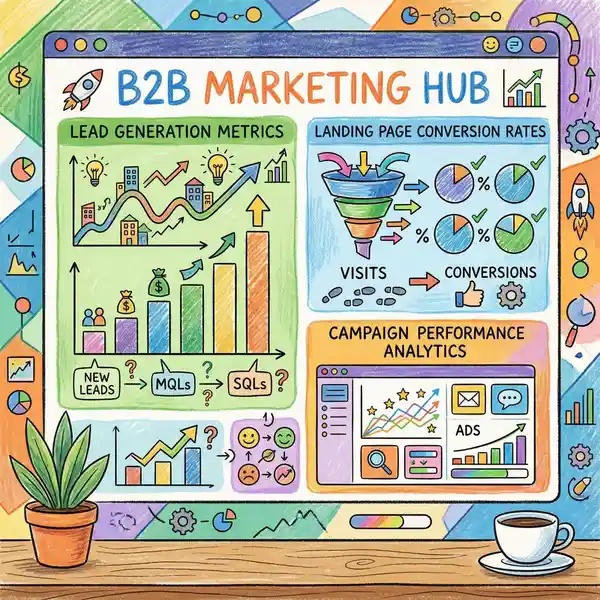
1. Implement behavioural lead scoring. The single investment that moves MQL-to-SQL from 13% to 30%+; start with a basic model and refine quarterly on win/loss data. 2. Build for AI discoverability (AEO). Restructure top landing pages for citation with clear headings, lists and comparative tables. 3. Integrate intent data. Use 6sense, Demandbase or ZoomInfo to flag in-market accounts; ABM against intent-flagged accounts converts 35–40% versus ~10% for broad campaigns. 4. Fix sales–marketing alignment. Document an SLA: MQL definition, 15-minute response target, weekly reconciliation. 5. Build multi-persona content. A 6.8-person buying committee needs ROI narratives mapped to procurement, IT, finance and end-users.
Frequently asked questions
What is a good MQL-to-SQL conversion rate for B2B companies?
The average is 13% across industries, but top performers using behavioural lead scoring achieve 35–45%. If yours is below 15%, implementing proper scoring in your CRM should be the priority — teams using scoring see roughly 77% higher lead-generation ROI.
How does data enrichment improve lead qualification?
Enrichment appends 40+ firmographic, technographic and intent attributes to each lead automatically, enabling accurate routing and segmentation. Companies using it see a 5–8× improvement in marketing ROI and free up roughly 40% more sales time for genuinely qualified opportunities. HubSpot's Breeze Intelligence makes this available at any tier from around £42/month for 100 credits.
What is behavioural lead scoring and how does it differ from manual scoring?
Behavioural scoring weights engagement signals (page visits, content downloads, email activity) alongside firmographic fit, then routes prospects by their combined profile. Manual scoring uses fixed point rules you define; predictive scoring uses machine learning trained on your historical conversions to find the patterns that actually predict closed deals.
How long is the average B2B sales cycle in 2026?
Around 11.3 months, with 70% of that time spent in anonymous research before any vendor contact. Enterprise deals run roughly 36% longer than in 2023, which is why sustained nurturing and early intent detection matter so much.
Why does multi-channel nurturing outperform email alone?
Campaigns using four or more coordinated channels outperform single-channel approaches by about 300%. Email remains foundational, but combining it with retargeting and on-site personalisation — orchestrated by engagement and score triggers — keeps you present through the long, mostly anonymous evaluation phase.
Ready to fix your MQL-to-SQL gap?
Get a free review of your lead-generation funnel and a 90-day plan covering enrichment, scoring and sales–marketing alignment.
Get Your Free AuditAbout the author
Clwyd Probert is founder of Whitehat SEO and a HubSpot Diamond Partner, and runs the London HubSpot User Group. He helps UK and US B2B companies build measurable demand systems that turn interest into qualified pipeline. Updated June 2026 with current UK benchmarks and HubSpot enrichment and scoring guidance.
Sources: Gartner B2B marketing benchmarks; Forrester B2B buying research; McKinsey on data and personalisation; Nucleus Research — HubSpot ROI. Figures reflect 2024–2026 data. Last updated June 2026.