
Published: 19 March 2020 | Updated: 16 January 2026
B2B Social Media Marketing Strategy: The 2025 Guide for Demand Generation Leaders
A B2B social media strategy is a documented plan that aligns social media activity with business objectives, audience behaviour, and measurable outcomes—with LinkedIn now generating 80% of all B2B social leads. Since this article was first published in 2020, global social media users have doubled to 5.24 billion and B2B buyers increasingly rely on social platforms during their purchasing journey, with 84% using social media when making buying decisions. This guide covers the strategic frameworks, platform priorities, and measurement approaches that professional services and demand generation leaders need to build pipeline from social in 2025.
Why does B2B social media strategy matter more in 2025?
The landscape has transformed dramatically since 2020. Social media advertising spend has increased from £39 billion to £275 billion globally—a sixfold increase that reflects where B2B buyers now spend their research time. The average B2B customer journey now requires 211 days and 76 touchpoints, with 6.8 buyer stakeholders involved across 3.7 channels.
For demand generation leaders at professional services firms, this complexity creates both challenge and opportunity. Without a documented strategy, social activity becomes random acts of marketing—the posts go out, but the pipeline doesn't follow. With a strategy, social becomes a predictable source of qualified opportunities that your integrated marketing programme can nurture to close.
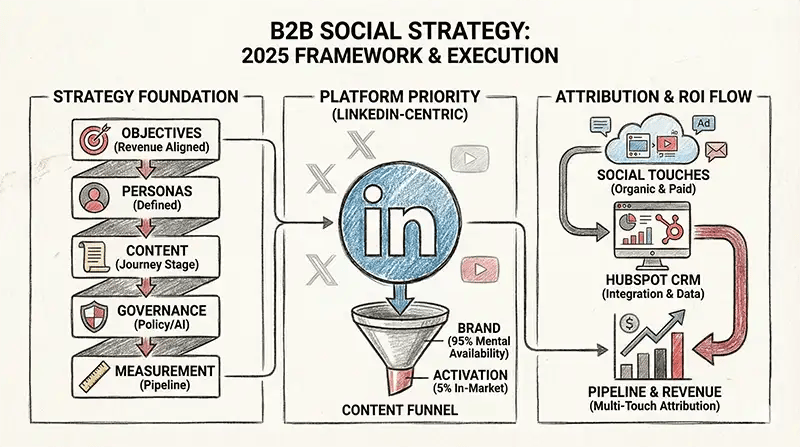
The businesses seeing results treat social as a strategic channel, not a checkbox. They understand that only 5% of B2B buyers are in-market at any time—which means 95% of your social activity should build mental availability for future purchases, not push bottom-funnel conversion.
What makes a B2B social media strategy effective?
An effective B2B social strategy starts with business alignment, not platform tactics. The original insight from social strategist Ketna Mistry at the London HubSpot User Group remains true: "Failing to plan is planning to fail." What's changed is the sophistication required to execute.
The foundation requires five elements: clear objectives tied to revenue outcomes, defined audience personas with platform preferences, a content framework that serves each stage of the buyer journey, governance policies that enable rather than restrict, and measurement systems that connect social activity to pipeline.
Align social objectives with business goals
Your social media goals must connect to what makes your CFO pay attention. For professional services firms, this typically means: brand awareness metrics that indicate mental availability, engagement that signals relationship development, website traffic that feeds your HubSpot marketing automation, and attributed pipeline that proves ROI.
Research from FirstPageSage shows organic social delivers 229% ROI over three years, while paid social achieves 192%. These figures require proper attribution—something many B2B organisations still struggle with when 84% of shares occur via dark social channels like Slack, WhatsApp, and email.
Which social platforms should B2B companies prioritise?
LinkedIn dominates B2B social media with unambiguous data: the platform generates 80% of all B2B social leads, with 96% of B2B content marketers using it for organic distribution. For UK-based professional services targeting decision-makers, LinkedIn provides access to 31-41 million members in your market.
The platform's effectiveness explains why 86% of B2B marketers use LinkedIn—ranking it as the number one platform—and why 84% say it delivers the best value among organic social channels. LinkedIn now captures 39% of total B2B digital advertising budgets, the single largest share of any channel.
The myth of platform omnipresence
The 2020 advice to "do two or three platforms well rather than spreading yourself too thinly" has become even more relevant. Facebook's organic reach has collapsed to 1.37%—down from 16% in 2012—making it effectively a paid media channel. Instagram's organic reach sits at approximately 4%, down 18% year-over-year.
For B2B demand generation, the evidence points to a focused approach: LinkedIn as your primary organic platform, supported by selective paid amplification. TikTok has grown to 1.7 billion users but only 8% of B2B marketers plan to invest there in 2025. X (Twitter) has seen significant advertiser exodus following platform changes, with many B2B brands reducing their presence.
How should B2B companies structure social content?
Content remains the backbone of social media strategy, but format preferences have shifted significantly. On LinkedIn, multi-image posts generate 6.60% engagement rates, while native documents and carousels achieve 6.10%—both outperforming video at 5.60%. Carousels specifically generate 278% more engagement than videos and 596% more than text posts.
The content funnel framework still applies: your audience needs to become aware of you, express interest, explore your expertise, then decide to take action. What's changed is the ratio of brand-building to activation content. Research from Binet and Field suggests a 46:54 split for B2B (versus 60:40 for consumer brands), though newer businesses should weight toward 65% performance content initially.
The five rules of B2B social content
Quality remains non-negotiable—but quality now means AI-optimised structure alongside substantive insight. Relevancy requires speed; pushing content 24 hours after a story breaks means the conversation has moved on. Consistency matters more than volume: companies posting weekly on LinkedIn see 2x lift in engagement, with the average B2B brand publishing 3.3 posts per week.
Visual consistency builds recognition—your audience should identify your content before reading a word. And repurposing remains essential: take that webinar recording and extract carousel posts, quote graphics, and text commentary that extends its life across weeks. Your content marketing strategy should view social as a distribution layer, not a separate content creation burden.
Why is thought leadership essential for B2B social success?
The 2024 Edelman-LinkedIn B2B Thought Leadership Impact Report reveals a significant shift: 73% of decision-makers now say thought leadership is more trustworthy than marketing materials—up from 59% in 2019. Thought leadership has jumped from 20th to 3rd place globally as a B2B decision driver.
The business impact is substantial. 86% of decision-makers are more likely to invite companies with quality thought leadership to RFP processes. 90% are more receptive to sales outreach from organisations demonstrating expertise. 60% would pay a premium for companies producing valuable thought leadership. Perhaps most compellingly, 70% of C-suite leaders have questioned existing supplier relationships after encountering competitor thought leadership.
Yet only 15% of executives describe overall thought leadership quality as "very good"—creating significant differentiation opportunity. Founder-led content consistently outperforms brand content: one CEO generated the same LinkedIn engagement with fewer than 5,000 followers as their company page with 300,000+ followers.
How do trust dynamics affect B2B social strategy?
The original observation that "76% of people trust content from normal people rather than brands" has proven prescient—the trust gap has widened. Nielsen research now shows 92% of people trust peer recommendations over brand communications. The 2024 Edelman Trust Barometer places social media as the least trusted institution at just 41% globally, yet 80% trust brands they actively use.
This creates a strategic imperative: activate your people, not just your brand pages. Employee networks are 10x larger than company networks on average. Content shared by employees receives 2x higher click-through rates and 8x more engagement than company page posts. Companies are 58% more likely to attract and 20% more likely to retain top talent with active employee advocacy programmes.
Building authentic social proof
Earned media remains optimal—recommendations and endorsements from others carry more credibility and authority than any advertising. B2B influencer marketing has reached mainstream adoption, with 85% of US B2B marketers incorporating it into strategies and reporting 520% ROI. However, authenticity concerns have emerged around AI-generated content: 62% of consumers are less likely to engage with or trust AI-assisted posts.
What are the engagement benchmarks for B2B social media?
LinkedIn leads major platforms with a 6.5% median engagement rate according to Buffer's 2025 analysis—though company pages typically see 0.5-1%. This gap reinforces the value of personal profiles and employee advocacy over brand-only approaches. Facebook engagement sits at 0.15% average (0.07% for pages), while Instagram achieves 0.50% and TikTok reaches 2.5%+ for business accounts.
Posting frequency matters less than consistency. LinkedIn data suggests 1-2 posts daily, though at minimum once per working day maintains visibility. Best times for B2B audiences cluster around 10am-2pm on Tuesday through Thursday, with peak engagement at 10am and 11am. 79% of LinkedIn videos are watched without sound, making captions essential for video content.
The engagement principles from 2020 still hold: observe your audience's behaviour to identify patterns, maintain a human voice rather than corporate robotics, and converse rather than broadcast. What's changed is the algorithm sophistication—LinkedIn's 2023-2024 overhaul now prioritises "quality over quantity," though Richard van der Blom's 2025 research shows organic reach has dropped 50% and engagement declined 25%.
When should B2B companies invest in paid social advertising?
The organic reach decline across all platforms has made paid social essential for scale, but the original principle holds: "Paid is only effective if you know who your target audience is." LinkedIn advertising commands premium CPCs of £4-12 versus Google's £0.50-2 for search, but delivers 2-5x higher ROAS for B2B advertisers targeting decision-makers.
Common B2B budget allocation recommends a 70/30 split: 70% organic efforts for brand building and thought leadership, 30% paid social for targeted campaigns and content amplification. Within paid budgets, LinkedIn Lead Gen Forms convert at 4x the rate of other formats, justifying the higher cost per lead (averaging £190 in North America, lower in other regions).
For professional services firms, paid social works best for retargeting website visitors, promoting high-value content to defined account lists, and accelerating reach for founder content that's already showing organic traction. Integration with your HubSpot CRM enables closed-loop attribution that connects social spend to pipeline and revenue.
How does social selling integrate with B2B strategy?
Social selling has matured from experimental tactic to proven practice. 87% of sellers confirm social selling has been effective for their business, with sales professionals using social closing 40-50% more new business than those who don't. 78% of businesses using social selling outperform those that don't, while 72% of salespeople using social media exceed their quota.
LinkedIn Sales Navigator users with strong Social Selling Index scores have 45% more sales opportunities. The platform has added significant AI capabilities including Account IQ and Relationship Explorer, with Forrester research showing 312% ROI over three years for Sales Navigator users. Perhaps most striking: 31% of sales reps using social selling closed deals worth over £400,000 without a single in-person meeting.
The alignment opportunity between marketing and sales social activity is significant. Marketing builds the audience and credibility through thought leadership and brand content. Sales leverages that reputation through personal connections and direct engagement. Both feed attribution data back to the CRM for accurate pipeline measurement.
How should B2B companies measure social media ROI?
The original advice to "benchmark all your metrics" remains essential, but attribution complexity has increased substantially. B2B deals now require an average of 266 touchpoints and 2,879 impressions to close—a 20% increase year-over-year. For deals exceeding £80,000, this rises to approximately 417 touchpoints and 5,500 impressions. 75% of companies now use multi-touch attribution to measure marketing performance.
LinkedIn appears as the leading touchpoint in the MQL-to-SQL phase at 14.7%, second only to website at 36.8%. However, dark social remains the measurement challenge: 77.5% of buyers share links through channels like WhatsApp, Messenger, and Slack where attribution is invisible. An estimated 84% of all shares occur via hidden sources.
Metrics that matter for demand generation
Move beyond vanity metrics like followers and likes to performance indicators your leadership cares about. Track social-attributed website sessions, content engagement rates by topic, share of voice against competitors, influenced pipeline, and revenue attribution. Regular audits of your analytics setup ensure you're capturing the full picture and identifying gaps in attribution.
What governance framework does B2B social media require?
Social media governance remains "like visiting the dentist—no one wants to go, but you know you need to." The components haven't changed: audit your landscape, implement clear policies, establish behavioural expectations, and define the parameters within which employees can operate. What's evolved is the compliance context.
UK businesses must comply with UK GDPR (maintained via the Data Protection Act 2018) plus PECR (Privacy and Electronic Communications Regulations). PECR requires consent for advertising cookies and tracking technologies. Custom audiences need clear lawful basis and privacy notice disclosure. Potential fines reach up to €20 million or 4% of global turnover. 72% of employees recognise their personal posts reflect on their employer, even when not speaking on behalf of the company.
AI has added new governance considerations. 71% of social marketers now use AI tools, but 62% of consumers are less likely to trust AI-generated content. Gartner predicts that by 2026, 60% of CMOs will adopt content authenticity technology and brand-endorsed user-generated content to protect against GenAI deception. Your policy should address AI usage, disclosure requirements, and quality standards.
How do you implement a B2B social media strategy?
Strategy without implementation is just theory. The practical steps from 2020 remain valid: start with a goal, establish purpose and intention for each platform, create parameters for your team to operate within, and design processes that alleviate pressure rather than create bureaucracy. What's changed is the technology stack supporting execution.
Modern B2B social strategy integrates with marketing automation, CRM, and analytics platforms. HubSpot's social tools connect publishing, monitoring, and reporting to your broader marketing data. AI-powered scheduling optimises posting times. Social listening tools track brand mentions, competitor activity, and industry conversations. Attribution platforms connect social engagement to pipeline.
Resource planning reality
The original warning about resource constraints deserves emphasis. If you have ambitious social goals, assess whether one person is enough or whether you need support. Many businesses feel disappointed because they lack the right infrastructure—expecting enterprise results from startup resources. Professional services firms increasingly partner with specialist agencies to supplement internal capacity while maintaining strategic control.
What should demand generation leaders prioritise?
The fundamentals from 2020 have proven durable: have a clear goal, establish purpose and intention, create governance parameters, and resource appropriately. The evolution comes in execution sophistication and platform focus. LinkedIn's dominance has strengthened, organic reach has declined everywhere, and measurement complexity has increased.
For demand generation leaders at professional services firms, the priority sequence is: document your strategy with measurable objectives, focus on LinkedIn as your primary B2B platform, activate employees alongside brand channels, invest in thought leadership content, integrate social with your marketing automation stack, and build attribution systems that connect activity to pipeline.
Social media is not a magic bullet—it won't fix fundamental business problems and will actually highlight them. But with strategy, social becomes a predictable demand generation channel that builds mental availability with the 95% of buyers not currently in market while capturing the 5% who are.
Frequently Asked Questions
What is B2B social media marketing?
B2B social media marketing is the use of social platforms to reach, engage, and convert business decision-makers. Unlike consumer marketing, B2B social focuses on relationship building, thought leadership, and long sales cycles—with LinkedIn generating 80% of B2B social leads. Success requires strategic alignment with business goals rather than vanity metrics like follower counts.
How often should B2B companies post on LinkedIn?
B2B companies should post on LinkedIn at least once per working day, with 1-2 posts daily being optimal. Research shows companies posting weekly see 2x lift in content engagement. Quality and consistency matter more than volume—the average B2B brand publishes 3.3 posts per week, focusing on peak times between 10am-2pm Tuesday through Thursday.
What content performs best for B2B on LinkedIn?
Multi-image posts and document carousels perform best on LinkedIn for B2B, achieving 6.60% and 6.10% engagement rates respectively. Carousels generate 278% more engagement than videos and 596% more than text posts. Thought leadership content from individual leaders outperforms brand content, with founder posts often matching large company pages despite fraction of followers.
How do you measure B2B social media ROI?
Measure B2B social media ROI through multi-touch attribution connecting social engagement to pipeline and revenue. Track social-attributed website sessions, engagement rates by content type, influenced deals, and revenue attribution. LinkedIn appears in 14.7% of MQL-to-SQL touchpoints. Integrate social data with your CRM for accurate measurement—75% of B2B companies now use multi-touch attribution models.
Should B2B companies use paid social advertising?
B2B companies should use paid social advertising to supplement organic reach, which has declined significantly across all platforms. Common budget allocation recommends 70% organic, 30% paid. LinkedIn advertising costs more (£4-12 CPC versus £0.50-2 for Google) but delivers 2-5x higher ROAS for B2B. Focus paid budgets on retargeting, account-based campaigns, and amplifying high-performing organic content.
Sources
- DataReportal/We Are Social - Digital 2024 Global Overview Report
- LinkedIn Marketing Solutions - B2B Marketing Benchmark Report (2024)
- Edelman-LinkedIn - B2B Thought Leadership Impact Report (2024)
- Content Marketing Institute - B2B Content Marketing Research (2024)
- HubSpot - State of Marketing Report (2024-2025)
- FirstPageSage - B2B Content Marketing Benchmarks (2024)
- Buffer - Social Media Engagement Benchmarks (2025)
- Socialinsider - LinkedIn Content Benchmarks (2025)
- DSMN8 - Employee Advocacy Statistics (2024)
- Richard van der Blom - LinkedIn Algorithm Insights Report (2025)
- HockeyStack Labs - B2B Customer Journey Touchpoints Research (2024)
- Forrester - LinkedIn Sales Navigator Total Economic Impact Study
- Nielsen - Global Trust in Advertising Report
- Gartner - CMO Spend Survey (2024-2025)
- Binet & Field - The Long and Short of It: B2B Edition
Ready to build a social strategy that generates pipeline?
Whitehat helps professional services firms integrate social media with HubSpot for measurable demand generation results. view our pricing
Speak to Our Team