
Conservation Marketing • B2B Strategy
What B2B Marketers Can Learn From Gorilla Conservation: 7 Proven Principles
Published: 31 December 2025 | Updated: 31 December 2025 | Reading time: 10 minutes
The most effective B2B marketing strategies often come from unexpected places. Mountain gorilla conservation succeeded through multi-stakeholder alignment, individual storytelling over statistics, and 40+ years of sustained commitment—turning a near-extinct population of 254 individuals in 1981 into over 1,063 today. B2B companies in crowded markets can apply these same principles to break through noise and build lasting market position.
When David Attenborough sat surrounded by gorillas in 1979, it wasn't about "gorilla population recovery statistics." It was about Pablo, a juvenile gorilla, sitting in his lap. That single moment of connection did more for gorilla conservation than decades of scientific papers. The footage aired as part of the BBC's Life on Earth series, and the world fell in love with these gentle giants.
This isn't just a heartwarming conservation story—it's a masterclass in marketing effectiveness that B2B companies should study closely. In March 2018, Ian Redmond OBE—the tropical field biologist who introduced Attenborough to those gorillas—spoke at Whitehat's London HubSpot User Group. His message: "I want to delight people." That philosophy underpins one of conservation's greatest success stories.
Seven years on from that talk, the lessons have only become more relevant. Mountain gorillas continue their recovery, now numbering over 1,063 individuals—a 318% increase since 1981. Meanwhile, B2B SaaS companies, professional services firms, and technology providers face their own extinction-level challenges in markets crowded with competitors fighting for the same customers' attention.
From 254 to 1,063: A Conservation Miracle
The mountain gorilla population has achieved what few endangered species ever manage—a sustained, multi-decade recovery. In 1981, only 254 mountain gorillas remained in the wild. Today, according to the Greater Virunga Transboundary Collaboration 2018 census, the population exceeds 1,063 individuals across two distinct regions: approximately 604 in the Virunga Massif spanning Rwanda, Uganda, and the Democratic Republic of Congo, and around 459 in the Bwindi-Sarambwe area.
This represents the only great ape species with a growing wild population—every other ape species continues to decline. The IUCN upgraded mountain gorillas from Critically Endangered to Endangered status in November 2018, a rare conservation victory worth celebrating.
Key Success Factors: Rwanda hasn't recorded a single poaching incident since 2002—over 22 years of zero poaching. The Gorilla Doctors' veterinary intervention programme is credited with contributing up to 40% of population growth through medical care for injured and ill gorillas. Ten gorilla births were recorded in Virunga National Park in 2024 alone.
But this success story faces renewed threats. As of January 2025, M23 rebels control Virunga National Park's headquarters, with approximately 350 mountain gorillas now under rebel-controlled territory. Tourism has been suspended, and the park has experienced a 50% wildlife decline since M23's resurgence in 2021. Conservation is never "done"—it requires sustained commitment even after achieving initial success.
Why This Matters for B2B Marketers
Your B2B SaaS product isn't literally facing extinction, but the analogy holds. In a market where 87.4% of AI referral traffic goes to ChatGPT and buyers complete 70% of their research before ever contacting sales, breaking through requires more than just "better content marketing."
Mountain gorillas were competing for attention and resources against pandas, elephants, tigers, and hundreds of other endangered species. Similarly, your solution competes against dozens—sometimes hundreds—of alternatives in buyers' consideration sets. The question isn't "How do we get people to care?" It's "How do we make them care enough to act?"
Gorilla conservation provides the answer through principles that have been tested and proven over 40+ years. These aren't abstract theories—they're battle-tested tactics backed by measurable outcomes. Companies implementing similar strategies report significantly improved marketing performance, just as gorilla conservation organisations saw tangible population recovery.
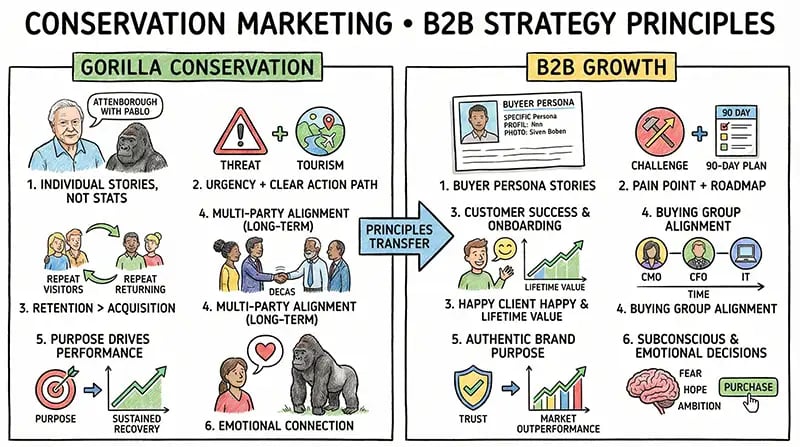
Principle 1: Make the Abstract Personal (The Single Gorilla Effect)
Conservation researchers have documented what they call the "identifiable victim effect"—people respond more strongly to individual stories than to aggregate statistics. Academic analysis across 41 studies found a modest but significant correlation (r=0.05), demonstrating that photographs and personal details of identified individuals increase donations by inducing positive emotional response.
Here's what's counterintuitive: rational, analytical thinking can actually reduce giving to identified individuals. When Attenborough's film crew captured Pablo the gorilla playing in David's lap, viewers didn't see "threatened species population dynamics." They saw a playful, curious youngster investigating a strange visitor—behaviour anyone with children immediately recognised.
B2B Application: Lead With Individual Customer Stories
- Use photographs, names, job titles, and personal details in case studies
- One specific customer success story outperforms "500+ happy customers"
- Save statistics for after establishing emotional connection
- Let customers describe challenges in their own words, not sanitised marketing speak
Whitehat's inbound marketing methodology applies this principle by developing detailed buyer personas—not demographic abstractions, but specific individuals with names, photos, frustrations, and aspirations. When you're creating content for "Sophie Turner, Marketing Director at a 50-200 person B2B SaaS company struggling to prove HubSpot ROI to her CEO," you write differently than when targeting "marketing professionals."
Principle 2: Create Urgency WITH Efficacy (Hope + Action)
Conservation campaigns learned a critical lesson: fear without efficacy creates paralysis, not action. Research published in conservation marketing literature demonstrates that fear appeals work most effectively when combined with a clear action pathway showing individuals what they can personally do to address the threat.
Information alone is a weak driver of behaviour change. Telling people "gorillas face extinction" without showing them actionable steps produces doom fatigue. But combining threat awareness with specific, achievable actions—"Visit Rwanda to support gorilla tourism" or "Choose FSC-certified wood products"—creates engagement rather than despair.
The B2B parallel: Don't just tell prospects their competitors are outperforming them or that they're losing market share. Immediately follow with specific, achievable next steps. "Your HubSpot implementation is underperforming—here's the 90-day roadmap to fix it" beats "You're not getting ROI from HubSpot" every time.
This is why Whitehat's website audits don't just identify problems—they provide prioritised roadmaps showing exactly what to fix first, how long it takes, and what results to expect. You're giving prospects efficacy: the belief that they can successfully address the challenge you've identified.
Principle 3: The Second Gift is Golden (Retention Over Acquisition)
Here's a shocking statistic from nonprofit marketing research: 70% of donors give only once. New donor retention sits at a dismal 7.2%. But once a donor makes a second gift, retention almost doubles to 59%. The lesson? The second conversion matters more than the first.
Conservation organisations learned decades ago what B2B companies are still discovering: it costs approximately 5x more to acquire a new customer than to retain an existing one. Mountain gorilla conservation succeeded not through constantly seeking new supporters, but by converting one-time visitors to Rwanda into lifelong advocates who returned multiple times and recruited others.
| Metric | First-Time Donors | Repeat Donors |
|---|---|---|
| Retention Rate | 7.2% | 59% |
| Average Gift Value | Lower | Higher |
| Acquisition Cost | 5x higher | Baseline |
B2B translation: Customer success and onboarding are your growth engines, not lead generation. Focus disproportionate resources on securing repeat business and expanding existing accounts. HubSpot onboarding programmes that include comprehensive training and ongoing support don't just improve platform adoption—they dramatically increase customer lifetime value by ensuring clients achieve their "second conversion": measurable ROI.
Principle 4: Modern Case Study—RSPB's TikTok Breakthrough
These conservation principles aren't historical curiosities—they're working today. The Royal Society for the Protection of Birds (RSPB) demonstrated their power with an award-winning TikTok strategy launched in 2023-2024 that transformed how UK conservation organisations approach digital marketing.
RSPB's "Bird of the Week" series grew their TikTok following from 3,000 to over 240,600 followers—an 8,000% increase. The campaign generated 35-37 million page views and 6.2-10.1 million total likes, reaching the critical 16-35 demographic that traditional conservation messaging struggled to engage. Within two weeks of launching merchandise, they sold 700 items.
What Made It Work:
- Platform-native content: Embraced TikTok's "unhinged" humour rather than polished, corporate tone
- Audience participation: Spin-the-wheel format let viewers influence content
- Educational entertainment: Made bird facts compelling through Gen Z/Alpha humour
- Authentic voice: Inspired by Duolingo's irreverent social presence
The campaign won The Drum Awards for Social 2024 in the Charity/Not for Profit category. More importantly, it demonstrated that conservation principles—making content personal, delightful, and accessible—work across any platform when properly adapted to audience expectations.
The B2B lesson: Platform-native content beats polished corporate messaging. Social media marketing strategies that embrace each platform's unique culture and format perform dramatically better than repurposed content.
Principle 5: Stakeholder Alignment Takes Time (The Long Game)
Mountain gorilla conservation required alignment across three countries (Rwanda, Uganda, Democratic Republic of Congo), multiple governments, dozens of NGOs, local communities, tourism operators, researchers, and veterinarians. This wasn't achieved in a quarter or even a year—it took 40+ years of sustained, multi-party collaboration.
Rwanda's 10% revenue-sharing programme—the most generous in Africa—built local buy-in by ensuring communities directly benefited from conservation. When local residents see tangible economic benefits from protecting gorillas rather than poaching them, they become conservation advocates rather than obstacles.
B2B parallel: The average B2B buying group now includes 11 stakeholders. These individuals have different concerns, priorities, and success metrics. Marketing directors care about attribution clarity. CFOs want ROI proof. IT directors need integration assurance. Sales directors want qualified leads.
Trying to rush this process or address only one stakeholder's concerns dooms deals. Just as gorilla conservation succeeded by patiently building multi-party alignment, B2B sales cycles require consistent, valuable touchpoints addressing multiple stakeholder needs over extended periods. Research shows 81% of buyers already have a preferred vendor before first contact—meaning your content shaped their decision during the "invisible" research phase.
Principle 6: Purpose Drives Performance (Not Just PR)
Mountain gorilla recovery didn't happen because of short-term campaigns or quarterly initiatives. It required 40+ years of sustained commitment to a clear purpose: preventing extinction and restoring wild populations. Short-term thinking would have abandoned the effort during the numerous setbacks, political instabilities, and funding challenges.
Purpose-driven organisations outperform across every metric that matters. Companies with clearly defined purpose are 2.5x more likely to outperform on revenue growth, report 40% higher workforce retention, and command premium pricing—buyers are 8x more likely to pay premium prices when they perceive personal value beyond functional benefits.
Purpose-Driven Performance Data
- Revenue growth: 2.5x more likely to outperform competitors (Kantar Purpose 2020)
- Employee retention: 40% higher in purpose-driven companies (Deloitte 2020)
- Stock performance: Purpose-driven brands outperform market by 134% (WiFiTalents)
- Brand advocacy: 73% of people globally defend purpose-driven brands they trust (Edelman)
- Premium pricing: Buyers 8x more likely to pay premium when perceiving personal value (Google)
This isn't about corporate social responsibility initiatives or sustainability reports gathering dust. Purpose must be authentic, operational, and permeate the entire organisation. Whitehat's founding principle—"Help First"—isn't marketing messaging. It's why we run the world's largest HubSpot User Group providing free education to hundreds of marketing professionals quarterly, even when they're not yet clients.
Principle 7: B2B is Just as Emotional as B2C
When Dian Fossey sat among wild gorillas in 1967, she wasn't appealing to rational analysis of ecosystem services. She was creating wonder, curiosity, and empathy—pure emotional connection. That emotional foundation made people care enough to learn about forest ecology, carbon sequestration, and biodiversity later.
B2B marketers often make a critical mistake: assuming business buyers operate purely rationally. Harvard Business School research demonstrates that 95% of purchase decisions are subconscious. B2B buyers are 50% more likely to purchase when they see personal value—not just company benefit—and are 8x more likely to pay premium prices when that personal value is clear.
Every "rational" B2B purchase decision involves fear (will this fail and damage my reputation?), hope (will this make me look good to my boss?), and ambition (will this advance my career?). The CMO evaluating SEO services isn't just buying "improved organic rankings"—they're buying career security through demonstrable marketing ROI that protects their position.
Stories inspire, data connects. Lead with the emotional narrative of customer transformation, then support it with ROI data. Not the reverse. This is why effective case studies start with the customer's challenge and frustration (emotional), describe the journey to resolution (narrative), and conclude with quantified outcomes (rational validation).
Frequently Asked Questions
What made mountain gorilla conservation so successful?
Mountain gorilla conservation succeeded through multi-stakeholder alignment across three countries, 40+ years of sustained commitment, community benefit-sharing (10% tourism revenue), individual animal storytelling that created emotional connection, and direct veterinary intervention credited with 40% of population growth. Rwanda's zero poaching record since 2002 demonstrates the effectiveness of combining enforcement, economic incentives, and public engagement.
Can B2B companies effectively use cause marketing principles?
Yes, but only when authentic, sustained, and measurable. Purpose-driven B2B companies are 2.5x more likely to outperform on revenue growth and report 40% higher workforce retention. However, cause marketing that's merely "greenwashing" or disconnected from core operations fails. The principles work when purpose genuinely drives business decisions, not just marketing messaging.
Why do single customer stories work better than aggregate statistics?
Academic research identifies the "identifiable victim effect"—personalised information reduces psychological distance between audience and subject. Photographs and specific details of identified individuals increase engagement by inducing positive emotional response. Counterintuitively, rational and analytical thinking can actually reduce giving to causes presented statistically rather than individually. One specific success story with a name and photograph outperforms "500+ happy customers."
How do you create urgency without doom fatigue in B2B marketing?
Combine threat awareness with clear action pathways showing exactly what prospects can do. Fear appeals work most effectively when paired with efficacy—the belief that action will successfully address the threat. Present the challenge clearly, immediately follow with specific achievable steps, and show evidence the solution works through case studies and ROI data. Fear without efficacy creates paralysis; fear with efficacy creates conversion.
How does ESG affect B2B purchasing decisions in 2025?
ESG has moved from "nice to have" to business-critical. ESG factors now rank as the #2 procurement priority (up from #5 in 2023), and 76% of businesses view sustainability as a growth driver rather than cost centre. Companies with high ESG ratings deliver 4.3% higher annual returns. B2B buyers increasingly evaluate supplier ESG credentials as risk mitigation and competitive differentiation.
What can B2B marketers learn from RSPB's TikTok success?
RSPB's 8,000% follower growth demonstrates the power of platform-native content that embraces each channel's unique culture. Rather than repurposing corporate content, they created TikTok-first material using the platform's "unhinged" humour style, audience participation through spin-the-wheel formats, and educational entertainment. The campaign won The Drum Awards 2024 and generated 700 merchandise sales within two weeks—proving conservation marketing principles work across any platform when properly adapted.
What Whitehat Learned From a Conservationist
When Ian Redmond OBE spoke at our London HUG event in March 2018, he opened with a simple statement: "I want to delight people." Seven years later, that philosophy continues to guide how we approach inbound marketing strategy.
Mountain gorillas weren't saved through aggressive marketing campaigns or quarterly initiatives. They recovered through patient, sustained effort building trust across stakeholders, focusing on individual stories that created emotional connection, and maintaining unwavering commitment to a clear purpose over decades.
B2B marketing works the same way. The companies that thrive aren't those chasing every new tactic or platform. They're the ones that:
- Lead with individual customer stories that create immediate emotional connection
- Combine urgency with clear action pathways showing exactly how to succeed
- Focus disproportionate resources on customer success and retention
- Embrace platform-native content that delights rather than corporate messaging that informs
- Patiently build multi-stakeholder alignment recognising buying journeys average 11.3 months
- Operate from authentic purpose that drives decisions, not just marketing materials
- Remember that B2B buyers make 95% of decisions subconsciously based on emotional factors
The mountain gorilla population continues its recovery despite renewed challenges from M23 rebels and ongoing threats. Conservation organisations maintain their commitment because the work matters more than quarterly results. The same principle applies to B2B marketing: sustainable growth comes from playing the long game, not optimising for short-term metrics.
Ready to Apply These Principles to Your Marketing?
Whether you need to improve HubSpot ROI, develop content that actually converts, or build a sustainable inbound marketing engine, Whitehat brings the patient, purpose-driven approach that creates lasting results.
Book Your Free Strategy SessionReferences and Further Reading
Gorilla Conservation Data:
Virunga National Park | Dian Fossey Gorilla Fund | Gorilla Doctors (Mountain Gorilla Veterinary Project) | International Gorilla Conservation Programme
Ian Redmond OBE:
Ecoflix Profile | Born Free Foundation | The Gorilla Organisation
Marketing Research:
M+R Benchmarks 2025 | CAF UK Giving Report 2024 | HubSpot for Nonprofits
RSPB TikTok Case Study:
The Drum Awards for Social 2024 | RSPB Official Website
Conservation Marketing Academic Research:
Veríssimo, D. et al. (ScienceDirect) | ConsMark.org (Society for Conservation Biology) | Cambridge University Press "Social Marketing and Conservation"