
Published: 1 November 2019 | Updated: January 2026
The Inbound Marketing Blueprint: Building a B2B Marketing Machine in 2026
Building an effective B2B marketing machine in 2026 requires integrating AI-powered personalisation with authentic content that earns trust before buyers contact sales—because 70% of the buyer journey happens before any sales engagement. HubSpot has declared traditional inbound "dead," replacing it with the Loop methodology designed for answer engines. This guide examines what's changed and what UK B2B marketers must do differently.
The Buyer Journey Has Stabilised—But Context Has Transformed
When Whitehat's CEO Clwyd Probert first presented this inbound blueprint at the London HubSpot User Group in 2019, he cited that 70% of the B2B buying journey happened before prospects contacted sales. Six years on, the 6sense 2025 Buyer Experience Report confirms this figure remains accurate—70% of purchase decisions occur before vendor engagement.
However, the 2025 data reveals a notable shift. First contact now happens 6-7 weeks earlier than in previous years, with the trigger point moving from 69% to 61% of the journey. Why? Buyers cite AI evaluation needs (58%) and economic uncertainty (62%) as primary drivers. They need to validate AI capabilities, pricing structures, and implementation requirements that simply aren't discoverable through self-service research alone.
The most critical statistic for B2B marketers: 81% of buyers have a preferred vendor before first sales contact, and approximately 80% of the time, the vendor contacted first wins the deal. This fundamentally changes the role of inbound marketing services—your job isn't just to generate leads, but to become the preferred choice before buyers even realise they're in-market.
Why 96.55% of Content Fails—And How to Be in the Other 3.45%
In 2019, the industry statistic was sobering: over 90% of content never got found by Google. The situation has actually worsened. Ahrefs' comprehensive study of 14 billion webpages found that 96.55% of all pages receive zero organic traffic from Google, with only 1.94% receiving just 1-10 monthly visits.
The pillar page and topic cluster strategy Clwyd advocated in 2019—sometimes called the skyscraper technique—remains valid in 2026. Search Engine Land confirms that "effectively implementing topic clusters and pillar pages improves organic visibility, increases search rankings, and drives reliable, long-term results." However, execution requirements have intensified significantly.
Google's algorithm has evolved substantially since 2019. In December 2022, E-A-T became E-E-A-T, adding "Experience" as a ranking factor. In March 2024, the Helpful Content Update was integrated into the core algorithm. Google estimates a 45% reduction in low-quality content appearing in search results. Pages with strong E-E-A-T signals now have a 30% higher chance of ranking in top positions, according to Semrush research.
For UK B2B companies working with SEO services, this means content must demonstrate genuine first-hand expertise. Generic content farms can't compete. The businesses winning organic traffic are those combining deep subject matter knowledge with proper technical optimisation—exactly what Whitehat's integrated SEO and HubSpot approach delivers.
From Flywheel to Loop: HubSpot's Methodology Evolution
The inbound methodology has undergone a fundamental transformation since 2019. The traditional marketing funnel that guided B2B strategies for decades was replaced by HubSpot's Flywheel model in 2018, which emphasised Attract, Engage, and Delight phases. But in April 2025, HubSpot declared even that approach obsolete.
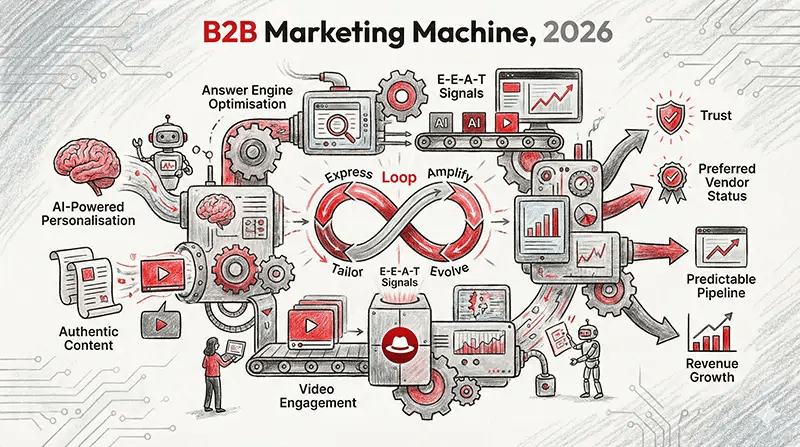
HubSpot CMO Kipp Bodnar stated: "When 60% of searches never leave Google and AI is answering questions before prospects even click, that playbook is broken." The company introduced "The Loop"—a four-stage methodology designed for AI-era marketing: Express (define brand identity before AI does it for you), Tailor (AI-driven personalisation at scale), Amplify (diversify across channels including AI search), and Evolve (real-time analytics and rapid experimentation).
This isn't just theory. HubSpot now serves 247,939 paying customers globally, holds 38% of the marketing automation market, and has been named Gartner Magic Quadrant Leader for B2B Marketing Automation for four consecutive years. Their Breeze AI platform, launched in September 2024, embeds over 80 AI features across the platform. Customers report 107% more leads and 35% more closed deals within six months.
For businesses undertaking HubSpot onboarding in 2026, understanding this evolution is critical. As a HubSpot Diamond Partner running the world's largest HubSpot User Group, Whitehat helps clients implement these new capabilities whilst avoiding the common pitfalls of platform migration.
Authentic Video Outperforms Polished Corporate Content by 3x
In 2019, Clwyd advocated using video interviews to unlock authentic subject matter expertise—filming internal experts rather than hiring expensive production crews. Six years of data proves this instinct was correct, with the gap now quantified: unscripted authenticity outperforms high production value by 3x in engagement.
HubSpot's 2024 Consumer Trends Survey found that audiences overwhelmingly prefer "authentic and relatable content" over "polished and high-quality content." LinkedIn data supports this shift: CEO video posts rose 52% over two years, and 78% of LinkedIn videos are shot with smartphones rather than professional equipment. The "lo-fi equals high trust" phenomenon reflects buyers gravitating toward creators who show up as people, not personas.
B2B video adoption has matured significantly, with 89-91% of businesses now using video in their inbound marketing and 93-95% considering it essential. Wyzowl's 2025 research—their 11th annual study—found 93% of marketers report video delivers good ROI, an all-time high. Videos in landing pages increase conversions by 80-86%.
The key insight for B2B marketers: almost half say short-form social video featuring subject matter experts delivers the highest ROI. Rather than expensive agency productions, businesses achieve better results with smartphones, good lighting, and genuine expertise. This democratises video marketing for companies of all sizes.
The Sales Productivity Problem Remains Stubbornly Unsolved
One of the most striking findings from our research: despite billions invested in sales technology since 2019, the fundamental productivity problem hasn't improved. Salesforce's 2024 State of Sales report confirms that sales representatives still spend only 30% of their time actually selling—virtually unchanged from 2019.
DocuSign puts the figure even lower at 28%, whilst HubSpot found reps spend just 2 hours per day on direct selling activities. Gartner research via SPOTIO indicates 50% of representative time goes to administrative work. This represents a massive opportunity cost that technology alone hasn't addressed.
What has changed dramatically is CRM adoption. Now 91% of companies with 10+ employees use CRM systems, up from approximately 74% in 2019, with 87% using cloud-based platforms. CRM delivers £8.71 ROI for every £1 spent and a 29% increase in sales. AI adoption in sales has accelerated rapidly—81% of sales teams have implemented or are experimenting with AI, and 83% of AI-enabled teams report revenue growth versus 66% without.
The solution isn't more technology—it's better alignment between sales and marketing. Research shows aligned organisations achieve 208% higher marketing revenue, 38% higher win rates, and 24% faster revenue growth. Yet only 8% of companies have strong alignment, and 60-70% of B2B content created is never used by sales. This is precisely why Whitehat emphasises integrated strategies rather than siloed tactics.
Answer Engine Optimisation: The New SEO Frontier
The 2019 blueprint focused on Google rankings and organic traffic. In 2026, there's an entirely new frontier: Answer Engine Optimisation (AEO). With ChatGPT, Perplexity, Claude, and Google AI Overviews now answering questions directly, B2B marketers must optimise for AI citation, not just search rankings.
Brand websites make up only 10% of AI citations—the remaining 90% comes from third-party sources like Wikipedia, Reddit, and review platforms such as G2 and Capterra. This means your content strategy must extend beyond your own website. Visitors from AI search are 4.4x more valuable than traditional search visitors because they've been pre-qualified by an AI endorsement.
Marcus Sheridan, whose "They Ask, You Answer" methodology Clwyd recommended in 2019, has evolved his approach for the AI era. His new book "Endless Customers" (2025)—a USA TODAY Bestseller—adds emphasis on zero-click content and AI-driven search impact. The core principle remains: businesses that answer customer questions transparently build trust. If someone reads 30+ pages of your website, they convert 80% of the time versus 20% for those reading less.
Content marketing strategies must now consider how AI systems extract and cite information. Content marketing generates £3 for every £1 invested versus £1.80 for paid advertising—a 67% performance advantage. SEO delivers 748% ROI for B2B companies, with break-even at approximately 7 months. But capturing this value requires structuring content for both human readers and AI extraction.
UK B2B Marketing: Budget Resilience and Strong HubSpot Adoption
UK marketing budgets have shown remarkable resilience. The IPA Bellwether Q2 2024 report recorded a +15.9% net balance—the strongest rate in over a decade and second highest in the report's 25-year history. After a brief pause during Autumn Budget uncertainty, Q4 2024 returned to growth at +1.9%.
The outlook for 2025/26 is positive: +25.6% net balance anticipate upward revision of marketing budgets, with 40.7% of companies actively lifting their marketing investment. Events (+15.7%), Direct Marketing (+14.3%), and PR (+10.3%) lead growth areas. The UK digital marketing market is valued at £33.49 billion, with digital advertising spending reaching £29.6 billion in 2023—an all-time high.
UK HubSpot adoption is particularly strong. Approximately 36,317 UK companies use HubSpot—the second largest market globally at 10.27% of users, behind only the United States at 58.89%. This concentration of HubSpot users creates opportunities for specialised partners who understand both the platform and the UK market context.
However, UK marketers face distinct challenges: inadequate budget (52%), lack of time (51%), and keeping up with trends (36%) are the top concerns. Currently 50% of UK marketers utilise AI in their strategy, with 83% using ChatGPT as their primary AI tool. For businesses seeking to maximise their marketing investment, working with agencies that understand what inbound marketing looks like in an AI-first world is essential.
Building Your 2026 Inbound Marketing Machine: Seven Priorities
The fundamentals Clwyd outlined in 2019 remain valid—positioning, personas, quality content, and sales-marketing alignment. But execution in 2026 demands new capabilities:
- Become the preferred vendor before buyers realise they're in-market. With 81% having a preferred choice before first contact, brand building and thought leadership are non-negotiable investments.
- Structure content for AI extraction. Answer engines now mediate between your content and buyers. Ensure your expertise can be cited and recommended.
- Embrace authentic video. Smartphone footage of genuine experts outperforms expensive productions. The barrier to entry has never been lower.
- Invest in E-E-A-T signals. Google rewards demonstrated experience. Your content must prove first-hand expertise, not just repeat industry platitudes.
- Align sales and marketing around shared revenue goals. The 208% revenue advantage from alignment dwarfs any tactical optimisation.
- Adopt HubSpot's Loop methodology. Express, Tailor, Amplify, Evolve—built for an AI-first world where 60% of searches never leave Google.
- Track AI visibility alongside traditional metrics. Monitor where your brand appears (or doesn't) in ChatGPT, Perplexity, and Google AI Overviews responses.
Frequently Asked Questions
What percentage of the B2B buyer journey happens before contacting sales?
Research confirms 70% of the B2B buying journey occurs before prospects engage with sales. The 6sense 2025 Buyer Experience Report shows this figure has remained stable since 2019, though first contact now happens slightly earlier due to AI evaluation needs and economic uncertainty. Critically, 81% of buyers have a preferred vendor before first sales contact.
Is the pillar page and topic cluster strategy still effective in 2026?
Yes, pillar pages and topic clusters remain effective for SEO in 2026. Search Engine Land confirms this approach "improves organic visibility, increases search rankings, and drives reliable, long-term results." However, success now requires stronger E-E-A-T signals—demonstrating genuine first-hand experience alongside topical authority. Generic content won't rank regardless of structure.
What is HubSpot's Loop marketing methodology?
The Loop is HubSpot's 2025 marketing methodology replacing the Flywheel. It comprises four stages: Express (define brand identity), Tailor (AI-driven personalisation), Amplify (multi-channel including AI search), and Evolve (real-time optimisation). HubSpot declared traditional inbound "dead" because AI now answers questions before prospects click, requiring fundamentally different approaches.
How much time do salespeople actually spend selling?
Sales representatives spend only 30% of their time actually selling, according to Salesforce's 2024 State of Sales report. This figure has remained virtually unchanged since 2019 despite significant technology investment. HubSpot research suggests reps spend just 2 hours per day on direct selling activities, with the remainder consumed by administrative tasks and CRM data entry.
What is Answer Engine Optimisation and why does it matter?
Answer Engine Optimisation (AEO) is the practice of structuring content for citation by AI systems like ChatGPT, Perplexity, and Google AI Overviews. It matters because AI now answers questions directly instead of showing traditional search results. Brand websites make up only 10% of AI citations, so content must be structured for AI extraction whilst maintaining presence on third-party platforms AI systems trust.
Sources and References
- 6sense B2B Buyer Experience Report 2025
- Ahrefs Search Traffic Study: 96.55% of Content Gets No Traffic (2023)
- HubSpot Loop Marketing: The New Playbook for Growth in the AI Era
- Wyzowl Video Marketing Statistics 2026
- Content Marketing Institute: B2B Content Marketing Trends 2025
- IPA Bellwether Report Q4 2024
- IMPACT: What is Endless Customers? (Marcus Sheridan's Updated Methodology)
- LOCALiQ UK Digital Marketing Statistics 2026
Ready to Build Your Inbound Marketing Machine?
As a HubSpot Diamond Partner running the world's largest HubSpot User Group, Whitehat helps UK B2B companies transform their marketing from random acts into predictable pipeline. Let's discuss how these strategies apply to your business. view our pricing
Book a Discovery Call