
Published: 28 December 2019 | Updated: 15 January 2025
Interview with Clwyd Probert: From SEO Pioneer to AI Marketing Strategist
Clwyd Probert, founder and CEO of Whitehat, has spent 14 years helping UK B2B companies grow through digital marketing—from early SEO techniques to today's AI-powered Answer Engine Optimisation. In this updated interview, he discusses how HubSpot has grown from a $675 million company to a $2.6 billion platform, why 66% of B2B buyers now use AI for supplier research, and what the shift from traditional search to answer engines means for marketing strategy. This conversation covers the journey from programmer to HubSpot Diamond Partner, the value of community-led growth, and practical guidance for businesses navigating the AI marketing revolution.
The Journey from Investment Banking to Digital Marketing
Interviewer: Clwyd, you've been on quite a journey since we first spoke in 2019. Let's start at the beginning—how did a programmer end up running one of the UK's leading HubSpot Diamond Partners?
Clwyd: The path was anything but linear. I came out of UCL as a programmer and ended up in investment banking technology in the late eighties and early nineties. I was the tech person who got dragged into sales meetings—the one who'd nod when the technical conversation got serious while the salespeople handled the relationships.
That's actually where I learned marketing. Not from textbooks, but from sitting in those rooms watching how deals got done. When our company was acquired by a NASDAQ-listed American firm, they made me VP of Marketing and shipped me off to New York. I had to figure it out on the fly.
Interviewer: And the digital marketing agency came from that experience?
Clwyd: Not directly. After New York, I raised venture capital for another tech business, but that coincided with 9/11 and the funding dried up. I pivoted to photography—I'd always been a passionate amateur—and built a successful wedding and corporate photography business.
That's where I taught myself SEO. I needed to drive traffic to my photography site, and within two years we were ranking number one for wedding photography, event photography, corporate photography across the UK. When the 2008 recession hit and I could see the photography market getting crowded with newly-unemployed people picking up cameras, business contacts started asking: "How did you do that Google thing?"
The light bulb moment was realising that teaching people SEO was a bigger business than taking photographs. We launched Whitehat in 2011, and we've been evolving ever since.
How Has Marketing Changed Since 2019?
Interviewer: When we last spoke, HubSpot was "nearly a billion-dollar company." What's happened since?
Clwyd: The scale of change is remarkable. HubSpot's revenue has grown from $675 million in 2019 to $2.63 billion in 2024—that's nearly 4x growth in five years. They've gone from 73,000 customers to nearly 250,000. The partner ecosystem has exploded from a couple of hundred agencies to over 5,500 partners globally.
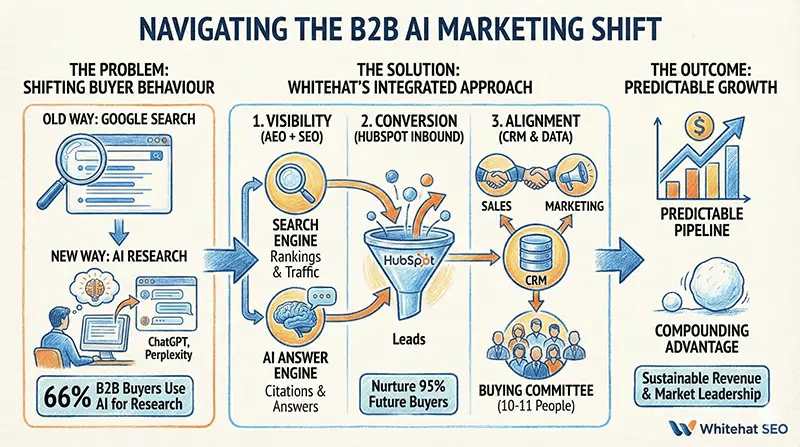
But the bigger transformation isn't HubSpot's growth—it's the fundamental shift in how people search for information. In 2019, we were focused entirely on Google rankings. Today, ChatGPT processes over 2 billion queries daily. Perplexity handles 780 million monthly queries. Google AI Overviews appear in 50-60% of searches. Gartner predicts traditional search engine volume will drop 25% by 2026.
Interviewer: That's a fundamental shift. How are you adapting?
Clwyd: We've pioneered what we call Answer Engine Optimisation—AEO for short. It's the evolution of SEO for the AI era. Instead of just optimising to rank on page one of Google, we're optimising content to be cited by ChatGPT, Perplexity, and Google's AI Overviews when they answer user questions.
The statistics are compelling: 66% of UK B2B decision-makers now use AI tools like ChatGPT and Perplexity to research suppliers. Among 25-34 year-olds—the people increasingly controlling procurement decisions—that figure rises to 85%. If your content isn't structured to be cited by AI, you're invisible to a growing majority of your potential buyers.
What Problems Does Whitehat Solve for Clients?
Interviewer: Give me the elevator pitch. What do you actually do?
Clwyd: We solve three interconnected problems that prevent B2B companies from growing predictably.
First: visibility. Companies come to us saying "we don't have enough visitors to our website" or "we're not showing up when prospects search for what we do." That's evolved from pure SEO to encompass AEO—being visible both in traditional search results and in AI-generated answers. With SparkToro's research showing only 360 out of every 1,000 Google searches now result in a click to the open web, you need to be the source AI quotes, not just a search result people might click.
Second: conversion. Traffic without conversion is vanity. We see companies with decent visitor numbers but terrible lead generation. That's where HubSpot's platform excels—we implement the inbound methodology to capture visitors, nurture them through the buyer's journey, and convert them into qualified leads. The 95-5 rule applies here: only 5% of B2B buyers are in-market at any time, so you need systems to stay visible to the 95% who'll buy later.
Third: sales-marketing alignment. "We get leads but sales won't follow them up" or "marketing generates MQLs that sales says are garbage." We fix that by implementing proper CRM workflows, lead scoring, and attribution that both teams trust. The data shows B2B buying committees have nearly doubled from 5-7 stakeholders to 10-11 people since 2019—you need systems that track influence across that complexity.
What Makes Whitehat Different from Other HubSpot Partners?
Interviewer: There are thousands of HubSpot partners now. Why choose Whitehat?
Clwyd: Three things differentiate us genuinely, not just in marketing copy.
First, Diamond Partner status. We're in the top 3% of HubSpot's 5,500+ partner ecosystem. That's not just a badge—it means we get early access to features like Breeze AI, priority support, and the ability to publish on HubSpot's blog. When HubSpot launched their AI tools at INBOUND 2024, we were already working with beta features.
Second, we run the world's largest HubSpot User Group. The London HUG started with 20-30 people when we took it over. We've grown it to thousands of registered members, with events regularly drawing 300+ attendees. That means we see patterns across hundreds of HubSpot implementations, not just our clients. We know what works and what doesn't because we're plugged into the entire ecosystem.
Third, we're SEO-native. Most HubSpot partners came from marketing automation or CRM backgrounds. We came from search engine optimisation. That means we don't just implement HubSpot—we fill it with traffic that converts. Our AEO services are a natural evolution of that DNA, helping clients be visible wherever their buyers search—including AI platforms.
How Did COVID Change B2B Marketing?
Interviewer: We have to address the elephant in the room. A lot has happened since December 2019.
Clwyd: COVID accelerated everything. McKinsey's research showed it pushed digital transformation forward by 3-4 years for customer interactions and 7 years for digital product portfolios. For us specifically, it validated the remote-first, digital-first approach we'd already been building toward.
The permanent changes are significant. Pre-pandemic, maybe 40% of business meetings were video. Now it's 75%+ and hasn't retreated. More importantly, 61% of B2B buyers now prefer a rep-free buying experience—up from just 33% in 2020. They're completing 60-70% of their research before ever contacting a vendor.
That's why content strategy matters more than ever. Your website, your blog, your presence in AI search results—that's often the only interaction a buyer has with your brand until they're ready to talk. If you're not helpful and visible during that research phase, you're not even on the shortlist.
For Whitehat specifically, we survived and thrived because we practised what we preached. Our systems were already digital. Our processes were already documented. When everyone scrambled to figure out remote work, we just kept going.
What's Your Philosophy on Partnerships?
Interviewer: You mentioned the HubSpot User Group. You seem to put a lot into community.
Clwyd: Community-led growth is genuinely undervalued. The data supports it: companies with community programs see 21% higher revenue growth and 37% higher customer retention. For HubSpot users specifically, community-engaged users show 2-3x higher expansion rates.
But I'll be honest—we didn't start the London HUG because of the business case. We started it because HubSpot needed one in London and nobody else was doing it properly. I stuck my hand up, like I tend to do, and then figured out how to deliver.
The remit from HubSpot is simple: educate and inspire. We bring in HubSpot themselves, industry leaders, partner agencies—even competitors sometimes. We're not standing on stage selling. We're creating value for the community, and the relationships that creates are worth far more than any sales pitch.
Interviewer: You work with competitors?
Clwyd: Absolutely. Last week I recommended a direct competitor to cover a client training session because we weren't available. They're excellent at what they do. We compete head-to-head on pitches, but that doesn't mean we can't collaborate. They have integration skills we call on; we have SEO expertise they refer to. There's plenty of business for everyone who does good work.
The partnership mindset scales faster than the competitive mindset. If you want to build a significant business, you need access to capabilities you don't have in-house. Fighting everyone isn't a growth strategy.
What's the Biggest Mistake Marketers Make?
Interviewer: You lecture at UCL and speak at conferences. What do you find yourself telling marketers most often?
Clwyd: Stop measuring activities and start measuring outcomes. I'm obsessed with the poor performance of marketers generally—and before anyone gets defensive, most marketers I work with agree with this.
The typical marketing team is driven by tasks: publish three blog posts, send the newsletter, run the social campaign. Those are vanity metrics. "We achieved our goal of publishing three blog posts" doesn't move revenue. What moved the pipeline? What generated sales-qualified leads? What actually contributed to business growth?
The inbound methodology gives you a framework for this. Document your buyer personas properly—not a one-pager, but deep understanding of their problems, goals, information sources, and decision-making process. Map the buyer's journey across awareness, consideration, and decision stages. Then create content that helps real people at each stage, measured by whether it actually generates business.
Interviewer: How does AI change that equation?
Clwyd: AI amplifies both good strategy and bad strategy. If you're creating genuinely helpful content for your buyers, AI tools will cite you and recommend you. If you're creating content that ticks boxes but doesn't help anyone, AI will ignore you just like human readers do—except now you're invisible in AI search results too.
The LinkedIn-Edelman research shows 90% of decision-makers are more receptive to sales outreach from companies producing high-quality thought leadership. That's always been true, but now AI is the gatekeeper. Get your content strategy right, and AI becomes your biggest amplifier. Get it wrong, and you disappear.
What Advice Would You Give to Someone Starting a Business Today?
Interviewer: You've done VC-funded startups, organic bootstrap, acquisition, everything. What's the key lesson?
Clwyd: Cash is king. It sounds boring, but the number one job of any company is don't go bust. I've seen brilliant businesses fail because of cash flow timing, not because the product was wrong or the market didn't exist.
When I started Whitehat, I consciously chose organic growth over raising capital. That's slower, but it forces discipline. You can't hide bad unit economics behind funding rounds. Every client has to pay for themselves.
My specific advice: build a buffer. Calculate your monthly outgoings—rent, salaries, everything—and work toward having three to six months sitting in the bank as cash. The peace of mind that creates is transformational. When you're not worried about making next month's payroll, you can think strategically about growth instead of reactively about survival.
Interviewer: Anything you'd do differently?
Clwyd: I would have partnered with HubSpot earlier, when they were smaller and hungry for UK market presence. Building relationships with platforms while they're growing is far easier than after they've scaled. We've done well, but earlier adoption would have compounded.
The same logic applies to AI and AEO now. Companies that establish themselves as authoritative sources in AI search results today will have compounding advantages as those platforms grow. First-mover advantage is real—the research shows companies that started AEO optimisation early capture 3.4x more traffic from AI sources than late adopters.
What's Next for Whitehat?
Interviewer: Where do you see the business going?
Clwyd: We're doubling down on Answer Engine Optimisation. The market is moving faster than most agencies realise. Just 5 brands capture 80% of top AI-generated responses in any given B2B category. That's a winner-take-most dynamic, and our clients need to be among those winners.
HubSpot's Breeze AI launch in September 2024 is also significant. They've embedded AI throughout the platform—Breeze Copilot for assistance, Breeze Agents for automated tasks, Breeze Intelligence for data enrichment. As Diamond Partners, we're helping clients navigate what's genuinely useful versus what's hype.
The London HUG continues to grow. We're exploring more specialised events—workshops on specific topics, training sessions for teams, deeper dives than the quarterly main events allow. The community aspect of what we do is genuinely rewarding, separate from any business benefit.
And we keep learning. The cutting-edge tools I'm using now didn't exist two years ago. That's the reality of this industry—you either stay curious or you become obsolete. I'd rather stay curious.
Frequently Asked Questions
What is Answer Engine Optimisation (AEO)?
Answer Engine Optimisation is the practice of structuring content to be cited by AI-powered search tools like ChatGPT, Google AI Overviews, and Perplexity when they answer user questions. Unlike traditional SEO which focuses on ranking in search results, AEO focuses on being the source AI systems reference. With 66% of UK B2B decision-makers now using AI tools for supplier research, AEO has become essential for B2B visibility alongside traditional search optimisation.
What is a HubSpot Diamond Partner?
HubSpot Diamond Partner status represents the top 3% of HubSpot's 5,500+ agency partner ecosystem globally. Diamond Partners must demonstrate exceptional client results, maintain 80%+ gross revenue retention, and accumulate significant platform expertise through certifications and implementations. Benefits include priority support from HubSpot, early access to new features like Breeze AI, publishing privileges on HubSpot's blog, and Partner Day access at the annual INBOUND conference.
How has B2B buyer behaviour changed since 2019?
B2B buyer behaviour has transformed dramatically since 2019. Buying committees have nearly doubled from 5-7 stakeholders to 10-11 people. The average B2B buying cycle now extends to 10.1 months, with enterprise deals requiring 62+ touchpoints across 10 different channels. Most significantly, 61% of B2B buyers now prefer a rep-free buying experience, up from 33% in 2020, completing 60-70% of their research independently before contacting any vendor.
What is the London HubSpot User Group?
The London HubSpot User Group (HUG) is one of the largest HubSpot User Groups globally, led by Whitehat. It brings together hundreds of HubSpot users quarterly for free educational events in Central London venues, featuring industry speakers, HubSpot experts, and practical workshops. The group has grown from around 30 members to thousands of registered attendees since Whitehat took over leadership, with major events regularly drawing 300+ companies.
How is AI changing digital marketing for UK SMEs?
AI is fundamentally reshaping how UK SMEs approach digital marketing. Gartner predicts traditional search engine volume will drop 25% by 2026 due to AI chatbots and virtual agents. ChatGPT now processes over 2 billion daily queries, and Google AI Overviews appear in 50-60% of searches. For UK SMEs, this means optimising content for AI citation (AEO) is becoming as important as traditional SEO, with 94% of B2B buyers already using AI tools during their research process.
Sources
- Gartner – Search Engine Volume Predictions (February 2024)
- SparkToro/Datos – Zero-Click Search Study (2024)
- 6sense – B2B Buyer Experience Report (2025)
- McKinsey – COVID-19 Digital Transformation Research (2020)
- LinkedIn-Edelman – B2B Thought Leadership Impact Report (2024)
- HubSpot – Annual Reports and INBOUND 2024 Announcements
- DemandSage – ChatGPT and AI Overview Statistics (2025)
- Traxtech – B2B Buyers and AI Research Report (2024)
Ready to optimise for the AI era?
Whitehat helps UK B2B companies get visible in AI search results, implement HubSpot effectively, and build marketing systems that generate predictable pipeline. Whether you need Answer Engine Optimisation, HubSpot onboarding, or strategic marketing guidance, we'd love to talk.