
B2B social media strategy in 2026 requires a fundamental shift from company-centric broadcasting to employee-led content, zero-click value delivery, and AI-aware optimisation. The collapse of LinkedIn company page organic reach—now just 1.6% of followers—means traditional brand page posting is effectively obsolete. UK B2B companies succeeding today are those mobilising their people, not their logo.
B2B Social Media Strategy 2026: The UK Guide to What Actually Works
Company page organic reach has collapsed to 1.6%. Here's the employee-led, AI-aware strategy UK B2B companies need to generate qualified pipeline and build sustainable competitive advantage.
1.6%
LinkedIn Company Page Organic Reach
Down from 7% in 2021
561%
More Reach from Employee-Shared Content
Personal profiles dominate LinkedIn feed
2.74%
LinkedIn Visitor-to-Lead Conversion
3x higher than Facebook
6.8:1
LinkedIn B2B ROAS
Highest among major platforms
This comprehensive guide covers what's actually working for B2B social media in 2026, with UK-specific data, fresh research from 2025-2026, and practical frameworks you can implement immediately. Whether you're a Marketing Director at a SaaS company or leading demand generation at a professional services firm, you'll find actionable strategies backed by current research.
Key Takeaway
Algorithm changes have made old tactics obsolete. The path to ROI now requires a fundamentally different approach centred on employee advocacy, zero-click value delivery, and AI-aware optimisation.
Three Structural Shifts Defining B2B Social Media in 2026
The B2B social media landscape has transformed fundamentally in the past 18 months. Understanding these three structural shifts is essential before implementing tactics. These aren't minor adjustments—they represent a complete realignment of how platforms function and how audiences discover brands.
1. The Collapse of Company Page Organic Reach
LinkedIn company pages now reach only 1.6% of their followers—a catastrophic collapse from 7% in 2021. This isn't a temporary algorithmic fluctuation; it's structural. Company page content accounts for just 1–2% of the LinkedIn feed, whilst personal profiles claim 65% of feed allocation. LinkedIn has explicitly deprioritised brand pages to encourage individual creators and make the feed feel more personal and authentic.
A company page with 10,000 followers might reach only 160 people initially. Unless your company page posts receive significant employee engagement or paid amplification, they're functionally invisible to your audience. The days of building an audience on your company page and using it as a free marketing channel are permanently over.
2. Platform Penalties on External Links
LinkedIn now reduces reach by up to 60% for posts containing external links. X (formerly Twitter) applies similar penalties of 30–50%. This "link tax" fundamentally breaks the traditional content marketing model of driving traffic from social to your website. Platforms have realised that every click away from their ecosystem is revenue they don't capture.
The winning approach delivers complete value directly in-feed through native carousels, videos, frameworks, and checklists—what practitioners call "zero-click content." Your social strategy must create engagement on the platform itself, not merely redirect attention elsewhere.
3. AI Content Saturation and Detection
Over 50% of LinkedIn long-form posts are now likely AI-generated. More significantly, LinkedIn's algorithm increasingly detects and deprioritises fully AI-generated content, with studies showing these posts achieve 47% less organic reach on average. The irony is stark: tools like ChatGPT make it easy to generate content, but platforms penalise you for using them without human intervention.
Whilst 79% of social media managers use AI daily, the winning formula uses AI for research, drafts, and repurposing whilst keeping human strategists responsible for voice, perspective, and authenticity.
Why Employee Advocacy Is No Longer Optional
Employee-led content generates 561% more reach than identical company page content. This statistic alone should reshape your entire social media strategy. Personal profiles dominate approximately 65% of LinkedIn's feed allocation, whilst company pages fight over the remaining scraps. This fundamental algorithmic choice creates an asymmetric advantage for companies with active, engaged employees.
The numbers compound further when examining engagement and conversion. Employee-shared content receives 8x more engagement than company posts. Leads from employee advocacy convert 7x more often than those from paid channels. Companies with active employee advocacy programmes see 20% higher revenue growth.
| Metric | Multiplier | Why It Matters |
|---|---|---|
| Reach vs company posts | 561% more | Your audience actually sees employee content |
| Engagement rate | 8× higher | More comments, saves, and shares per post |
| Lead conversion rate | 7× better | Employees build trust; prospects convert faster |
| Revenue impact | 20% higher growth | Companies with formal programmes outperform |
| Programme adoption | Only 17% formalised | Massive competitive gap for early adopters |
Yet only 17% of firms have formalised advocacy programmes—making this a massive competitive gap. The distinction between high-growth and low-growth firms is striking: 79.1% of high-growth companies use employee advocacy versus just 31% of low-growth firms.
Implementing Employee Advocacy Effectively
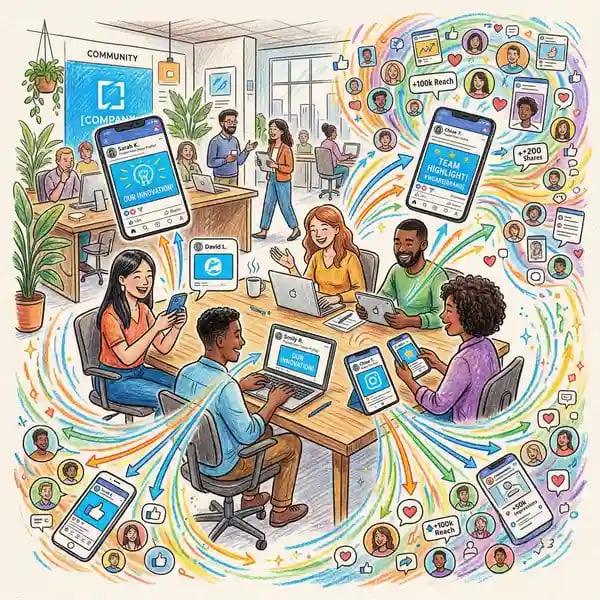
The most effective approach is "Expert Amplification"—rather than encouraging all employees to share all content, specific experts share selected content relevant to their personal area of expertise and enrich it with their own insights. This strategy respects employee autonomy, makes sharing easier, and creates a sustainable long-term programme rather than asking everyone to become brand ambassadors overnight.
Executive participation matters disproportionately. CEO content receives 4x more engagement than other content from LinkedIn members, and executives' interactions with company content receive 3.5x more algorithmic weight. LinkedIn Thought Leader Ads—which amplify employee posts as sponsored content—deliver 1.7x higher click-through rates and 62% lower cost-per-click than standard brand ads.
Content Strategy: What's Working in 2026
Short-form video is the highest-ROI content format, with 104% more marketers naming it their most valuable channel in 2025 versus 2024. LinkedIn video views grew 36% year-over-year. B2B organisations using video report 27% higher MQL rates and 23% shorter sales cycles.
The critical insight: authenticity trumps production value. A CEO talking into a phone camera outperforms a polished £5,000 corporate video on LinkedIn. The platforms reward real over refined because authenticity signals trustworthiness to algorithms and audiences alike.
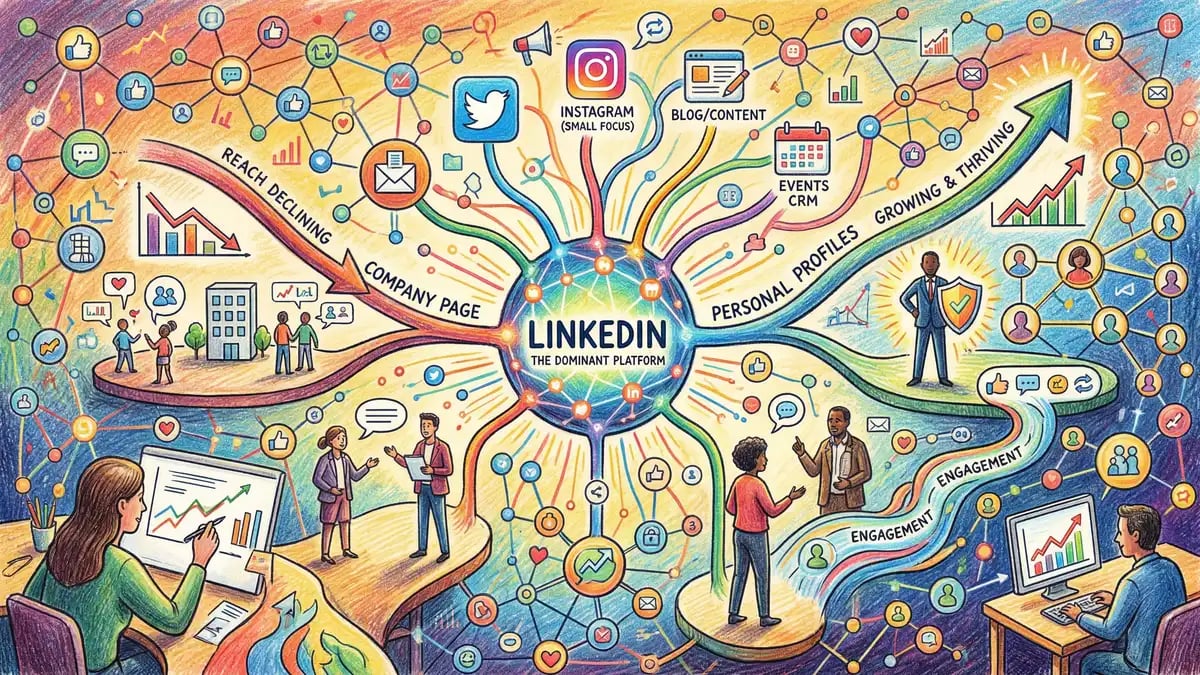
Zero-Click Content: Delivering Value In-Feed
With external link penalties reducing reach by up to 60%, the winning approach delivers complete value directly on the platform. This means native carousels explaining frameworks, videos demonstrating expertise, checklists people can screenshot and use, and insights that stand alone without requiring a click-through.
IDC's FutureScape predicts 75% of B2B buy-side stakeholders will use social media to gather vendor information by 2026. This makes in-feed content quality a direct revenue driver—not just a brand awareness play. When three-quarters of your buyers are researching on social platforms, skipping social strategy is skipping three-quarters of your sales funnel.
Content Format Performance Rankings
| Format | Engagement Multiplier | Best Used For |
|---|---|---|
| Polls | 1.64× | Engagement, conversation starters |
| Native Video | 1.52× | Thought leadership, demonstrations |
| Document/Carousel | 1.41× | Frameworks, step-by-step guides |
| Text + Image | 1.0× | Personal stories, insights |
| External Link Posts | 0.4–0.6× | Avoid unless necessary |
LinkedIn's Algorithm Changes in 2025-2026
LinkedIn's October 2025 overhaul introduced LLM embeddings that narrow 300 million daily posts to approximately 2,000 candidates per user. This represents a shift from broadcast to precision delivery—rather than showing everyone's posts broadly, the algorithm now matches individual posts to the specific people most likely to engage with them.
Algorithm Insight
LinkedIn's October 2025 update means your first 60 minutes determine reach. Post during peak engagement windows (8-10am, 3-5pm GMT for UK audiences), encourage saves and DMs rather than likes, and respond to comments within 30 minutes to signal quality to the algorithm.
Platform Benchmarks and LinkedIn Performance Metrics
LinkedIn's average engagement rate is 2.8%, which falls within the recommended 1-5% range. For B2B specifically, LinkedIn delivers superior conversion performance, with conversion rates up to 2x higher than other social media. The platform achieves a visitor-to-lead conversion rate of 2.74%—nearly three times higher than Facebook.
Video significantly outperforms static posts, with video receiving five times more engagement. LinkedIn video uploads increased 34% year-over-year in 2024. Carousel posts generate 596% more engagement than text-only content.
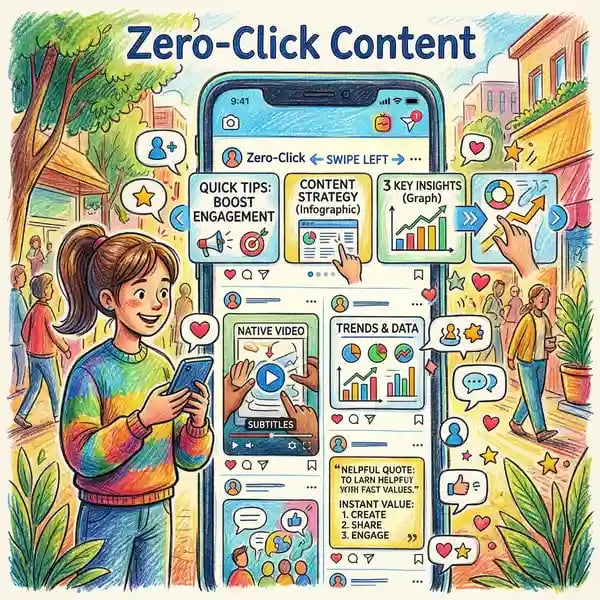
For UK audiences specifically, LinkedIn outreach effectiveness varies by campaign type. Personalised connection requests achieve a 9.36% response rate compared to 5.44% without a message. Messenger campaigns lead with 11.72% total reply rate. Two-action campaigns combining a message with a profile visit achieve an impressive 11.87% reply rate.
Optimal Posting Times for UK Audiences
Tuesday through Thursday are highest-performing days. Within those days, two windows generate disproportionate engagement: 08:00–10:00 GMT (morning commute and start-of-day browsing) and 15:00–17:00 GMT (afternoon productivity lull). Weekend posting generates 30–40% less reach unless your audience specifically consumes professional content then.
Mobile matters enormously: 72% of LinkedIn activity happens on mobile devices. Format your content for vertical scrolling, keep opening hooks visible without clicking "see more," and test how carousels render on phone screens.
Beyond LinkedIn: Multi-Platform Strategy
YouTube
AI engines cite YouTube more than any other domain. Long-form educational content and product demonstrations rank well both in YouTube search and AI-generated responses.
X (formerly Twitter)
Engagement remains high, but reach has declined significantly. Best used for real-time commentary, industry news, and conversation with peers and journalists.
Reddit & Communities
Reddit accounts for 46.7% of citations in Perplexity AI's top sources. Subreddits relevant to your industry provide direct access to your target audience.
The 95-5 Rule: Reaching Future Buyers
Only 5% of B2B buyers are actively in-market at any given time. This research from the Ehrenberg-Bass Institute fundamentally changes how you should think about social media ROI. The purpose of B2B social isn't primarily lead generation—it's building mental availability with the 95% who'll buy later.
This explains why short-term conversion metrics are misleading. A prospect might consume your CEO's LinkedIn content for 18 months before entering a buying cycle. When they do, you want to be the first brand they think of—not one of ten vendors they find through a Google search.
75% of B2B buyers use social media to support purchase decisions, and 84% of C-level executives use social media as an information source during purchasing. The average B2B buying group comprises 8.2 stakeholders—each consuming different content across an average of 10 different research channels.
Social platforms now drive over 60% of product discovery, whilst Google accounts for only 34.5%. Your social presence needs to reach multiple personas, not just the primary buyer. This multiplicity requires diversified content—different angles, formats, and messaging for different audience segments consuming in parallel.
Dark Social and Attribution: The Hidden Problem
Dark social accounts for an estimated 84% of all content shares. Private channels—Slack, WhatsApp, email, direct messages—have become the primary way professionals share recommendations with colleagues. 77.5% of B2B buyers share links through these private channels, invisible to your analytics.
LLMs like ChatGPT and Claude have expanded the dark funnel further. Buyers increasingly use AI chatbots as private advisors, asking questions and receiving recommendations that leave zero click paths or attribution signals. Your social analytics are capturing only 16% of actual social influence—the vast majority is invisible.
Self-Reported Attribution: The Essential Fix
Add "How did you hear about us?" as an open-text field on your lead forms. Not a dropdown (which constrains answers to your assumptions), but a free-text field that captures actual discovery paths. This single change addresses the fundamental attribution problem that's plagued marketing for a decade.
You'll find entries like "saw your CEO's post on LinkedIn," "my colleague shared an article in Slack," or "ChatGPT recommended you." This qualitative data often contradicts what your analytics shows—and it's more accurate for understanding real influence.
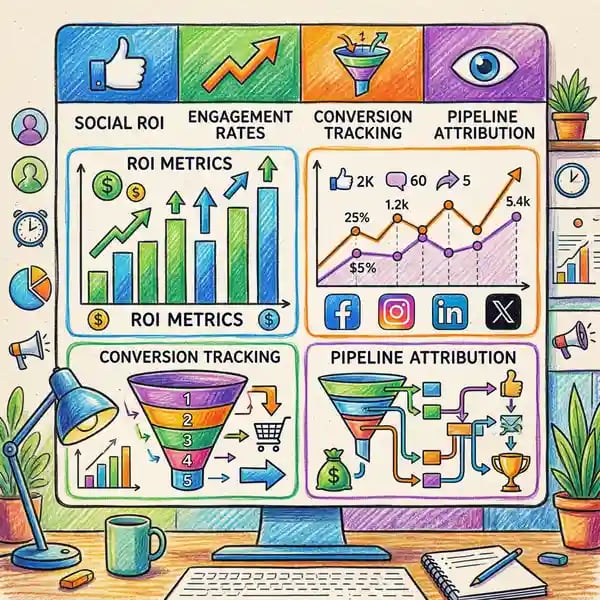
Measuring B2B Social Media ROI Your CFO Will Trust
Only 52% of CMOs successfully prove marketing ROI according to Gartner. For social media specifically, the challenge is acute—vanity metrics like impressions and followers don't connect to revenue, whilst the 95-5 rule makes immediate attribution misleading. Building credibility with finance requires rethinking how you measure entirely.
The solution is a layered measurement framework that tracks leading indicators, influenced pipeline, and self-reported attribution together. 67% of marketers identify revenue attribution from social as their top measurement goal in 2025, emphasising the shift from vanity metrics to business impact.
Three-Layer ROI Framework
| Layer | Metrics | Why It Matters |
|---|---|---|
| Leading Indicators | Engagement rate, share of voice, follower growth, saves/shares | Content momentum and audience resonance |
| Pipeline Indicators | Social-sourced leads, engagement-to-MQL rate, time-to-close | Connection to commercial outcomes |
| Revenue Indicators | CAC from social, LTV of social customers, influenced revenue | Proof of business impact for CFO |
UK B2B Social Media Budget Allocation
Average B2B marketing spend sits at 8.4–9.4% of revenue in 2025. Social media's share of total marketing budget is approximately 14.9–17%, with most spending focused on lead generation and brand building. Understanding where budget flows helps calibrate your programme expectations and competitive positioning.
| Programme Type | Budget Share | Focus |
|---|---|---|
| New Lead Generation | 36% | Paid campaigns and content promotion |
| Brand Building | 30% | Organic content and thought leadership |
| Demand Generation | 20% | Nurture campaigns and engagement |
| ABM Programs | 15% | Targeted account-based campaigns |
The outlook is bullish: 69% of marketers expect budget increases and 83% of B2B marketing decision-makers expect marketing investments to grow. Social professionals using social selling are 51% more likely to hit quota and create 45% more opportunities—direct business impact numbers that justify investment to finance leaders.
Social Selling: Aligning Marketing and Sales
Sales professionals using social selling are 51% more likely to hit quota. This isn't marketing claiming sales impact—it's sales data proving that social presence directly affects commercial outcomes. Companies that integrate social selling with marketing create compounding returns where the whole is greater than the sum of parts.
The practical integration looks like this: marketing creates foundational content and frameworks, sales personalises them for specific prospects, marketing amplifies high-performing sales content, and both teams use the same CRM to track social touchpoints through the buyer journey. This creates a virtuous cycle where sales success signals back to marketing what content resonates with real prospects.
LinkedIn Thought Leader Ads bridge the gap perfectly—they amplify individual employee posts as sponsored content, combining the credibility of personal content with the targeting precision of paid media. These ads deliver 1.7x higher CTR and 62% lower CPC than standard company page ads, making them a critical lever for scaling employee advocacy with measurable ROI.
Social Media and AI Search Optimisation
AI search traffic surged 527% from 2024 to 2025. Gartner predicts a 25% drop in traditional search volume by 2026 due to AI chatbots. Zero-click searches rose from 56% in 2024 to 69% in 2025. Your social media content must now be optimised for both platform-native discovery and citation by AI answer engines—a dual optimisation challenge that didn't exist two years ago.
Here's what this means practically: AI engines cite YouTube more than any other domain. Reddit accounts for 46.7% of citations among Perplexity's top sources. LinkedIn posts can appear in AI responses when they contain specific, authoritative answers to questions your buyers ask. This creates a new discovery pathway entirely separate from social feeds and search results.
46% of Gen Z and 35% of Millennials now prefer social media over traditional search engines for finding information. For B2B marketers, this means your social content isn't just building awareness—it's becoming a primary discovery channel. The intersection of social media and AI search is where competitive advantage lies in 2026 and beyond.
Mid-Article CTA
Need help building your B2B social media strategy?
Our team can audit your current approach, design employee advocacy programmes, and establish attribution that connects social to pipeline.
Explore Our Marketing ServicesYour B2B Social Media Action Plan for 2026
Theory matters less than execution. Here's what to implement this quarter to begin shifting your strategy toward what actually works in 2026.
Action Plan Steps
This Week: Quick Wins
- Add self-reported attribution to your lead forms
- Audit your company page reach
- Identify 3-5 potential employee advocates
- Remove external links from next 3 LinkedIn posts
This Month: Foundation
- Launch pilot advocacy programme
- Create zero-click content library
- Set up proper UTM tracking
- Brief your CEO on executive presence
This Quarter: Investment
- Formalise advocacy with calendars
- Test LinkedIn Thought Leader Ads
- Build short-form video capability
- Integrate social into attribution model
Frequently Asked Questions
What is B2B social media marketing?
B2B social media marketing is the use of social platforms to reach and engage business decision-makers, build brand awareness, and generate qualified leads. In 2026, it primarily focuses on LinkedIn, employee advocacy, and zero-click content that delivers value directly in-feed rather than driving traffic to external websites.
What are the best social media platforms for B2B in 2026?
LinkedIn remains dominant, with 76% of B2B marketers rating it most effective. YouTube ranks second for educational and search-driven content. TikTok and Reddit are emerging for specific audiences, whilst X has been significantly deprioritised. Choose 1–2 platforms and invest deeply rather than spreading thin.
How do you measure ROI from B2B social media?
Measure through pipeline attribution, not vanity metrics. Track engagement-to-MQL conversion rates, social-sourced pipeline value, and influenced revenue. Use UTM parameters, CRM tracking, and self-reported attribution fields to capture dark social influence. CFOs trust revenue attribution, not impressions.
How often should B2B companies post on social media?
LinkedIn's algorithm promotes only one post per account per 24-hour period—multiple daily posts cannibalise each other. The winning approach is posting less but better: 2–3 high-quality posts per week outperform daily superficial updates. Focus on depth and substance over frequency.
What is employee advocacy and how does it help B2B brands?
Employee advocacy is a systematic programme where employees share company content through their personal profiles. It works because personal profiles generate 561% more reach than company pages, employee-shared content receives 8x more engagement, and leads from employee advocacy convert 7x more often.
What type of content works best for B2B social media?
Short-form video is the top ROI content format in 2026. Zero-click content—native carousels, videos, frameworks, and checklists that deliver complete value in-feed—outperforms link-driven posts. Authentic, founder-led content significantly outperforms polished corporate videos.
What is the 95-5 rule in B2B marketing?
The 95-5 rule states that only 5% of B2B buyers are actively in-market at any time. The remaining 95% will buy in the future. B2B social media should focus on building mental availability—ensuring your brand is remembered when buyers enter the market—rather than obsessing over immediate conversion.
How has LinkedIn's algorithm changed in 2025-2026?
LinkedIn's October 2025 overhaul introduced LLM embeddings narrowing 300 million daily posts to approximately 2,000 candidates per user. The algorithm now scans post copy directly for keywords, suppresses engagement pods, and heavily weights saves and DM sends. Company page reach collapsed to 1.6% of followers.
References and External Resources
- LinkedIn B2B Statistics 2025 – SalesSo, LinkedIn engagement and conversion benchmarks
- Social Media ROI By Industry: 2025 Benchmarks – MarTech Zone, ROAS data by sector
- Social Media Trends in the UK (2026) – Sprout Social, UK-specific marketing trends
- B2B LinkedIn Outreach Benchmarks 2025 – Belkins, LinkedIn reply rate research
- Social Media Marketing Statistics 2025 – Sprinklr, comprehensive industry benchmarks
Last updated: March 2026 with latest B2B social media benchmarks, LinkedIn algorithm changes, and UK-specific data.
Ready to Build a Social Media Strategy That Drives Pipeline?
Whitehat runs the largest London HubSpot User Group and helps UK B2B companies build marketing engines that generate predictable pipeline with attribution your CFO will trust.
Clwyd Probert
Strategy Director, Whitehat SEO
Clwyd leads B2B marketing strategy for SaaS and professional services firms. Specialising in LinkedIn optimisation, he's helped companies build employee advocacy programmes that generate 561% more reach than company page content and implement attribution frameworks that connect social to revenue.
Related Reading: