
Social Media Marketing & AEO
Social search optimisation is the practice of structuring your presence across social platforms—LinkedIn, YouTube, TikTok, Reddit—so that both human searchers and AI answer engines can find, trust, and cite your content. For B2B brands, this represents the most significant shift in search behaviour since Google's rise.
Social Search Optimisation in 2026: The Definitive B2B Playbook
How to capture visibility across TikTok, LinkedIn, YouTube, Reddit and AI answer engines—before your competitors do
The bottom line
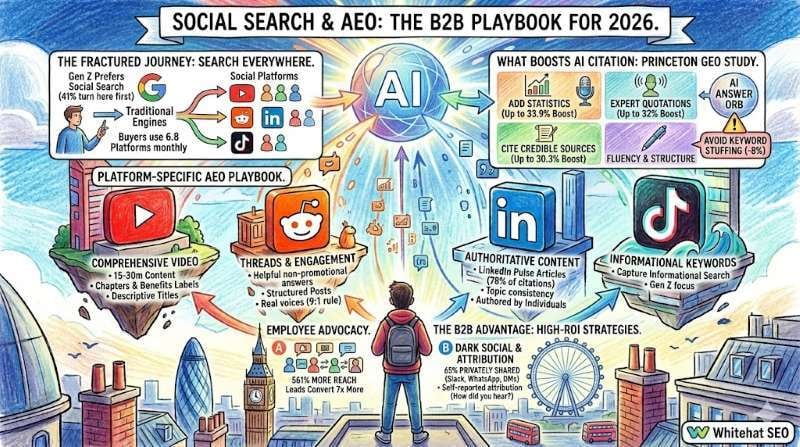
Social platforms have become the primary discovery channel for Gen Z, and AI answer engines now cite social content more than brand-owned websites. 49% of consumers used TikTok as a search engine in 2026 (Adobe), while social media citations in AI engines grew 347% between September and December 2025. If your brand isn't visible in social search and AI-generated answers, you're not on the shortlist.
The data is unambiguous: 75% of B2B buyers say social media influences purchase decisions, and 94% of buying groups rank their shortlist before ever contacting sales. Meanwhile, AI engines like ChatGPT, Google AI Overviews, and Perplexity are citing what others say about your brand on social platforms more than what you say on your own website.
At Whitehat SEO, we've been helping UK B2B companies navigate this shift through our Answer Engine Optimisation services. This guide synthesises the latest research and platform changes to give you a complete playbook for 2026.
The search landscape has fundamentally fractured
The era of Google monopoly on search intent is over—not because Google is shrinking (SparkToro reports Google Search actually grew 20% in 2024), but because search behaviour has diversified across platforms, each capturing specific intent types that Google never owned.
Gen Z has already shifted. A Sprout Social Q2 2025 Pulse Survey found that 41% of Gen Z turn to social media first when looking for information, making social the number-one search destination ahead of traditional search engines (32%) and AI chatbots (11%). Meanwhile, 52% of Gen Z trust brand information found on social media more than Google or AI chatbots.
However, Adobe's February 2026 study reveals an important nuance: Gen Z preference for TikTok over Google actually declined from 8% to 4% between 2024 and 2026. Social search supplements Google rather than replacing it. The correct mental model is search fragmentation, not search migration—buyers now use an average of 6.8 social platforms monthly alongside traditional search.
Platform dominance by use case
- YouTube is the top destination for traditional search in the US, EU, and UK. Over 70% of viewers report buying from brands they discover on YouTube.
- Reddit became the second-most-visited website in the US in 2025. Reddit Answers grew from 1 million to 15 million weekly active users between Q1 and Q4 2025.
- TikTok processes 503% more fashion-related searches than Google, with 73% of higher-volume TikTok keywords being informational.
- LinkedIn reaches 45-48 million members in the UK, with 76% of B2B marketers rating it the most effective platform.
The zero-click reality compounds this shift. Semrush reports 58.5% of US searches and 59.7% of EU searches end without any click. For queries triggering AI Overviews, the median zero-click rate reaches 80%. Social platforms are the ultimate zero-click environments—content is discovered, consumed, and acted upon entirely within the platform.
UK-specific context: Ofcom reported 1.8 million UK adults abandoned Google for social searches in 2024. The UK has 54.8 million social media user identities (79% of the population), with UK users spending an average of 1 hour 37 minutes daily on social media. Critically, 48.6% of UK adult internet users use social media to find information about brands and products.
AI answer engines are rewriting the rules of visibility
The most consequential development for content strategy in 2025-2026 is that AI answer engines have begun citing social media content at scale—and social citations are growing faster than any other source category.
According to Goodie's analysis of 6.1 million citations across 10 AI platforms, social citations grew 4x while overall citations grew 2-3x between September and November 2025. By November, social citations were 4.17 times the volume of brand-owned content citations. This means AI engines now reference what others say about your brand on social platforms more than what you say on your own website.
| Month | YouTube | X/Twitter | ||
|---|---|---|---|---|
| August | 18.9% | 44.2% | 0.0% | 12.2% |
| September | 28.8% | 41.7% | 0.1% | 19.6% |
| October | 32.4% | 15.9% | 29.9% | 18.0% |
| December | 39.2% | 20.3% | 23.5% | 11.6% |
YouTube has overtaken Reddit as the most-cited social platform overall. BrightEdge reports YouTube enjoys a 200-fold citation advantage over rival video sites, with citations in Google AI Overviews surging 25.21% since January 2025 and 35.6% for instructional content specifically.
Each AI engine has distinct citation preferences. Google AI Overviews most frequently cite Reddit (21%), YouTube (18.8%), and LinkedIn (13%). ChatGPT cites LinkedIn 4.2x more than before, with 78% of LinkedIn citations pointing to LinkedIn Pulse articles. Perplexity heavily favoured Reddit until Reddit sued Perplexity in October 2025, after which Reddit citations dropped 86% and YouTube surged.
The citation overlap gap is critical: overall overlap between AI citations and Google's top 10 results is only 12%. This means ranking well on Google does not guarantee visibility in AI answers—social presence provides a separate, increasingly important pathway to AI citation. This is why SEO and AEO need to work together.
How to optimise content for AI citation
The Princeton GEO (Generative Engine Optimisation) study—published at ACM SIGKDD, one of the most rigorous computer science venues—tested 9 optimisation methods across 10,000 queries and found clear patterns for what works.
What boosts AI visibility (Princeton GEO Study)
- Adding statistics boosts AI visibility by up to 33.9%
- Adding expert quotations boosts visibility by up to 32%
- Citing credible sources boosts visibility by up to 30.3%
- Fluency optimisation provides a 15-30% boost
- Keyword stuffing actively hurts visibility by -8%
The practical implication: social content should be data-rich, include expert perspectives, cite sources, and be clearly written. AI engines cannot generate original data—they gravitate toward sources that provide it.
Platform-specific AI optimisation priorities:
- YouTube: 85% of citations point to specific videos. Include comprehensive transcripts, use descriptive titles matching natural question patterns, and create 15-30 minute videos for maximum citation potential.
- Reddit: 99% of citations point to individual discussion threads. Write self-contained, structured posts that answer questions completely. Avoid promotional language. The average cited Reddit post is 1 year old—AI builds durable knowledge, not chasing virality.
- LinkedIn: Focus on LinkedIn Pulse articles (78% of all LinkedIn citations). ChatGPT cites LinkedIn most frequently; authoritative long-form content with clear expertise signals performs best.
Platform-specific playbook for 2026
LinkedIn: expertise over engagement
LinkedIn underwent a structural shift in 2025-2026, moving from broadcast distribution to precision, relevance-based delivery. Richard van der Blom's Algorithm InSights 2025 report documents organic views down approximately 50% year-on-year, while engagement per post rose 12%. Fewer people see each post, but those who do are more relevant and more engaged.
The algorithm now evaluates three signals: who you are (topic consistency, profile credibility), what you post (clarity, expertise), and who engages (seniority and relevance of commenters). Comments are 15x more valuable than likes for distribution. LinkedIn's March 2025 "Authenticity Update" introduced AI detection of engagement pods, effectively imposing an algorithmic death penalty on users detected using them.
Content format performance on LinkedIn (Socialinsider 2025)
- Multi-image carousels: 6.60%
- Native documents (PDFs): 6.10%
- Video: 5.60%
- Single images: 4.85%
- Polls: 4.40%
- Text posts: 4.0%
LinkedIn newsletters remain massively underutilised for B2B. Company newsletters average 40% open rates—far exceeding typical email benchmarks. Newsletters surface in Google searches, boosting SEO visibility. Of the top 100 newsletters, 98% are written by individuals, not companies, underscoring the importance of personal brand over corporate publishing.
YouTube: the B2B search and AI visibility asset
YouTube's strategic importance for B2B has transcended traditional video marketing. As Jessica Finch, Head of SEO at Brainlabs, told Digiday: "YouTube has evolved from a pure social channel play into a major focus for AI visibility strategies." LLMs effectively ingest video transcripts, meaning video scripts directly influence what AI engines cite about your brand.
The numbers support this investment: 70% of B2B buyers incorporate video in purchase decisions, 59% of senior executives prefer video over text when researching solutions, and 51% of B2B buyers use YouTube specifically to research purchases. In the UK, adults spend 51 minutes daily watching YouTube, and it is the UK's second-most-watched media service after the BBC.
B2B YouTube strategy for 2026: Use Shorts (200 billion daily views) for discovery and long-form for conversion. Short-form social videos drive the highest ROI—41% of B2B marketers say so. Convert long-form demos into 60-90 second clips with single clear hooks. For AI citation, create comprehensive 15-30 minute videos with full transcripts, descriptive titles matching question patterns, and 4-8 chapter segments with benefit-led labels.
Reddit: reaching decision-makers others can't
Reddit's B2B potential is often underestimated, but the data is compelling. Reddit reaches 61% of business decision-makers, and critically, 68% of Reddit's users are not on LinkedIn. Tech decision-makers use Reddit for peer reviews (72%) and product research (49%). Users make buying decisions 9x faster on Reddit than other social networks, and 90% of consumers trust Reddit recommendations.
Reddit's importance extends beyond direct engagement—it is the primary training source for AI/LLM models. Discussions shape what appears in AI-generated outputs. Reddit's average CPM of £2.60 significantly undercuts LinkedIn (£12-20), with B2B SaaS customer acquisition costs running 15-30% lower than LinkedIn.
Reddit best practices for B2B: Follow the 9:1 rule—nine helpful, non-promotional contributions for every branded post. Use real voices ("I'm a product marketer at X"). Focus depth, not breadth: 2-3 highly relevant subreddits with regular engagement outperform scattered efforts. Reddit introduces prospects who often convert 60-90 days later through other channels—multi-touch attribution is essential.
Employee advocacy: the highest-ROI social strategy available
The data on employee advocacy is so consistently strong that it demands a central place in any B2B social strategy. Posts shared by employees generate 561% more reach than corporate posts, with 8x more engagement and an 8x higher click-through rate. Leads from employee advocacy convert 7x more frequently than other leads.
The cost efficiency is remarkable: employee advocacy CPC averages £0.40-£0.70, which is up to 88% cheaper than LinkedIn ads at £3-6 CPC. Companies with active advocacy programmes see 20% higher revenue growth. Crucially, LinkedIn posts written by employees outperformed pre-written shares by 9x.
Founder-led content amplifies results
The 2025 Edelman-LinkedIn Thought Leadership Impact Report found that 95% of "hidden buyers"—stakeholders who influence purchase decisions but rarely interact with sales—say strong thought leadership makes them more receptive to outreach.
A Momentum ITSMA study of 600 senior decision-makers found 99% say thought leadership is important or critical in decision-making, and 66% say they won't work with a provider who produces poor thought leadership.
Only 1% of LinkedIn users create content but generate 9 billion impressions—a massive whitespace opportunity for B2B leaders. At Whitehat, we've seen this first-hand through our work helping HubSpot clients build their inbound presence.
The B2B buyer journey has compressed and diversified
Understanding how B2B buyers actually research and decide is essential context for social search optimisation. Dreamdata's 2025 LinkedIn Ads Benchmarks Report documents 76 touchpoints across 3.7 channels, with journeys averaging 211 days from first touch to revenue. Buying groups now contain 6-10 stakeholders across multiple functions.
61% of the buyer journey is now complete before first sales contact, and 94% of buying groups rank their shortlist before initiating contact—with the number-one-ranked vendor winning approximately 80% of the time. This means the competition is effectively over before your sales team enters the conversation.
AI is accelerating this trend: 94% of B2B buyers use LLMs during their buying process, and 72% encountered Google's AI Overviews during research. The B2B buying cycle has actually shortened from 11.3 months to 10.1 months between 2024 and 2025, partly because AI tools accelerate research.
Dark social dominates how buyers actually share and discover. Over 65% of social sharing in 2025 occurs via private, non-public channels—DMs, Slack groups, email forwards, WhatsApp threads. Only 5% of potential B2B buyers are actively in-market at any time (the "95/5 rule"). Demand generation targeting the 95% through ungated, shareable social content consistently outperforms lead-generation approaches targeting only the 5%. Self-reported attribution ("How did you hear about us?" fields) is now the recommended primary approach for measuring dark social influence.
UK regulatory guardrails for social media marketing
UK B2B marketers must navigate three overlapping regulatory frameworks. The ASA/CAP Code covers all paid social media advertising, including influencer partnerships. In April 2025, the Code was updated to align with the Digital Markets, Competition and Consumers Act 2024, and in May 2025, new guidance on disclosing AI use in advertising was published.
The #ad disclosure must be used—alternatives like #spon or #gifted are not sufficient. Both advertisers and influencers may be liable for content; brands cannot avoid liability by claiming influencers acted independently.
UK GDPR and the Data Protection Act 2018 govern personal data handling across social platforms. Consent is required before deploying tracking pixels or cookies for ad retargeting under PECR. Custom audience uploads to platforms (even hashed data) require a lawful basis and privacy notice disclosure.
UK social media advertising spend reached £9.02 billion in 2025 (up 13.8% year-on-year), with the social commerce market projected to reach £16 billion by 2028. With 82% of UK B2B marketers planning to increase spend in 2025, compliance is not optional—it's a competitive advantage when competitors cut corners.
What this means for your B2B social strategy in 2026
Three interconnected shifts define the 2026 landscape. First, search has permanently fragmented across social platforms, AI engines, and traditional search—brands must now practise "Search Everywhere Optimisation." Second, AI answer engines cite social content at 4x the rate of brand-owned content, making what others say about you on Reddit, YouTube, and LinkedIn more consequential than your own website copy. Third, the B2B buyer journey is effectively decided before sales contact, with social proof and thought leadership determining shortlist rankings.
Highest-impact actions for B2B brands
- Treat every social post as a potential AI citation source—structure content with statistics, expert perspectives, and clear answers
- Invest heavily in employee advocacy (561% more reach at 88% lower cost than paid)
- Build genuine Reddit presence among the 61% of decision-makers that LinkedIn cannot reach
- Optimise YouTube content for both human search and LLM transcript ingestion
- Shift measurement from last-click attribution to self-reported attribution and pipeline influence tracking
The competitive window is now. Only 1% of LinkedIn users create content. Reddit B2B advertising costs a fraction of LinkedIn. Most B2B brands have no YouTube search strategy and no AI citation awareness. The brands that move first to optimise for social search and AI citation will compound advantages that become increasingly difficult to replicate—because the algorithms reward consistent expertise over time, and AI engines build durable knowledge bases from established, authoritative voices.
Frequently asked questions
What is social search optimisation?
Social search optimisation is the practice of structuring your presence across social platforms—LinkedIn, YouTube, TikTok, Reddit—so that both human searchers and AI answer engines can find, trust, and cite your content. It combines traditional social media marketing with answer engine optimisation (AEO) principles.
How do AI engines decide which social content to cite?
AI engines favour content that includes statistics (up to 33.9% visibility boost), expert quotations (32% boost), and credible source citations (30.3% boost). They also value fluency and clear structure. Keyword stuffing actively hurts visibility by 8%.
Which platform is best for B2B social search?
There's no single best platform—each serves different purposes. LinkedIn reaches the most B2B professionals, YouTube has the highest AI citation rate, Reddit reaches decision-makers LinkedIn can't, and TikTok captures informational search intent from younger buyers. A multi-platform approach is essential.
How quickly can we see results from social search optimisation?
Employee advocacy can show engagement improvements within weeks. AI citation typically takes 60-90 days to see measurable improvements as content gets indexed and cited. Building genuine Reddit authority takes 3-6 months of consistent, helpful participation.
Does social search replace traditional SEO?
No—social search optimisation complements traditional SEO. Google remains the dominant search engine, growing 20% in 2024. The correct approach is "Search Everywhere Optimisation"—ensuring visibility across traditional search, social search, and AI answer engines simultaneously.
Ready to optimise for social search and AI visibility?
Whitehat helps UK B2B companies get visible across social platforms and AI answer engines. As a HubSpot Diamond Partner, we track every visibility improvement through to revenue.
Explore Our AEO ServicesReferences and sources
- Adobe Express (2026). TikTok as a Search Engine: How Consumers and Businesses Use It. February 2026.
- Aggarwal, P. et al. (2024). GEO: Generative Engine Optimization. ACM SIGKDD Conference on Knowledge Discovery and Data Mining.
- Ofcom (2025). Media Nations: UK 2025. Annual media market report.
- Sprout Social (2025). Q2 2025 Pulse Survey: Social Media Search Behaviour.
- Richard van der Blom (2025). LinkedIn Algorithm InSights 2025.
- Socialinsider (2025). LinkedIn Benchmarks 2025.
- Semrush (2025). State of Search Q1 2025.
- 6Sense (2025). B2B Buyer Intent Data Report 2025.
- Edelman & LinkedIn (2025). Thought Leadership Impact Report 2025.
- ASA (2025). Recognising Ads: Social Media. Updated guidance.
Whitehat SEO
Whitehat is a London-based HubSpot Diamond Solutions Partner helping UK B2B companies get visible in AI search results, implement HubSpot effectively, and build marketing systems that generate predictable pipeline. We also run the world's largest HubSpot User Group. marketing services view our pricing