
How to Build an Effective SEO Strategy for UK B2B Companies in 2026
An effective SEO strategy for UK B2B companies in 2026 combines technical foundations, content structured around buyer intent, and optimisation for both Google and AI search engines. With organic search driving 44.6% of all B2B revenue and delivering a median ROI of 748%, a well-executed strategy remains the single highest-returning marketing investment a business can make.
Yet most UK businesses are underinvesting. The LOCALiQ 2026 report found that while 86% of UK businesses say SEO is "very important," only 48% actively include it in their marketing strategy. That gap between intention and action represents an enormous opportunity for B2B companies willing to commit to a structured, evidence-based approach.
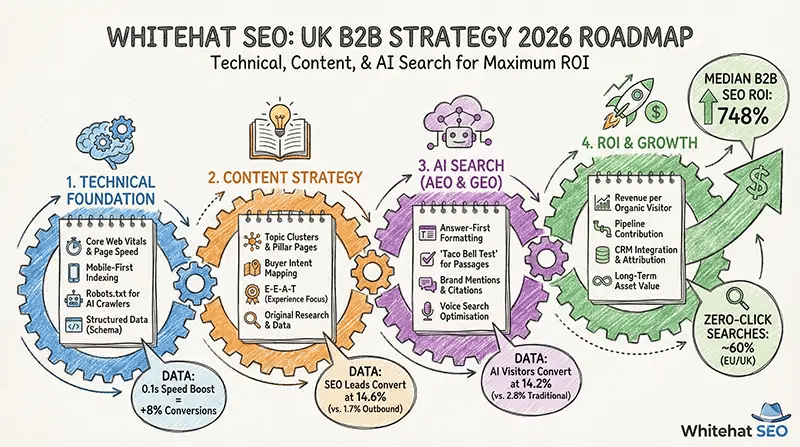
This guide walks through the ten steps Whitehat SEO uses when building SEO programmes for UK B2B clients, drawing on current research, UK market data, and our experience as a HubSpot Diamond Solutions Partner working with companies from SaaS to life sciences.
Why SEO Remains the Highest-ROI Marketing Channel in 2026
The data is unequivocal. FirstPageSage's analysis of campaigns through Q3 2025 found the median SEO return on investment sits at 748%, far exceeding paid search, social advertising, and email marketing. For B2B SaaS companies specifically, SeoProfy research places the average at 702%, with break-even typically occurring at seven months.
What makes organic search uniquely valuable for B2B is lead quality. SEO leads close at 14.6% compared to just 1.7% for outbound methods, making them roughly eight times more likely to convert. BrightEdge data shows organic search generates 44.6% of all B2B revenue, more than double the contribution of any other single channel.
Despite doomsday predictions about AI disrupting organic traffic, Graphite's analysis of the top 40,000 websites found organic search traffic declined only 2.5% year-on-year. Meanwhile, 91% of businesses in Conductor's 2025 survey reported that SEO positively impacted their marketing goals. The channel is evolving, not dying.
The UK B2B Search Landscape: What Has Changed
Google still holds 93.35% of UK search market share, with near-total dominance on mobile at approximately 98%. For UK B2B companies, Google remains the primary discovery channel, with 71% of B2B buyers starting their research with a Google search. However, the search environment has shifted in three significant ways.
AI search is reshaping how buyers find suppliers
ChatGPT now reaches 800 million weekly active users, and Google's AI Overviews serve 2 billion users globally. Critically for B2B, 94% of B2B buyers now use large language models during their purchasing process, according to the 6sense Buyer Experience Report 2025. Whitehat SEO's answer engine optimisation services help businesses adapt to this shift, ensuring visibility across both traditional and AI-powered search.
Zero-click searches dominate the UK market
SparkToro and Datos research found that 59.7% of EU and UK Google searches result in zero clicks. By March 2025, only 40.3% of Google searches led to an organic click. This means SEO strategy must now account for brand visibility even without a website visit, making branded search growth and Share of Voice increasingly important metrics.
UK regulatory changes create both risks and advantages
The UK's Data (Use and Access) Act became law in June 2025, reforming cookie consent requirements. The CMA launched its first Strategic Market Status investigation into Google in January 2025, which could reshape how UK search results are displayed. Businesses that understand these regulatory shifts and adapt their analytics and tracking accordingly gain a genuine competitive edge.
Setting Goals That Connect SEO to Revenue
The single biggest mistake UK B2B companies make with SEO is measuring traffic volume instead of revenue contribution. With zero-click searches rising and AI Overviews filtering out low-intent visitors, traffic as a standalone KPI is increasingly misleading. AI search visitors convert at 14.2% compared to 2.8% for traditional Google traffic, making quality dramatically more important than quantity.
Effective B2B SEO goals should be structured in tiers. Start with visibility metrics such as organic impressions, keyword rankings, and Share of Voice. Layer in engagement measures including click-through rate and time on page. Then connect these to business outcomes: organic-sourced MQLs, pipeline contribution, and revenue per organic visitor. Platforms like HubSpot make this attribution chain trackable from first touch to closed deal.
For companies targeting UK B2B markets, Whitehat SEO recommends tracking non-branded keyword growth as a leading indicator. Rising rankings for non-branded, category-level terms signal expanding market reach and typically precede pipeline growth by three to six months.
Conducting a Technical SEO Foundation Audit
Google's John Mueller put it plainly in November 2025: "Consistency is the biggest technical SEO factor." A comprehensive website audit should verify that your internal links, canonical tags, structured data, and navigation all send consistent signals to search engines.
Only 47% of websites currently pass all three Core Web Vitals metrics. Research from Deloitte and Google demonstrates that a 0.1-second improvement in page speed increases conversions by 8%. Pages ranking at position one are 10% more likely to pass Core Web Vitals than those at position nine, confirming that technical performance correlates directly with ranking success.
For B2B companies targeting AI search visibility, the technical checklist expands further. Ensure your robots.txt allows AI crawlers (GPTBot, Google-Extended, Claude-Web, PerplexityBot). Verify that your web application firewall is not blocking AI user agents. Confirm that critical content renders without JavaScript, since AI crawlers cannot execute it. These technical prerequisites determine whether AI platforms can even discover and cite your content.
Keyword Research for B2B: Quality Over Volume
B2B keyword research operates on fundamentally different principles from B2C. Where consumer brands chase high-volume head terms, B2B companies gain more value from long-tail, high-intent keywords that even at 20 to 100 monthly searches can represent substantial deal value. A phrase like "HubSpot Salesforce integration consultant UK" might get 40 searches per month, but each represents a prospect with genuine purchase intent.
The competitive landscape data is stark: 96.55% of all web pages get zero traffic from Google, according to Ahrefs' study of 14 billion pages. The top three positions capture approximately 68% of all clicks. This concentration of value means targeting the right keywords matters far more than targeting many keywords.
Whitehat SEO recommends B2B companies prioritise three keyword categories. First, problem-aware terms that your buyers search before they know your solution exists. Second, solution-aware terms where buyers are comparing approaches. Third, "shoulder topics," the adjacent subjects your audience cares about that establish topical authority without being directly product-focused. UK English spelling and terminology should be used throughout, as UK SERPs prioritise localised content and sources.
Content Strategy: Building Topic Clusters That Convert
Google's June 2025 core update reinforced the value of topical authority. Research from HireGrowth found that content organised into pillar pages and topic clusters drives approximately 30% more organic traffic and holds rankings 2.5 times longer than standalone articles.
For B2B, cluster architecture should map directly to buyer journey stages. Awareness-stage content addresses pain points and educates. Consideration-stage pieces compare approaches and present frameworks. Decision-stage content features case studies with measurable outcomes. B2B buyers consume an average of 13 content pieces before purchase, eight from vendors and five from third parties, so the depth and breadth of your content ecosystem directly impacts whether your brand makes it onto the shortlist.
Content depth now outweighs content length. Google's December 2025 update specifically penalised "experience dilution," content that technically covers a topic but lacks genuine first-hand expertise. Shorter authoritative articles regularly outrank longer generic pieces when they better address user intent. Every piece should demonstrate real experience through documented processes, original data, and UK-specific examples.
On-Page Optimisation for Google and AI Search Engines
On-page optimisation in 2026 serves two masters: traditional search engines and AI systems that extract passages for citation. The approach that satisfies both starts with answer-first formatting. Every page targeting an informational query should open with a direct 40 to 60 word answer to the primary question, followed by supporting evidence and deeper exploration. This structure wins featured snippets while giving AI engines a clean passage to cite.
Each section should pass what the industry calls the "Taco Bell Test": is this section comprehensible without reading what came before it? AI systems evaluate individual passages independently through a process called chunking. Sections that restate key terms, avoid ambiguous pronouns, and contain enough context to stand alone are far more likely to be cited by AI platforms.
Implement rich snippets and structured data using JSON-LD schema markup, which functions as a common language for both search engines and large language models. Combine Article, FAQPage, and Organization schemas on key pages. A strong internal linking strategy with descriptive anchor text reinforces topical authority and helps both crawlers and AI understand the relationships between your content.
Building Authority Through E-E-A-T and Link Earning
E-E-A-T (Experience, Expertise, Authoritativeness, Trustworthiness) has become the primary quality differentiator for both Google rankings and AI citation likelihood. A 2024 Semrush study found pages with strong E-E-A-T signals had a 30% higher chance of ranking in the top three positions. As Lily Ray, VP of SEO Strategy at Amsive, stated in December 2025: "Being mentioned in AI search is all about reputability, experience, and trust."
Experience is the one E-E-A-T component that AI-generated content can never replicate. Documenting real client outcomes, sharing proprietary data, and publishing detailed case studies with measurable results create content that both Google and AI systems recognise as genuinely authoritative. This is where UK B2B companies that do excellent work but fail to document it are leaving significant value on the table.
Link building has evolved from outreach volume to authority earning. Digital PR is now the most effective strategy for acquiring high-quality links, followed by content-led link earning through original research, interactive tools, and comprehensive guides. Relationship-first outreach, where you engage with publications for two or more weeks before making any pitch, yields roughly 40% success rates compared to less than 5% for cold mass outreach. Avoid black hat SEO tactics such as private blog networks and low-quality directory submissions, which carry increasingly severe penalties.
Optimising for AI Search: AEO and GEO Essentials
AI search optimisation is not a replacement for traditional SEO. It is an additional layer. Google still processes an estimated 8.5 billion searches daily and handles over 90% of all search activity. The pragmatic approach is to build strong SEO foundations and then optimise for AI discovery on top. Danny Sullivan, Google's former Search Liaison, summed this up at WordCamp US in August 2025: "Good SEO is good GEO."
Two distinct disciplines have emerged. Answer Engine Optimisation (AEO) targets featured snippets, Google's AI Overviews, and voice search results through concise, question-focused content with schema markup. Generative Engine Optimisation (GEO) targets citation by large language models like ChatGPT, Perplexity, and Claude through conversational, fact-dense content structured for AI synthesis. Princeton University research shows GEO methods can boost visibility by up to 40% in generative engine responses.
In the UK specifically, AI Overviews currently trigger on 12.5% of queries, and that proportion is growing. AI referrals to top websites surged 357% year-on-year between June 2024 and June 2025. For a practical introduction to optimising content for these platforms, explore Whitehat SEO's AEO service page, which details the technical prerequisites and content approaches that increase AI citation likelihood.
Measuring What Matters: SEO KPIs for B2B in 2026
The traditional funnel of rankings to clicks to sessions to revenue is breaking. With AI Overviews and zero-click results, relying on organic sessions as the primary metric understates the true value of SEO. Whitehat SEO recommends a four-tier measurement framework for UK B2B companies.
Tier 1 (Visibility): organic impressions, keyword rankings, Share of Voice, and AI Answer Inclusion Rate, which tracks how often your brand appears in responses from ChatGPT, Perplexity, and Google AI Overviews. Tier 2 (Engagement): organic click-through rate, engagement time on page, and Core Web Vitals scores. Tier 3 (Business Impact): organic-sourced conversions, revenue per organic visitor, marketing qualified leads from organic, and overall SEO ROI. Tier 4 (Authority): domain authority growth, backlink acquisition quality, and brand sentiment in LLM responses.
The critical metric for B2B is revenue per organic visitor rather than total organic traffic. When integrated with a CRM like HubSpot or Salesforce, this connects the full attribution chain from first organic touch through to closed-won revenue, giving your CFO the proof they need to continue investing.
Frequently Asked Questions
How long does it take for SEO to show results for a B2B company?
Most B2B companies see measurable ranking improvements within three to six months, with meaningful pipeline impact between six and twelve months. SeoProfy data shows B2B SaaS companies typically break even on SEO investment at seven months. Nearly 60% of pages in Google's top ten results are three or more years old, highlighting that SEO rewards sustained commitment rather than short-term campaigns.
How much should a UK B2B company spend on SEO?
UK SEO agency retainers typically range from £800 per month for small-scale projects to £5,000 or more per month for mid-sized companies, with enterprise-level programmes running £10,000 to £50,000+ monthly. The Gartner 2025 CMO Spend Survey found average marketing budgets sit at 7.7% of revenue. For B2B companies prioritising organic growth, allocating 15 to 25% of the total marketing budget to SEO typically delivers the strongest returns.
Is SEO still worth investing in with the rise of AI search?
Yes. Organic search traffic across major websites declined only 2.5% year-on-year according to Graphite's analysis, far less than predicted. Critically, AI search visitors convert at 14.2% versus 2.8% for traditional Google traffic, making each AI-referred visit roughly five times more valuable. The businesses that invest in both traditional SEO and AI search optimisation will capture the most qualified traffic from both channels.
What is the difference between SEO and AEO?
SEO (Search Engine Optimisation) focuses on ranking web pages in traditional search results on Google and Bing. AEO (Answer Engine Optimisation) focuses on getting your brand cited in AI-generated answers from platforms like ChatGPT, Google AI Overviews, and Perplexity. Both disciplines share foundations in quality content and technical best practices, but AEO adds requirements around answer-first formatting, structured data, and AI crawler accessibility.
How do I measure SEO ROI for a B2B business?
Connect your SEO tools to your CRM (HubSpot or Salesforce) to track the full journey from organic first touch through to closed revenue. Calculate ROI by dividing organic-attributed revenue by total SEO investment (agency fees plus internal resource costs plus tools). FirstPageSage reports a median B2B SEO ROI of 748%. For accurate attribution in long B2B sales cycles, use multi-touch models that credit organic touchpoints throughout the buyer journey, not just last-click.
References and Sources
- FirstPageSage, SEO ROI Statistics (2025)
- Backlinko / BrightEdge, SEO Statistics (January 2026)
- Gartner 2025 CMO Spend Survey (May 2025)
- SparkToro / Datos, Zero-Click Search Study (October 2024)
- Semrush, AI Overviews Study (December 2025)
- 6sense, Buyer Experience Report (2025)
- Exposure Ninja, AI Search Statistics (2025)
- Ahrefs, Search Traffic Study (ongoing)
- Search Engine Land / Graphite, Organic Traffic Analysis (2025)
- Search Engine Journal, 20 SEO Experts Predictions for 2026 (December 2025)
- Search Engine Roundtable / John Mueller on Technical SEO (November 2025)
- Google Search Central, Succeeding in AI Search (May 2025)
- WebProNews / Danny Sullivan Farewell Keynote (August 2025)
- BrightLocal, Local SEO Statistics (2025)
Ready to Build a Revenue-Driving SEO Strategy?
Whitehat SEO helps UK B2B companies turn organic search into predictable pipeline. Book a free strategy consultation to see where your biggest opportunities are. view our pricing
Book Your Free Consultation