
The latest B2B video marketing statistics reveal that 91% of businesses now use video in their strategy, with 93% reporting positive ROI. According to Whitehat's analysis of 2026 market data, companies investing in video content see 49% faster revenue growth compared to non-video strategies, making it essential for any B2B marketing programme.
Key Takeaway
B2B video marketing is no longer optional. With 91% adoption rates and 93% of marketers reporting positive ROI, video drives measurable business outcomes. The UK video advertising market reached £8.3 billion in 2026, and companies implementing video see faster conversions, higher engagement, and improved lead quality across all platforms.
Video Adoption Statistics for 2026
The B2B video landscape has undergone a dramatic transformation. According to Wyzowl's 2026 State of Video report, 91% of businesses now use video as part of their marketing strategy—up from 86% in 2024. This isn't simply about awareness; 95% of businesses consider video marketing an essential component of their digital strategy.
Budget commitment is intensifying across the industry. A joint report from the Content Marketing Institute and HubSpot reveals that 61% of B2B marketers plan to increase their video marketing budgets over the next 12 months. This upward trend reflects the clear, measurable impact video content is having on lead generation, brand awareness, and customer retention.
On the buyer side, the preference for video is even more pronounced. 96% of B2B buyers prefer video content for learning about products and services, with video consistently outperforming text and static images across engagement metrics. This creates a powerful alignment: marketers are investing more because buyers actively seek video content.
Source: Wyzowl State of Video 2026, Content Marketing Institute/HubSpot Marketing Statistics 2026
Platform Performance Benchmarks
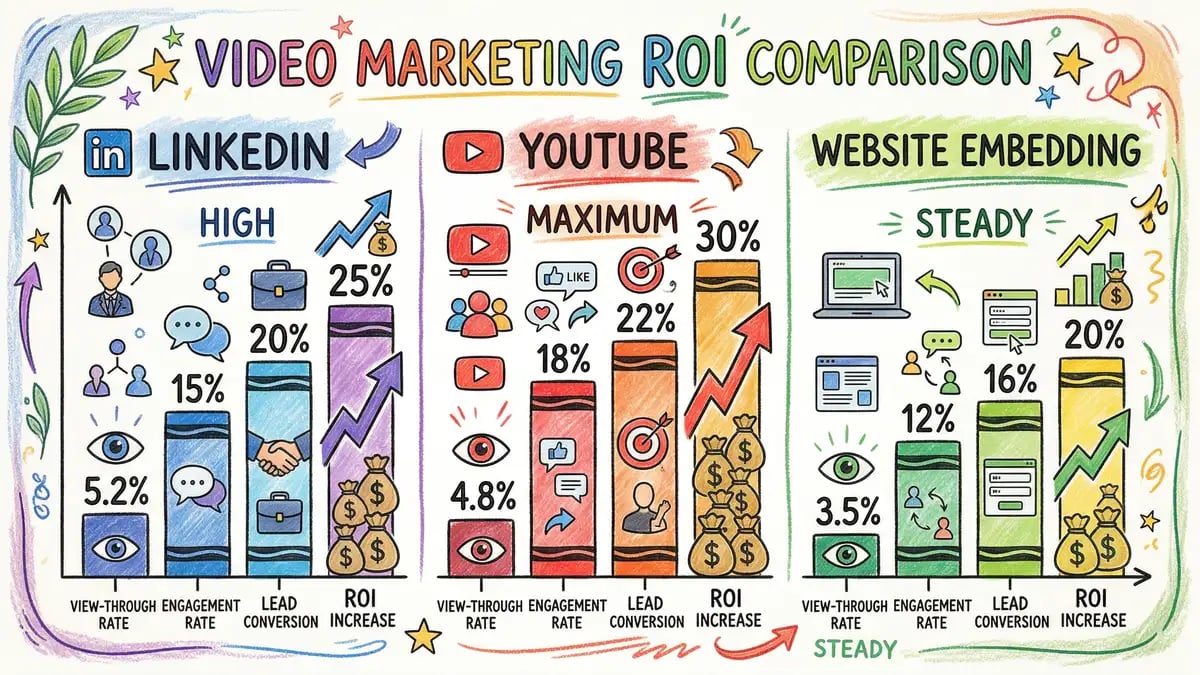
Different platforms deliver different results for B2B video content. Understanding where your audience engages and which formats perform best is critical to maximising ROI. The three dominant platforms—LinkedIn, YouTube, and your own website—each have distinct performance characteristics and optimal content strategies.
LinkedIn Performance
LinkedIn continues to dominate for B2B video engagement. According to Socialinsider's LinkedIn benchmarks, video content achieves an average engagement rate of 5.60% on the platform—significantly higher than static posts. For accounts with 5,000–10,000 followers, video posts achieve a 26% view rate, demonstrating that LinkedIn's algorithm actively promotes video content.
Video length matters considerably on LinkedIn. Videos under 30 seconds show 200% higher completion rates compared to longer formats, though educational content between 60–90 seconds also performs well. Native LinkedIn videos (uploaded directly rather than linked) outperform YouTube links by 5x, making native uploads essential for LinkedIn strategy.
YouTube Performance
YouTube remains the research platform for B2B buyers. 90% of B2B marketers use YouTube for video distribution, and 51% of B2B buyers research on the platform before making purchase decisions. The platform's search functionality and recommendation algorithm make it ideal for long-form educational content.
For B2B content, the optimal video length is 5–10 minutes. This duration allows sufficient depth to cover complex topics while maintaining viewer attention. Videos in this range generate higher watch time, more comments, and better shareability than shorter formats. YouTube's analytics also provide rich data on viewer retention, enabling continuous optimisation of content structure and pacing.
Website Video Performance
Video on your own website drives immediate, measurable business outcomes. Research shows that adding video to landing pages improves conversion rates by 80–86%. Product demo videos and customer testimonials are particularly effective, with homepage video viewers showing 97% higher conversion rates than non-viewers.
| Platform | Engagement Rate | Optimal Length | Key Metric |
|---|---|---|---|
| 5.60% | <30 sec | 26% view rate (5k–10k followers) | |
| YouTube | 3.80% | 5–10 min | 51% of B2B buyers research here |
| Website | N/A | 1–3 min | 80–86% conversion lift |
Source: Socialinsider LinkedIn Benchmarks 2026, HubSpot Marketing Statistics 2026, Wistia Video Marketing Data 2025
Video Length & Engagement Benchmarks

Content consumption patterns have shifted dramatically. The average B2B video length has compressed from 168 seconds in 2024 to just 76 seconds in 2026. This reflects both platform algorithm changes and viewer behaviour—busy professionals increasingly prefer concise, high-value content over lengthy explanations. However, optimal length varies significantly by content type and distribution channel.
The relationship between video length and completion rate is non-linear. Short videos (under 30 seconds) achieve the highest completion rates but may lack depth for complex product explanations. Mid-length videos (60–90 seconds) balance engagement with substantive content, making them ideal for most B2B use cases. Longer videos (5–10 minutes) work well for tutorials, case studies, and product demos on dedicated platforms like YouTube.
| Content Type | Optimal Length | Avg Completion Rate | Best Platform | Expected Engagement |
|---|---|---|---|---|
| Product Demo | 2–4 min | 78% | Website | High (80%+ conversion lift) |
| Educational | 5–8 min | 72% | YouTube | High (subscribers, shares) |
| Social Clip | <30 sec | 88% | Very High (200% lift) | |
| Case Study | 8–12 min | 65% | YouTube | High (lead quality) |
| Lead Gen Long-Form | 30+ min | 42% | Gated Page | Very High (65% conversion) |
Long-form video deserves special attention. While completion rates drop significantly for videos exceeding 30 minutes, the quality of leads generated is exceptional. Long-form content (30+ minutes) achieves 65% conversion rates for lead generation campaigns, often outpacing shorter content because viewers self-select for genuine interest.
Source: HubSpot Marketing Statistics 2026, Wistia Video Engagement Research 2025
Integrate Video Into Your Complete Marketing Strategy
Video performance depends on integration with broader marketing systems. When paired with SEO, email, and paid advertising, video accelerates results across every channel. Our video marketing services combine production, optimisation, and analytics to maximise ROI from day one.
Explore Our Video Marketing ServicesWebinar Performance Benchmarks 2026
Webinars remain one of the highest-ROI video formats for B2B marketing. Unlike passive video content, webinars create synchronous engagement, build relationships, and generate qualified leads at scale. The 2026 benchmarks show sustained strength in the webinar channel despite the proliferation of on-demand alternatives.
According to ON24's comprehensive 2025 Webinar Benchmarks Report, the average webinar achieves a 57% registration-to-attendance conversion rate. This means that for every 100 registrants, 57 actually attend the live event—a significantly higher completion rate than most digital initiatives.
Average live webinar attendance sits at 216 attendees, with a year-over-year growth of 7%. This growth is driven by improving production quality, better topic selection, and more targeted promotion. Importantly, on-demand viewing extends the value of each webinar: 40% of total webinar views occur on-demand after the live event, effectively doubling the reach of your investment.
Lead quality from webinars is exceptional. 47% of webinar attendees become qualified leads, with 5–20% ultimately converting to paying customers. This conversion range reflects variation in offer quality and sales follow-up, but even at the conservative 5% end, webinar ROI typically exceeds other content formats by 3–5x.
Source: ON24 Webinar Benchmarks Report 2025
AI in Video Production — The 2026 Reality

Artificial intelligence is transforming video production from ideation through distribution. The adoption curve for AI in video creation has accelerated dramatically: 41% of video creators now use AI tools in their production workflow, compared to just 18% in 2024—a 128% increase in two years.
Specific applications are leading adoption. AI-generated captions and subtitles are used by 60%+ of producers, addressing both accessibility and the reality that 92% of video viewers watch without sound. Script writing assistance ranks second at 49.8%, helping teams overcome writer's block and accelerate production timelines. Thumbnail generation (38%) and background removal (35%) handle technical tasks that previously required skilled operators or manual work.
The cost implications are dramatic. AI-assisted video production reduces total production costs by an average of 70%, with even more substantial savings for localisation tasks (80% reduction). These savings unlock video production for smaller budgets, democratising high-quality output. One of the most striking trends is the growth of AI avatars, which have seen 12x usage growth year-over-year, creating synthetic presenters who can deliver consistent, on-brand messaging across hundreds of videos.
However, AI adoption comes with caution. While automation saves costs and time, audiences still prefer authenticity and human connection in certain contexts—particularly testimonials, thought leadership, and relationship-building content. The optimal strategy combines AI for efficiency (captions, backgrounds, thumbnails, script enhancement) with human creativity and expertise in content strategy and on-camera presence.
Source: Video Creator AI Adoption Study 2026, Descript AI Report 2025

Measuring Video ROI and Attribution
The most compelling video marketing statistic is also the simplest: 93% of marketers report that video marketing generated positive ROI for their organisation. This isn't marginal improvement—it's overwhelming consensus that video delivers measurable business value.
Breaking down this ROI by business outcome reveals the breadth of video's impact:
- 82–88% increased traffic or enquiries: Video content attracts more visitors and generates more inbound requests, whether through search rankings, social shares, or email click-through.
- 82–88% increased leads or conversions: Video accelerates the decision-making process, particularly for complex B2B solutions.
- 57–62% reduced customer support queries: Product videos and FAQ content answer common questions before customers reach your support team, improving efficiency.
- 77% improved sales effectiveness: Sales teams equipped with product videos and customer case studies close deals faster and at higher average values.
Attribution and measurement require proper tooling. HubSpot CRM, when paired with video analytics platforms, allows revenue attribution to specific videos, forms, and campaigns. This enables you to identify which videos drive the highest-value customers, optimise investment accordingly, and prove video ROI to stakeholders using their language: pipeline generated, revenue influenced, and cost per acquisition.
Source: HubSpot Marketing Statistics 2026, Wyzowl Video Marketing ROI Study 2025
UK Video Market Data
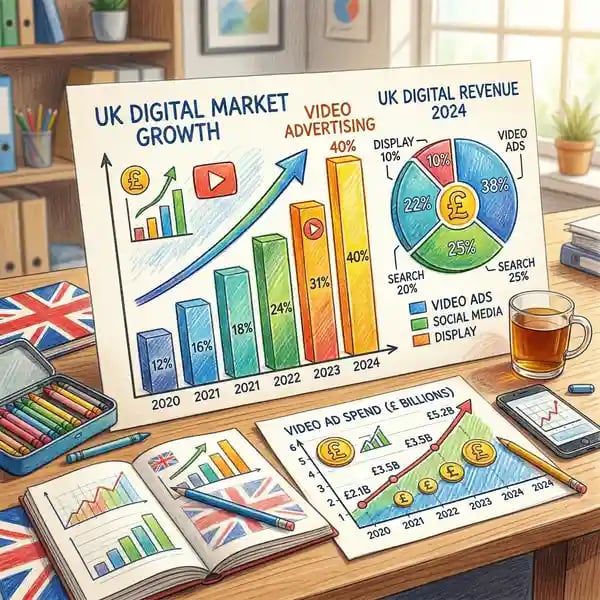
The United Kingdom represents a mature, competitive video advertising market. According to IAB UK market analysis, video advertising spend reached £8.3 billion in 2026, representing 20% year-over-year growth. This positions video advertising as approximately 23% of the UK's total digital advertising budget of £35.5 billion.
Platform penetration in the UK is exceptionally high:
- LinkedIn: 45 million UK members, with strong engagement from professionals and decision-makers across all industries.
- YouTube: 54.8 million UK users, making it a near-universal research platform.
- TikTok & Instagram Reels: Increasingly important for B2B campaigns targeting younger decision-makers and early adopters.
- Facebook Video: Continued relevance for demographic targeting and retargeting campaigns.
Device and viewing context also differ in the UK market compared to global averages. 87% of B2B videos in the UK are watched on desktop devices, reflecting professional environments and serious purchase intent. Mobile viewing is less dominant in B2B contexts, though mobile optimisation remains essential for B2C and awareness-stage content.
Audio is a critical consideration. 92% of video viewers watch with sound off, making captions and on-screen text essential. Yet paradoxically, 50% of viewers use captions even when watching with sound enabled, suggesting captions serve both accessibility and comprehension purposes. This reinforces the importance of burned-in captions, bright, readable text overlays, and high-contrast design.
Source: IAB UK, HubSpot Video Marketing Statistics 2026
Frequently Asked Questions
What percentage of B2B buyers prefer video content?
96% of B2B buyers prefer video content when learning about products and services. This preference is consistent across industries and buyer personas, making video an essential component of any B2B marketing strategy. Video allows complex concepts to be explained clearly and builds trust through demonstration.
What's the ideal length for B2B marketing videos?
Ideal length varies by platform and content type. LinkedIn performs best with videos under 30 seconds (200% higher completion). YouTube content optimally runs 5–10 minutes for educational material. Website videos (product demos, landing page) perform best at 1–3 minutes. For lead generation webinars and long-form content, 30+ minutes can achieve 65% conversion rates. Match length to context and purpose rather than aiming for a universal duration.
What's a good webinar attendance rate?
The average B2B webinar achieves a 57% registration-to-attendance conversion rate, meaning 57 out of every 100 registrants actually attend the live event. This is an exceptionally strong benchmark compared to other digital marketing initiatives. Additionally, 40% of webinar value comes from on-demand views after the live event, effectively extending reach and ROI beyond the live broadcast.
How much does B2B video marketing cost?
Costs vary widely depending on production quality and approach. Budget videos (using AI tools and templates) can start at £500–£2,000 per video. Professional production (scriptwriting, cinematography, editing) typically ranges £5,000–£15,000. High-end productions (multi-day shoots, full crew, colour grading) can exceed £25,000. However, AI-assisted production reduces costs by 70% on average, making professional-quality video accessible to smaller budgets. The key metric is ROI: videos that generate qualified leads or drive conversions justify investment regardless of upfront cost.
Does video really improve conversion rates?
Yes, substantially. Adding video to landing pages improves conversion rates by 80–86%. Product demo videos increase homepage conversion by 97%. Video testimonials and case studies build trust and reduce purchase friction. 93% of marketers report positive ROI from video. However, results depend on video quality, relevance, and strategic placement. Poorly produced or misaligned content underperforms. The most successful approach integrates video into a broader marketing strategy aligned with buyer journey stages, platform dynamics, and clear CTAs.
Ready to Transform Your B2B Marketing With Video?
The data is clear: video marketing drives measurable ROI, accelerates sales cycles, and builds brand authority. From strategy and production through analytics and optimisation, our integrated approach ensures every video works for your business goals. Whether you're launching your first campaign or scaling existing efforts, we provide the expertise and tools to succeed.
Related Resources
Explore our comprehensive video marketing knowledge base:
- B2B Video Marketing Guide — Complete strategy framework and platform playbooks
- Video Marketing SEO Guide — Optimise video content for search visibility and organic traffic
- YouTube Video Marketing Guide — Master YouTube strategy, ranking factors, and growth tactics
- Video Sales Strategy — Use video to shorten sales cycles and increase deal size
- Brand Engagement Through Video — Build authentic customer relationships and loyalty
- Video Across the Marketing Funnel — Strategic video deployment across awareness, consideration, and decision stages
Clwyd Probert
CEO & Founder, Whitehat SEO
Clwyd founded Whitehat SEO to help ambitious B2B brands dominate their markets through integrated video, content, and digital strategy. With expertise spanning video production, SEO, and revenue attribution, Clwyd leads a team obsessed with delivering measurable marketing outcomes. His analysis of video marketing trends shapes strategy for agencies and enterprises across the UK.
References & Sources
- Wyzowl: State of Video 2026 Report — Annual survey of 1,000+ businesses on video adoption, ROI, and strategy
- HubSpot Marketing Statistics 2026 — Comprehensive marketing benchmarks including video engagement and conversion data
- Wistia Video Marketing Statistics 2025 — Engagement metrics and viewing behaviour across platforms
- Socialinsider LinkedIn Benchmarks 2026 — Platform performance data including engagement rates and video metrics
- ON24 Webinar Benchmarks Report 2025 — Comprehensive webinar performance data, attendance, and conversion metrics
- IAB UK — UK digital advertising market size and video ad spend analysis
- HubSpot Blog: Video Marketing Statistics — Curated video metrics, platform insights, and strategic recommendations