
HubSpot is the number-one marketing automation platform globally with 38% market share, ~289,000 customers, and five consecutive years as a Gartner Magic Quadrant Leader for B2B Marketing Automation. Approximately 3,207 UK companies use HubSpot CRM — making the UK the second-largest market after the US. Inbound leads close at roughly 14.6% versus 1.7% for outbound, generate 3× more leads at 62% lower cost, and HubSpot users report 505% ROI over three years with break-even at approximately four months. This playbook from Whitehat SEO, a HubSpot Diamond Solutions Partner, covers inbound strategy, the six-hub platform architecture, Breeze AI capabilities, lead generation and nurturing, sales-marketing alignment, reporting and ROI measurement, UK GBP pricing, and implementation — with honest assessments of where HubSpot falls short.
The State of Inbound Marketing for UK B2B in 2026
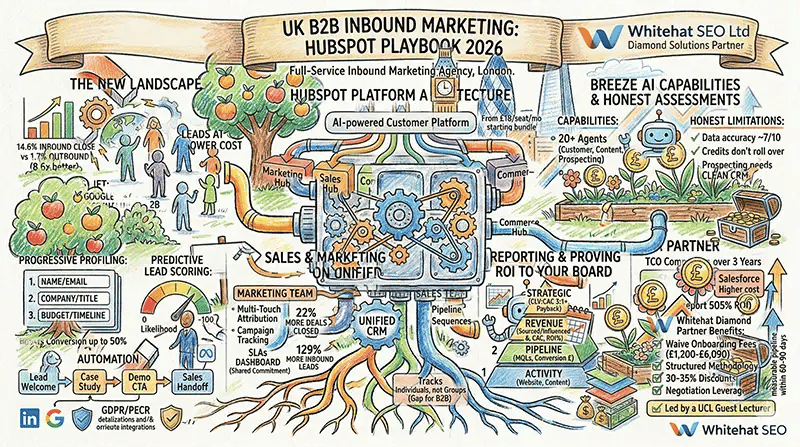
Inbound marketing remains the highest-ROI channel for B2B, but the playbook has fundamentally changed. Websites, blogs, and SEO remain the number-one ROI-generating channel according to HubSpot's 2026 State of Marketing Report (1,500+ marketers). Inbound leads close at roughly 8.6× the rate of pure outbound (14.6% vs 1.7%), and inbound generates three times more leads at approximately 62% lower cost per lead. Yet the landscape is being reshaped: 50% of Google searches now include an AI Overview, 94% of B2B buyers used LLMs during their purchasing journey in 2025, and AI search has become the primary starting point for B2B vendor discovery.
UK marketing budgets ended 2025 on a net balance of 0.0% — flat — with the 2026/27 outlook at just +1.7%, one of the weakest in the IPA Bellwether's 25-year history. Globally, marketing budgets stand at 7.7% of company revenue (Gartner, 402 CMOs including UK), flat from 2024 and well below the pre-pandemic 9.5% peak. The top challenge facing UK B2B marketers: 39% cite pressure to deliver short-term results over long-term growth (Anteriad UK). Despite this, 78% of top-performing B2B tech firms now blend inbound and outbound approaches, slashing customer acquisition costs by 40%.
14.6%
Inbound close rate vs 1.7% outbound
7.7%
Average B2B marketing budget (% of revenue)
3,207
UK companies using HubSpot CRM (6sense)
HubSpot's Six-Hub Architecture and Breeze AI
HubSpot positions itself as an AI-powered Customer Platform consisting of six premium hubs, a Smart CRM (the unifying data layer), and Breeze AI (the intelligence layer). HubSpot closed FY2025 with $3.13 billion in revenue (+19% YoY), approximately 289,000 customers (+16% YoY), and has been named a Gartner Magic Quadrant Leader for five consecutive years. In the broader CRM market, HubSpot holds ~5.3–5.6% versus Salesforce's ~21–22.5% — its strength is concentrated in SMB and mid-market, where ease of use (92% user satisfaction rate) is the primary differentiator.
Marketing Hub
Email automation, lead scoring, Journey Automation, forms, landing pages, social media, SEO topic clusters, ABM tools, multi-touch attribution. From £18/seat/mo.
Sales Hub
Sales Workspace, pipeline management, email sequences, meeting scheduling with AI notetaker, playbooks, forecasting, conversation intelligence. From £18/seat/mo.
Content Hub
Website and blog builder, Content Remix (repurpose one asset into many), Brand Voice AI, podcast hosting, smart personalisation, membership content. From £18/seat/mo.
Data Hub + Service + Commerce
Data Studio (AI-powered analytics), Help Desk and Customer Success workspaces, ticketing, NPS/CES/CSAT surveys, AI-powered quotes (CPQ), invoicing, Stripe payments. From £18/seat/mo each.
Breeze AI: Genuine Capability With Honest Limitations
Breeze AI launched at INBOUND 2024, expanded with 20+ agents at INBOUND 2025, and upgraded to GPT-5 in January 2026. The Breeze Assistant drafts emails, summarises deals, prepares meeting briefs, and answers natural language queries about CRM data. Breeze Agents include Customer Agent (resolves 50%+ support tickets automatically), Prospecting Agent (researches accounts, crafts personalised outreach), Content Agent (generates blog posts, landing pages, case studies), and the new Closing Agent (answers buyer questions 24/7). Breeze Intelligence (powered by Clearbit) provides contact and company enrichment from 200M+ profiles. However, long-form content quality requires significant human editing, data accuracy scores approximately 7/10 per independent review, UK/European data quality may lag behind US coverage, and credits at £0.01 each do not roll over monthly. The Prospecting Agent is only truly effective if your CRM is exceptionally clean and well-tagged.
Lead Generation, Scoring, and Nurturing
HubSpot's lead generation engine centres on progressive profiling, predictive scoring, and workflow automation. Progressive profiling (Professional+) replaces already-answered form fields with new questions on return visits — a typical B2B sequence captures name and email on visit one, company and job title on visit two, then budget and timeline on visit three, improving conversion rates by up to 50%. Predictive lead scoring uses machine learning to analyse historical closed-won versus closed-lost deals, generating a 0–100 "Likelihood to Close" percentage that self-optimises as new deals close. It requires a minimum of ~100 customers and ~1,000 non-customers for accurate predictions.
Full workflow automation (Professional or Enterprise) powers sophisticated B2B nurture sequences: new lead welcome series with educational content escalating to case studies and demo CTAs, automated MQL-to-SQL handoff with internal notifications and task creation, re-engagement sequences for contacts inactive 30+ days, and lifecycle stage automation progressing contacts from Subscriber through Lead, MQL, SQL, Opportunity, to Customer based on score thresholds and sales rep actions. HubSpot integrates with LinkedIn Ads (lead gen form sync, audience creation, deal-level attribution), Google Ads (keyword-level conversion tracking), and Meta Ads (lead ad sync with 90-day historical data). For UK marketers, GDPR compliance tools are built in: consent management with lawful basis tracking, customisable cookie banners, GDPR delete function, and marketing versus non-marketing contact categorisation. PECR rules require specific prior consent for individual subscribers, though corporate subscribers (limited companies, LLPs) can be emailed without consent provided an opt-out is offered.
Sales and Marketing Alignment on a Unified CRM
When sales and marketing are fully aligned, 80% of teams reach their revenue goals — a 60% increase versus unaligned teams (Pipeline360). Yet only 8% of companies have truly strong alignment. HubSpot's unified CRM means sales and marketing share one database, one contact record, and one timeline — companies using it close 22% more deals and report 129% more inbound leads. The practical impact versus separate tools (for example, marketing on HubSpot with sales on Salesforce) is elimination of data discrepancies, duplicate records, and broken handoff processes. HubSpot versus Salesforce is ultimately a question of ease-of-use versus enterprise customisation depth.
HubSpot's lifecycle stages — Subscriber → Lead → MQL → SQL → Opportunity → Customer → Evangelist — now support custom stages. Lead handoff is automated through workflows: contacts matching MQL criteria trigger lifecycle stage updates, internal sales notifications, task creation, and assignment. SLAs define mutual commitments (marketing delivers X qualified leads per month; sales contacts each within 24 hours) with dashboards tracking compliance. Revenue attribution is available at three levels: Contact Create Attribution (Professional+), Deal Create Attribution (Enterprise only), and Revenue Attribution (Enterprise only), with nine multi-touch models. The critical limitation for B2B: attribution tracks individual contacts, not buying groups — a significant gap when the average purchase involves 10–13 stakeholders.
Reporting, Analytics, and Proving ROI to Your Board
HubSpot's reporting is genuinely strong for a unified platform — non-technical marketers can build dashboards without SQL or developer support. Dashboard limits scale with tier (Free: 10, Starter: 30, Professional: 75, Enterprise: 100), each holding up to 50 reports. Cross-object reports combining contacts with deals require Professional+, while customer journey reports and revenue attribution require Enterprise (£3,000+/mo for Marketing Hub). AI-powered report generation lets you describe the report you need in natural language and HubSpot builds it. Breeze Intelligence enriches data from 200M+ profiles with firmographic, demographic, and technographic attributes starting from ~£24/month — though ZoomInfo's larger database (500M+ contacts) and phone-verified mobile numbers win for companies needing deeper intelligence, at a fundamentally different price point ($25,000+/year).
Proving Marketing ROI to a UK B2B Board
Tier 1 — Activity (monthly, internal): Website sessions by source, content performance, email engagement, social reach. Shows the marketing machine is running.
Tier 2 — Pipeline (monthly, leadership): MQLs generated, MQL-to-SQL conversion rate, marketing-sourced pipeline value (£), cost per lead by channel. Shows marketing is feeding sales.
Tier 3 — Revenue (quarterly, board): Marketing-sourced revenue (£), marketing-influenced revenue (£), customer acquisition cost, marketing ROI = (revenue − cost) ÷ cost. Ties marketing directly to commercial results.
Tier 4 — Strategic (quarterly/annually): CLV:CAC ratio (target 3:1+), payback period, pipeline velocity, share of search, direct traffic growth. Demonstrates long-term strategic value.
Where HubSpot's native reporting falls short: no multi-source data blending (cannot combine CRM data with GA4, ad spend, and finance data in one report), no SQL access, 40-minute to 2-hour data refresh lag, limited historical snapshots, and rules-based attribution only — no algorithmic, incrementality, or marketing mix modelling. Layer Looker Studio or Power BI on top for board-level reporting, budgeting £30–100/month for connector middleware (Supermetrics, Coupler.io).
UK Costs, Implementation, and Diamond Partner Value
The Starter Customer Platform bundles all six hubs for just £18/seat/month — effectively a no-brainer for growing UK B2B companies. Full HubSpot pricing in GBP scales significantly at Professional and Enterprise tiers. Marketing Hub Professional starts at £780/month (3 core seats, 2,000 contacts), while Enterprise reaches £3,000/month (5 core seats, 10,000 contacts). A critical pricing rule: if you have a mix of tiers, all Core Seats are priced at the highest tier level — mixing Marketing Hub Professional with Sales Hub Enterprise means every core seat costs £60/month, not £40/month.
| Scenario | Year 1 | 3-Year Total | Includes |
|---|---|---|---|
| SMB (50–100 employees) | ~£45K–£49K | ~£119K–£123K | Sales + Marketing Hub Pro, 8 users, partner implementation + retainer |
| Mid-Market (100–500 employees) | ~£105K–£114K | ~£284K–£293K | Sales + Marketing + Service Hub Pro, 25 users, complex implementation + retainer |
| Salesforce equivalent (50 users) | — | £497K–£1,019K | Includes mandatory dedicated admin (£35K–£55K/yr salary) |
All prices exclude 20% UK VAT. ~5% annual renewal uplift on Professional/Enterprise. Onboarding fees waived via Solutions Partner. Verified February 2026 via Whitehat SEO Diamond Partner portal.
DIY implementation is cheapest on paper but requires 200–400 hours of internal effort, takes 3–6 months versus 45–60 days with a partner, and carries significant risk — 55% of CRM implementations fail overall. Partner-led implementations close 3× more deals, generate 53% more inbound leads, and complete 20–40% faster (sample: 12,264 customers). A Diamond Solutions Partner waives mandatory onboarding fees (saving £1,200–£6,090 per hub), typically negotiates 30–35% below list prices, and provides structured methodology. Only ~164 partners globally hold Diamond status — fewer than 3% of all partners. HubSpot users report 505% ROI over three years with break-even at approximately four months, though this represents an average across optimised implementations. UK B2B companies should target a minimum 5:1 return over three years, with measurable pipeline impact emerging within 60–90 days. For maximum negotiation leverage: purchase through a Solutions Partner, time purchases for quarter-end (December yields strongest discounts), and consider multi-year commitments saving 10–20%. SEO package pricing should be budgeted alongside HubSpot, as the platform's native SEO tools are adequate for planning but not a replacement for specialist SEO services.
Where HubSpot Falls Short: An Honest Assessment
No platform does everything well, and a Diamond Partner that won't tell you HubSpot's limitations isn't acting in your interest. Enterprise-grade reporting does not compete with Tableau or Power BI for complex multi-source analysis. ABM capabilities are serviceable but surface-level compared to Demandbase or 6sense, which offer deeper intent data across the broader web. SEO tools cover content planning and basic on-page optimisation but lack the keyword research depth, backlink analysis, rank tracking, technical audit, and competitor analysis of Ahrefs, Semrush, or Screaming Frog. Revenue attribution requires Enterprise at £3,000+/month, pricing out many mid-market companies from the reporting they most need. And the scalability ceiling is real — enterprise-tier companies with 500+ employees and complex multi-entity structures may find Salesforce more flexible, though at significantly higher cost. HubSpot excels as an exceptional unified platform for UK B2B companies in the SMB-to-mid-market range, with specialist tools and expert partners filling the gaps in AI search optimisation, advanced analytics, and enterprise ABM.
Frequently Asked Questions
How much does HubSpot cost for UK B2B companies?
The Starter Customer Platform bundles all six hubs for £18/seat/month (excluding VAT). Marketing Hub Professional starts at £780/month (3 core seats, 2,000 contacts), while Enterprise reaches £3,000/month. Total cost of ownership for a typical UK SMB (50–100 employees) is approximately £119,000–£123,000 over three years including partner implementation and retainer. HubSpot costs 30–60% less than Salesforce for companies under 200 employees. Purchasing through a Diamond Solutions Partner waives mandatory onboarding fees and secures 30–35% below list prices.
Is HubSpot better than Salesforce for UK B2B?
It depends on your size and complexity. HubSpot excels for SMB and mid-market UK B2B companies (under 500 employees) with its unified CRM, ease of use (92% satisfaction rate), lower total cost, and faster implementation. Salesforce offers deeper enterprise customisation, stronger ABM ecosystem, and greater scalability for complex multi-entity structures — but at 2–3× the cost and significantly higher implementation complexity. Our full HubSpot versus Salesforce comparison covers pricing, features, and decision criteria in detail.
What ROI should UK B2B companies expect from HubSpot?
HubSpot's official data reports 505% ROI over three years with break-even at approximately four months. After 12 months, users report a 129% increase in inbound leads and 26% reduction in lead acquisition costs. However, these are averages across optimised implementations — given that 55% of CRM implementations fail overall, the gap between well-executed and poorly-executed deployments is enormous. Target a minimum 5:1 return over three years, with measurable pipeline impact emerging within 60–90 days.
Do I need a HubSpot partner or can I implement it myself?
DIY implementation is possible but carries significant risk. It requires 200–400 hours of internal effort, takes 3–6 months versus 45–60 days with a partner, and 55% of CRM implementations fail overall. Partner-led implementations close 3× more deals, generate 53% more inbound leads, and complete 20–40% faster. A Solutions Partner also waives mandatory onboarding fees (saving £1,200–£6,090 per hub) and typically negotiates 30–35% below list subscription rates — often making the partner route cost-neutral or even cheaper than DIY.
Is HubSpot GDPR-compliant for UK marketing?
HubSpot provides comprehensive GDPR tools: consent management with lawful basis tracking, customisable cookie consent banners, GDPR delete function (right to be forgotten), audit logs, and marketing versus non-marketing contact categorisation. EU data residency is available via a Frankfurt data centre. However, compliance is a shared responsibility — organisations must correctly configure settings, establish internal governance, and consult legal counsel. For UK email marketing specifically, PECR rules require consent for individual subscribers but allow corporate subscriber outreach without prior consent, provided opt-out mechanisms are included.
Ready to Get More From HubSpot?
As a HubSpot Diamond Solutions Partner, Whitehat SEO helps UK B2B companies implement, optimise, and integrate HubSpot with specialist SEO and AEO services. Request a free audit to see where your setup can improve.
Request Your Free HubSpot AuditRelated HubSpot & Marketing Guides HubSpot onboarding professional website design view our pricing HubSpot CRM UK guide HubSpot UK pricing guide HubSpot vs Salesforce what inbound marketing is
- HubSpot CRM: The Complete UK Guide — Everything you need to know about HubSpot CRM
- HubSpot Pricing UK — Full GBP pricing breakdown with TCO scenarios
- HubSpot vs Salesforce — The real comparison for UK B2B companies
- SEO Services — Specialist SEO alongside your HubSpot investment
- Answer Engine Optimisation — Get cited by ChatGPT, Perplexity, and Google AI