
Video Marketing | Demand Generation
B2B Webinar Marketing Strategy: The Complete UK Guide for 2026
By Clwyd Probert | |
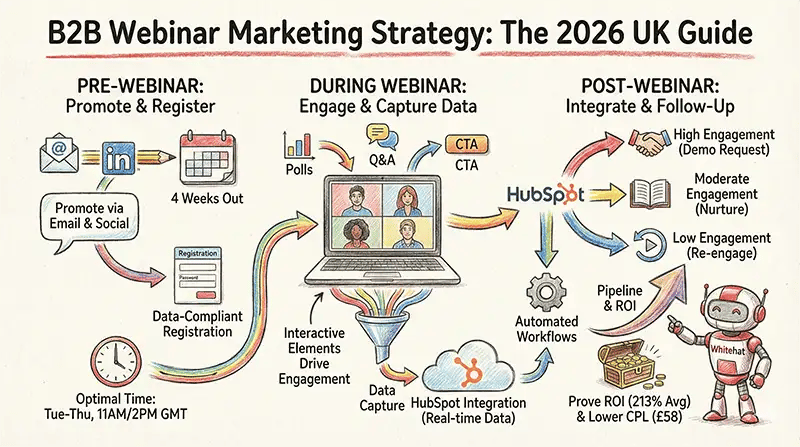
An effective B2B webinar marketing strategy combines educational content with integrated CRM tracking to generate qualified leads and prove marketing ROI. According to ON24's 2025 benchmark report, webinars achieve an average 213% ROI with cost-per-lead of £58—significantly lower than LinkedIn Ads (£340) or trade shows (£680). The key is connecting webinar engagement data directly to your sales pipeline through platforms like HubSpot.
Why B2B Webinars Remain Essential in 2026
Webinars have evolved from pandemic necessity to strategic demand generation channel. Goldcast's 2025 B2B Webinar Benchmark Report, analysing 19,531 webinars across 418 brands, found average attendance reached 216 participants per session—a 7% year-over-year increase. More importantly, 78% of marketers report webinars lower their overall cost-per-lead compared to other channels.
For UK B2B marketing professionals, webinars solve a persistent challenge: demonstrating marketing's contribution to revenue. Unlike blog posts or social content, webinars generate first-party engagement data—who attended, how long they stayed, what questions they asked, which resources they downloaded. When this data flows into your CRM through proper marketing services integration, you can trace pipeline influence directly to specific events.
The shift toward AI-assisted research has made webinars more valuable, not less. While buyers increasingly use ChatGPT and Perplexity for initial research, they still need deep-dive content for complex purchase decisions. Webinars provide the expert perspective and interactive Q&A that AI cannot replicate—and attendees arrive with higher purchase intent than typical organic traffic.
B2B Webinar Benchmarks You Should Target
Understanding current benchmarks helps you set realistic goals and identify improvement opportunities. ON24's 2025 Digital Engagement Benchmarks Report provides the most comprehensive industry data, analysing millions of B2B interactions across their platform.
Key Webinar Benchmarks (2025 Data)
| Metric | Benchmark | Source |
|---|---|---|
| Registration-to-Attendance | 40-57% | ON24/Goldcast |
| Attendee-to-Lead Conversion | 20-40% | ON24 |
| Average Watch Time (Live) | 51 minutes | ON24 |
| Average Cost-Per-Lead | £58 | Industry Average |
| CTA Conversion Rate | 22% (avg), 69% (high-engagement) | ON24 |
Smaller webinars often outperform larger events. Webinars with under 100 registrants achieve 43% attendance rates—10.3% higher than larger events. This suggests focusing on targeted, persona-specific topics rather than broad awareness webinars, particularly when building your content marketing strategy.
Optimal Timing for UK B2B Webinars
Timing significantly impacts webinar attendance. For UK-based B2B companies, ON24's benchmark data reveals clear patterns that should inform your scheduling decisions.
Wednesday generates the highest attendance rates at approximately 48%, followed closely by Thursday. The Tuesday-through-Thursday block captures 76% of successful webinars. Mondays suffer from catch-up fatigue whilst Fridays see weekend mindset decline—though Goldcast's 2025 data found technology companies actually perform well with Friday lunchtime sessions.
For UK-only audiences, target 11:00 AM or 2:00 PM GMT. The late morning slot catches professionals after their first meetings but before lunch. The afternoon slot works well for decision-makers who've cleared morning priorities. If you're reaching European audiences, 2:00 PM GMT (5:00 PM Berlin time) captures both regions effectively.
For global reach, particularly including North American prospects, 4:00 PM GMT equals 11:00 AM Eastern Time—the highest-attendance slot in ON24's data with 82% attendance rates. This timing works for UK participants ending their workday whilst catching Americans mid-morning.
Seasonal patterns matter too. January (50% attendance), April, September, and November represent peak months for B2B webinar engagement. Avoid launching new webinar series during summer months or the Christmas period when decision-maker availability drops significantly.
HubSpot Integration: Connecting Webinars to Pipeline
The difference between webinars that generate leads and webinars that generate revenue lies in CRM integration. Without proper data flow, you're collecting registration forms but losing the engagement intelligence that enables sales follow-up and attribution reporting.
For HubSpot users, platform selection should prioritise integration depth. Contrast leads HubSpot Marketplace ratings at 4.9 stars, purpose-built for HubSpot with 21 data points syncing including registration, attendance, replay views, watch time, UTM parameters, poll responses, and engagement scores. Univid achieves a perfect 5.0-star HubSpot rating with similarly deep engagement data synchronisation.
ON24 offers enterprise-grade integration with 85+ field mapping capabilities, timeline events, and engagement scoring—though custom objects require HubSpot Enterprise tier. GoToWebinar provides reliable long-standing integration with registration, attendance status, and timeline events with approximately 5-minute sync times for new registrants.
Critical integration gaps exist that UK marketers should note: Zoom Webinars lacks native HubSpot integration, requiring Zapier with frequent disconnection issues. Webex discontinued its HubSpot integration in July 2024. If your organisation mandates these platforms, factor in the manual data management overhead or consider HubSpot onboarding support to implement workarounds.
The essential integration capabilities to prioritise include two-way data sync, HubSpot forms support for registration, engagement data synchronisation (not just attendance), Marketing Events object support, and workflow triggers for automated follow-up sequences.
AI-Powered Webinar Marketing: The 2026 Advantage
ON24's 2025 report reveals that 87% of B2B marketers now use or test AI in their webinar workflows, with 98% planning to enhance webinars with AI capabilities. This isn't future speculation—it's current competitive reality.
The impact data is striking: B2B marketers using AI are 7X more likely to hit their marketing goals. Audience engagement with AI-generated content increased more than 7X year-over-year—far exceeding the 3X growth in AI content creation itself. This suggests audiences respond positively to AI-enhanced experiences when executed well.
Primary AI use cases driving results include promotional content generation (63% adoption), automated transcription (8X usage increase), content repurposing into blog posts, video clips, and social content, AI-powered chatbots for attendee Q&A, and personalisation that delivered a 4X increase in demo bookings.
AI repurposing saves significant time: Goldcast reports content repurposing efforts saved approximately 13,000 hours (roughly £520,000 at £40 per hour) in 2024 alone. For resource-constrained UK marketing teams, this represents substantial efficiency gains. Video clips created from webinars increased 2,903% year-over-year, whilst text assets grew 11,464%.
If you're exploring AI capabilities beyond webinars, Whitehat's AI consulting services help B2B companies implement AI strategically across their marketing operations.
Pre-Webinar Promotion and Post-Webinar Follow-Up
Registration timing data reveals 47% register more than one week in advance, 30% register within the final week, and 23% register on the day itself. This means your promotional strategy needs both early awareness and last-minute urgency tactics.
Email generates 57-70% of webinar registrations, making it your primary channel. The optimal email sequence spans 4-5 touchpoints: announcement at three weeks, speaker spotlight at two weeks, content preview at one week, urgency message at 1-2 days, and a day-of reminder with join link. Personalised subject lines increase open rates by 26%.
For social promotion, LinkedIn remains critical for B2B audiences—85% of B2B marketers report success with the platform. Feature speaker headshots (significantly improves conversion), share teaser video clips, and use countdown posts. Interestingly, using "webinar" in titles increased registrations by 66% with a 9% attendance boost—contradicting previous guidance to avoid the term.
Post-webinar follow-up timing is equally critical. Deploy thank-you emails with recording links within 24 hours. Send no-show sequences with separate messaging at 24-48 hours. Additional resources and survey requests follow at 3-5 days. Future webinar invitations and nurture content deploy at 1-2 weeks.
Segment follow-up by engagement level: direct demo offers for high-engagement attendees, educational nurture for moderate engagement, and re-engagement sequences for low engagement and replay-only viewers. This requires the HubSpot integration capabilities discussed earlier.
Interactive Elements That Drive Engagement and Conversion
Goldcast's 2025 data shows per-webinar averages of 177 chat messages, 30 questions, 22 poll submissions, 17 resource clicks, and 3.3 CTA clicks. High-engagement webinars generating 5-10 reactions per attendee achieve 69% CTA conversion—compared to 22% average.
Only 34% of webinars currently use polls, presenting a significant differentiation opportunity. Best practice places polls at opening for ice-breaking, every 10-15 minutes for attention maintenance, at midpoint for understanding checks, and at close for interest gauging and lead segmentation.
Q&A remains the most valued element—92% of attendees expect live Q&A and 82% cite it as the most interesting part of webinars. Dedicate 10-15 minutes specifically for Q&A, use moderators to manage questions, and allow question upvoting. Unanswered questions become valuable content for follow-up materials and future video marketing content.
Two CTAs active during a webinar achieve 25% conversion—slightly higher than single CTAs. Consider pairing a primary conversion CTA (demo request, consultation booking) with a softer secondary CTA (resource download, newsletter signup) to capture prospects at different buying stages.
UK Compliance Considerations for Webinar Registration
UK B2B marketers must ensure webinar registration processes comply with GDPR and UK data protection requirements. Non-compliance risks significant fines and reputational damage.
Registration form requirements include: explicit consent with no pre-ticked boxes, clear purpose disclosure explaining how data will be used, data minimisation collecting only necessary information, mandatory privacy policy links, and easily accessible right-to-withdraw consent mechanisms.
For non-essential cookies (analytics, tracking), explicit opt-in consent is required before cookies are placed. Most webinar platforms set cookies automatically—ensure your cookie consent mechanism covers these.
For B2B marketing follow-up post-webinar, legitimate interest can apply without explicit consent if notice is provided within 30 days, purpose and usage are explained clearly, and easy opt-out mechanisms exist. However, consent is required for sharing data with sponsors or partners and for marketing communications beyond event administration.
The UK ICO recommends email and event data retention of 12 months, with webinar transcripts typically retained for 7 years where business justification exists. Document your retention policies and ensure your webinar platform and CRM configurations reflect these timeframes.
Need Help Connecting Webinars to Revenue?
Whitehat helps UK B2B companies implement HubSpot properly—including webinar integration that connects engagement data to pipeline and proves marketing ROI.
Book a Discovery CallFrequently Asked Questions
What is the ideal length for a B2B webinar?
The optimal B2B webinar length is 45-60 minutes according to Goldcast's 2025 benchmark data. However, attendee preferences are shifting shorter: 44% prefer 45-minute sessions whilst 41% prefer 30 minutes. Average actual watch time is 29 minutes, so front-load your most valuable content in the first half.
Should I gate my webinar replay or make it freely available?
Gate the replay behind a registration form—on-demand viewers show higher focus rates (86.3% versus 74.2% for live) and making replays available can increase total views by up to 80%. The registration captures leads even if they missed the live event, whilst 45% of all webinar consumption now happens on-demand.
How many webinars should I run per month?
Quality matters more than quantity. Series webinars (26% of all webinars) generate 30% more registrants and achieve 38% attendance versus 33% for standalone events. Start with monthly webinars, measure engagement and pipeline impact, then scale based on results rather than arbitrary frequency targets.
What webinar format works best for B2B audiences?
Panel discussions generate highest engagement due to multiple perspectives—average webinars now feature 4 speakers. Educational presentations follow the 80/20 rule (80% educational, 20% promotional) and align with the 91% of B2B buyers who prefer webinars as a content format. Product demos perform best at 20-30 minutes for feature-focused sessions.
How do I measure webinar ROI in HubSpot?
Track webinar-sourced contacts through lifecycle stages to closed-won deals using HubSpot's attribution reporting. Key metrics include registrations, attendance rate, engagement score, MQLs generated, opportunities influenced, and revenue attributed. With proper integration, you can calculate true cost-per-acquisition and compare webinar performance against other channels.
References and Citations
- ON24 (2025). 2025 Digital Engagement Benchmarks Report. https://www.on24.com/blog/key-takeaways-from-the-2025-webinar-benchmarks-report/
- Goldcast (2025). The 2025 B2B Webinar Benchmark Report. https://www.goldcast.io/reports/b2b-webinar-benchmark-report-2025
- Contrast (2025). 56 Webinar Statistics You Need to Know. https://www.getcontrast.io/learn/webinar-statistics
- Airmeet (2024). Checklist for GDPR Compliance in Webinars. https://www.airmeet.com/hub/blog/checklist-for-gdpr-compliance-in-webinars-with-european-attendees/
- HubSpot Community (2024). Best Webinar Integration with HubSpot. https://community.hubspot.com/t5/Marketing-Integrations/What-s-the-best-webinar-integration-with-Hubspot/td-p/13362