
|
What Is Black Hat SEO? The 2026 UK Guide to Manipulation Risks
By Clwyd Probert, CEO & Founder at Whitehat SEO Ltd
Black hat SEO refers to manipulative tactics that violate search engine guidelines to artificially inflate rankings. These techniques—including keyword stuffing, link schemes, and AI-generated spam—risk severe penalties. Google's March 2024 update eliminated 45% of low-quality content from search results, with 837 websites deindexed. For UK businesses, black hat approaches represent an existential risk to organic visibility.
As a UK SEO agency (yes, our name gives away our position), we've spent over a decade helping B2B companies build sustainable organic visibility. This guide explains what black hat SEO looks like in 2026, why the consequences have never been more severe, and what ethical alternatives actually deliver better long-term results.
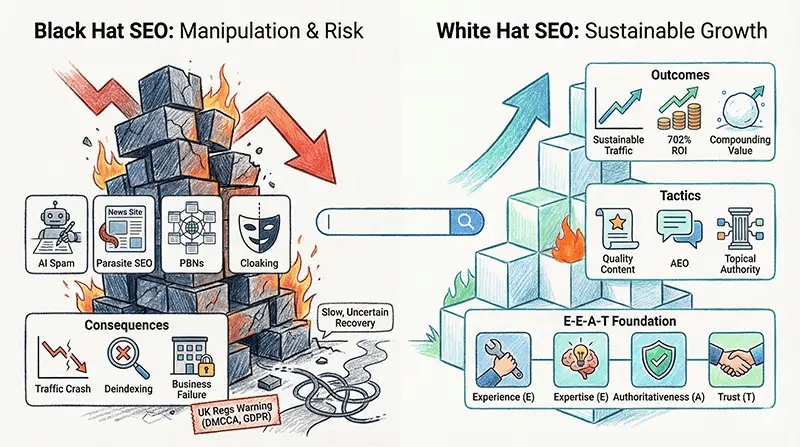
How does black hat SEO differ from white hat SEO?
The distinction comes down to intent and methods. White hat SEO focuses on creating genuine value for users—quality content, good user experience, and earning links through merit. Black hat SEO manipulates search algorithms to achieve rankings the content doesn't deserve.
Google's quality guidelines are explicit: sites cannot pay for rankings or use deceptive measures to appear more relevant than they are. When manipulation is detected, penalties range from ranking demotions to complete removal from search results. According to industry analysis, only 30% of penalised websites recover rankings within a year.
There's also "grey hat" territory—tactics that aren't explicitly banned but push ethical boundaries. Guest posting for links, for instance, sits in a grey area that becomes black hat when done at scale with manipulative anchor text.
Which black hat techniques are most common in 2026?
The manipulation landscape has evolved significantly since the early days of keyword stuffing. Today's black hat tactics are more sophisticated—and Google's detection has become equally advanced.
AI-generated content spam represents the fastest-growing category. Research from Search Atlas found that over 16% of search results now contain AI-generated content, yet human-generated content dominates 83% of top rankings. Google's SpamBrain system detects AI content through predictability analysis—if Google's own systems can predict the next word too accurately, it signals machine authorship. Websites relying solely on AI content lost an average of 17% of traffic and dropped 8 positions in rankings.
Parasite SEO (officially called "Site Reputation Abuse") involves publishing content on high-authority third-party sites to hijack their domain authority. An Ahrefs case study documented a marketing agency ranking for competitive keywords by placing sponsored content on major news sites. Google's November 2024 policy update clarified that no amount of first-party involvement exempts sites from enforcement.
Private Blog Networks (PBNs) remain active but increasingly detectable. Building a basic PBN costs £16,000-£24,000+, with expired domains priced at £80-£2,400+ each. Google detects PBN footprints through shared hosting IP ranges, similar content patterns, and matching analytics codes. Search Engine Land now describes PBNs as "mostly ineffective at best—and dangerous at worst" for 2025.
Cloaking and doorway pages show different content to search engines than to users. A 2024 case study documented a B2B company serving EU visitors stripped-down content while showing Googlebot full content—flagged within 3 weeks, resulting in £144,000 in lost pipeline over a four-month recovery period.
What are the consequences of black hat SEO?
The consequences have intensified dramatically. Google's March 2024 update was the longest on record at 45 days, running simultaneously with a Spam Update. According to Amsive's analysis of 49,000 monitored sites, 837 websites were completely deindexed—representing over 20 million monthly organic visits lost and an estimated £357,000 monthly ad revenue eliminated.
Traffic collapse happens fast. Penalised sites typically experience 50-95% decline in organic traffic within 24-72 hours. Recovery is neither guaranteed nor quick—algorithmic penalty recovery typically requires 4-6 months minimum, with severe cases taking 6 months to 2 years.
The business impact extends beyond traffic. Industry data indicates that 40% of businesses cease operating within six months of receiving a Google penalty. For B2B companies where organic search drives 44.6% of revenue—the largest single channel—a penalty can be existential. A comprehensive website audit can identify risk factors before they trigger penalties.
What UK regulations affect SEO practices?
UK businesses face additional regulatory considerations that most SEO guidance overlooks. The Digital Markets, Competition and Consumers Act 2024 (DMCCA) was enacted on 24 May 2024, with key consumer protection provisions taking effect 6 April 2025.
The Competition and Markets Authority (CMA) now has direct powers to investigate unfair commercial practices, levy substantial fines for misleading practices, and enforce new fake review provisions. The Advertising Standards Authority (ASA) governs content marketing and influencer disclosure—their May 2025 review found only 57% of advertising was clearly disclosed, up from 35% in 2021.
UK GDPR implications affect data-driven SEO tactics. The ICO's guidance on generative AI established that scraping personal data requires explicit consent or legitimate interest basis. France's CNIL fined KASPR €240,000 in December 2024 for scraping contact details—a precedent for UK enforcement.
Can websites recover from black hat penalties?
Recovery is possible but neither guaranteed nor quick. Manual action recovery typically takes 10-30 days after submitting a reconsideration request, with SEMrush's 2024 analysis documenting an average of 67 days for documented cases. You must fix the underlying issue, then submit a detailed reconsideration request explaining the problem, remediation steps, and future prevention measures.
Algorithmic penalties are harder—there's no notification, and you must wait for Google's systems to re-crawl and re-evaluate your site. Search Engine Journal found that sites increasing content depth by 80% and adding expert credentials recovered 67% of lost traffic within two algorithm cycles. HubSpot's research indicated that sites updating their oldest 30% of content saw 43% faster algorithmic recovery.
The HouseFresh case study illustrates the stakes. This independent air purifier review site—which conducted hands-on product testing—lost 91% of Google traffic following the March 2024 update. While they reported recovery exceeding pre-update levels by October 2025, the 18-month journey forced staff layoffs and near-business collapse.
What ethical alternatives deliver better results?
The ethical path centres on Google's E-E-A-T framework: Experience, Expertise, Authoritativeness, and Trustworthiness. Google's December 2025 documentation emphasises that trust is the most important factor, with content demonstrating strong E-E-A-T receiving preferential treatment—particularly for topics affecting health, financial stability, or safety.
Answer Engine Optimisation (AEO) has emerged as a critical consideration. Gartner predicts 25% of organic traffic will shift to AI chatbots by 2026, while current research shows AI platforms already drive 6.5% of organic traffic. Best practices include structuring content for direct answers, implementing FAQ schema, and front-loading key information in the first 40-60 words.
For B2B companies specifically, building topical authority through pillar pages and content clusters, publishing original benchmark data, and implementing proper schema markup delivers compounding returns. A thorough SEO audit identifies opportunities to strengthen these foundations.
The ROI case is compelling: First Page Sage research found B2B SaaS companies achieve 702% ROI from SEO. With only 0.63% of users clicking results from page 2 of search results, sustainable rankings deliver value that manipulation cannot match.
Frequently Asked Questions
How long does it take to recover from a Google penalty?
Manual action recovery typically takes 10-67 days after submitting a reconsideration request. Algorithmic penalties require 4-6 months minimum, with severe cases taking up to 2 years. Only 30% of penalised sites recover rankings within a year.
Can Google detect AI-generated content?
Yes. Google's SpamBrain system analyses content predictability—if the next word can be easily predicted by AI models, it signals machine authorship. Sites relying solely on AI content saw average traffic losses of 17% and dropped 8 positions in rankings.
Is buying backlinks considered black hat SEO?
Yes. Google's guidelines explicitly prohibit buying or selling links that pass PageRank. John Mueller stated that Google's systems are effective at dealing with spammy links and recommended focusing on making your site "awesome" rather than chasing manipulative link schemes.
What percentage of traffic comes from organic search for B2B companies?
Organic search drives 53% of all website traffic and accounts for 44.6% of B2B revenue—the largest single channel. Combined organic and paid search represents 76% of B2B traffic, making search visibility critical for business growth.
How do I check if my website has been penalised?
Check Google Search Console for manual action notifications under Security & Manual Actions. For algorithmic issues, monitor traffic in Google Analytics—sudden drops exceeding 50% around known update dates suggest algorithmic impact. A professional SEO audit can identify penalty risk factors.
The bottom line on black hat SEO
The calculus is clear: with only 30% of penalised sites recovering within a year and 40% of affected businesses failing within six months, the risk-reward ratio of black hat approaches has never been worse. Meanwhile, ethical SEO delivers 702% ROI for B2B companies and builds assets that appreciate over time.
As Google's John Mueller put it: "Building a business on risky practices seems like a terrible idea." We agree. Sustainable SEO requires more patience but delivers results that manipulation cannot match—visibility that compounds rather than collapses. answer engine optimisation view our pricing
References
- Google. (2024). Google Search: New updates to address spam and low-quality results. Google Blog.
- Amsive. (2024). The March 2024 Spam & Core Updates on Google. Amsive Insights.
- Search Engine Journal. (2024). Google On Spammy Backlinks & Negative Impact On Rankings.
- Google. (2024). Updating our site reputation abuse policy. Google Search Central Blog.
- Conductor. (2024). The 2024 Organic Search Traffic Benchmarks Report.
- SeoProfy. (2024). 71 B2B SEO Statistics for 2025.