
What Is White Hat SEO? The Complete Guide for 2026
White hat SEO encompasses ethical search engine optimisation strategies that comply with Google's Search Essentials guidelines. These techniques—including quality content creation, technical optimisation, and earning natural backlinks—build sustainable rankings without risking penalties. Research from First Page Sage shows businesses using white hat methods achieve 550% average ROI, compared to just 200% from paid advertising.
If you've ever wondered why some websites maintain strong search rankings year after year whilst others plummet after algorithm updates, the answer usually comes down to one thing: whether they've built their visibility on solid foundations or risky shortcuts.
At Whitehat SEO, we've spent over a decade helping UK businesses build sustainable organic growth through ethical SEO services. As a HubSpot Diamond Solutions Partner, we've seen firsthand how white hat practices consistently outperform manipulative tactics—particularly after Google's increasingly sophisticated algorithm updates.
This guide explains exactly what white hat SEO means in 2026, why it matters more than ever in the age of AI search, and how to implement these practices effectively for your business.
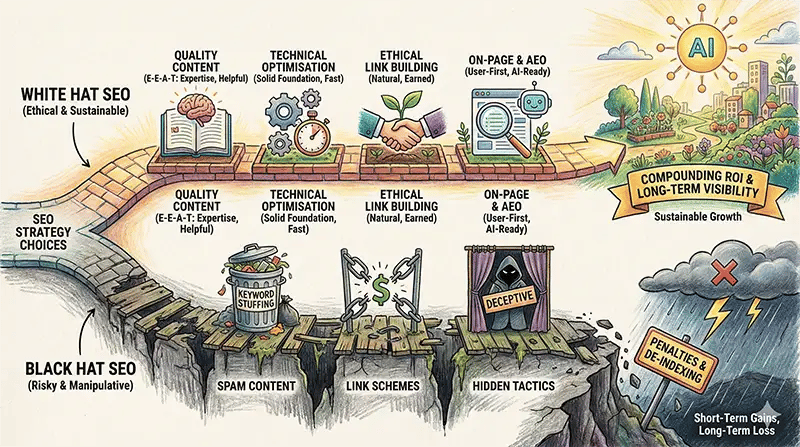
The Core Definition of White Hat SEO
White hat SEO refers to optimisation practices that align with Google's published guidelines and focus on creating genuine value for users. The term originates from old Western films, where heroes wore white hats and villains wore black—a distinction that perfectly captures the ethical divide in search marketing.
Google's Search Essentials (formerly Webmaster Guidelines) define acceptable SEO as creating "helpful, reliable, people-first content" that uses relevant keywords naturally and provides genuine value to searchers. The principle is straightforward: build websites for humans, not algorithms.
This stands in stark contrast to black hat SEO tactics, which attempt to manipulate rankings through deceptive practices like link schemes, keyword stuffing, cloaking, or scaled spam content. Whilst these shortcuts might deliver temporary gains, they carry substantial risk of penalties—and Google's March 2024 Core Update eliminated 45% of low-quality content from search results.
Why Ethical SEO Matters More in 2026
The SEO landscape has transformed dramatically since Google introduced AI-powered features like Search Generative Experience and AI Overviews. These changes have made white hat practices not just ethically preferable but strategically essential.
Current UK SEO Statistics (2025-2026)
- 61.8% of UK businesses now have an SEO strategy (LOCALiQ Survey)
- 93.35% of UK search traffic goes through Google (Statista)
- 39.8% click-through rate for position one organic results (First Page Sage)
- Only 0.63% of searchers click to page two (Advanced Web Ranking)
- £19.2 billion UK SEO market value, projected to reach £25 billion by 2028
Google's John Mueller confirmed in December 2025 that traditional SEO best practices remain the foundation for visibility—even in AI search features. His advice? "Write like blogging is alive" and avoid formulaic "digital mulch" content created purely for algorithms.
For UK businesses competing in increasingly crowded markets, sustainable rankings deliver compounding returns. Our clients typically see a 22:1 ROI ratio from white hat SEO—£22 return for every £1 invested—compared to the temporary visibility of paid advertising or the penalties risked by manipulative tactics.
Essential White Hat SEO Techniques for 2026
Effective white hat SEO combines several complementary disciplines. Here's what works right now:
Quality Content Creation
Google's E-E-A-T framework (Experience, Expertise, Authoritativeness, Trustworthiness) guides content evaluation. The extra "E" for Experience, added in December 2022, prioritises first-hand knowledge. Content demonstrating genuine expertise consistently outperforms generic articles—Lily Ray of Amsive Digital notes: "Write one good article about taxes with all the best experts on your staff. That's gonna do a lot better" than publishing dozens of mediocre pieces.
Technical Optimisation
Technical SEO ensures search engines can effectively crawl, index, and understand your content. Core requirements include meeting Core Web Vitals thresholds (LCP under 2.5 seconds, INP under 200ms, CLS under 0.1), implementing HTTPS, ensuring mobile responsiveness, and using semantic HTML structure. A comprehensive website audit identifies technical issues blocking your performance.
Ethical Link Building
Natural backlinks remain a crucial ranking factor, but how you acquire them matters enormously. Google-approved methods include creating linkable assets (original research, comprehensive guides), digital PR and earned media, guest posting on genuinely relevant sites, and relationship building within your industry. John Mueller's guidance is clear: "Don't focus so much on the absolute count of links... There are more important things for websites nowadays."
On-Page Optimisation
Strategic on-page elements help search engines understand your content's relevance. This includes descriptive title tags with primary keywords, compelling meta descriptions, proper heading hierarchy (H1-H6), descriptive internal linking, and short, keyword-rich URLs. These elements should serve users first—if an optimisation feels forced or unnatural, it probably is.
Comparing White Hat and Black Hat Approaches
Understanding the distinction helps you evaluate SEO recommendations and avoid risky tactics:
| Aspect | White Hat SEO | Black Hat SEO |
|---|---|---|
| Focus | User experience and value | Manipulating algorithms |
| Timeline | 3-6 months for initial results | Quick gains, then penalties |
| Risk Level | Low—builds durable assets | High—penalties, deindexing |
| Content | Original, expert-driven | Scraped, spun, AI-spam |
| Links | Earned naturally | Bought or manipulated |
| Average ROI | 550%+ long-term | Negative after penalties |
Lily Ray's response to those boasting quick wins from black hat tactics? "Call me in six months and let me know how that site is doing." The industry consensus remains clear: shortcuts create technical debt that eventually comes due.
White Hat SEO in the Age of AI Search
The rise of AI-powered search—ChatGPT with 900 million weekly users, Perplexity processing 780 million monthly queries, and Google's AI Overviews appearing in 16% of desktop searches—has transformed how people find information. Yet the core principles of white hat SEO remain more relevant than ever.
Google's Gary Illyes confirmed: "To get your content to appear in AI Overview, simply use normal SEO practices. You don't need GEO, LLMO or anything else." Traditional white hat techniques—quality content, proper structure, genuine authority—form the foundation for visibility across both traditional and AI-powered search.
This evolution has given rise to Answer Engine Optimisation (AEO)—the practice of structuring content so AI systems can easily extract and cite your information. Key AEO tactics include leading with direct answers, using clear structure, implementing schema markup, and creating original research that AI cannot generate independently.
The fundamental shift? Success increasingly means being cited and recommended within AI responses, not just ranking in traditional results. White hat practices—building genuine authority that both humans and AI systems trust—position your business for this new reality.
Realistic Timeline for White Hat Results
One of the most common questions we receive at Whitehat SEO: how long until we see results? The honest answer: white hat SEO requires patience, but delivers compounding returns.
Typical White Hat SEO Timeline
- Months 1-3: Technical fixes, content audit, strategy development
- Months 3-6: Initial ranking improvements, traffic growth begins
- Months 6-12: Significant visibility gains, lead generation increases
- Year 2-3: Peak performance as authority compounds
According to Shopify's SEO senior specialist, most sites can expect measurable results within three to six months. The key advantage? Unlike paid advertising that stops when spending stops, white hat SEO builds durable assets that continue delivering value for years.
How to Identify a Genuine White Hat SEO Agency
Not all agencies practise what they preach. Here's how to verify ethical practices before engaging an SEO partner:
Green flags:
- Transparent about methods and willing to explain their approach
- Provides detailed, regular reporting with clear metrics
- Sets realistic timelines (months, not days)
- Focuses on your business goals, not just rankings
- Holds recognised credentials (HubSpot Partner, Google Partner)
Red flags:
- Guarantees specific rankings in fixed timeframes
- Won't disclose their link building sources
- Extremely cheap prices for SEO pricing guide "guaranteed results"
- Wants to control your domain or hosting
- Vague about what work they'll actually do
At Whitehat, we believe in complete transparency. Our comprehensive inbound marketing services come with detailed reporting, and we're always happy to explain exactly how we're building your visibility. If an agency can't clearly explain their methods, that tells you something important.
Frequently Asked Questions
How long does white hat SEO take to show results?
White hat SEO typically shows initial improvements within 3-6 months, with significant growth between 6-12 months. Unlike quick-fix tactics, these results compound over time—peak performance often occurs in years 2-3 as content authority builds and backlink profiles strengthen.
Is white hat SEO worth the investment for UK businesses?
Yes. UK businesses report an average 22:1 ROI ratio from SEO—£22 return for every £1 invested. With 61.8% of UK businesses now using SEO and a market worth £19.2 billion, ethical optimisation has become essential for competitive visibility in British search results.
Can white hat SEO compete with paid advertising?
Absolutely. Research shows SEO delivers 550% average ROI compared to 200% for PPC, with organic leads converting at 14.6% versus 1.3% for paid. Many businesses use both strategically—PPC for immediate visibility whilst building sustainable organic presence through white hat methods.
What happens if competitors use black hat techniques?
Focus on your own ethical strategy. Google's March 2024 Core Update eliminated 45% of low-quality content from results. You can report spam via Google Search Console, but the best response is building genuinely valuable content that earns sustainable rankings competitors can't replicate.
Does white hat SEO still work with AI search?
More than ever. Google's Gary Illyes confirmed that normal SEO practices work for AI Overviews. Quality content, genuine expertise, and user-focused optimisation—the pillars of white hat SEO—are precisely what AI systems prioritise when selecting sources to cite and recommend.
What's the difference between SEO and AEO?
SEO focuses on ranking in traditional search results to drive clicks. AEO (Answer Engine Optimisation) focuses on getting your content cited in AI-generated answers from ChatGPT, Perplexity, and Google AI Overviews. The best strategy combines both—good SEO is good AEO.
Building Sustainable Search Visibility
White hat SEO isn't just about following rules—it's about building genuine value that search engines and users both reward. In an era where AI is reshaping how people find information, the businesses that invest in authentic expertise, quality content, and ethical practices will capture sustainable competitive advantages.
At Whitehat SEO, we've built our reputation—and our name—on these principles. As the hosts of the world's largest HubSpot User Group, we see what works across hundreds of businesses. The evidence is consistent: white hat practices deliver better long-term results, lower risk, and higher ROI than any shortcut.
Ready to Build Sustainable Organic Growth?
Discover how white hat SEO can transform your search visibility. Book a free consultation with our team.
Book Your Free ConsultationReferences & Further Reading
- Google Search Essentials — Official Google Search Central Documentation (Updated December 2025)
- Google Click-Through Rates by Ranking Position — First Page Sage (May 2025)
- Google E-E-A-T: How To Demonstrate First-Hand Experience — Search Engine Journal
- Google Says Normal SEO Works for Ranking in AI Overviews — Search Engine Land (2024)
- UK Digital Marketing Statistics — LOCALiQ (2024-2025)
- White Hat SEO: Best Practices Guide — Ahrefs
About the Author
Clwyd Probert
CEO and Founder of Whitehat SEO, Clwyd is a guest lecturer at UCL and leads the world's largest HubSpot User Group. With over a decade of experience in ethical SEO and inbound marketing, he helps UK businesses build sustainable organic growth. view our pricing