
SEO costs in the UK range from £500 to £20,000+ per month in 2026, depending on your business size, industry competitiveness, and strategic goals. For most B2B SMEs, the realistic investment in SEO packages sits between £1,500 and £5,000 monthly — the range where agencies can deliver genuine strategic work rather than template-based solutions. At Whitehat SEO, we believe pricing transparency is the foundation of a productive agency-client relationship, so we have compiled the most comprehensive UK SEO pricing guide available in 2026 — complementing our comparison of the best SEO agencies in London.
This guide draws on industry survey data, agency benchmarks, and our own experience delivering SEO campaigns for B2B companies across the UK. Whether you are evaluating your first SEO packages investment or benchmarking your current spend, you will find the data you need to make an informed decision.
Key Takeaway
Meaningful SEO investment for UK businesses starts at £1,500 per month. Budgets below £500 carry significant risk of automated, low-quality work that may actually harm your rankings. The sweet spot for B2B SMEs is £2,500–£5,000 monthly, delivering 30–50 hours of strategic work including technical SEO, content production, and link building.

How Much Does SEO Cost in the UK in 2026?
Short answer: how much does SEO cost in the UK?
UK SEO packages cost £500–£20,000+ per month in 2026. Most B2B SMEs pay £1,500–£5,000 monthly; £2,500–£5,000 buys 30–50 hours of genuinely strategic work. Below £500 a month, expect automated output rather than strategy. Freelancers charge £300–£2,500 monthly, agencies £1,500–£20,000+.
UK SEO pricing packages fall into four clear tiers based on business size and ambition. Monthly retainers remain the dominant model at 78% market prevalence, reflecting the reality that SEO requires sustained, compounding effort rather than one-off fixes. Here is what each tier typically includes and costs.
| Business Size | Monthly Cost | Hours/Month | What's Included |
|---|---|---|---|
| Local / Startup | £500–£1,200 | 5–10 | Local SEO foundations, basic on-page optimisation, Google Business Profile management |
| Growing SME | £1,500–£3,000 | 15–30 | Technical SEO, ongoing content production, basic digital PR, regional targeting |
| Mid-Market B2B | £2,500–£5,000 | 30–50 | Full-service SEO, content at scale, strategic link building, competitor monitoring, dedicated account management |
| Enterprise | £5,000–£20,000+ | 50–100+ | Multi-location or international SEO, enterprise content programmes, integrated digital PR, technical architecture work |
These figures represent 2026 benchmarks that have increased 15–30% since 2024. The inflation reflects three forces: rising operational costs, expanded scope of work driven by AI search platforms, and Google's increasing quality requirements around E-E-A-T (Experience, Expertise, Authoritativeness, Trustworthiness) signals.
For context, Gartner's CMO Spend Survey data shows marketing budgets typically allocate 7.7% of company revenue to marketing, with search claiming 13.6–13.9% of digital spend. For a £10 million revenue company, that translates to roughly £3,800 monthly on search — placing mid-market B2B firmly in the £2,500–£5,000 tier.
£1,500–£3,000
SME Sweet Spot
Monthly retainer range where UK agencies deliver genuine strategic SEO work
78%
Retainer Model
Share of UK SEO providers using monthly retainers as primary pricing model
15–30%
Price Increase
UK SEO pricing inflation since 2024 driven by AI search expansion
What Are the Different SEO Pricing Models?
Three SEO pricing models dominate the UK market: monthly retainer packages, project-based fees, and hourly consulting. Each serves different needs, and the right choice depends on whether you need ongoing strategic support or a defined deliverable.
Monthly retainers
Monthly retainers suit businesses seeking sustained organic growth. You pay a fixed monthly fee — typically £500–£10,000+ — for an agreed scope of ongoing work. This model aligns with SEO's true nature as a compound investment where each month's work builds on the last. The disadvantage is potential scope creep if deliverables are not clearly defined upfront.
Project-based pricing
Project-based pricing works for well-defined deliverables with clear start and end points. Common examples include SEO audits (£500–£7,500 depending on depth), website migrations (£1,000–£15,000), and content pieces (£80–£300 per 1,000-word article). Around 49% of UK SEO providers offer project-based options alongside retainers. The risk lies in scope changes — complex projects frequently trigger additional fees when requirements evolve.
Hourly consulting
Hourly consulting suits businesses needing expert advice without committing to ongoing management. UK hourly rates range from £40–£100 for freelancers to £70–£300 for agency consultants, with London-based specialists reaching £250–£400+ for strategic work. This model works well for supplementing internal marketing teams or troubleshooting specific issues, but becomes prohibitively expensive for sustained campaigns.
| Pricing Model | UK Cost Range | Best For | Market Prevalence |
|---|---|---|---|
| Monthly Retainer | £500–£10,000+/mo | Ongoing growth, compound results | 78% |
| Project-Based | £500–£50,000 | Audits, migrations, defined deliverables | 49% |
| Hourly Consulting | £40–£300+/hr | Strategy sessions, troubleshooting, team support | ~25% |
| Performance-Based | Base + bonus | Hybrid models with shared risk | 15% |
The Cost of Getting It Wrong
Performance-based SEO pricing — where agencies charge based on rankings achieved — carries serious risks. Google and Bing explicitly warn against providers promising guaranteed rankings. Such guarantees often mask aggressive tactics that risk algorithmic penalties costing £5,000–£50,000 to recover from. Only 15% of UK providers offer performance-based models, and reputable ones always combine them with a base retainer to maintain ethical practice how to choose an SEO company.
What Factors Determine SEO Pricing?
Five factors drive the difference between a £500 and a £20,000 monthly SEO investment. Understanding these helps you evaluate whether a quoted price reflects genuine strategic value or padding of undifferentiated tasks.
Industry Competitiveness
Highly competitive sectors (legal, finance, healthcare, ecommerce) command 30–50% pricing premiums. A local solicitor's SEO needs differ dramatically from a fintech startup competing nationally against well-funded incumbents with massive link profiles.
Geographic Scope
Local single-location campaigns sit at the low end, regional multi-location in the middle, and national or international programmes at the premium end. London agencies command 30–50% premiums over provincial providers, though this gap is narrowing as remote delivery matures.
Website Size and Technical Complexity
A 50-page business website needs different technical work than a 50,000-page ecommerce catalogue. Legacy sites with technical debt commonly require £5,000–£15,000 in upfront remediation before ongoing optimisation can begin.
Content Requirements
Standard blog content costs £100–£300 per article. Specialist content for regulated industries (healthcare, finance, legal) attracts 20–50% premiums. Pillar pages and comprehensive guides cost £1,000–£3,000+.
Link Building Needs
UK link acquisition costs trend 50–59% higher than global averages. Guest posts average £325–£365, while high-authority links (DR 71+) can cost £2,025+ per link. Beauty and fashion niches command the highest premiums at £948–£1,171 per link.
How Much Does Answer Engine Optimisation (AEO) Cost?
Answer Engine Optimisation adds 20–50% to traditional SEO costs in 2026, reflecting the genuine expansion in scope required to maintain visibility across AI-powered search platforms. With 25% of search traffic expected to shift to AI interfaces by the end of 2026, and organic click-through rates dropping 61% when Google AI Overviews appear, AEO has moved from optional add-on to essential investment.
Currently, 61% of UK agencies are expanding AEO service offerings. At Whitehat SEO, we integrate AEO into our core methodology rather than treating it as a bolt-on — because the same content quality that earns AI citations also strengthens traditional rankings.
| AEO Service Tier | Monthly Cost | What's Included |
|---|---|---|
| Basic AEO Add-On | £400–£800 | AI visibility audit, schema markup optimisation, answer-first content restructuring |
| Integrated AEO | ~£740 | Prompt research, entity mapping, citation tracking, bundled with SEO retainer |
| Comprehensive AEO (SME) | £1,500–£5,000 | Multi-platform optimisation (ChatGPT, Perplexity, Google AI Overviews, Claude), brand mention strategy |
| Enterprise AEO | £6,000–£24,000+ | Competitor citation analysis, cross-platform monitoring, dedicated AEO strategist |
The business case for AEO investment is supported by emerging traffic data. Research from Microsoft Clarity shows AI-referred visitors convert at significantly higher rates than traditional organic traffic — ChatGPT referrals convert at 16.8% and Perplexity at 10.5–12.4%, compared to 2.8% for standard Google organic traffic. These conversion premiums mean that even modest AI search visibility can deliver outsized commercial returns.
Key Takeaway
Budget 15–25% of your total SEO investment for AEO in 2026. Organisations neglecting AI search optimisation risk invisibility in channels that already account for 16% of Google searches featuring AI Overviews and 21% of all keywords triggering them. The content structures that earn AI citations — direct answers, authoritative data, clear entity relationships — also strengthen traditional organic rankings.
What ROI Can You Expect from SEO Investment?
SEO delivers measurable, durable returns that compound over time — but the timeline differs fundamentally from paid advertising. Expect initial traction at 3–6 months and mature results at 6–12 months, with the strongest ROI emerging after 12 months as authority effects compound.
702%
B2B SaaS ROI
Average SEO return on investment for B2B SaaS companies
14.6%
SEO Lead Close Rate
Compared to 1.7% for outbound leads — an 8.6x difference
8x
Return vs PPC
Organic search delivers 8x return compared to paid search's 4x
Industry-specific ROI data paints a compelling picture. Real estate achieves the highest SEO ROI at 1,389%, followed by financial services at 1,031% and legal services at 526%. B2B companies generate twice as much revenue from organic search compared to any other marketing channel, and 70% of marketers confirm SEO generates more sales than PPC.
Conversion rates vary significantly by content type, which underscores the importance of strategic content planning. FirstPageSage's analysis of 15 years of campaign data shows white papers converting at 4.6%, case studies at 3.5%, service landing pages at 2.7%, and thought leadership articles at 2.0%. This variation is why we align content type with commercial intent in every content strategy we build. For sector-specific pricing data, see our breakdown of marketing costs and ROI for accountants.
When will you see results?
Most SEO campaigns follow a predictable trajectory. Months one to three produce early signals — content indexing, long-tail keywords appearing in Search Console, and impressions rising before clicks. Months four to six bring measurable traffic growth, stabilising rankings, and featured snippet appearances. By months six to twelve, competitive keywords start moving, content earns natural links, and organic traffic growth becomes self-reinforcing.
This compounding nature is why most SEO professionals recommend 6–12 month minimum engagements. Terminating at six months often happens precisely when compounding effects should accelerate — representing poor timing for client and agency alike. Unlike PPC, where traffic stops the moment you stop paying, SEO traffic continues beyond contract completion, creating residual value that justifies the upfront investment.
Not sure which SEO package fits your budget?
Our free SEO audit reveals where your site stands and which investment level will deliver the best ROI for your business.
How Do You Spot Overpriced or Low-Quality SEO?
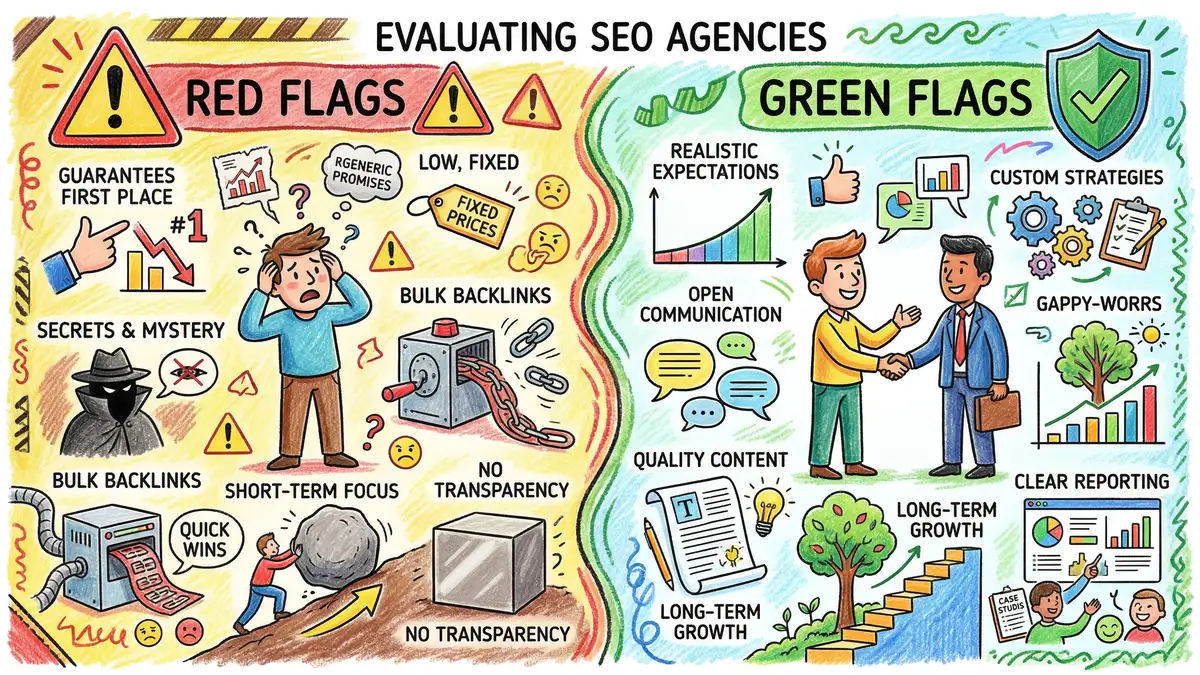
The gap between excellent and poor SEO packages is wider than in most professional services. Here are the red flags that signal either overpricing without corresponding value or dangerously cheap work that could harm your site.
Red Flags — Walk Away
Guaranteed first-page rankings or specific position promises (Google explicitly warns against this). Pricing below £500/month for anything beyond basic local SEO. Vague deliverables like "ongoing SEO work" without specific monthly scope. Reluctance to explain methodology or provide references. Proprietary tools that create data lock-in.
Green Flags — Worth Your Investment
Realistic 3–6 month timeline expectations before measurable results. Detailed monthly scope with specific deliverables. Customised strategy developed after a proper audit, not a template. Regular reporting tied to business metrics (traffic, conversions, revenue), not vanity numbers. Flexible contracts with reasonable notice periods.
Tool cost transparency deserves particular attention. Ahrefs Pro costs £399 monthly and Semrush Pro roughly £119 monthly at retail. If an agency charges £500+ monthly for "tool access" bundled into your retainer, that warrants scrutiny. Reputable providers detail which tools are included and whether you retain data access if you leave.
Should You Hire an SEO Freelancer or an Agency?
Freelancers cost 30–50% less than agencies for equivalent SEO packages, making them strong choices for businesses with budgets under £2,000 monthly. Agencies provide resource depth, team continuity, and multi-discipline coordination that justifies their premium above £2,500 monthly.
| Factor | Freelancer | Agency |
|---|---|---|
| Monthly Cost | £300–£2,500 | £1,500–£20,000+ |
| Hourly Rate | £40–£100 | £70–£300+ |
| Best Budget Range | Under £2,000/mo | Over £2,500/mo |
| Strengths | Direct access, deep specialism, cost efficiency | Team depth, multi-channel coordination, formal processes |
| Risks | Capacity limits, single point of failure, narrower skill set | Higher cost, potential for junior staff delivery, less personalised |
| Ideal For | Local SEO, single-channel focus, supplementing in-house teams | National campaigns, complex sites, multi-channel strategies |
In the £2,000–£2,500 overlap zone, the decision should hinge on your specific needs. If a freelancer's specialisation exactly matches your requirements, they may deliver superior focused work. If you need coordinated content, link building, technical SEO, and digital PR working in concert, an agency's team structure provides genuine value.
What Are Typical Freelance SEO Day Rates in the UK?
If you are weighing up a freelancer, day rates are often a clearer comparison point than monthly retainers — especially for audits, consultancy days and embedded work with an in-house team. Across 2026 UK rate benchmarks, freelance SEO day rates cluster into three bands by experience level.
| Experience level | Typical day rate (UK, 2026) | Best suited to |
|---|---|---|
| Junior (0–3 years) | £200–£400/day | On-page tasks, content briefs, local SEO basics |
| Mid-level (3–7 years) | £400–£700/day | Technical audits, content strategy, ongoing optimisation |
| Senior / specialist (7+ years) | £700–£1,200+/day | Strategy, enterprise technical SEO, migrations, training |
Market-wide data supports these bands: Malt's platform listings average around £418 per day for SEO consultants, YunoJuno's UK data puts the average marketing freelancer at £347 per day, and Earns' analysis of over 261,000 UK freelance contracts found an all-discipline average of £390 per day — with SEO strategy and technical specialists sitting above those averages.
The day-rate maths also explains the freelancer-versus-agency crossover above. Two days a month of a senior freelancer's time costs roughly £1,400–£2,400 — similar money to a mid-market agency retainer, but buying depth in one discipline rather than a coordinated team. For a one-off audit or a few strategy days a quarter, day rates are usually the better value; for sustained multi-channel work, the retainer wins.
Sources: Malt platform rate data 2026; YunoJuno UK freelance rates; Earns UK Freelance Rate Benchmarks (December 2025, 261,000+ contracts).

How Should You Budget for SEO in 2026?
Effective SEO budgeting starts with matching your investment to your strategic ambition and competitive context. Here is a practical framework for evaluating SEO packages based on 2026 UK market data.
Assess Your Competitive Landscape
Run an SEO audit to understand where you stand. Identify keyword difficulty for your target terms and the domain authority of competitors currently ranking. Higher competition requires higher investment — there are no shortcuts around this reality.
Set Realistic Minimum Investment
Local businesses in low-competition niches: £800–£1,500/month. B2B SMEs with regional ambitions: £1,500–£3,000/month. National or competitive sectors: £3,000–£8,000+/month. Enterprise with international scope: £10,000–£50,000+/month.
Allocate for AEO
Reserve 15–25% of your total SEO budget for Answer Engine Optimisation. This is no longer optional — AI search channels will represent 25%+ of search traffic by the end of 2026.
Commit to 12 Months Minimum
SEO compounds over time. Six months shows early traction, but 12 months is where the real returns materialise. Organisations that commit to the full cycle see 5–7x ROI multiples on their initial investment.
Compare Against Acquisition Costs
Calculate your cost-per-acquisition through other channels (PPC, outbound, events). SEO leads close at 14.6% versus 1.7% for outbound — making organic search one of the most cost-effective B2B acquisition channels available.
Frequently Asked Questions
How much should a small business spend on SEO per month?
Small businesses in the UK should budget £500–£1,200 monthly for local SEO and £1,500–£3,000 for regional growth. The meaningful minimum for genuine strategic work is £800 per month — budgets below £500 risk automated, template-based approaches that rarely deliver measurable results.
Are cheap SEO packages worth it?
SEO packages priced below £500 monthly almost always involve automated reporting and minimal strategic input. Industry data consistently shows that companies spending below £1,000 monthly achieve significantly weaker organic growth than those investing £1,500+. Worse, low-cost providers sometimes use aggressive tactics that risk Google penalties costing £5,000–£50,000 to recover from.
How long does it take for SEO to show results?
Most campaigns show measurable results within 3–6 months, with mature performance at 6–12 months. Early signals (increased impressions, long-tail keyword rankings) appear within weeks, but competitive keyword movement and significant traffic growth typically require 4–6 months of sustained work.
What is the difference between SEO and AEO?
Traditional SEO optimises for Google's organic search results. Answer Engine Optimisation (AEO) extends this to AI-powered platforms like ChatGPT, Google AI Overviews, and Perplexity. AEO focuses on structuring content so AI systems cite your brand in their responses. In 2026, both are essential — AEO adds 20–50% to traditional SEO costs but targets high-converting AI referral traffic.
Can you guarantee SEO rankings?
No reputable SEO professional guarantees specific rankings. Google and Bing explicitly warn against providers making such promises. Rankings depend on algorithm changes, competitor activity, and market dynamics that no agency controls. What a quality provider can guarantee is transparent methodology, regular reporting, and strategic work aligned with your business goals.
Is SEO better value than PPC?
For long-term customer acquisition, SEO typically delivers superior ROI. Organic search returns 8x compared to PPC's 4x, and SEO leads close at 14.6% versus 1.7% for outbound channels. The key difference is timeline: PPC delivers immediate traffic that stops when you stop paying, while SEO builds compounding value that persists beyond the investment period. Most B2B companies benefit from both channels working together.
If you are evaluating SEO investment for your business, we offer a free initial consultation to assess your competitive landscape and recommend an appropriate budget level. Book a free SEO consultation to discuss your specific requirements with our team.
Ready to Invest in SEO That Delivers Measurable ROI?
We help UK B2B companies build organic pipelines that compound month after month. Let's find the right SEO package for your growth goals.
Sources: FirstPageSage 2026 Conversion Rate Report, Gartner CMO Spend Survey 2025, Ahrefs AI SEO Statistics 2026, SEOprofy ROI Benchmark Study 2025, Microsoft Clarity AI Traffic Report 2025