
How much should your accounting firm spend on marketing — and which channels actually deliver a return? UK accounting firms allocate just 5–6% of revenue to marketing versus 11% for their US counterparts, yet high-growth practices investing 8–10% grow 4.6× faster than average peers (Hinge Research Institute, 2025). The difference isn't just spend — it's where the money goes. SEO delivers 748% ROI over 18 months while email marketing returns £36–£42 for every pound invested (First Page Sage, 2025). This guide breaks down marketing costs channel by channel, sets realistic budgets by firm size, and shows you exactly how to calculate whether your spend is generating profitable growth.
5–6%
Avg. Marketing Spend
UK accounting firms as % of revenue
748%
SEO ROI
Highest long-term return of any channel
£36–£42
Email ROI
Return per £1 spent on email marketing
4.6×
Growth Premium
How much faster high-growth firms grow vs average
Sources: Hinge Research Institute High Growth Study 2025, First Page Sage ROI Study 2025, IPA Bellwether Q4 2024
What UK Accounting Firms Actually Spend on Marketing
Most UK accounting practices significantly underinvest in marketing compared to other professional services sectors. The services and consulting sector in the UK allocates approximately 6% of revenue to marketing — one of the lowest percentages across all industries measured. Banking, finance, and insurance spends 12%, while technology and software firms invest around 10%.
The gap between average and high-growth firms tells the real story. High-growth accounting and professional services firms allocate roughly 10% of revenue to marketing compared with 5% for average-growth peers. These firms don't just spend more — they spend differently, prioritising thought leadership, SEO, and relationship-building over vanity metrics and sporadic campaigns.
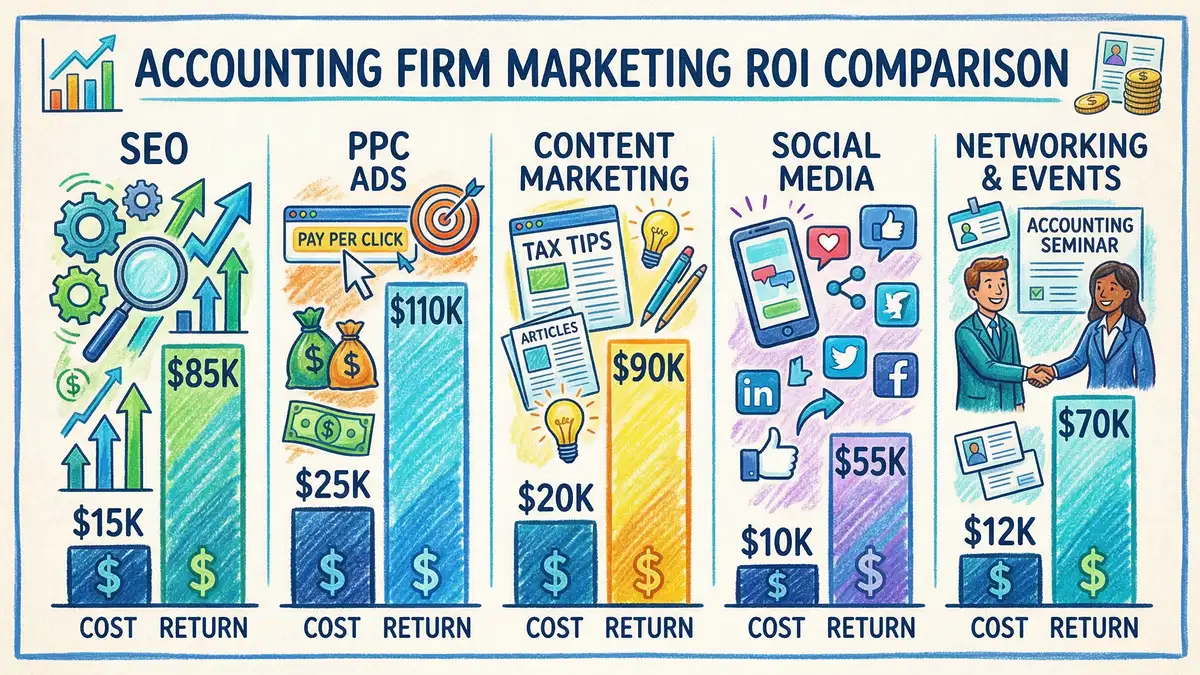
Translated into pounds, that percentage becomes meaningful fast. A small practice generating £500,000 annual revenue at 6% spends £30,000 per year (£2,500 monthly). A mid-sized firm on £2 million allocates £120,000 annually (£10,000 monthly). A larger firm turning over £10 million budgets approximately £600,000 per year. These aren't theoretical — they're the entry point for sustainable marketing that actually generates new clients rather than disappearing into ad platforms.
Channel-by-Channel Cost Breakdown
Every pound matters when you're running a practice, so here's what each marketing channel actually costs for UK accounting firms — and what you should expect to get back.
| Channel | Monthly Cost | ROI | Time to ROI | Best For |
|---|---|---|---|---|
| SEO | £500–£10,000+ | 748% | 9–12 months | Sustainable lead flow, brand authority, compounding returns |
| Google Ads (PPC) | £1,000–£7,500 | 36% | 3–6 months | Immediate leads, seasonal pushes, new service launches |
| Email Marketing | £200–£2,000 | 3,600–4,200% | 6 weeks–3 months | Client retention, cross-selling, nurturing referrals |
| Content Marketing | £2,000–£15,000 | 317% | 6–9 months | Thought leadership, SEO fuel, prospect education |
| Social Media | £1,000–£5,000 | 192–229% | 5 months | LinkedIn B2B leads, employer branding, reputation |
| Events & Networking | £500–£3,000 | Variable | 1–3 months | Relationship building, referral pipeline, local awareness |
| Website (ongoing) | £150–£800 | Foundation | Ongoing | Conversion infrastructure, all channels depend on it |
SEO: The Compounding Investment
SEO is the most cost-effective long-term channel available to accounting firms, delivering approximately 748% return on investment for B2B businesses. Local SEO campaigns for smaller practices cost £500–£3,000 monthly, while comprehensive national or multi-location strategies run £5,000–£10,000+. Break-even typically arrives around month nine, with momentum accelerating sharply through month twelve and beyond. The critical advantage: unlike PPC, organic traffic doesn't disappear when you stop spending. A well-optimised page continues generating leads for years after the initial investment — which is why high-growth firms allocate 25–30% of their total marketing budget here.
Google Ads (PPC): Immediate but Expensive
Paid search generates leads within days rather than months, but at a premium. UK accounting keywords cost £3.50–£5.50 per click, with customer acquisition costs averaging £802 through paid search in 2025 — a figure that climbed 40–60% between 2023 and 2025. Monthly budgets range from £1,000 for a small local campaign to £7,500+ for multi-service, multi-region coverage. PPC works best as a complement to SEO during the 9–12 months organic takes to gain traction, not as a permanent standalone strategy. For a deeper walkthrough, see our Google Ads guide for accountants.
Email Marketing: The Silent Performer
With £36–£42 returned per pound invested, email delivers the highest ROI-per-pound of any channel. Platform costs start at £0 for basic plans (under 250 contacts) and scale to £200 monthly for mid-sized lists. The real cost sits in campaign creation — copywriting, design, segmentation, and automation setup adds £500–£2,000 monthly. Open rates for professional services emails reach 15–20%, with click-through rates of 2–5%. Unlike social media or paid ads, you own your email list — no algorithm changes can cut off your access.
Not Sure Where Your Marketing Budget Is Going?
We'll audit your current marketing spend and show you exactly which channels are generating clients — and which are burning cash.
Recommended Budgets by Firm Size
The right marketing budget depends on your revenue, growth targets, and where you are in the marketing maturity curve. A firm just starting marketing needs to invest more heavily in foundations (website, SEO infrastructure, email systems) before optimising channel allocation.

| Firm Size | Revenue | Monthly Budget | Recommended Allocation |
|---|---|---|---|
| Sole Practitioner | £150k–£300k | £750–£1,800 | Local SEO + Google Business Profile (40%), email marketing (30%), networking (30%) |
| Small (2–5 staff) | £300k–£750k | £1,800–£4,500 | SEO (30%), content marketing (25%), email (20%), PPC (15%), networking (10%) |
| Mid-size (6–20) | £750k–£3m | £4,500–£18,000 | SEO (25%), content (25%), PPC (15%), email (15%), social (10%), events (10%) |
| Large (20–50+) | £3m–£10m+ | £18,000–£60,000+ | Full multi-channel with dedicated marketing team or agency partnership |
These budgets assume the firm is ready to commit to 12–18 months of consistent investment. Marketing for professional services follows compound growth patterns — months one through six build credibility infrastructure, months seven through twelve generate accelerating lead flow, and months twelve through eighteen achieve sustainable ROI stabilisation. Firms that pull the plug after three months of "not seeing results" waste 100% of their investment.
Customer Acquisition Cost vs Client Lifetime Value
The single most important marketing metric for an accounting firm is the ratio between what you spend to win a client and what that client is worth over their lifetime. Without this calculation, you're navigating blind.
Customer acquisition costs vary dramatically by channel. Referrals cost approximately £150 per client for B2B firms — the cheapest channel by far. Organic search generates clients at roughly £480. Paid search costs approximately £802 per client (and rising 40–60% between 2023 and 2025). Outbound sales sits highest at around £1,980 per new client.
Against these costs, consider what accounting clients are actually worth. A sole trader on basic bookkeeping and tax generates £300–£850 annually. A limited company with statutory accounts, Corporation Tax, payroll, and VAT produces £2,430–£7,430 per year. With average client tenure of 5–12 years, a mid-range limited company client at £4,000 annual fees and 8-year tenure generates £32,000 in lifetime revenue — or £8,000–£12,800 in profit at 25–40% margins.

The industry standard target is a CLV:CAC ratio of at least 3:1 — meaning lifetime value should exceed acquisition cost by three times. Efficient operations target 4:1 to 6:1. For our mid-range client worth £32,000 lifetime revenue, that supports acquisition costs up to £10,600 (at 3:1) or £8,000 (at 4:1). Most accounting firms can comfortably invest £500–£2,000 to acquire a client and still achieve exceptional returns — yet many spend far less and wonder why growth stalls.
Key Takeaway
Calculate your client lifetime value before setting any marketing budget. A limited company client staying 8 years at £4,000 annual fees generates £32,000 in revenue. At a 3:1 CLV:CAC ratio, you can afford to spend up to £10,600 acquiring each client — most firms spend a fraction of this and leave growth on the table.
In-House Team vs Agency vs Freelancers
The delivery model you choose shapes both your costs and your marketing effectiveness. Each approach has trade-offs that depend on firm size, growth stage, and internal capacity.
Hiring in-house gives you dedicated focus but comes with significant fixed costs. A marketing executive earns £32,000–£38,000 annually, a marketing manager £40,000–£55,000, and a head of marketing £80,000–£100,000+ (Hays UK Salary Guide 2025). Once you add employer NI (13.8%), pension, equipment, software, and workspace, total employment cost exceeds salary by 40–50%. That marketing executive at £35,000 salary actually costs £50,000–£52,500 fully loaded. For a small practice on £500,000 revenue, that single hire consumes 10% of turnover.
Agencies specialising in professional services charge £2,500–£7,500 monthly for small firms (under £2m revenue) and £7,500–£25,000 for mid-market firms. The economics shift as firm size increases: a £5,000 monthly agency retainer delivers multi-discipline expertise (SEO, content, PPC, design) that would require three or four in-house hires at £150,000+ combined cost. The trade-off is less institutional knowledge and potentially less responsive than an internal team.
Freelancers offer the most flexibility. Digital marketing freelancers charge £300–£1,000 monthly for social media, £500–£2,000 for content creation, and £1,000–£3,000 for strategic consulting. Accountancy-specialist freelancers command £1,500–£4,000 monthly for comprehensive services. This model works well for firms wanting to test channels before committing to agency retainers or full-time hires.
The 60/40 Rule: Long-Term vs Short-Term Spend
High-growth professional services firms follow a consistent pattern: 60% of budget toward owned and organic channels, 40% toward paid and event-based channels. This balance builds long-term competitive advantage while maintaining short-term lead flow.
The 60% — allocated to SEO, content marketing, email systems, and website optimisation — creates assets that appreciate over time. A blog post ranking page one for "tax planning for limited companies" generates leads every month for years. An email automation sequence nurturing prospects costs nothing to run after initial setup. These investments compound.
The 40% — covering Google Ads, LinkedIn advertising, events, and networking — keeps the pipeline filled while organic channels mature. This is particularly critical during the first 9–12 months of a marketing programme when SEO hasn't yet reached break-even. As organic traffic grows, many firms gradually shift to 70/30 or even 80/20, reducing paid dependence without sacrificing lead volume.
Common Marketing Mistakes That Waste Budget
Most accounting firms don't fail because they spend too little — they fail because they spend in the wrong ways. These are the patterns we see repeatedly across practices of every size.
Treating marketing as a short-term experiment. Firms running campaigns for two to three months, seeing minimal results, and pulling the plug waste 100% of their investment. Trust-building in professional services requires 12–18 months of consistent visibility before meaningful lead flow materialises (Hinge Marketing, 2025). An SEO campaign stopped at month four loses everything — the domain authority you've built, the content library you've created, and the momentum you've generated.
Hiring generalist agencies without professional services experience. Many marketing agencies excel at selling their services to accountants whilst failing to generate actual clients. Accounting firm marketing requires understanding multi-month sales cycles, relationship-dependent purchase decisions, and the critical role of perceived expertise. A generalist agency running the same playbook they'd use for a restaurant or retailer will damage your credibility through unsuitable messaging.
Marketing to everyone simultaneously. "Accounting services for all UK businesses" communicates weaker value than "tax advisory for ecommerce entrepreneurs" or "bookkeeping for creative agencies". Niche positioning consistently outperforms broad messaging for professional services — yet most firms resist specialisation out of fear they'll miss opportunities. The research shows the opposite: firms with defined ideal client profiles generate 2–3× more qualified leads per marketing pound.
Ignoring measurement and attribution. The accounting profession's analytical orientation makes the failure to track marketing ROI particularly ironic. Every channel should have a clear cost-per-lead and cost-per-client metric. If you can't calculate what each channel costs to acquire a client, you're allocating budget based on gut feeling rather than data — and your profession knows better than most how that ends.
Marketing ROI Timeline: What to Expect and When
Set realistic expectations — professional services marketing delivers slower initial returns than consumer marketing, but with more predictable, compounding results.
Months 1–3 (Foundation): Minimal visible results. This period covers strategy development, website optimisation, content creation, SEO technical fixes, and system setup. Paid channels may generate some leads, but organic is building infrastructure. This is where most firms make the critical mistake of expecting immediate returns.
Months 4–6 (Traction): Early indicators appear. Organic search impressions increase, email engagement metrics improve, content starts indexing and ranking for long-tail keywords. PPC campaigns are optimised with enough data to identify winning keywords and negative keyword lists. You should see initial lead flow from paid channels.
Months 7–9 (Acceleration): SEO approaches break-even. Content library reaches critical mass. Email nurturing converts early subscribers. Lead quality improves as brand awareness builds. Cost per lead decreases across channels as optimisation data compounds.
Months 10–18 (Compounding Returns): SEO delivers the highest ROI of any channel. Content drives organic traffic without ongoing production costs for existing pieces. Referral rates increase as brand visibility grows. The 60/40 organic-to-paid split begins shifting toward 70/30 as organic traffic scales. This is where the 748% SEO ROI benchmark becomes reality.
Frequently Asked Questions
How much should a small accounting firm spend on marketing per month?
A small firm with 2–5 staff and £300,000–£750,000 revenue should budget £1,800–£4,500 monthly (6–8% of revenue). Prioritise local SEO and Google Business Profile (30%), content marketing (25%), and email marketing (20%), with smaller allocations to PPC and networking. This budget supports sustainable growth without overcommitting fixed costs.
Which marketing channel has the best ROI for accountants?
SEO delivers the highest long-term ROI at 748%, though it requires 9–12 months to reach break-even. Email marketing offers the best pound-for-pound return at £36–£42 per £1 spent with much shorter payback (6 weeks to 3 months). The optimal approach combines both — use email to monetise your existing network while SEO builds your organic pipeline.
Is it better to hire an in-house marketer or use an agency?
For firms under £2 million revenue, agencies or freelancers typically deliver better value — a £5,000 monthly retainer buys multi-discipline expertise that would require 3–4 in-house hires. Above £2 million, a hybrid model works best: one in-house marketing coordinator managing brand and day-to-day execution, supported by specialist agencies for SEO, PPC, and content production.
How long does it take to see ROI from marketing?
Paid channels (Google Ads, LinkedIn) generate leads within 2–4 weeks but require 3–6 months for ROI optimisation. SEO takes 9–12 months to break even but delivers compounding returns thereafter. Content marketing shows measurable impact from months 6–9. Commit to minimum 12–18 months before making comprehensive ROI judgements — firms stopping early waste their entire investment.
What's a good cost per client acquisition for an accounting firm?
This depends entirely on your client lifetime value. For a limited company client generating £4,000 annual fees with 8-year average tenure (£32,000 CLV), acquisition costs up to £5,000–£8,000 are profitable at a 4:1 CLV:CAC ratio. Most firms achieve CAC of £480 (organic search) to £802 (paid search), well within profitable range for all but the lowest-value service tiers.
Ready to Invest in Marketing That Actually Grows Your Practice?
Whitehat SEO helps UK accounting firms build marketing systems that generate predictable, profitable client acquisition. We'll analyse your current spend, identify wasted budget, and build a channel mix matched to your growth targets.
Sources: Hinge Research Institute High Growth Study 2025, First Page Sage ROI Statistics 2025, Hays UK Salary Guide 2025, IPA Bellwether Report Q4 2024, Intuit QuickBooks Accountant Technology Report 2025
More Accountant Marketing Guides
- SEO for Accountants UK: The Complete Guide — Our comprehensive pillar guide to accountant SEO
- Digital Marketing for Accountants — Full channel comparison with ROI data
- Accountant Website Design & SEO — Building high-converting practice websites
- Lead Generation for Accounting Firms — Multi-channel client acquisition
- Local SEO for Accountants — Google Business Profile and map pack domination
- Social Media Marketing for Accountants — Platform-by-platform strategy guide
- Content Marketing for Accountants — Blog topics, formats, and ROI guide
- PPC & Google Ads for Accountants — Campaign structure and budget guide
Clwyd Probert
Founder & Managing Director, Whitehat SEO
Clwyd has been advising UK accounting firms on marketing strategy and budget allocation since 2009, helping practices of all sizes build predictable client acquisition systems through data-driven SEO, content marketing, and integrated digital campaigns.