
Google Ads for accountants enables UK accounting firms to capture high-intent prospects actively searching for tax preparation, bookkeeping, and advisory services — generating qualified leads within days rather than the months required for organic SEO. Professional services landing pages achieve 6–8% conversion rates (top performers reach 10–13%), with accounting-specific keywords costing £3.50–£5.50 per click in the UK market (Unbounce, 2025). Yet most accounting firms waste 30–50% of their PPC budget through poor campaign structure, broad match without smart bidding, and landing pages that don't match ad copy. This guide delivers a complete Google Ads playbook for UK accountants — from campaign architecture and keyword strategy to budget recommendations by firm size, landing page optimisation, and Local Services Ads.
£3.50–£5.50
Avg. CPC
UK accounting services keyword cost per click
6–8%
Conversion Rate
Professional services PPC landing page benchmark
4:1
Target ROAS
Standard return on ad spend for accounting PPC
£300–£800
Target CPA
Cost per client acquisition for accounting firms
Sources: Unbounce Conversion Benchmark Report 2025, WordStream Industry Benchmarks 2025, Whitehat SEO PPC Management Data 2026
Campaign Structure: How to Organise Your Google Ads Account
Poor campaign structure is the single biggest reason accounting firms waste PPC budget. Mixing unrelated services, geographies, or client segments into one campaign makes bid optimisation impossible and dilutes your Quality Score — which directly inflates your cost per click.
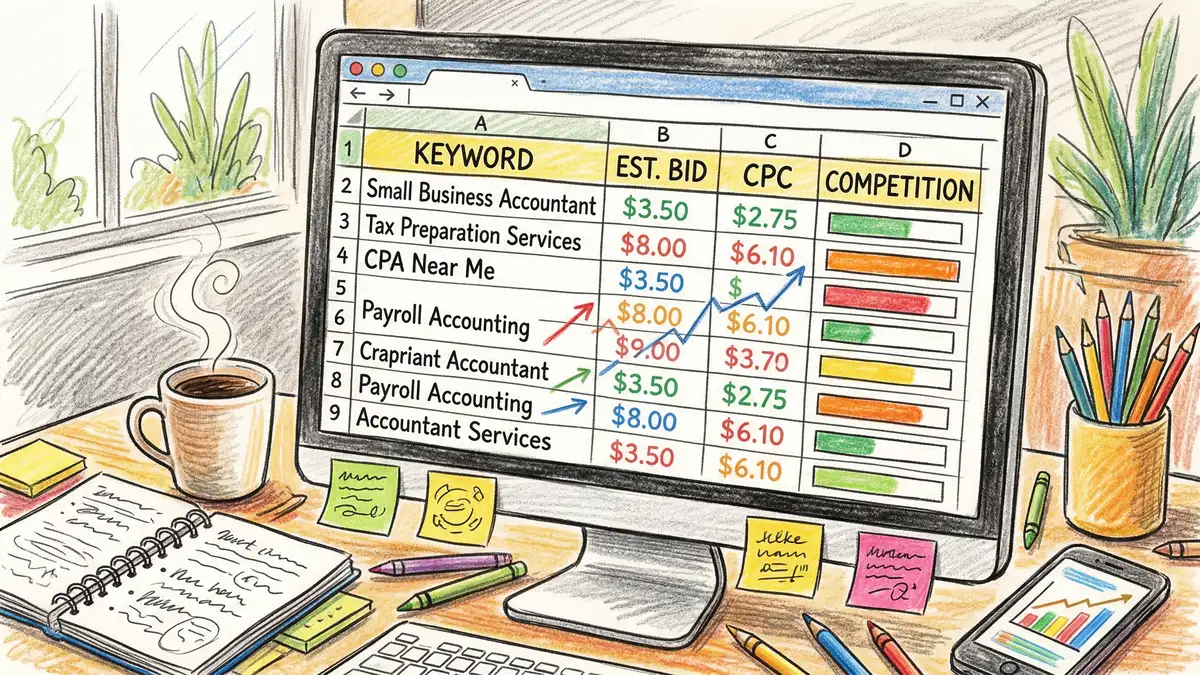
The recommended structure for a multi-service accounting firm uses separate campaigns for each business objective: high-intent service searches ("tax accountant near me", "bookkeeper"), niche speciality services (forensic accounting, R&D tax credits), brand protection (your firm name + competitor names), and remarketing to website visitors. Within each campaign, ad groups should follow the single-theme principle — one service per ad group, with tightly related keywords and landing pages that match.
For example, a tax compliance campaign might contain separate ad groups for "self-assessment accountants", "corporation tax services", "VAT advisory", and "PAYE and payroll". Each ad group gets its own tailored ad copy and dedicated landing page. This tight organisation improves Quality Scores (which Google rewards with lower CPCs), ensures ad copy directly addresses search intent, and makes performance measurement straightforward.
Keyword Match Types: Getting the Balance Right
Use exact match for high-intent core keywords like [tax accountant manchester] — highest relevance, best conversion rates. Use phrase match for intent-rich variations like "small business accountants in Leeds". Deploy broad match cautiously — only when combined with smart bidding strategies and comprehensive negative keyword lists. Without these safeguards, broad match inflates CPA by 40–60%.
Essential Negative Keywords for Accountants
Build your negative keyword list before launch, then expand it weekly from search term reports. Start with these categories: "free" (users seeking unpaid advice), "jobs" and "careers" (job seekers), "courses" and "training" (students), "software" (users wanting tools not services), "HMRC phone number" and "tax calculator" (information seekers). Comprehensive negative keyword management reduces cost per acquisition by 18–25%.
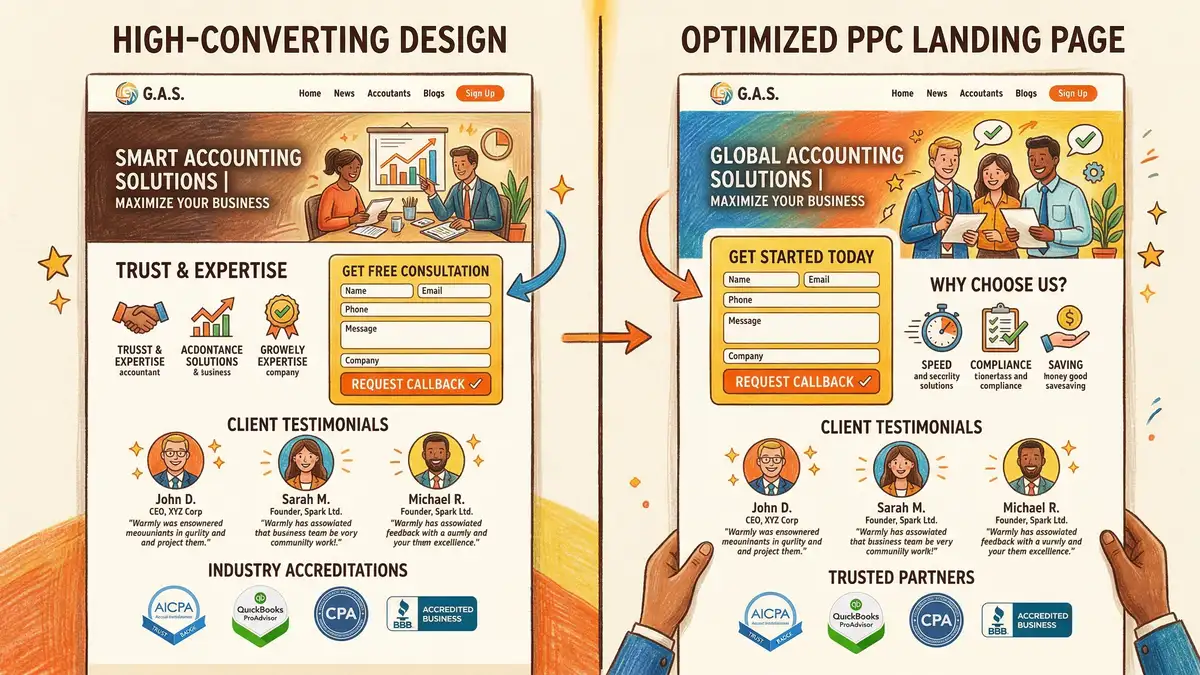
Landing Pages: The Difference Between 3% and 13% Conversion Rates
Your landing page — not your ad copy — determines whether PPC is profitable. Financial services landing pages achieve a median 8.3% conversion rate, significantly outperforming the 3.75% all-industry average (Unbounce, 2025). Top-performing accounting firm pages reach 10–13%.
The elements that drive these results: a benefit-focused headline that matches your ad copy exactly (message match improves conversion by 20–40%), a single focused call-to-action ("Book Your Free Tax Review" rather than multiple competing options), prominent trust signals (ACCA/ICAEW badges, client testimonials, review ratings), and a short form — reducing fields from ten to three increases completion rates by 10–50%.
Mobile optimisation is non-negotiable: over 60% of accounting-related searches happen on mobile. Ensure button sizes work for thumb taps, text is readable without zooming, and page load times stay under 2.5 seconds (Google's Core Web Vitals threshold). Pages scoring "Good" on Core Web Vitals convert 15–25% higher than "Needs Improvement" pages.
Key Takeaway
Create a separate landing page for every major service you advertise. Sending all PPC traffic to your homepage is the fastest way to burn budget — generic pages convert at 2–3%, while service-specific landing pages with message-matched headlines convert at 8–13%. One landing page per ad group, every time.
Budget Recommendations by Firm Size
Calculate your budget backwards from client acquisition targets — not as an arbitrary percentage of revenue. Determine your average client lifetime value, set an acceptable acquisition cost (typically 20–33% of annual client value), and work out how many leads you need at your expected conversion rate.
| Firm Size | Monthly Budget | Est. Clicks | Est. Leads | Campaign Scope |
|---|---|---|---|---|
| Small (1–5 staff) | £1,000–£2,000 | 285–570 | 18–45 | Core service keywords + single geography |
| Mid-size (6–20) | £3,000–£7,500 | 860–2,140 | 50–170 | Segmented by service line + multi-region |
| Large (20+ staff) | £10,000–£25,000+ | 2,850–7,140+ | 170–570+ | Full service + LSAs + remarketing + display |
Estimates assume £3.50 average CPC and 6–8% conversion rate. Budgets exclude management fees (typically £1,000–£1,600/month from UK agencies).
Seasonal budget adjustment is critical. Increase spend by 25–50% during tax season (January–March) and financial year-end (April). Reduce to 60–75% of baseline during summer months (July–August). This flexibility captures high-intent prospects when demand peaks without wasting budget during quieter periods.
Want PPC that works alongside your SEO? See our integrated search marketing services.
View Our Services
PPC vs SEO: When to Use Each (and Why You Need Both)
PPC generates leads within days. SEO builds sustainable traffic over months. The most effective UK accounting firms use both — hybrid PPC-SEO strategies outperform single-channel approaches by 40–60% in lead volume and cost efficiency.
PPC excels during seasonal peaks (self-assessment deadline, year-end), for new service launches, and when you need immediate pipeline. But PPC costs increase 8–15% annually as competition intensifies, and leads stop the moment you pause spend.
SEO requires 6–12 months of investment before significant returns, but cost per lead declines 20–35% after the initial optimisation period. A well-structured content marketing strategy compounds over time — every blog post and guide becomes a permanent lead-generation asset.
The optimal allocation: 60–70% to your primary channel, 30–40% to the complementary channel. During tax season (January–April), shift to 75% PPC / 25% SEO to capture immediate demand. During off-season, reverse the ratio to build content assets that reduce long-term acquisition costs. Our digital marketing for accountants guide covers the full channel comparison.
Local Services Ads: Pay-Per-Lead for Accountants
Local Services Ads (LSAs) appear above both organic results and standard PPC ads, commanding the most premium search position available. Unlike traditional Google Ads, LSAs charge per lead (not per click), meaning you only pay when a prospect contacts you directly — fundamentally reducing acquisition risk.
To qualify, accounting firms must complete Google's verification process: business classification confirmation, Google Business Profile completion, minimum review requirements (typically 5–10 reviews at 3.5+ stars), background checks, and credential verification (ACCA/ICAEW membership). Verified firms earn a Google Screened badge that significantly increases click-through rates and client confidence.
LSA cost per lead ranges from £15–£50 depending on location (metropolitan areas command higher rates). For accounting firms in competitive urban markets where standard PPC CPCs exceed £5, LSAs frequently deliver more efficient lead generation. Key ranking factors: geographic proximity to the searcher, review score and quantity, response speed to enquiries, and clearly defined service areas.
Frequently Asked Questions
How much should an accountant spend on Google Ads?
Small firms (1–5 staff) should start with £1,000–£2,000 monthly ad spend, mid-size firms (6–20 staff) with £3,000–£7,500, and large firms (20+ staff) with £10,000–£25,000+. These budgets exclude agency management fees (typically £1,000–£1,600/month). Calculate your budget backwards from client lifetime value — target an acquisition cost of 20–33% of annual client value.
What is a good conversion rate for accounting PPC?
Professional services PPC landing pages average 6–8% conversion rates, with top performers reaching 10–13%. Financial services pages specifically achieve a median 8.3% conversion rate. If your landing pages convert below 6%, focus on improving message match between ads and landing pages, reducing form fields, and adding trust signals (ACCA/ICAEW badges, testimonials).
Are Google Ads worth it for small accounting firms?
Yes, if managed correctly. At £1,500 monthly spend with £3.50 average CPC, a small firm generates approximately 430 clicks and 25–35 qualified leads at 6–8% conversion rates. With a 20–35% lead-to-client conversion rate, that's 5–12 new clients monthly. The key is tight keyword targeting, dedicated landing pages, and comprehensive negative keyword lists to prevent waste.
How do PPC and SEO work together for accountants?
Hybrid strategies outperform single-channel approaches by 40–60%. PPC captures immediate demand (especially during tax season), while SEO builds sustainable organic traffic that reduces long-term acquisition costs by 20–35%. PPC keyword data also informs SEO strategy — showing which terms convert best — while strong organic presence improves PPC click-through rates by 15–25%.
What are Local Services Ads for accountants?
LSAs are a pay-per-lead Google ad format appearing above standard search results. Accountants pay only when prospects contact them (£15–£50 per lead). Qualification requires Google verification of credentials, reviews, and business details. Verified firms earn a Google Screened badge. LSAs are particularly cost-effective in competitive metropolitan markets where standard PPC costs are high.
Want Google Ads That Actually Generate Clients?
Whitehat SEO builds integrated search campaigns for UK accounting firms — combining PPC for immediate leads with SEO for sustainable growth. Let's audit your current campaigns.
Sources: Unbounce Conversion Benchmark Report 2025, WordStream Industry Benchmarks 2025, Google Local Services Ads, Cal Partners Accounting PPC Guide 2025, Whitehat SEO PPC Management Data 2026
More Accountant Marketing Guides
- SEO for Accountants UK: The Complete Guide — Our comprehensive pillar guide to accountant SEO
- Digital Marketing for Accountants — Full channel comparison with ROI data
- Accountant Website Design & SEO — Building high-converting practice websites
- Lead Generation for Accounting Firms — Multi-channel client acquisition
- Local SEO for Accountants — Google Business Profile and map pack domination
- Social Media Marketing for Accountants — Platform-by-platform strategy guide
- Content Marketing for Accountants — Blog topics, formats, and ROI guide
- Accountant Marketing Costs & ROI — What to spend by firm size
Clwyd Probert
Founder & Managing Director, Whitehat SEO
Clwyd has been managing PPC and integrated search campaigns for professional services firms since 2009, specialising in Google Ads strategy, landing page optimisation, and SEO-PPC integration for UK accounting practices.