
The critical finding for B2B strategists: brands cited in AI Overviews earn 35% more organic clicks and 91% more paid clicks compared to non-cited brands. Being visible in AI responses isn't just defensive—it amplifies traditional SEO performance. And 97% of AI Overview citations come from pages already ranking in the top 20 organic results, meaning traditional SEO directly feeds AI visibility.
SEO Strategy in 2026: The Definitive Research Briefing for B2B Marketers
Organic search remains the dominant revenue channel for B2B companies—generating 44.6% of all B2B revenue—but the rules have fundamentally changed. Despite alarming predictions, actual organic traffic declined just 2.5% year-over-year in 2025, not the 25% Gartner projected. The real shift is structural: AI Overviews now appear in 30% of US queries (12.5% in the UK), zero-click searches have climbed to 58–69%, and brand mentions now predict AI visibility 3x more reliably than backlinks.
For UK B2B marketers, the opportunity is immense—the UK actually saw a +0.57% organic traffic rebound in 2025 whilst the US declined 4.5%. This briefing synthesises the most credible 2025–2026 research to inform a comprehensive SEO strategy for forward-thinking businesses.
The AI Search Reality Is Nuanced, Not Catastrophic
The narrative around AI destroying organic search is significantly overstated. A graphite/Similarweb analysis of 40,000+ US websites in January 2026 found organic search traffic declined just 2.5% year-over-year—a fraction of the dramatic losses industry commentators predicted. Google still processes over 16 billion searches daily (up from 8.5 billion in 2024) and maintains 93.35% UK market share. The absolute number of clicks has actually expanded.
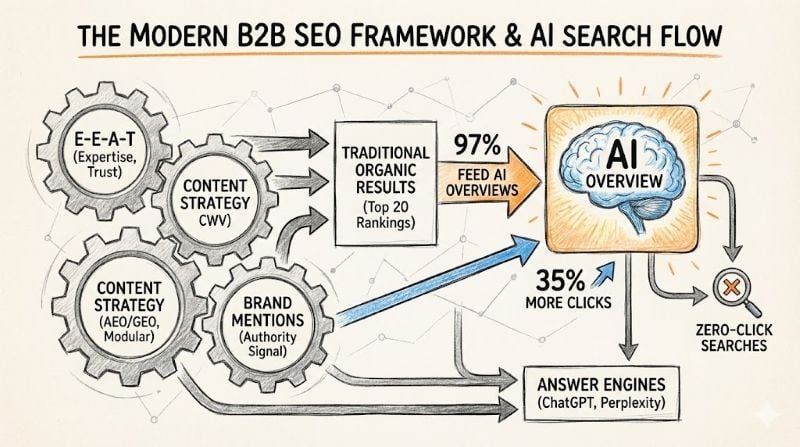
That said, the impact is real and unevenly distributed. AI Overviews now trigger on approximately 30% of US desktop queries and 12.5% of UK searches, with 88.1% of those being informational queries. When AI Overviews appear, Seer Interactive's study of 25.1 million organic impressions found organic CTR plummets 61% (from 1.76% to 0.61%). Even queries without AI Overviews saw organic CTR decline 41% year-over-year, suggesting a broader behavioural shift.
The publishing sector bears the heaviest losses—global publisher Google traffic dropped by a third in 2025. HubSpot reported 70–80% traffic declines, CNN saw 27–38% drops. But these losses concentrate in informational publishing—e-commerce, local services, and B2B companies with strong commercial intent content remain more insulated.
35%
more organic clicks for brands cited in AI Overviews compared to non-cited brands
Zero-Click Searches and the AI Mode Threat
Zero-click searches have grown from 56% to 69% between May 2024 and May 2025. Only 360 out of every 1,000 Google queries in the US now reach the open web. Google's AI Mode—a separate conversational search experience launched in 2025—is even more concerning: 93% of AI Mode searches end without a click, versus 43% for standard AI Overviews. Analysts expect Google may make AI Mode a default experience in 2026.
For AI answer engines specifically, ChatGPT holds 64.5–68% of the AI chatbot market (down from 87% in January 2025), Google Gemini has nearly quadrupled to 18–21.5%, whilst Perplexity, Claude, and Grok each hold approximately 2%. AI platforms still account for just 0.18% of global internet traffic—but that figure grew 225% year-over-year and AI referral traffic converts at rates up to 9x better than other channels.
The Modern SEO Framework Now Has Four Pillars
The traditional three-pillar SEO model (technical, content, authority) has expanded to four, with Answer Engine Optimisation (AEO) and Generative Engine Optimisation (GEO) establishing themselves as a distinct discipline. A Conductor survey of 250+ CMOs found 97% reported positive impact from AEO/GEO in 2025, and 94% plan to increase investment in 2026.
How AEO/GEO Works Differently from Traditional SEO
The distinction matters because AI engines evaluate content differently from Google's traditional algorithm. Elementor's research reveals a dramatic bifurcation: Google AI Overviews strongly correlate with traditional top-10 rankings (81.1% probability of citing a top-10 result), but standalone LLMs show weak correlation—over 80% of ChatGPT citations come from sources outside top search results.
Only 12% of ChatGPT citations match URLs on Google's first page, and 89% of citations differ between ChatGPT and Perplexity for the same queries. This means brands need parallel optimisation strategies.
| Factor | Traditional SEO | AEO/GEO |
|---|---|---|
| Primary signals | Backlinks, relevance, Core Web Vitals | Content depth, readability, brand mentions |
| Citation sources | 10 blue links | 2–7 domains per response |
| Content structure | Keyword-optimised | Answer-first, modular, self-contained |
| Top cited sources | Domain authority leaders | Wikipedia (7.8%), Reddit (1.8%), G2 (1.1%) |
The practical integration looks like this: optimise for traditional SEO as the foundation (you need top-20 rankings to feed AI Overviews), then layer in AEO-specific tactics—answer-first content structure, modular content design, schema markup, and cross-platform brand presence. Microsoft published a comprehensive AEO/GEO guide in January 2026 declaring these disciplines "may soon overtake SEO."
E-E-A-T Has Become the Non-Negotiable Quality Framework
Experience, Expertise, Authoritativeness, and Trustworthiness moved from a quality rater concept to the central evaluation framework for both traditional search and AI engines. The December 2025 Core Update was pivotal—E-E-A-T requirements broadened beyond YMYL topics to virtually all competitive queries. Even entertainment and lifestyle content now needs demonstrated expertise.
Health sites were hit hardest (67% affected) alongside affiliate sites (71%). Author attribution has become essentially mandatory for competitive queries after the December 2025 update. Anonymous or generic authorship faces ranking challenges. Google evaluates author expertise through credentials, publication history, cross-platform presence, and citations by other experts.
⚡ E-E-A-T Requirements for B2B Content
- Qualified author identification with verifiable credentials
- Original images and screenshots showing real work
- Specific case studies with data and timelines
- Rigorous fact-checking and transparent editorial standards
- Expert review process for AI-assisted content
AI-generated content receives a "Lowest" quality rating in the January 2025 QRG update if it lacks originality or value—though Google does not penalise AI-assisted content that meets quality standards. The key distinction is scaled content abuse (mass-producing content solely to manipulate rankings) versus AI-assisted quality content (expert-guided, thoroughly reviewed, adding unique value).
Content Strategy Demands Dual Optimisation and Topical Depth
Structure Content for AI Extraction
The single most actionable content change for 2026 is adopting an answer-first structure. Place a 40–60 word direct answer immediately after each heading—this is the "citation block" AI may extract. AI Overviews average 157 words per response, with 99% under 328 words. One case study showed modular content design (breaking articles into self-contained modules) increased AI citation rates by 340% over traditional long-form articles.
Content with question-based H2/H3 headers, clear formatting, bullet points, and comparison tables is 28–40% more likely to be cited by AI engines. Pages with proper Article and FAQ schema see AI citations increase by 28%. Content updated within the last 30 days earns 3.2x more citations. And content featuring original statistics sees 30–40% higher visibility in AI responses.
Build Topical Authority Through Content Clusters
Topical authority has overtaken domain authority as the primary ranking signal. Google's June 2025 Core Update specifically reinforced this—rewarding sites that cover subjects thoroughly, consistently, and credibly. Content grouped into topic clusters drives approximately 30% more organic traffic and holds rankings 2.5x longer than standalone pieces.
Sites with topic clusters receive 3.2x more AI citations than single-page competitors, with 86% of AI citations coming from sites with 5+ interconnected pages on a topic. The recommended structure: pillar pages of 2,500–4,000 words covering broad topics, supported by 8–12 cluster pages of 800–1,500 words each, all internally linked.
Off-Site Platforms Drive AI Citations
The platforms AI engines cite most are revealing. YouTube now appears in 16% of LLM answers versus Reddit's 10%—a complete reversal from 2025. A Surfer SEO study of 36 million AI Overviews found YouTube captures 23.3% of all AI citations. For B2B companies, the priority platforms are YouTube (video content is no longer optional), LinkedIn (highest B2B impact for thought leadership), Reddit (authentic community participation), and review sites like G2 and Capterra (10% increase in G2 reviews = 2% increase in AI citations).
Technical SEO Foundations Remain Critical
Core Web Vitals thresholds remain unchanged since INP replaced FID in March 2024: LCP ≤ 2.5 seconds, INP ≤ 200 milliseconds, and CLS ≤ 0.1. Only 47–52% of websites pass all three metrics, with mobile pass rates (43.4%) significantly trailing desktop. CWV function as a tiebreaker among pages with similar content quality—moving from "Poor" to "Good" produces measurable ranking improvements.
In March 2025, both Google and Microsoft publicly confirmed they use Schema Markup for their generative AI features. ChatGPT confirmed it uses structured data to determine which products appear in search results. Pages with rich results see 20–40% CTR improvements, and entity linking through schema increases AI Overview visibility by up to 69% in documented case studies.
The most important schema types for 2026: Organization, Article/BlogPosting, LocalBusiness, Product, Review/AggregateRating, BreadcrumbList, Person (for author E-E-A-T), and VideoObject. FAQ and HowTo schemas no longer generate rich results for most sites (deprecated 2023–2024) but still provide semantic value for AI systems.
The AI crawler ecosystem has expanded significantly. GPTBot (OpenAI) accounts for 30% of AI crawler traffic, followed by ClaudeBot (21%), Meta-ExternalAgent (19%), and Amazonbot (11%). The strategic recommendation is nuanced: allow search-focused AI crawlers (OAI-SearchBot, PerplexityBot) to maintain visibility in AI answers, whilst making deliberate decisions about training-only crawlers. ChatGPT's search mode is powered by Bing's index, making Bing Webmaster Tools indexing essential for AI visibility.
Brand Mentions Now Outweigh Backlinks for AI Visibility
This represents the most significant shift in off-page SEO since PageRank. Ahrefs' research across 75,000 brands found brand mentions show a 0.664 correlation with AI Overview visibility—the strongest signal measured—significantly outperforming traditional backlinks. Brands in the top 25% for web mentions earn 10x more AI visibility than others.
Link building remains important for traditional rankings—the #1 Google result has 3.8x more backlinks than positions 2–10—but LLMs do not use PageRank-style evaluation. They are trained on raw text and evaluate recurring brand references, context, and co-occurrence patterns. Seer Interactive found traditional SEO strength (rankings, backlinks) showed little correlation with brand mentions in AI answers.
Digital PR: The Dominant Strategy
Digital PR was voted the most effective link-building tactic by 48.6% of 518 SEO professionals for the second consecutive year. John Mueller himself endorsed it: "I love some of the things I see from digital PR; it's just as critical as tech SEO, probably more so in many cases." Digital PR earns both editorial backlinks for traditional rankings and brand mentions for AI visibility—the ideal combination.
Local SEO Remains High-Converting Despite AI Disruption
Local search represents a distinct opportunity because AI Overviews trigger on only 7.9% of local searches—far below the 30% average. Meanwhile, 46% of all Google searches have local intent, 76% of nearby searchers visit a physical location within a day, and 78% of location-based mobile searches result in an offline purchase.
Google Business Profile optimisation requires treating the listing as a living asset. Businesses posting weekly updates see 30% higher customer interactions. GBP verification requirements tightened in January 2026, now checking citation consistency before approval. Reviews have become both trust signals and ranking factors—73% of consumers won't consider reviews older than one month, and businesses with 200+ reviews generate 2x the revenue of others.
For B2B specifically, 80% of B2B buyers use mobile at work and 60%+ say mobile played a significant role in their recent purchase. LocalBusiness schema with geo coordinates, service areas, and sameAs links is essential for feeding AI citations in local contexts.
The Business Case for SEO Investment Remains Overwhelming
For B2B marketing directors evaluating channel allocation, the data strongly favours SEO investment.
748%
Median ROI for SEO thought leadership vs 36% for PPC
702%
Average B2B SaaS SEO ROI with 7-month break-even
8.5x
Better conversion rate for SEO leads (14.6%) vs outbound (1.7%)
44.6%
Of all B2B revenue generated by organic search
70% of marketers confirm SEO generates more sales than PPC. Content marketing costs 62% less and generates 3x more leads than traditional marketing. The global SEO services market reaches £83.98 billion in 2026, projected to nearly double by 2030.
The UK context makes the case even stronger: UK organic search traffic actually grew 0.57% in 2025 whilst the US declined. UK social media traffic is just 6.14% of total traffic—well below US levels—meaning organic search is proportionally even more dominant for UK B2B companies. And Google's UK market share of 93.35% means the search audience is concentrated on a single platform more than almost any other major market.
What Endures, What's Obsolete, and What's Next
Five SEO practices will remain critical regardless of AI developments: E-E-A-T as the quality framework, technical SEO fundamentals, brand reputation and authority building, high-quality human-authored content with genuine expertise, and strong organic rankings that feed AI citation systems. The data is clear that 97% of AI Overview citations come from traditional top-20 results—the bridge between old and new SEO is direct.
What's becoming obsolete: thin keyword-stuffed content, traffic-only success metrics, siloed SEO programmes disconnected from PR and product, programmatic content farms, and single-channel dependency on Google organic alone. The shift toward conversion quality over traffic volume is the defining strategic reorientation.
Looking ahead, Gartner's boldest prediction—that by 2028, 90% of B2B buying will be AI agent intermediated—points toward "agent engine optimisation" as the next frontier. But their previous predictions (25% organic decline by 2026) proved dramatically overstated when actual data showed 2.5%. The measured reality: search is fragmenting across more surfaces, AI amplifies the advantage of authoritative brands, and the companies investing in genuine expertise, structured content, and multi-platform presence will compound their advantage. For UK B2B companies, the window to establish AI-era SEO dominance is now—before the market catches up to the structural shift already underway.
Frequently Asked Questions
How much has organic traffic actually declined in 2025?
Organic search traffic declined just 2.5% year-over-year in 2025, according to a Graphite/Similarweb analysis of 40,000+ US websites. This is far below the 25% decline Gartner originally predicted. The UK actually saw a +0.57% organic traffic rebound whilst the US declined 4.5%.
What percentage of searches trigger AI Overviews?
AI Overviews now trigger on approximately 30% of US desktop queries and 12.5% of UK searches. When AI Overviews appear, organic CTR drops by 61% on average. However, brands cited in AI Overviews earn 35% more organic clicks compared to non-cited brands.
What is Answer Engine Optimisation (AEO)?
Answer Engine Optimisation (AEO) is the practice of optimising content to appear in AI-generated responses from platforms like ChatGPT, Google AI Overviews, Perplexity, and Claude. It focuses on answer-first content structure, modular design, schema markup, and cross-platform brand presence.
Do brand mentions matter more than backlinks for AI visibility?
Yes. Ahrefs' research across 75,000 brands found brand mentions show a 0.664 correlation with AI Overview visibility—the strongest signal measured—significantly outperforming traditional backlinks. Brands in the top 25% for web mentions earn 10x more AI visibility than others.
What ROI can B2B companies expect from SEO investment?
B2B SaaS companies average 702% ROI from SEO with a 7-month break-even period. SEO leads close at 14.6% versus 1.7% for outbound—an 8.5x better conversion rate. Organic search generates 44.6% of all B2B revenue, making it the largest revenue channel.
Ready to Future-Proof Your SEO Strategy?
As a HubSpot Diamond Partner and leaders of the world's largest HubSpot User Group, we help B2B companies navigate the AI search transition with evidence-based strategies.
Book a Discovery Call →References & Sources
- Semrush AI Overviews Study: What 2025 SEO Data Tells Us About Google's Search Shift
- Ahrefs: 43 B2B SEO Statistics for 2025
- Search Engine Land: Google AI Overviews Surged in 2025, Then Pulled Back
- SeoProfy: 71 B2B SEO Statistics for 2025-2026
- Powered by Search: B2B SaaS SEO Statistics for 2025
- The Digital Bloom: 2025 Organic Traffic Crisis Analysis Report
- Onely: Zero-Click Search Is Evolving Into Zero-Search Discovery
- BrightEdge Research: Organic Search Performance Studies
- First Page Sage: SEO ROI Statistics and Benchmarks