
Process visualisation outperforms outcome visualisation by 6–8 points on measured outcomes, and structured approaches like WOOP have shown participants become twice as physically active and complete difficult projects at three times the rate of those without implementation plans. This isn't motivational theory—it's peer-reviewed science that Whitehat SEO applies to marketing strategy and goal-setting with clients across sectors.
Evidence-Based Visualisation for Goal Achievement: Why Process Beats Pure Positive Thinking
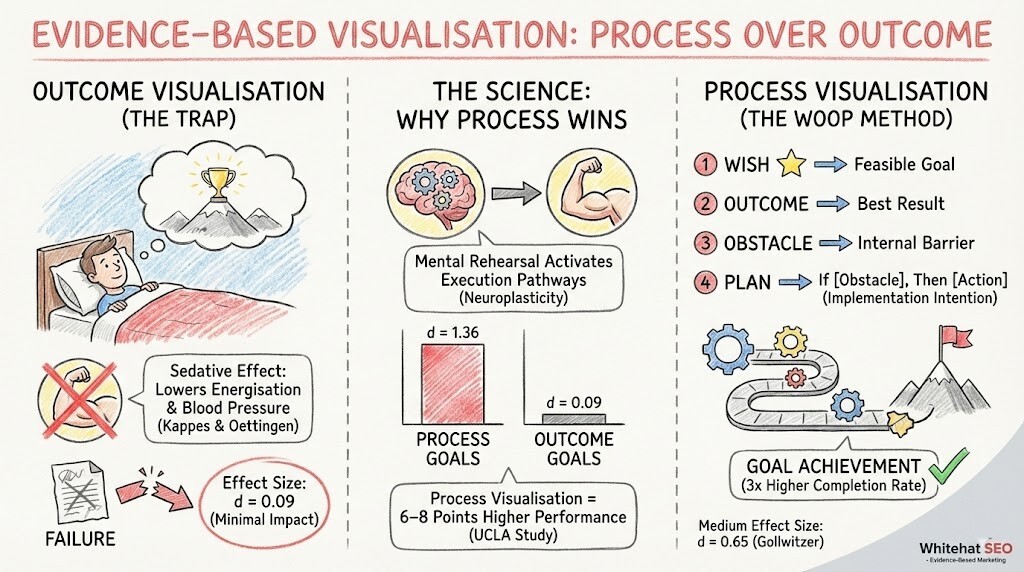
Pure positive thinking can actually sabotage your goals—but the right visualisation techniques can double your chances of success. Research spanning 20+ years from psychologists Gabriele Oettingen and Peter Gollwitzer demonstrates that how you visualise matters more than whether you visualise at all. The WOOP method (Wish, Outcome, Obstacle, Plan) produces a medium effect size (d = 0.65) across 94 studies, whilst outcome-only visualisation creates a "sedative effect" that tricks your brain into thinking goals are allready achieved.
For B2B marketers, sales leaders and business owners, this distinction is critical. Whether you're setting quarterly pipeline targets, preparing for a crucial client presentation, or aligning your team around annual objectives, the evidence clearly supports visualisation as a strategic tool—but only when applied correctly.
The Neuroscience Behind Why Visualisation Works—and Why It Often Fails
Mental imagery activates the same neural pathways as physical execution. fMRI studies demonstrate that imagining a task engages the visual cortex, motor cortex, prefrontal cortex and parietal regions identically to performing the action. A 2024 study from Imperial College London published in Frontiers in Human Neuroscience confirmed that mental rehearsal produces neuroplastic changes associated with skill learning, including reduced attentional demands and increased task automaticity.
However, this same mechanism creates a trap. When you vividly imagine achieving a goal without considering obstacles, your brain experiences a relaxation response. Research by Heather Kappes and Gabriele Oettingen showed that positive fantasies about idealised futures actually lower systolic blood pressure—the physiological marker of energisation needed to pursue goals.
Oettingen's research found that job seekers who spent more time fantasising about their "dream job" received fewer offers and lower starting salaries than those who engaged in mental contrasting. The Cleveland Clinic research adds another dimension: mental visualisation increased pinkie finger strength by 35% and mental rehearsal of weight training boosted muscle strength by up to 13.5%. The brain-body connection is real—but the research consensus is clear: visualisation must include both the desired future and the obstacles standing in the way.
Process Visualisation Consistently Outperforms Outcome Visualisation
The landmark UCLA study by Shelley Taylor and Lien Pham divided students into three groups before an exam: one visualised studying (process), one visualised receiving an A grade (outcome), and one served as a control. Results showed process visualisers scored 8 points higher than the control group and 6 points higher than outcome visualisers. Crucially, the outcome-only group performed barely better than doing nothing at all.
A 2022 meta-analysis published in the International Review of Sport and Exercise Psychology quantified this difference dramatically across multiple studies:
- Process goals: effect size of d = 1.36 on performance
- Performance goals: effect size of d = 0.44
- Outcome goals: effect size of only d = 0.09
Process goals also significantly increased self-efficacy (d = 1.11), creating a virtuous cycle where confidence reinforces behaviour change. For marketing teams setting quarterly targets, this means visualising the campaign execution, client meetings, and strategic decisions—not just the revenue numbers on a dashboard.
Whitehat SEO's HubSpot onboarding process incorporates these principles by helping clients visualise the specific workflows, content production steps, and team coordination required—rather than simply imagining the end-state of "marketing automation success."
The WOOP Method Delivers the Strongest Evidence-Based Results
WOOP (Wish, Outcome, Obstacle, Plan) combines mental contrasting with implementation intentions into a four-step framework. A 2021 meta-analysis in Frontiers in Psychology analysing 21 studies with 15,907 participants found MCII/WOOP effective with a small-to-medium effect size (g = 0.336). Face-to-face delivery proved more effective (g = 0.465) than document-based self-guided approaches (g = 0.277).
The practical results are compelling: WOOP users doubled their physical activity levels, students completed 60%+ more practice questions when preparing for exams, and medical residents studied nearly three times more (4.3 versus 1.5 hours per week) compared to goal-setting alone. Cross and Sheffield's 2019 meta-analysis found mental contrasting effects actually strengthen over time—from g = 0.28 at four weeks to g = 0.38 at three months.
Oettingen explains the mechanism: "What mental contrasting does, it connects the desired future to the obstacles of reality. So, if you mentally contrast a feasible wish, then you cannot really think about that wish anymore without the obstacle appearing right away." This automatic cognitive link transforms vague aspirations into concrete action triggers.
Implementation intentions, developed by Peter Gollwitzer, form the "Plan" step. These if-then statements ("If situation X arises, then I will do Y") create what Gollwitzer calls "strategic automaticity"—delegating behavioural control to environmental cues. His landmark meta-analysis of 94 independent tests found implementation intentions produced a medium-to-large effect (d = 0.65) on goal attainment. Simply formulating a written plan increases success probability by 50%, and people with implementation intentions completed difficult projects at three times the rate of those without.
The Four Steps of WOOP
- Wish: Identify a meaningful, challenging but feasible goal
- Outcome: Vividly imagine the best possible result of achieving this wish
- Obstacle: Identify the main internal obstacle that could prevent you from achieving it
- Plan: Create an if-then plan: "If [obstacle], then I will [action to overcome it]"
Vision Boards Require Reconfiguration to Align with Research
The evidence on vision boards is genuinely mixed. A TD Bank survey of over 1,100 people found that 82% of small business owners using vision boards accomplished more than half their goals, and users were nearly twice as confident (59% versus 31%) about achieving their objectives. However, psychotherapist Amy Morin, writing in Inc., observes: "Rather than get out there and work toward their goals, people who created vision boards seemed to be waiting for the universe to grant their wishes."
The reconciliation lies in how vision boards are constructed. Neuroscientist Dr Tara Swart, who works with executive clients including LinkedIn, MIT Sloan and Samsung, recommends renaming them "Action Boards." The brain assigns higher value to images than written to-do lists through a process called "value-tagging," and repeated exposure can reduce the physiological fear response to new situations. But Swart emphasises: "Research also shows that visualising only outcomes rather than the work it actually takes to get there hinders success."
For B2B applications, evidence-based vision boards should include process images (yourself taking action), paired SMART goals and action plans, specific implementation steps alongside end results, and connections to meaningful personal and professional values.
Strategic Visualisation Drives Business Performance and Investor Confidence
Harvard Business Review published research in July 2025 demonstrating that compelling strategic visualisation was the key factor determining investor response to CEO acquisition presentations. Analysis of 654 CEO presentations found that a single, clear visualisation of strategy was the best way to win buy-in from employees and investors. Case study: Cypress Semiconductor's acquisition of Spansion ($1.6 billion) resulted in a 13% stock price jump, attributed significantly to effective strategy visualisation.
The researchers identified five critical design principles: group ideas into three or four main concepts, create layers with increasing detail, use colour only to distinguish layers, indicate clear sequence of relationships, and make content rapidly digestible. These principles align with cognitive science—brains process visuals 60,000 times faster than text, and people remember 65% of visual content after three days versus only 10–20% of written information.
OKR frameworks integrate visualisation through strategy maps, dashboards and roadmaps. Research shows 83% of survey participants agree OKRs have positive organisational impact, and teams with transparent goals are 6.4 times more likely to produce high-quality work. Yet less than 10% of strategic plans are effectively executed, highlighting the gap between planning and implementation where process visualisation and implementation intentions can intervene.
Brian Scudamore, founder of 1-800-GOT-JUNK?, credits his "Painted Picture" visualisation technique with transforming a business stalled at $1 million for eight years into a $100 million multinational. Written as a detailed narrative of the future state, his vision was read aloud at quarterly meetings and shared with all stakeholders. Research on 183 entrepreneurs (average revenue $2.5 million) found companies with documented visions grew more than double compared to those without.
The Manifestation Trap: Real Risks for Business Decision-Making
A peer-reviewed study by Dixon, Hornsey and Hartley published in Personality and Social Psychology Bulletin provides crucial counterbalance. Over one-third of participants endorsed manifestation beliefs, with #manifestation accumulating 34.6 billion TikTok views. Critically, manifesters perceived themselves as more successful but showed no difference in actual income or education attainment. More concerning:
- 1.42× more likely to have declared bankruptcy
- 1.28× more likely to have been fraud victims
The researchers concluded: "Manifestation belief was related to risky financial investments and negative financial outcomes as well as overconfident estimates of the likelihood and timeframe for achieving unlikely levels of success." For business contexts, this underscores why evidence-based visualisation frameworks matter—the difference between WOOP's structured approach and pure "positive thinking" is the difference between strategic planning and magical thinking.
Psychology Today's analysis identified specific harms: victim blaming (attributing all outcomes to mindset), emotional suppression (pressure to maintain "high vibrations"), reality distortion, and spiritual bypassing. For B2B organisations, manifestation culture can lead to unrealistic projections, inadequate risk assessment and blame dynamics when targets aren't met.
Practical Applications for Marketing and Sales Teams
Mental rehearsal applies directly to high-stakes business scenarios. Before sales calls and presentations, visualising not just successful outcomes but the specific process—tone of voice, body language, handling objections, and recovery from setbacks—improves performance and reduces anxiety. Research confirms visualising both outcome and process together improves confidence and execution.
For marketing strategy, team goal visualisation workshops using visual canvases and collaborative boards create alignment across functions. Documented case studies show Zoom achieved 280% revenue increase (2019–2020) after adopting goal-based management with visual alignment, and Unilever's Sustainable Living Plan produced a 22% increase in team performance through cross-departmental workshops with shared visual goals.
Digital tools supporting evidence-based approaches include the official WOOP app (free, implementing the full method), GoalsOnTrack (combining vision board functionality with SMART frameworks), and Miro templates for team goal-setting workshops. Whitehat SEO's HubSpot partner services often integrate these methodologies into dashboard design and team alignment processes.
Key Research Statistics at a Glance
| Finding | Effect/Statistic | Source |
|---|---|---|
| Implementation intentions effect | d = 0.65 (medium-to-large) | Gollwitzer meta-analysis, 94 studies |
| MCII/WOOP effect | g = 0.336 (small-to-medium) | Frontiers in Psychology 2021, 15,907 participants |
| Process vs outcome goals | d = 1.36 vs d = 0.09 | Sport Psychology meta-analysis 2022 |
| Process visualisation exam scores | 8 points higher than control | Taylor & Pham, UCLA |
| Written plan success increase | 50% higher probability | Gollwitzer research |
| Vision board goal achievement | 82% achieved >50% of goals | TD Bank survey, 1,100+ participants |
| Visual processing speed | 60,000× faster than text | Cognitive science research |
The Evidence Demands Strategic, Process-Focused Visualisation
The research consensus is unambiguous: visualisation works, but only when it includes process focus, obstacle identification and specific implementation plans. Pure outcome visualisation—whether through traditional vision boards or manifestation practices—can reduce motivation and lead to worse outcomes than no visualisation at all.
For B2B marketing professionals, the practical framework is clear: apply WOOP systematically to individual and team goals, emphasise process visualisation in sales preparation and campaign planning, use strategic visualisation for stakeholder buy-in (following HBR's design principles), and reconfigure any vision board practices to include action steps and implementation intentions.
The neuroscience confirms that mental imagery creates real neural changes. The meta-analyses quantify meaningful effect sizes. The critical research explains why some approaches backfire. Together, this evidence base provides marketing leaders with a rigorous foundation for incorporating visualisation into goal-setting practices—transforming an often-dismissed "soft skill" into a strategic capability grounded in psychological science.
Apply Evidence-Based Strategy to Your Marketing
Whitehat SEO helps B2B companies build marketing strategies grounded in research, not wishful thinking. From SEO programmes to HubSpot implementation, we focus on process, measurement and results.
Explore Our ServicesFrequently Asked Questions
What is the WOOP method and how does it work?
WOOP stands for Wish, Outcome, Obstacle, Plan. Developed by psychologist Gabriele Oettingen, it combines mental contrasting (imagining both success and obstacles) with implementation intentions (if-then planning). Research across 15,907 participants shows WOOP produces measurable improvements in goal attainment, with effects that strengthen over time.
Why does positive thinking sometimes backfire?
Vividly imagining success without considering obstacles creates a "sedative effect"—your brain experiences a relaxation response as if the goal is already achieved. Research shows this actually lowers the physiological energisation needed to pursue goals. Job seekers who fantasised more about their dream job received fewer offers and lower salaries.
How can I apply visualisation to B2B sales and marketing?
Focus on process visualisation: before client calls, mentally rehearse your specific actions, tone, objection handling and recovery from setbacks—not just the successful outcome. For team goals, use visual strategy maps and create implementation intentions for key milestones. Research shows this approach improves both confidence and execution.
Do vision boards actually work?
Vision boards can work—but only when configured correctly. 82% of business owners using them achieved over half their goals. However, they must include process images (yourself taking action), specific implementation steps, and obstacles alongside outcomes. Pure outcome-focused boards may actually reduce motivation.
What is the difference between manifestation and evidence-based visualisation?
Manifestation relies on belief in cosmic attraction through positive thinking alone. Evidence-based visualisation (like WOOP) systematically combines desired outcomes with obstacle identification and concrete action planning. Research shows manifesting believers are 1.42× more likely to declare bankruptcy, whilst WOOP users achieve goals at significantly higher rates.
References and Further Reading
- Wang, G., Wang, Y., & Gai, X. (2021). A Meta-Analysis of the Effects of Mental Contrasting With Implementation Intentions on Goal Attainment. Frontiers in Psychology. Read the study
- Dixon, L. J., Hornsey, M. J., & Hartley, N. (2023). "The Secret" to Success? The Psychology of Belief in Manifestation. Personality and Social Psychology Bulletin. Read the study
- Salvado, J. C., & Vermeulen, F. (2025). You Should Be Able to Boil Your Strategy Down to a Single Clear Visualization. Harvard Business Review. Read the article
- WOOP My Life – Official website for the WOOP method with free app, research summaries and practice guides. Visit woopmylife.org
- Gollwitzer, P. M. (1999). Implementation Intentions: Strong Effects of Simple Plans. American Psychologist. Read the PDF
- Mental Rehearsal and Neuroplasticity (2024). Frontiers in Human Neuroscience. Read the study
About Whitehat SEO: We're a London-based HubSpot Diamond Partner and full-service inbound marketing agency. Since 2011, we've helped B2B companies across sectors build marketing strategies that deliver measurable results. We run the world's largest HubSpot User Group and believe in applying evidence-based thinking to everything we do.