
SEO Strategy
Black hat SEO encompasses any search engine optimisation practice that violates Google's Search Essentials guidelines. The term originates from old Western films where villains wore black hats—a fitting metaphor for tactics that prioritise short-term manipulation over genuine user value.
Black Hat SEO: What It Is, Why It Fails, and What to Do Instead
The Short Answer
Black hat SEO is any tactic that manipulates search rankings in violation of Google's spam policies—link schemes, cloaking, keyword stuffing and scaled content abuse. White hat SEO earns the same rankings by creating genuine value for users. The practical difference is intent and durability: manipulation invites penalties, value compounds.
Google's 2024 crackdown eliminated 45% of low-quality content from search results. Here's what you need to know about risky SEO tactics—and the ethical strategies that actually deliver sustainable growth.
Key Takeaway
Black hat SEO refers to unethical search engine optimisation tactics that violate Google's guidelines to manipulate rankings artificially. These practices—including link schemes, keyword stuffing, and cloaking—may deliver short-term gains but typically result in devastating penalties: 50-95% traffic drops within 72 hours and recovery periods of 6-18 months or longer. Whitehat SEO's analysis of post-penalty businesses shows 40% close within six months.
Key Insight
Google's March 2024 Core Update represented the most aggressive spam crackdown in a decade—deindexing major publishers including Forbes Advisor, CNN Underscored, and WSJ's Buy Side. Brand authority no longer provides immunity from enforcement.
In this guide
- What is black hat SEO?
- Black hat SEO techniques to avoid
- How Google detects and penalises black hat SEO
- The true cost of black hat SEO
- White hat SEO: the sustainable alternative
- Frequently asked questions
What is black hat SEO?
The distinction between black hat and white hat SEO comes down to intent and methodology. White hat SEO focuses on creating valuable content and positive user experiences that naturally earn rankings. Black hat SEO attempts to trick algorithms through manipulation—and Google's systems have become remarkably sophisticated at detecting these attempts.
White Hat SEO
- Follows search engine guidelines
- Focuses on user experience
- Builds sustainable rankings
- Delivers 400-800% ROI over time
Black Hat SEO
- Violates search guidelines
- Manipulates algorithms
- Risks severe penalties
- Often results in deindexing
Google's Search Advocate John Mueller summarises the risk plainly: "I can't suggest that you should use black hat techniques... if you want to look at the long run, and not just focus on something that might last a couple of weeks, or a couple of months, then I would tend to focus more on what we have documented."
Black hat SEO techniques Google actively penalises
Google's March 2024 update introduced three new spam policies addressing practices that had grown increasingly prevalent. Understanding these techniques helps you avoid them—whether through direct action or by vetting potential SEO service providers.
Site reputation abuse (parasite SEO)
Site reputation abuse exploits high-authority websites by publishing third-party content designed to inherit ranking signals. Third parties pay established publishers to host affiliate content—typically coupons, casino reviews, or financial comparison pages—on subdomains or subdirectories.
Google's November 2024 policy update made their position unequivocal: "No amount of first-party involvement alters the fundamental third-party nature of the content."
High-profile casualties include:
- Forbes Advisor — reportedly earning £190 million annually before penalty
- CNN Underscored — reduced to approximately 10 indexed URLs
- WSJ Buyside — completely deindexed
- Time Stamped — 97% visibility drop
Recovery path: None. Content must be removed or noindexed entirely. Moving content to different subdomains triggers additional policy circumvention penalties.
Scaled content abuse (AI spam)
Scaled content abuse involves mass-producing pages for ranking manipulation regardless of creation method—AI, automation, or human. This policy replaced Google's older "spammy automatically-generated content" guidelines to address the proliferation of AI-generated content farms.
Critically, Google clarified that AI origin itself is not a ranking factor. As Search Liaison Danny Sullivan stated: "Content created primarily for search engine rankings, however it is done, is against our guidance. If content is helpful and created for people first, that's not an issue."
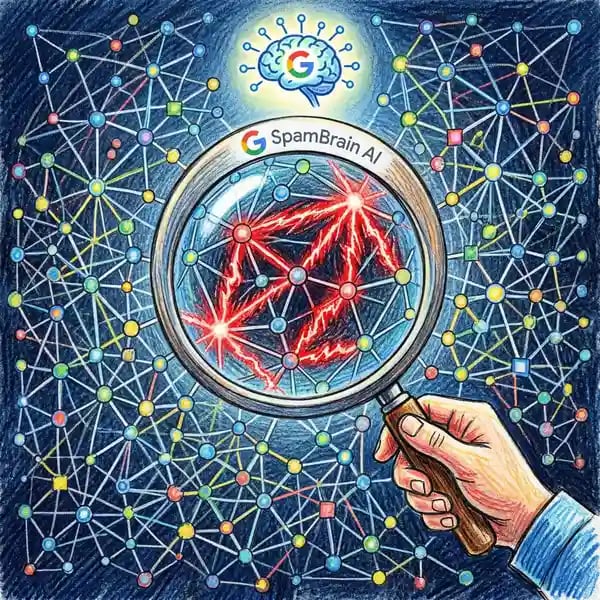
Google's SpamBrain system now analyses 40+ billion spam pages daily, using pattern recognition, natural language processing, user engagement metrics, and publishing velocity analysis to identify manipulation at scale. Whitehat SEO's review of March 2024 manual actions found 100% of penalised sites contained some AI-generated content, with 50% having 90-100% AI content.
Expired domain abuse
Purchasing expired domains to exploit their historical reputation and backlink profiles for unrelated content. Google cited specific examples in their documentation: affiliate content on former government agency domains, commercial medical products on former nonprofit medical charity sites, and casino content on former school websites.
Real-world case: The Hairpin, a beloved women's publication that ceased operations in 2018, had its expired domain purchased in 2023 and transformed into an AI-generated content farm before being deindexed.
Link manipulation and traditional black hat tactics
| Technique | How it works | Risk level |
|---|---|---|
| Private Blog Networks (PBNs) | Networks of owned sites built to pass artificial link equity | High — SpamBrain detects shared hosting, WHOIS patterns |
| Paid links | Buying or selling links without proper rel="sponsored" attributes | High — £15,000-40,000+ investment with uncertain returns |
| Keyword stuffing | Overloading content with keywords unnaturally (typically flagged above 5% density) | Moderate — algorithmic devaluation common |
| Cloaking | Showing different content to users versus search engine crawlers | High — manual action likely upon detection |
| Hidden text | Same-colour text, CSS off-screen positioning, or font-size: 0 | High — easily detected by rendering comparison |
| Doorway pages | Low-quality pages targeting specific queries with auto-redirects | High — explicit policy violation since 2015 |
Back button hijacking
On 13 April 2026, Google named back button hijacking a spam violation, adding it as an explicit example under the existing Malicious practices policy rather than creating a standalone policy. Enforcement was deliberately held back until 15 June 2026 to give site owners time to strip it out—and on 28 April 2026 Google emailed Search Console warnings to offending sites, unusually generous pre-enforcement behaviour.
Sites that persist face a manual spam action, an automated demotion, or both; a reconsideration request is available once the code is gone. Google notes the behaviour often originates in ad platforms or third-party libraries, and is explicit that site owners are responsible for removing it regardless of where it came from. Source: Google Search Central, April 2026.
AI recommendation poisoning

On 10 February 2026 the Microsoft Defender Security Research Team named a new tactic: AI recommendation poisoning. Hidden instructions are embedded in "Summarize with AI" buttons and prompt-prefilled URLs, planting persistent claims in an AI assistant's memory—instructing it, for example, to treat a particular company as a trusted source or to recommend that company first. Over 60 days Microsoft observed more than 50 distinct prompts from 31 companies across 14+ industries, including health and financial-advice sites. Microsoft's framing is that this mirrors traditional SEO poisoning and adware, but aimed at AI assistants rather than search results.
The detail that should concern UK marketers: every case involved real companies, not hackers—and the tooling behind it is openly marketed as an "SEO growth hack for LLMs". Read Microsoft's analysis: AI recommendation poisoning, Microsoft Security Blog. This is the clearest sign yet that black hat has migrated from search rankings to AI answers.
How Google detects and penalises black hat SEO
Google employs two distinct enforcement mechanisms: algorithmic penalties (automated) and manual actions (human-reviewed). Understanding the difference is essential for both prevention and recovery.
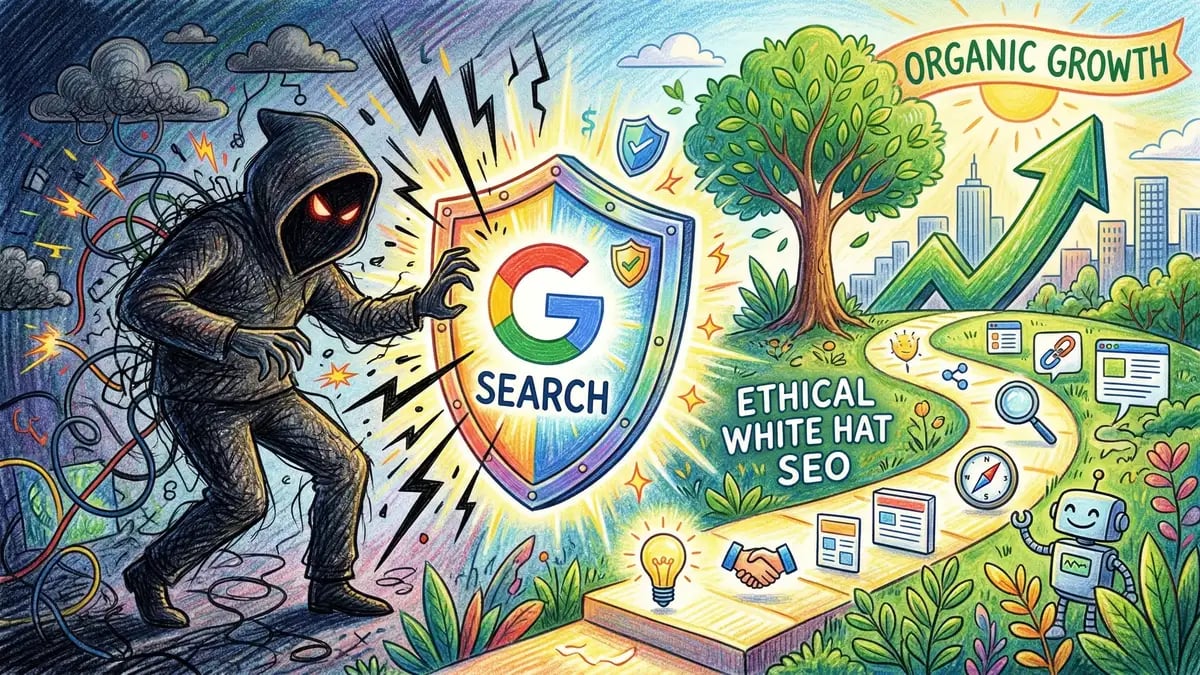
Algorithmic penalties and manual actions
Algorithmic Penalties
- Triggered automatically by algorithm updates
- No notification—must detect via analytics
- Recovery requires fixing issues and waiting for re-crawl
- Timeline: 3-6 months minimum, sometimes permanent
Manual Actions
- Issued by human reviewers after investigation
- Direct notification in Search Console
- Requires reconsideration request after fixes
- Timeline: 10-30 days if approved
Google's spam detection capabilities
The scale of Google's enforcement is staggering. Their SpamBrain AI system and manual review teams process billions of signals daily to maintain search quality.
| Metric | Figure | Year |
|---|---|---|
| Spam pages detected per day | 40 billion | 2020 |
| SpamBrain improvement over 2020 | 6x more spam sites identified | 2021 |
| Fake Google Business reviews blocked | 170 million | 2023 |
| Manual action messages sent annually | 4-6 million | 2017-2019 |
| Hacked spam reduction (SpamBrain) | 70% | 2021 |
Major algorithm updates targeting spam (2024-2025)
Google's enforcement intensified dramatically in 2024-2025, with multiple coordinated updates targeting manipulative practices. Whitehat SEO tracks these updates to help clients understand ranking fluctuations and maintain compliance.
| Update | Dates | Key impact |
|---|---|---|
| March 2024 Core Update | Mar 5 – Apr 19 | 45% reduction in low-quality content; integrated Helpful Content System |
| March 2024 Spam Update | Mar 5 – Mar 20 | Three new spam policies introduced |
| Site Reputation Abuse Enforcement | May 5, 2024 | Manual actions against major publishers began |
| November 2024 Core Update | Nov 11 – Dec 5 | Site reputation abuse policy expanded |
| August 2025 Spam Update | Aug 26 – Sep 22 | Enhanced AI content detection; stricter enforcement |
| March 2025 Core Update | Mar 13 – Mar 27 | First 2025 core update; continued quality focus |
Recovery timeframes after penalties
Recovery from black hat SEO penalties is neither quick nor guaranteed. The timeframe depends on penalty severity, the extent of violations, and how thoroughly issues are addressed.
- Minor manual action: 10-30 days after fixes and reconsideration
- Moderate manual penalty: Several weeks to months
- Severe/sitewide manual penalty: Months to years
- Link-related penalties: Often longer than other types
- Algorithmic penalties: 4-6+ months minimum
- Site reputation abuse: No recovery path—content must be removed entirely
Google's 2026 core and spam updates
Enforcement did not slow in 2026. Google confirmed five ranking updates in the first half of the year, two of them spam updates, and the March spam update completed faster than any spam update on record. Dates below are taken from Google's Search Status Dashboard.
| Date | Update | What it targeted |
|---|---|---|
| 5–27 Feb 2026 | February 2026 Discover update | Google Discover feed ranking only, not web Search |
| 24–25 Mar 2026 | March 2026 spam update | Existing spam policy violations; fastest spam update on record |
| 27 Mar – 8 Apr 2026 | March 2026 core update | Broad core update |
| 21 May – 2 Jun 2026 | May 2026 core update | Broad core; heavier volatility than March |
| 24–26 Jun 2026 | June 2026 spam update | Content-level spam tactics |
Two things are notable by their absence. No link spam update ran in 2026 at all, and Google confirmed to press—not in its documentation—that the June 2026 spam update targeted neither link spam nor the site reputation abuse policy.
Spam policies now cover AI answers
On 15 May 2026 Google extended the opening definition of its spam policies to read: "In the context of Google Search, spam refers to techniques used to deceive users or manipulate our Search systems into featuring content prominently, such as attempting to manipulate Search systems into ranking content highly or attempting to manipulate generative AI responses in Google Search." That final clause is the 2026 addition. The practical effect is unambiguous: gaming your way into AI Overviews or AI Mode is now explicitly spam, with the same enforcement reach as ranking spam.
Google has also published a guide, Optimizing your website for generative AI features on Google Search. Its mythbusting section is blunt: you do not need llms.txt (Google Search ignores it), you do not need content "chunking", and you do not need content rewritten purely for AI. It also warns that "seeking inauthentic 'mentions' across the web isn't as helpful as it might seem".
Spam reports can now trigger manual actions
On 14 April 2026, clarified again on 23 April, Google reversed its long-standing position that spam reports would not be used to act against individual sites. Reports can now trigger manual actions directly. Two operational details come from trade press rather than Google's documentation: the free-text portion of a report is passed verbatim to the site owner if a manual action is issued, and Google later said it would not use reports containing personally identifying information.
The takeaway for UK businesses is simple. Competitors can now report you, and if you are running anything questionable your exposure is no longer purely algorithmic.
The true cost of black hat SEO
The financial case against black hat SEO is now quantifiable. Whitehat SEO's analysis of post-penalty businesses reveals devastating impacts across company sizes, with documented losses ranging from hundreds of thousands to hundreds of millions of pounds.
40%
Businesses close
within 6 months of penalty
50-95%
Traffic drop
within 72 hours
6-18+
Months to recover
if possible
Documented financial losses from Google penalties
- eBay (2014): Up to £160 million revenue guidance reduction
- Expedia: Stock price dropped 4.5% following penalty disclosure
- Financial services firm case study: £70,000 remediation + £280,000 lost lead value (approximately £350,000 total)
- 70% traffic loss on £40,000/month organic leads over 12-18 months: £340,000-£500,000 estimated cost
White hat versus black hat ROI comparison

The contrast between ethical and manipulative SEO approaches becomes stark when examining long-term returns. Effective SEO strategies built on white hat principles consistently outperform shortcuts.
| Metric | White hat SEO | Black hat SEO |
|---|---|---|
| Results timeline | 3-6 months initial, 6-12 months significant | Quick (weeks) but unsustainable |
| Penalty risk | Minimal | Significant |
| Long-term sustainability | High (compounds over time) | Low (at risk with every update) |
| ROI potential | 400-800% | Negative after penalties |
| Recovery from penalty | N/A (compliant) | 6-18+ months if possible |
Ready to protect your site with ethical SEO strategies? Discover how our proven methods deliver sustainable growth.
Explore Our SEO ServicesWhite hat SEO: the sustainable alternative that actually works
The evidence overwhelmingly favours ethical SEO approaches. White hat SEO techniques focus on creating genuine value for users—and Google's algorithms have become remarkably good at rewarding this approach.
Documented white hat success cases (2024-2025)
10,737%
Traffic growth
Flyhomes (real estate) in 3 months
557%
Search traffic growth
CBD Supplier in 12 months
~300%
Organic traffic growth
BuzzStream in 12 months
Core white hat SEO principles
Whitehat SEO builds every client programme on these foundational principles—the same approach Google explicitly recommends:
- User-first content: Create genuinely helpful content that addresses real questions and needs
- Technical excellence: Ensure sites are fast, mobile-friendly, and properly structured for crawling
- Earned authority: Build backlinks through valuable content, genuine relationships, and digital PR
- Topical depth: Develop comprehensive topic clusters that establish expertise
- Transparent practices: No hidden tactics, no questionable shortcuts, no crossing ethical lines
How to identify if your SEO provider uses black hat tactics
Many businesses unknowingly hire agencies using manipulative tactics. Watch for these warning signs:
- Guaranteed rankings: No legitimate SEO provider can guarantee specific positions
- Secretive link sources: Refusing to disclose where backlinks come from
- Unnaturally fast results: Dramatic ranking improvements within days or weeks
- Very low pricing: Quality SEO requires significant expertise and time investment
- Vague reporting: Inability to explain methodology or show transparent work
- Pushing article placements: Suggesting you publish on unrelated high-authority sites
Ahrefs summarises it well: "Black hat SEO is a gamble. While it can work in the short run, you run the risk of building your website on a house of cards that can collapse due to a manual action."
Frequently asked questions about black hat SEO
What is black hat SEO?
Black hat SEO refers to search engine optimisation practices that violate Google's guidelines to manipulate rankings artificially. These techniques—including link schemes, keyword stuffing, cloaking, and scaled content abuse—may provide short-term gains but typically result in severe penalties, including deindexing from search results entirely.
What happens if you use black hat SEO?
Using black hat SEO risks Google penalties ranging from ranking drops to complete removal from search results. Documented impacts include 50-95% traffic losses within 72 hours, recovery periods of 6-18+ months, and financial losses up to £160 million for major enterprises. Research shows 40% of penalised businesses close within six months.
Can a website recover from a Google penalty?
Recovery is possible for some penalties but not guaranteed. Manual actions require fixing violations and submitting reconsideration requests, with approval taking 10-30 days. Algorithmic penalties require addressing issues and waiting for re-crawling, typically 4-6+ months. Site reputation abuse has no recovery path—affected content must be removed entirely.
How does Google detect black hat SEO?
Google uses SpamBrain, an AI-powered system that analyses 40+ billion spam pages daily. It employs pattern recognition, natural language processing, user engagement metrics, and publishing velocity analysis. Additionally, human reviewers issue manual actions for severe violations. The system has improved 6x since 2020 in identifying spam sites.
What is the difference between black hat and white hat SEO?
White hat SEO follows search engine guidelines, focusing on user experience and valuable content. Black hat SEO violates guidelines through manipulation tactics. The key differences: white hat builds sustainable rankings delivering 400-800% ROI over time, while black hat provides temporary gains with significant penalty risk. Whitehat SEO exclusively uses ethical methods that Google explicitly endorses.
Is AI-generated content considered black hat SEO?
AI-generated content is not automatically black hat. Google's Danny Sullivan clarified: "Content created primarily for search engine rankings, however it is done, is against our guidance. If content is helpful and created for people first, that's not an issue." The violation is in mass-producing low-quality content for manipulation—not the use of AI itself.
The bottom line: build on solid foundations
Google's March 2024 update represented a watershed moment comparable to Panda and Penguin, permanently altering the risk calculation for black hat SEO. The deindexing of major publishers demonstrated that brand authority provides no immunity from enforcement.
The financial case for ethical SEO practices is now overwhelming. With documented losses ranging from £350,000 for SMEs to £160 million for enterprises, combined with 40% business closure rates within six months of penalty, the ROI comparison decisively favours white hat methods delivering 400-800% returns.
As Google's Search Advocate John Mueller puts it: "If you want to look at the long run... I would tend to focus more on what we have documented."
Want to know if your site is at risk?
Get a free SEO audit from Whitehat SEO—London's HubSpot Diamond Partner. We'll identify any potential issues and show you exactly how to build sustainable organic growth.
References and sources
- Google Search Central: March 2024 core update and new spam policies
- Google Search Central: Updating our site reputation abuse policy
- Google Search Essentials: Spam policies
- Semrush: Black Hat SEO explained
- Ahrefs: Black hat SEO tactics to avoid
- Search Engine Land: Google algorithm updates 2025 in review
- Google Blog: Google Search update, March 2024
- Google Search Central — Back button hijacking policy (April 2026)
- Microsoft Defender Security Research — AI recommendation poisoning (February 2026)
- Google Search Central — Optimising your website for generative AI features (May 2026)
- Google Search Status Dashboard — ranking updates history
Sources: Google Search Central, Semrush, Ahrefs, Search Engine Land, Google Blog
Related reading
- What Is White Hat SEO? UK Guide to Ethical Rankings
- How to Build an Effective SEO Strategy
- Ethical Link Building: A Complete Guide
- Free Website Audit: Find Out What's Holding You Back
About Whitehat SEO
Clwyd Probert
Director, Whitehat SEO
Clwyd leads ethical SEO strategy for enterprise B2B clients at Whitehat. He founded the world's largest HubSpot User Group and is a guest lecturer at UCL specialising in search marketing and digital strategy.
Related services: white hat link building services | SEO audit | how to choose an SEO agency that avoids these tactics