
Whitehat SEO • Updated 20 March 2026 | Explore our digital marketing FAQs
Topic Clusters for SEO: Build Content That Ranks (2026 Guide)
Topic clusters organise your website content around a central pillar page linked to multiple supporting articles, creating a hub-and-spoke structure that signals topical authority to search engines. Research shows clustered content drives 30% more organic traffic and receives 3.2× more AI citations than standalone posts—making topic clusters essential for both traditional SEO and AI search visibility in 2026.
If you're investing in content marketing but struggling to see results from your HubSpot platform, the problem often isn't the content itself—it's how that content is structured. Random blog posts competing against each other rarely build the topical authority that search engines and AI systems reward.
This guide covers everything B2B marketers need to implement topic clusters effectively: from foundational concepts to advanced optimisation techniques for AI answer engines. Whether you're building your first cluster or updating existing content, you'll find actionable strategies backed by current research from Whitehat SEO's work with over 200 UK businesses.
Key Takeaway
Topic clusters drive 30% more organic traffic and 3.2× more AI citations. Sites implementing clustered architecture see average ranking improvements within 60–90 days and sustained visibility gains over 6–12 months.
What Are Topic Clusters and Why Do They Matter?
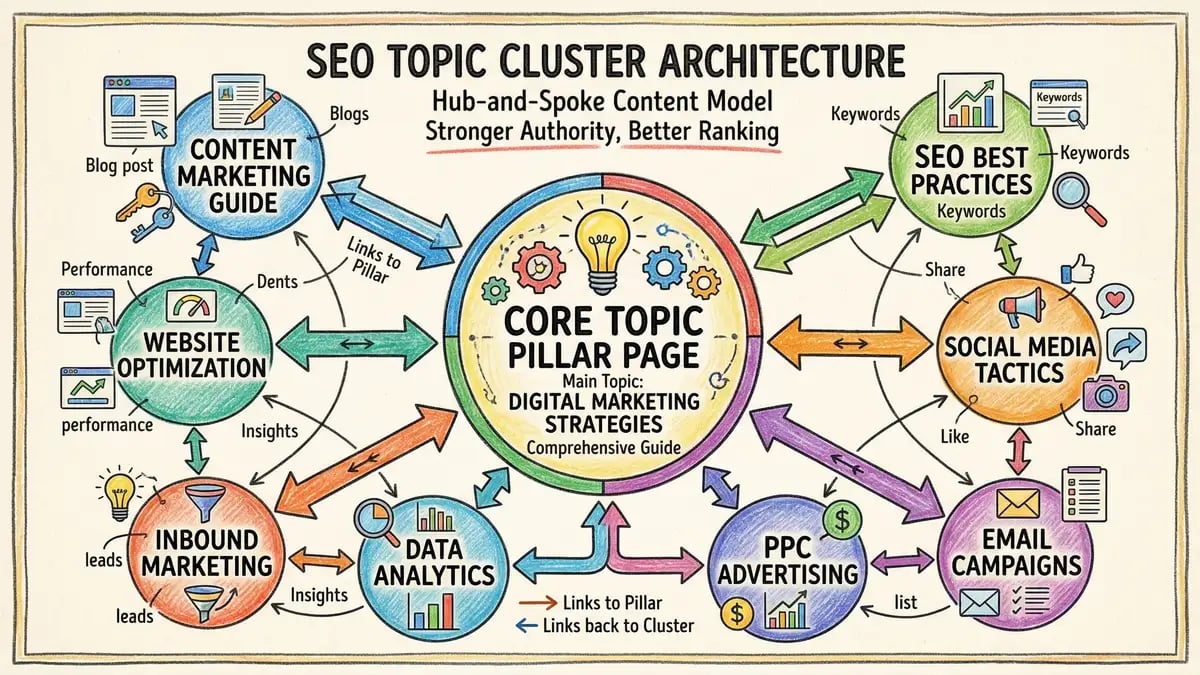
A topic cluster is a content architecture model where one comprehensive pillar page links to and from multiple related cluster pages through strategic internal linking. HubSpot pioneered this approach in 2016-2017 as a response to how search engines were evolving—moving from ranking individual pages for individual keywords to evaluating your authority on entire topics.
Topic clusters have three core components. Your pillar page sits at the centre, covering the broad topic comprehensively (typically 2,500-4,000 words). Surrounding it, cluster pages are individual blog posts (800-1,500 words each) exploring specific subtopics in depth. Internal links connect everything together—each cluster page links back to the pillar, and the pillar links out to all clusters.
For B2B companies using professional SEO services, topic clusters solve a common problem: producing content without a strategic framework. Instead of random blog posts that cannibalise each other's keywords, you create an organised system that compounds authority over time. As Mitul Gandhi, Co-Founder of seoClarity, notes: "Topic clusters strengthen authority signals by aligning content with Google's semantic and intent-focused ranking shifts."
The Evidence Behind Topic Clusters in 2026
Topic clusters aren't just a theoretical best practice—they deliver measurable results across both traditional search and AI platforms. According to HireGrowth's 2025 analysis (cited by Search Engine Land), content grouped into topic clusters drives approximately 30% more organic traffic and holds rankings 2.5× longer than standalone pieces.
30%
More Organic Traffic
With topic clusters vs. standalone content
3.2×
AI Citations
Clustered vs. single-page competitors
2.5×
Longer Rankings
Duration held vs. standalone posts
23%
Visibility Gain
Post-Dec 2025 Helpful Content Update
Sources: HireGrowth 2025, Yext AI Citation Study, Google December 2025 Helpful Content Update
The impact extends to AI search visibility, which is increasingly critical as AI Overviews now appear in 30% of Google search results and 74% of problem-solving queries. Yext's 2025 AI Citation Study, analysing 6.8 million AI citations, found that websites with topic clusters receive 3.2× more citations than single-page competitors. Even more significant: 86% of AI citations came from sites with five or more interconnected pages on the topic, and bidirectional internal linking increased citation probability by 2.7×.
Google's December 2025 Helpful Content Update reinforced these findings. Sites with clear topic authority—demonstrated through deep content clusters—gained an average 23% in organic visibility, whilst generic sites covering too many unrelated topics lost approximately 18% on average. When HubSpot themselves implemented topic clusters, they observed Domain Authority growth from 49 to 60 and clicks for target keywords increasing by more than 500%.
How to Build a Topic Cluster That Drives Results
Building an effective topic cluster requires strategic planning before any writing begins. Here's the process Whitehat SEO uses with content marketing strategy clients across the UK:
Step 1: Choose Your Pillar Topic
Your pillar topic should be broad enough to support 8-12 subtopics but specific enough to align with your business. The key question: "Would this page answer every question a reader searching this topic might have, AND is it broad enough to be an umbrella for 20-30 supporting posts?" For a B2B SaaS company, "email marketing" is too broad and competitive. "Email marketing automation for professional services firms" is more targeted whilst still supporting multiple cluster topics.
Step 2: Map Your Cluster Subtopics
Identify 8-12 subtopics that your target audience would naturally want to explore after landing on the pillar page. Use keyword research tools, competitor analysis, and—critically—actual questions your sales team hears from prospects. Each cluster topic should have distinct search intent. Avoid creating multiple pages targeting essentially the same query—this causes keyword cannibalisation where your pages compete against each other rather than competitors.
Step 3: Create the Pillar Page First
Publish your pillar page before cluster content. This establishes the hub of your architecture and gets indexed early, signalling topic intent to search engines. Your pillar should comprehensively cover the topic—hitting all key questions and concepts—whilst linking to (planned) cluster content for deeper exploration. Optimal pillar page length is 2,500-4,000+ words, with an anchor-linked table of contents for navigation. Orbit Media's 2025 Blogger Survey found that 39% of marketers publishing 2,000+ word posts report "strong results" versus just 21% for shorter content.
Step 4: Build Cluster Content Systematically
Create cluster pages that go deep on specific subtopics. Each piece should add genuine value—not thin content created purely for SEO purposes. Aim for 1,200-1,800 words with data, examples, and actionable insights. As each cluster page publishes, add the internal link from your pillar page and ensure the cluster links back. This bidirectional linking is essential—it's what creates the semantic relationship that search engines and AI systems recognise.
Ready to implement topic clusters? Explore our SEO services that build cluster strategies.
Discover SEO Strategy ServicesInternal Linking Architecture for Topic Clusters
Internal linking is where topic clusters either succeed or fail. Research from Authority Hacker's study of over 1 million websites shows that proper internal linking boosts rankings by up to 40%. Pages within three clicks of the homepage generate 9× more SEO traffic than deeper pages, according to My Rankings Metrics' 2024-2025 analysis.
Follow these internal linking rules for effective topic clusters:
- Every cluster page links to the pillar page—ideally near the top of the content, within the first 200-300 words
- The pillar page links to all cluster pages—within contextually relevant sections, not just a list at the bottom
- Related cluster pages cross-link to each other—2-3 contextual links where naturally relevant
- Use descriptive anchor text—avoid generic "click here" or "read more" phrases
- Vary your anchor text—mix exact match phrases (sparingly), partial matches, synonyms, and descriptive phrases
Whitehat SEO's approach to internal linking focuses on creating what we call "semantic pathways"—links that guide both users and search engines through related content in a logical sequence. This approach is central to our SEO services and consistently delivers measurable ranking improvements for UK B2B companies.
Optimising Topic Clusters for AI Answer Engines
The emergence of AI search—ChatGPT, Google AI Overviews, Perplexity, Claude—has added a critical new dimension to topic cluster strategy. Brands cited in AI Overviews earn 35% more organic clicks and 91% more paid clicks, according to Seer Interactive's September 2025 research. For companies serious about answer engine optimisation, topic clusters provide the interconnected content depth that AI systems trust.

Structure Content for Query Fan-Out
When someone asks an AI a question, the system doesn't search for that exact query. Instead, it breaks the question into 12-15 sub-questions—a process called query fan-out. Your topic cluster architecture naturally addresses this: the pillar answers the main question whilst cluster pages handle the sub-questions. Surfer SEO data shows ranking for fan-out queries makes pages 161% more likely to earn AI Overview citations.
Make Each Section Standalone
AI systems extract and evaluate individual passages independently—a process called "chunking." Each section of your content must be comprehensible without surrounding context. Restate key terms in each section, avoid pronouns without clear references, and ensure each passage answers a specific question completely. Content with 19+ data points averages 5.4 AI citations versus 2.8 for pages with minimal statistics, according to research from SE Ranking and Profound.
Prioritise Freshness
AI platforms heavily weight content recency. Pages updated in the last 30 days receive 76.4% more AI citations than older content. Recently updated content is 2.5× more likely to appear in AI responses. Build quarterly content refreshes into your workflow—update statistics, add new examples, and ensure your publication dates reflect recent modifications.
Topic Cluster Mistakes to Avoid
After reviewing hundreds of topic cluster implementations across UK businesses, Whitehat SEO has identified consistent patterns of failure. Avoid these common mistakes:
The Cost of Getting It Wrong
Common mistake: Building cluster pages without proper internal linking structure or allowing keyword cannibalisation between pages targeting similar search intent.
The reality: Your pages compete against each other rather than external competitors, fragmenting authority and preventing any single page from ranking. Sites without proper linking see up to 40% less traffic than properly structured clusters.
| Mistake | Impact | Solution |
|---|---|---|
| Keyword cannibalisation | Pages fragment authority, competing internally | Audit for intent overlap; each page owns unique subtopic |
| Weak internal linking | Clusters exist but aren't semantically connected | Link pillar to all clusters; cross-link related pages |
| Thin cluster pages | Content under 800 words provides minimal value | Aim for 1,200–1,800 words; prioritise depth over quantity |
| Set-it-and-forget-it | Stale content loses visibility over time | Refresh clusters quarterly; update stats and examples |
Source: Whitehat SEO 2026 Content Architecture Review
Tools for Building and Managing Topic Clusters
HubSpot's built-in Content Strategy tool (available in Marketing Hub Professional and above) provides native topic cluster planning and tracking. For teams already on HubSpot, this is the natural starting point—it integrates directly with your blog and reporting. Whitehat SEO's HubSpot onboarding services include full configuration of topic clusters within the platform.
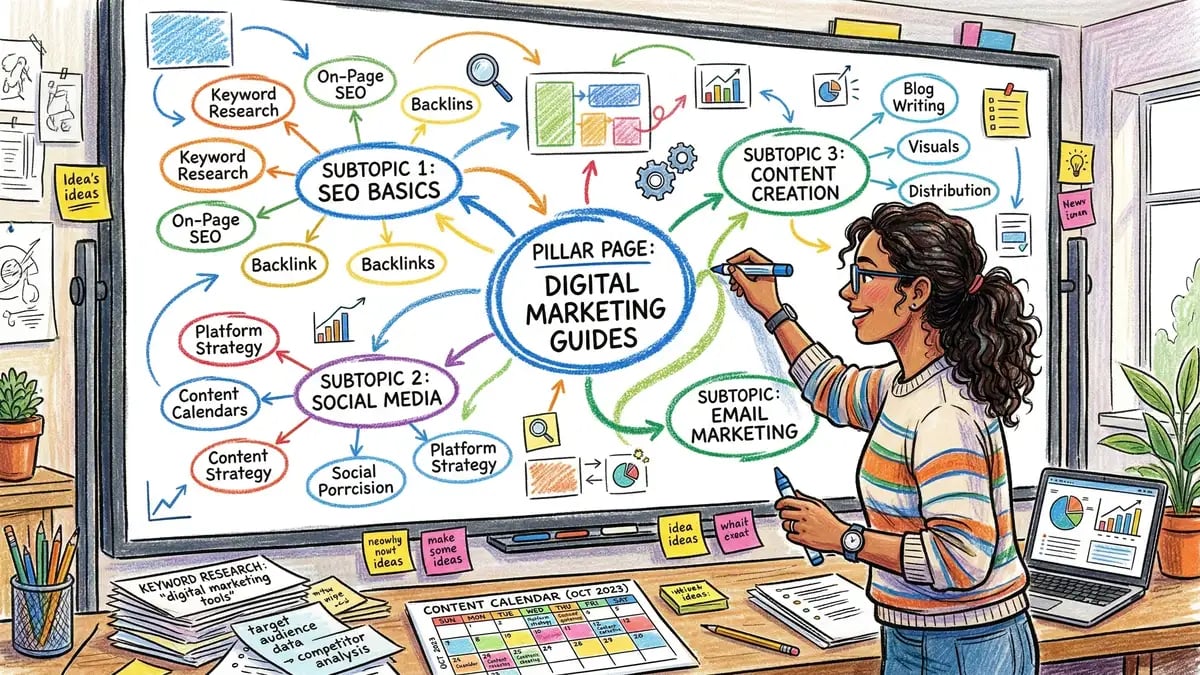
Beyond HubSpot, several tools support topic cluster development. Semrush's Keyword Strategy Builder provides automated topic and subtopic grouping with pillar suggestions. MarketMuse (£99-£499/month) offers AI-powered topical gap analysis. Clearscope and Surfer SEO (£89+/month) help optimise individual cluster pages for comprehensive coverage.
For internal link management at scale, Link Whisper (WordPress plugin) or InLinks can suggest and audit contextual internal links. Free options include Google Search Console for cannibalisation detection and AnswerThePublic for question-based subtopic discovery. According to LOCALiQ UK's 2026 research, 38% of UK businesses need training in AI-generated search optimisation—these tools help bridge that knowledge gap.
Frequently Asked Questions About Topic Clusters
How many cluster pages should support a pillar page?
Most successful topic clusters contain 8-12 supporting cluster pages per pillar. HubSpot recommends a minimum of 6-10 subtopics, with 8-10 being ideal. For small marketing teams producing 2-3 full clusters per year, quality and depth matter more than quantity—each cluster page should provide genuine value rather than thin content.
Do topic clusters still work for SEO in 2026?
Yes, topic clusters remain highly effective in 2026. Research shows clustered content drives 30% more organic traffic and holds rankings 2.5× longer than standalone posts. Google's December 2025 Helpful Content Update specifically rewarded sites with clear topic authority, with clustered sites gaining an average 23% in organic visibility.
What is the difference between a pillar page and cluster content?
A pillar page broadly covers an entire topic (2,500-4,000 words), serving as the central hub of the cluster. Cluster content comprises individual blog posts (800-1,500 words each) that explore specific subtopics in depth. The pillar answers "What is X?" whilst clusters answer "How do I do specific aspect of X?"
How do topic clusters help with AI search visibility?
Websites with topic clusters receive 3.2× more AI citations than single-page competitors, according to Yext's 2025 AI Citation Study analysing 6.8 million citations. AI systems evaluate topical depth across interconnected pages—86% of AI citations came from sites with 5+ interconnected pages on a topic. Bidirectional internal linking increased citation probability by 2.7×.
How long does it take to see results from topic clusters?
Initial ranking improvements typically appear within 60-90 days of publishing a complete cluster. Full impact—including improved domain authority and AI citations—usually materialises within 6-12 months. Clustered content holds rankings 2.5× longer than standalone posts, making the upfront investment worthwhile for sustained organic growth.
Getting Started with Topic Clusters
If you're serious about improving your content's SEO performance, topic clusters aren't optional in 2026—they're foundational. Content marketing generates £3 for every £1 invested (3:1 ROI) versus £1.80 for paid advertising, according to Revenue Zen's 2024-2025 analysis. Topic clusters maximise that return by creating compounding authority over time.
Start by auditing your existing content to identify potential pillar topics and cannibalisation issues. Then map out your first cluster with 8-12 supporting subtopics that align with your buyers' questions. For teams using HubSpot without seeing expected ROI, topic cluster implementation is often the missing piece—the platform's Content Strategy tool makes planning straightforward, but strategy matters more than tools.
Ready to build topic clusters that drive measurable results?
Whitehat SEO's content architecture strategy includes cluster planning, implementation, and ongoing optimisation—all connected to pipeline attribution through HubSpot.
References and Sources
- Search Engine Land (2025). Topic clusters and SEO: Everything you need to know in 2025
- HubSpot (2025). Topic Clusters: The Next Evolution of SEO
- Orbit Media Studios (2025). Annual Blogger Survey 2025
- seoClarity (2025). SEO Topic Clusters: What They Are and How to Create Them
- Surfer SEO (2025). AI Overviews SEO Study: What Gets Cited
- LOCALiQ UK (2026). UK Digital Marketing Statistics 2026
Clwyd Probert
CEO & Founder, Whitehat SEO
Clwyd is CEO & Founder of Whitehat SEO, a guest lecturer at UCL, and host of the world's largest HubSpot User Group. He has helped over 200 B2B companies build content strategies that connect directly to pipeline and revenue.