
SEO in 2026 requires dual optimisation: traditional search engine rankings plus visibility in AI-powered answer engines like ChatGPT and Google AI Overviews. The fundamentals—quality content, technical excellence, and authority signals—remain essential, but UK businesses face a new reality where AI Overviews have contributed to an 86% collapse in organic traffic growth. Meanwhile, visitors from AI search convert at 3x higher rates than traditional organic, making Answer Engine Optimisation (AEO) essential for forward-thinking marketers.
Key Takeaway
The AI search era demands a fundamentally different SEO strategy. Traditional rankings alone no longer guarantee visibility—you need dual optimisation for both Google and AI answer engines to capture the full spectrum of search demand.
How does Google's algorithm actually work in 2026?
Google's ranking process operates through three connected stages—crawling, indexing, and serving—but with significantly more sophisticated AI interpretation at every step than even two years ago.
Crawling begins with Googlebot downloading pages using a recent version of Chrome to render JavaScript content. The Web Rendering Service caches resources for up to 30 days to preserve crawl budget—a critical consideration for sites with thousands of pages.
During indexing, Google analyses text, images, and videos whilst determining canonical versions of similar pages. Not all crawled pages make it to the index; quality and accessibility factors determine inclusion.
The third stage, serving search results, is where rankings happen. Google's ranking systems now include BERT, MUM, Neural matching, and RankBrain working together to understand language, intent, and concepts far beyond simple keyword matching.
The March 2024 Core Update
The longest update in Google's history at 45 days, this merged the Helpful Content System into core ranking. Google promised a 45% reduction in low-quality content in search results. The update simultaneously introduced new spam policies targeting site reputation abuse ("parasite SEO"), scaled content abuse, and expired domain manipulation.
What are the three pillars of modern SEO?
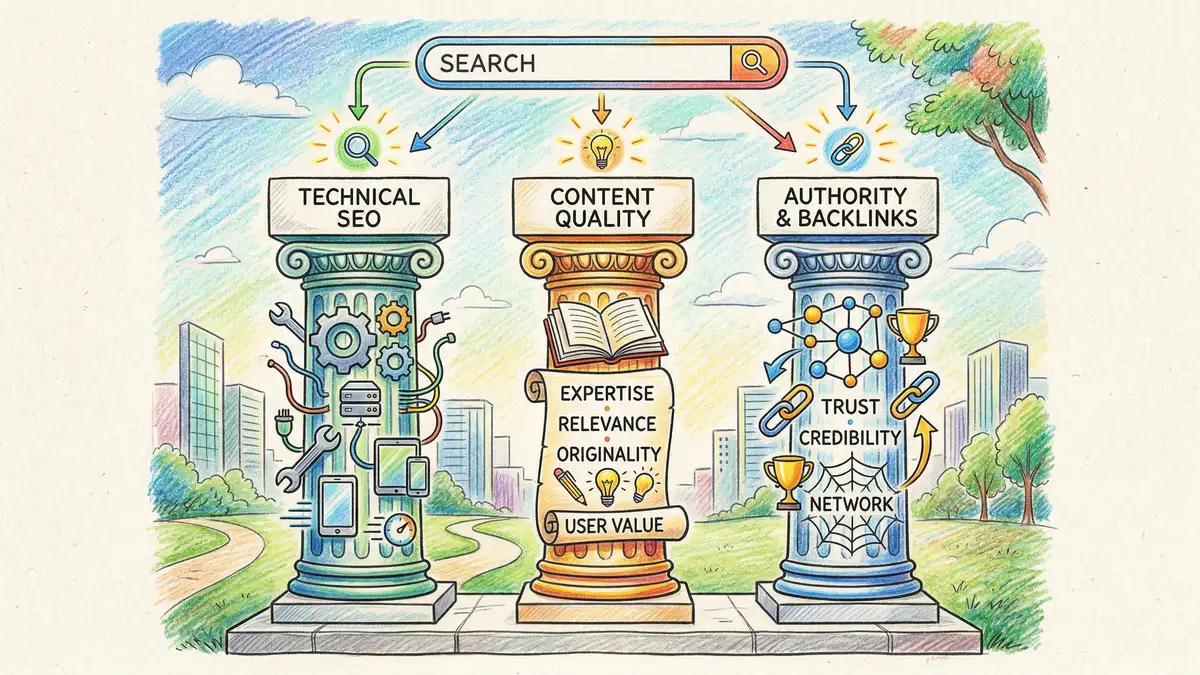
The three foundational pillars—technical SEO, content relevance, and authority—remain essential, but each has evolved considerably. At Whitehat, our SEO services address all three with an integrated approach.
Pillar 1: Technical Foundation
Google now exclusively uses the mobile version of sites for indexing and ranking. Since July 2024, non-mobile-responsive sites have stopped being indexed entirely. Core Web Vitals remain a confirmed ranking factor, with current thresholds requiring:
- LCP (Largest Contentful Paint): Under 2.5 seconds
- INP (Interaction to Next Paint): Under 200 milliseconds—replaced FID in March 2024
- CLS (Cumulative Layout Shift): Under 0.1
Only 47% of sites currently pass all Core Web Vitals thresholds, according to Google's own data—making technical excellence a significant competitive differentiator.
Pillar 2: Content and Relevance
Content strategy has shifted from keyword optimisation to demonstrating genuine expertise. Google evaluates content through the lens of E-E-A-T: Experience, Expertise, Authoritativeness, and Trustworthiness. The first "E" for Experience was added in December 2022, emphasising first-hand knowledge.
Trust sits at the centre as the most critical component. Whilst E-E-A-T isn't a direct ranking factor, it informs how quality raters evaluate content, and these evaluations shape algorithm refinements. The practical implication: author bios with credentials, original research, verifiable facts, and clear demonstrations of real-world experience now matter enormously. Topic clusters that establish topical authority outperform isolated content pieces.
Pillar 3: Authority and Trust
Backlinks still matter significantly, despite Google's public statements suggesting otherwise. The May 2024 API leak confirmed backlinks remain significant, with the documentation revealing a "siteAuthority" metric despite years of Google denying any such measurement exists.
Gary Illyes from Google has stated that "over the years, we've made links less important" and that Google needs "very few links to rank pages"—but quality links from topically relevant, authoritative sources continue to correlate strongly with ranking success. At Whitehat, our ethical white-hat approach focuses on earning genuine editorial links rather than manipulative tactics.
How have AI Overviews changed search for UK businesses?
Google's AI Overviews launched to all US users in May 2024 and expanded to the UK on 15 August 2024. As of late 2025, AI Overviews reach 1.5 billion monthly users across 200+ countries. The impact on organic traffic has been substantial—and UK businesses have felt it acutely.
| Metric | Before AI Overviews | After AI Overviews | Change |
|---|---|---|---|
| UK organic traffic growth | 26.3% | 3.7% | -86% |
| Finance sector growth | +13.1% | -1.4% | Negative |
| Hospitality sector growth | +47.9% | -6.7% | Worst hit |
| Position 1 CTR | 28% | 19% | -32% |
Source: Tank Digital research analysing 800 UK companies across 16 sectors, October 2025
Query types most affected are informational (84% of AI Overview appearances), though commercial and transactional queries are increasingly triggering AI Overviews—up from 8.15% to 18.57% for commercial queries. Local searches remain relatively protected, with only 0.01% triggering AI Overviews, making local SEO increasingly valuable for businesses with physical locations.
The zero-click search phenomenon has accelerated: 60% of Google searches now end without any click to a website. Since AI Overviews launched, the percentage of news-related searches ending without clicks grew from 56% to 69%. This represents a fundamental shift in how businesses must think about search visibility—being present in the answer, not just ranking highly, becomes the new battleground.
What is Generative Engine Optimisation (GEO)?
Generative Engine Optimisation (GEO)—also called Answer Engine Optimisation (AEO)—is the practice of optimising content for citation within AI-generated responses rather than traditional search rankings. The term was formalised in academic research by Princeton University and Georgia Tech, with their study finding that GEO methods can boost visibility in AI responses by up to 40%.
The distinction matters because a page can rank number one in Google but never get cited by ChatGPT if it lacks the structural elements AI engines prioritise. At Whitehat, our comprehensive AEO guide details exactly how to optimise for these platforms.
1B+
Daily ChatGPT queries
Exceptional scale of AI usage
527%
YoY traffic growth from AI
Explosive growth opportunity
15.9%
ChatGPT conversion rate
9x better than organic
500M+
Monthly Perplexity queries
Emerging search engine rival
Source: SE Ranking 2025 research, WordStream July 2025
How different AI platforms prioritise sources
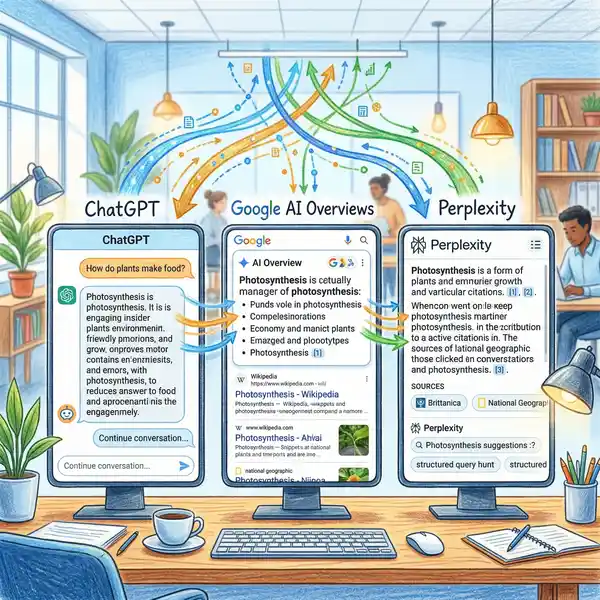
ChatGPT prioritises structured summaries and high E-E-A-T content, with Wikipedia cited in nearly 48% of factual answers. Notably, ChatGPT has shifted from using Bing's index to Google's, with Google alignment increasing from 12% to 33%.
Perplexity emphasises real-time information with Reddit accounting for 46.7% of top sources, showing strong preference for content published within the past 90 days.
Google AI Overviews prioritise content that already ranks well organically, with 52% of sources coming from top 10 organic results.
The Princeton research identified three techniques that consistently outperform: adding statistics every 150-200 words, including expert quotes with attribution, and citing authoritative sources within content. Pages implementing these achieved 30-40% relative improvement in AI visibility.
Which ranking factors actually matter now?
The May 2024 API leak revealed significant discrepancies between Google's public statements and internal practices. The most notable revelation was NavBoost, a system that explicitly uses click data to modify rankings.
What the API Leak Confirmed
- NavBoost uses click data: Documentation references "goodClicks," "badClicks," and "lastLongestClicks"—contradicting years of official denials
- Chrome browser data informs rankings: User behaviour signals are more influential than publicly acknowledged
- "siteAuthority" metric exists: Despite official denials of any domain-level authority score
- New site sandbox effect: Fresh websites face suppressed rankings until demonstrating reliability
Topical authority has become increasingly important. Google evaluates depth of topic coverage rather than individual pages in isolation. Sites demonstrating comprehensive coverage through content clusters—pillar pages supported by detailed cluster content—see stronger rankings across related keywords and increased visibility in AI Overviews.
Brand signals and entity optimisation represent the next frontier. Google's Knowledge Graph now contains billions of entities, and search has evolved from keyword matching to understanding real-world things and their relationships. Consistent NAP (Name, Address, Phone) information, schema markup, Wikipedia and Wikidata presence, verified social profiles, and press coverage all strengthen entity recognition. Even unlinked brand mentions contribute to entity footprint—John Mueller confirmed Google "picks up mentions" even without links.
Ready to understand your current SEO position? Our SEO services identify quick wins and long-term opportunities.
Explore Our ServicesHow has link building evolved?
The evidence clearly supports quality over quantity for link building in 2025. One high-quality backlink from an authoritative, topically relevant site delivers more value than dozens of low-quality links. Guest posting remains effective for 64.9% of marketers according to Authority Hacker research, though Google has explicitly warned against "large-scale" guest posting schemes.
Effective in 2025
- Digital PR and earned media
- Original research and data studies
- Strategic guest contributions
- Linkable asset creation
- Unlinked mention outreach
Tactics to Avoid
- Private blog networks (PBNs)
- Paid links at scale
- Excessive reciprocal linking
- Low-quality directories
- Forum spam and comment links
The March 2024 spam update specifically targeted AI-generated content created solely for ranking manipulation and purchased links designed to game the algorithm. At Whitehat, our white-hat methodology has always focused on earning genuine editorial links—an approach that's now more valuable than ever.
How do you optimise for both Google and AI search?
For 2026, content strategy must serve both traditional Google search and AI platforms simultaneously. This dual optimisation approach is what Whitehat delivers for clients through our integrated SEO services.
Content structure that works for both
- Clear H1-H2-H3 hierarchies with descriptive headings
- Direct answers to questions within the first 40-60 words
- Statistics every 150-200 words with source attribution
- Expert quotes with credentials where applicable
- Comprehensive FAQ sections with schema markup
- Self-contained sections that make sense in isolation (the "Taco Bell Test")
Technical priorities for 2025
- Core Web Vitals optimisation (particularly INP, which most sites struggle with)
- Mobile-first design as the baseline requirement
- Clean site architecture with all pages within three clicks of homepage
- Schema implementation in JSON-LD format
- robots.txt allowing GPTBot, ClaudeBot, and PerplexityBot
Measurement must evolve beyond rankings
Track search impressions as a leading indicator, AI citations across platforms, share of voice against competitors, engagement metrics in GA4, and most importantly for B2B—organic conversions connected to CRM pipeline. New KPIs include AI visibility score, citation frequency in LLM responses, and brand sentiment in AI-generated answers.
The goal shifts from "driving clicks" to "being the answer" across both traditional and AI search. As a HubSpot Diamond Partner, Whitehat provides closed-loop attribution showing exactly which organic efforts drive revenue—essential for proving ROI in this new landscape.
UK market context: challenges and opportunities
Google maintains 93.35% search market share in the UK, reaching 97.85% on mobile. The UK SEO industry is worth £22.3 billion, with 60% of UK businesses actively implementing SEO tactics and 45% planning to increase investment.
40%
UK adults use voice search daily
Growing query pattern shift
76%
"Near me" searches leading to store visits
Local search intent power
126%
More traffic for Google 3-Pack positions
Local pack dominance
68%
B2B traffic still from desktop
Enterprise preference
Source: Statista UK Digital Trends Report, McKinsey Digital Index 2025
The shift toward AI search creates urgency: 38% of business decision-makers have already allocated budget specifically for AI Search Optimisation, whilst unprepared brands may experience 20-50% traffic decline from traditional search according to McKinsey projections. The time to act is now.
Frequently Asked Questions
Is SEO still worth investing in for 2026?
Yes, absolutely. Whilst AI Overviews have reduced click-through rates, organic search still drives the majority of website traffic. More importantly, SEO now serves dual purposes: ranking in traditional search AND building the authority signals that influence AI citations. Businesses that invest in quality SEO today are positioning themselves for visibility in both traditional and AI-powered search.
What's the difference between SEO and AEO?
Traditional SEO optimises for ranking positions in search results where users click through to websites. AEO (Answer Engine Optimisation) optimises for citation and recommendation within AI-generated responses. The goal shifts from "get the click" to "be the recommended answer." Both require quality content, but AEO demands specific structural elements that help AI systems extract and cite your content.
How long does SEO take to show results in 2025?
Most businesses see initial ranking movements within 2-3 months, meaningful traffic improvements by months 4-6, and significant business impact by months 6-12. Technical fixes and content optimisation can deliver quicker wins, but sustainable rankings require consistent effort. AI visibility typically follows a similar timeline, though well-structured content can appear in AI responses more quickly.
Do backlinks still matter for SEO?
Yes, the May 2024 API leak confirmed backlinks remain a significant ranking factor despite Google's public downplaying. However, quality matters far more than quantity. One editorial link from a relevant, authoritative site delivers more value than dozens of low-quality links. Focus on earning links through valuable content, digital PR, and genuine thought leadership rather than manipulative tactics.
How can I get my business mentioned in ChatGPT?
ChatGPT citations come from content that demonstrates clear expertise, uses structured formatting with statistics and expert quotes, and appears on authoritative sources. Ensure your robots.txt allows GPTBot, create answer-first content that directly addresses common questions, build presence on review platforms like G2 and Capterra, and establish mentions across relevant industry publications and communities.
What are Core Web Vitals and why do they matter?
Core Web Vitals are Google's metrics for user experience: LCP (loading speed), INP (interactivity), and CLS (visual stability). They're confirmed ranking factors, and only 47% of sites pass all thresholds—making technical excellence a competitive advantage. INP replaced FID in March 2024, so any references to First Input Delay are now outdated.
Ready to future-proof your organic visibility?
Get a comprehensive audit showing where your SEO stands today and what's needed to succeed in both traditional and AI-powered search.
References
- Tank Digital - The Google AI Search Shift Report (October 2025)
- SE Ranking - AI Traffic in 2025: Comparing ChatGPT, Perplexity & Other Platforms
- WordStream - Google AI Overviews Statistics (June 2025)
- Ahrefs - AI Overview CTR Study (April 2025)
- Princeton/Georgia Tech - GEO: Generative Engine Optimization (Academic Research)
- Google Search Central - How Google Search Works
- Authority Hacker - Link Building Statistics 2025
- Google Web.dev - Core Web Vitals
Clwyd Probert
CEO & Founder, Whitehat SEO
Clwyd founded Whitehat in 2011 and leads the world's largest HubSpot User Group (London HUG). He lectures on digital marketing at UCL, advises on AI implementation for marketing transformation, and has helped hundreds of B2B companies build predictable organic pipelines through ethical SEO and inbound marketing.