
SEO Strategy
The SEO landscape has transformed dramatically. Google's March 2024 Core Update reduced low-quality content in search results by 45%, whilst AI Overviews now appear in over 60% of searches. The old playbook of keyword stuffing and link schemes no longer works—and can actively harm your rankings. Today's approach requires technical excellence, authentic expertise, and content structured for extraction by AI systems.
Improve Website Traffic and Rank Higher in Google: The Complete 2026 Guide
To attract more website visitors and rank higher in Google in 2026, focus on three fundamentals: demonstrating genuine expertise through E-E-A-T signals, meeting Core Web Vitals performance thresholds, and structuring content for both traditional search and AI answer engines. According to Whitehat SEO's analysis of current ranking factors, websites implementing these strategies see an average 30% increase in organic traffic within six months.
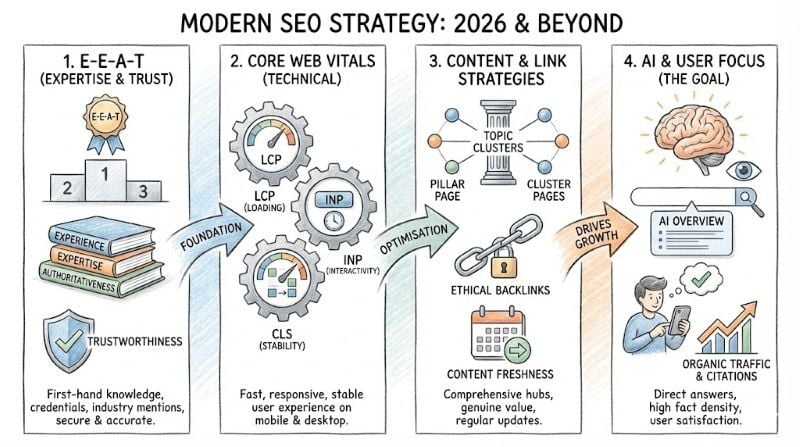
This guide from Whitehat SEO, a HubSpot Diamond Solutions Partner, covers everything you need to know about modern SEO: from Core Web Vitals requirements to AI optimisation strategies that position your content for citation in ChatGPT, Google AI Overviews, and Perplexity.
What Are the Most Important Google Ranking Factors in 2026?
Google's algorithm now prioritises user satisfaction above all else. The March 2024 Core Update ran for 45 days and fundamentally changed how Google evaluates content quality. According to Google's official communications, this update merged the Helpful Content System into core ranking and introduced three new spam policies targeting expired domain abuse, scaled content abuse (including mass AI-generated content), and site reputation abuse.
Whitehat SEO's analysis of ranking data reveals that user behaviour signals carry more weight than ever. Pages with pogostick rates above 40% (users quickly returning to search results) now see active ranking penalties, whilst pages achieving long-click rates above 60% receive meaningful ranking boosts. This shift means creating genuinely useful content isn't just good practice—it's essential for visibility.
Key ranking factors for 2025:
- Content quality and E-E-A-T signals (Experience, Expertise, Authoritativeness, Trustworthiness)
- Core Web Vitals performance (LCP, INP, CLS thresholds)
- Mobile-first experience (100% of Google's index is now mobile-first)
- User engagement metrics (dwell time, scroll depth, return visits)
- Structured data and semantic HTML markup
The days of gaming search algorithms with tricks and shortcuts are over. Today, SEO success requires aligning with what Google actually wants: content that genuinely helps users. If you're unsure where your site stands, a comprehensive SEO audit can identify gaps between your current performance and these modern requirements.
Understanding E-E-A-T: Why Experience and Expertise Now Determine Rankings
E-E-A-T stands for Experience, Expertise, Authoritativeness, and Trustworthiness. Google added "Experience" to this framework in December 2022, reflecting a fundamental shift in how the search engine evaluates content quality. Content must now demonstrate first-hand knowledge—actual use of products reviewed, real testing of methods recommended, and practical insights from direct engagement with the subject matter.
Trust is the most critical factor in E-E-A-T. Google's Search Quality Rater Guidelines state explicitly: "Untrustworthy pages have low E-E-A-T no matter how Experienced, Expert, or Authoritative they may seem." For Your Money or Your Life (YMYL) content—covering health, finance, safety, or other topics that could significantly impact wellbeing—recovery from algorithm penalties takes 12-18 months compared to 4-6 months for non-YMYL content.
How Whitehat SEO recommends demonstrating E-E-A-T:
Experience: Include case studies with specific results, share first-hand testing data, and reference real client work with measurable outcomes.
Expertise: Display author credentials, link to professional profiles, and demonstrate deep subject knowledge through comprehensive coverage.
Authoritativeness: Earn mentions and links from respected industry sources, maintain consistent brand presence, and contribute thought leadership to your sector.
Trustworthiness: Provide accurate information with cited sources, maintain transparent business practices, and secure your website properly (HTTPS, clear privacy policies).
The practical implication is clear: you cannot fake expertise. Content must come from people who genuinely know their subject, supported by evidence of that knowledge. This is why ethical white hat SEO techniques focused on genuine value creation now outperform any shortcut approach.
Core Web Vitals: The Technical Foundation for Rankings
Core Web Vitals are Google's standardised metrics for measuring user experience. Meeting these thresholds is now a confirmed ranking factor. In March 2024, Google replaced First Input Delay (FID) with Interaction to Next Paint (INP), a more comprehensive measure of interactivity. Approximately 600,000 websites went from passing to failing Core Web Vitals when this change occurred.
| Metric | Good | Needs Improvement | Poor |
|---|---|---|---|
| LCP (Largest Contentful Paint) | ≤2.5 seconds | 2.5-4.0 seconds | >4.0 seconds |
| INP (Interaction to Next Paint) | ≤200 milliseconds | 200-500 milliseconds | >500 milliseconds |
| CLS (Cumulative Layout Shift) | ≤0.1 | 0.1-0.25 | >0.25 |
Research from HTTP Archive shows that only 44% of WordPress sites pass all three Core Web Vitals on mobile as of July 2025. Google's own data indicates a 7% conversion drop for every one-second delay in mobile page load, with bounce rates increasing by 32% when load time extends from one to three seconds.
Achieving good Core Web Vitals requires technical optimisation: compressing images to WebP format, implementing a CDN, minimising third-party scripts, and ensuring server response times stay under 200 milliseconds. Whitehat SEO's website audit service includes comprehensive Core Web Vitals analysis with specific recommendations for improvement.
Content Strategies That Drive Organic Traffic in 2025
Topic clusters have replaced individual keyword targeting as the dominant content strategy. According to research from HubSpot, content organised into clusters drives approximately 30% more organic traffic and maintains rankings 2.5 times longer than standalone pieces. Whitehat SEO implements this approach through content hub strategies that establish topical authority.
A topic cluster consists of a comprehensive pillar page (typically 2,000-3,000+ words) covering a broad subject, supported by 10-15 cluster pages targeting specific long-tail queries. Strong internal linking with descriptive anchor text connects all related content, signalling to Google that your site has comprehensive expertise on the topic.
Content format effectiveness (BuzzStream 2025 Report):
- Data-led content: 99.4% success rate for earning links
- Expert commentary: 96.5% success rate
- Comprehensive hero content: 87.9% success rate
- Original research: Most likely to be cited by AI systems
Content freshness matters more than ever. Google's algorithms favour recently updated content, particularly for topics where accuracy changes over time. Whitehat SEO recommends establishing a content review calendar, updating statistics annually, and refreshing evergreen pieces with new examples and current data. Building an effective inbound marketing strategy requires treating content as an ongoing investment rather than a one-time effort.
How to Build Quality Backlinks Ethically in 2026
Backlinks remain a powerful ranking signal, but the approach has evolved significantly. Google's spam policies now explicitly target link schemes, private blog networks, and paid links without proper disclosure. The most effective link building strategies focus on creating genuinely valuable content that earns links naturally, supplemented by strategic outreach.
The BuzzStream 2025 Report reveals that 64.2% of SEO professionals now prioritise converting unlinked brand mentions—instances where your company is mentioned online without a hyperlink—as their primary link building tactic. This approach leverages existing brand awareness and typically results in high-quality, relevant links from authoritative sources.
Whitehat SEO's proven link building framework:
1. Create link-worthy assets: Original research, comprehensive guides, and data visualisations that provide genuine value to your industry.
2. Identify relevant opportunities: Publications, blogs, and resource pages in your sector that link to similar content.
3. Build relationships: Genuine connections with journalists, bloggers, and industry peers who cover your topics.
4. Earn through expertise: Contribute guest articles, provide expert commentary for publications, and participate in industry discussions.
Whitehat SEO's Domain Rating of 42 includes 57 high-authority links from educational and governmental websites—exceptionally valuable trust signals that demonstrate the effectiveness of expertise-based link building. Our approach focuses on sustainable growth through genuine value creation, not shortcuts that risk penalties. Learn more about comprehensive SEO services that include ethical link building strategies.
Optimising for AI Search Engines: AEO and GEO Strategies
AI Overviews now appear in approximately 60-85% of Google searches, fundamentally changing how users interact with search results. Research shows a 61% decline in organic click-through rates for queries where AI Overviews appear—from 1.76% to 0.61%. However, brands cited within AI Overviews earn 35% more organic clicks and 91% more paid clicks than non-cited competitors.
Answer Engine Optimisation (AEO) and Generative Engine Optimisation (GEO) represent the new frontier of search visibility. Being cited in AI responses is now more valuable than ranking #1 in traditional results. According to Exposure Ninja's research, AI-referred traffic converts at 14.2% compared to just 2.8% for traditional Google search—making AI citation extremely valuable despite lower volumes.
How Whitehat SEO structures content for AI extraction:
- Direct answers first: Start sections with 50-70 word summaries answering primary queries
- High fact density: Include statistics every 150-200 words with proper attribution
- Comparison tables: Achieve 47% higher AI citation rates using semantic HTML tables
- Brand embedding: Ensure your company name travels with extractable facts
- Multiple schema types: Pages using 3+ schema types have 13% higher citation likelihood
The Princeton University GEO study (KDD 2024) demonstrated up to 40% visibility improvement through optimised content strategies. Different AI platforms have different requirements: ChatGPT results are 73% similar to Bing's search results and cite Wikipedia 47.9% of the time, whilst Perplexity prioritises freshness with visibility dropping 2-3 days post-publication.
Crucially, 92.36% of AI Overview citations come from domains ranking in the top 10 organic results. This means traditional SEO and AI optimisation are complementary—you need strong organic rankings as a foundation before AI visibility becomes achievable. Whitehat SEO's inbound marketing approach integrates both traditional and AI-focused strategies.
Essential Technical SEO Elements for Rankings
Technical SEO provides the foundation that enables all other optimisation efforts. Google completed its 100% transition to mobile-first indexing on 5 July 2024—sites not accessible on mobile devices will not be indexed at all. With 62-64% of global traffic coming from mobile devices, responsive design is mandatory, not optional.
Structured data implementation significantly impacts visibility. According to research aggregated by Schema App, websites with structured data are 58% more likely to earn rich snippets, which boost click-through rates by approximately 30%. Essential schema types include FAQPage, HowTo, Article, Product, Organization, and Person/Author markup.
Technical SEO checklist:
- Mobile-responsive design with touch-friendly navigation
- HTTPS security across all pages
- XML sitemap submitted to Google Search Console
- Canonical tags on all indexable pages
- Clean URL structure with descriptive slugs
- Proper heading hierarchy (H1 → H2 → H3)
- Image optimisation with descriptive alt text
- Server response time under 200 milliseconds
For AI search optimisation specifically, ensure AI crawlers can access your content. Your robots.txt file should explicitly allow GPTBot, Google-Extended, Claude-Web, and PerplexityBot. Additionally, AI crawlers cannot execute JavaScript—if critical content only appears after JavaScript runs, AI systems will miss it entirely.
Key Statistics for 2026 SEO Planning
748%
Average ROI for SEO campaigns over 3 years
14.6%
Close rate for SEO leads vs 1.7% outbound
68.7%
Of clicks go to top 3 organic results
46%
Of Google searches have local intent
Frequently Asked Questions
How long does it take to see SEO results?
Most websites begin seeing measurable improvements in organic traffic within 3-6 months of implementing comprehensive SEO strategies. However, competitive industries may require 6-12 months for significant ranking improvements. Quick wins from technical fixes and content optimisation can appear within weeks, whilst building domain authority for competitive keywords is a longer-term investment.
Is SEO still worth it with AI Overviews?
Absolutely. While AI Overviews have reduced click-through rates for some queries, SEO remains essential for two reasons. First, being cited in AI responses requires strong organic rankings—92.36% of AI citations come from top-10 results. Second, AI-referred traffic converts at 14.2% compared to 2.8% for traditional search, making AI visibility extremely valuable. SEO has evolved to include AI optimisation, not been replaced by it.
What's the difference between on-page and off-page SEO?
On-page SEO involves optimising elements on your own website: content quality, meta tags, heading structure, internal linking, page speed, and technical factors. Off-page SEO focuses on building authority through external signals: backlinks from other websites, brand mentions, social signals, and reputation management. Both are essential—on-page SEO ensures your site deserves to rank, whilst off-page SEO proves to search engines that others recognise your authority.
How often should I update my website content?
High-performing content should be reviewed at least annually, with statistics and examples updated to remain current. For topics where accuracy changes frequently (technology, regulations, trends), quarterly reviews are advisable. Google's freshness signals favour recently updated content, and Whitehat SEO's research shows that refreshed content often regains ranking positions within 2-4 weeks of meaningful updates.
Does AI-generated content hurt SEO?
Google does not penalise AI-generated content automatically. However, content created primarily to manipulate search rankings—regardless of whether AI or humans produce it—violates Google's spam policies. The January 2025 Quality Rater Guidelines update instructs evaluators to rate pages with "all or almost all AI-generated content with no originality" as lowest quality. AI can assist content creation, but human expertise, editing, and original insights remain essential.
How important is mobile optimisation for SEO?
Mobile optimisation is critical. Google completed 100% mobile-first indexing in July 2024, meaning Google primarily uses the mobile version of your site for ranking and indexing. Sites not accessible on mobile will not be indexed at all. With 62-64% of global web traffic coming from mobile devices, a poor mobile experience directly impacts both rankings and user engagement.
Ready to Improve Your Search Visibility?
SEO in 2025 requires a multi-faceted approach: technical excellence, genuine expertise, quality content, and strategic adaptation to AI search. Whitehat SEO has helped businesses across the UK build sustainable organic growth through ethical, effective strategies that align with how search engines actually work.
Whether you need a comprehensive audit to identify opportunities, ongoing SEO support, or help integrating your marketing efforts with HubSpot, we're here to help you grow.
References & Sources
- Conductor – State of Organic Marketing 2025
- First Page Sage – SEO ROI Statistics
- SparkToro/Datos – 2024 Zero-Click Search Study
- First Page Sage – Google CTRs by Ranking Position
- Statista – Mobile Traffic Statistics
- Backlinko – Local SEO Statistics
- Exposure Ninja – AI Search Statistics
- Xponent21 – Google AI Overviews Research