
Content Strategy
Google's 2025 algorithm updates have reinforced topic cluster effectiveness. Sites with clear topic authority gained an average of 23% in organic visibility following recent core updates. Pages are now evaluated as units within clusters, not just individually—Google assesses the entire content ecosystem surrounding a topic.
2026 Content Strategy: A Combination of Pillar Pages, Topic Clusters and AI-Optimised Blog Posts
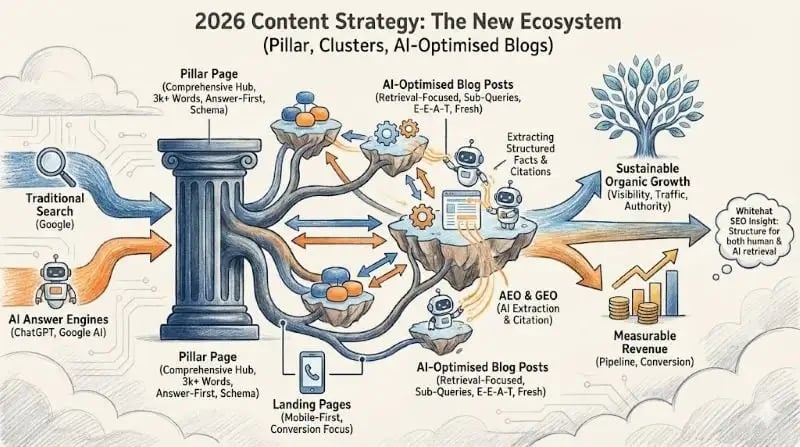
A modern content strategy combines pillar pages, topic clusters, and AI-optimised blog posts to drive sustainable organic growth. With AI Overviews now appearing on 47–50% of Google searches and AI referrals jumping 527% year-over-year by mid-2025, optimising for retrieval—not just ranking—has become essential. Content grouped into topic clusters drives 30% more organic traffic and holds rankings 2.5× longer than standalone pieces. Whitehat's approach helps UK B2B companies structure content for both traditional search and emerging AI answer engines like ChatGPT and Google AI Overviews.
Pillar pages have evolved for AI-first search
The pillar page remains the cornerstone of topic cluster strategy in 2025, but its role has expanded significantly. Beyond serving as a comprehensive resource linking to cluster content, pillar pages now function as primary citation targets for AI systems like ChatGPT, Perplexity, and Google AI Overviews.
Optimal length ranges from 2,000 to 5,000 words, with 3,000 words representing the consensus sweet spot across industry research. However, the critical insight from Whitehat's analysis of successful B2B content is that word count should be driven by topic comprehensiveness, not arbitrary targets. A well-structured 1,500-word page can outperform a bloated 4,000-word page if it better satisfies user intent and provides clearer answers.
Structural best practices have crystallised around several key elements that serve both traditional SEO and AI extraction:
- Answer-first structure: Lead with a direct definition or answer in 40–60 words, then expand with context and examples
- Clickable table of contents with jump links for navigation (fixed or floating recommended)
- Clear heading hierarchy (H1→H2→H3) that mirrors how AI systems extract information
- Visual breaks every 300–500 words including tables, diagrams, and infographics
- FAQ sections with schema markup positioned near the end
- Strong CTAs distributed throughout, not just at the conclusion
For AI citation optimisation, pillar pages should include content that can be extracted in semantic chunks. Research shows that 92.36% of AI Overview citations come from domains ranking in the top 10 organic positions, reinforcing that strong traditional SEO remains foundational. AI systems particularly favour comparative content and comprehensive category hubs that cover topics fairly and thoroughly.
Each pillar should be surrounded by 8–15 focused cluster articles that link bidirectionally. All cluster content should link back to the pillar using consistent, keyword-rich anchor text, whilst the pillar links out to every supporting piece. This creates the network of semantic relationships that both Google's algorithm and AI retrieval systems reward.
Whitehat insight: We've found that pillar pages positioned at the top level of a website (/topic-name/ rather than /blog/topic-name/) and accessible from main navigation perform significantly better for both traditional rankings and AI citations. This signals to search engines that the content represents core expertise.
Blog post strategy now prioritises retrieval over ranking
The most significant shift in blog strategy for 2026 is conceptual: write for retrieval, not just ranking. AI systems don't list links—they retrieve answers from trusted sources and cite them. This requires asking "Am I retrievable?" alongside "Where do I rank?"
Featured snippets' SERP visibility dropped by 64% between January and June 2025 (from 15.41% to 5.53%) as AI Overviews expanded. However, optimising for featured snippets and AI citations requires similar structural approaches—the content that wins snippets also tends to get cited by AI answer engines.
Optimal blog post structure for AI extraction
| Query Type | Format | Best Practice |
|---|---|---|
| Definitions ("What is") | Paragraph (40–60 words) | Concise definition under descriptive H2 |
| Processes ("How to") | Numbered lists | Clear sequential steps with H3 headers |
| Comparisons | Tables | HTML tables with clear column headers |
| Multiple items | Bullet lists | Proper <ul> or <ol> markup |
The inverted pyramid structure works best: answer first, context second, examples and depth third. Each section should function as a self-contained unit that AI can extract without surrounding context. Question-format headers (matching how users query AI engines) significantly improve extraction potential.
Long-form content continues to dominate for comprehensive topics. Research shows that 37% of bloggers publishing 2,000+ word posts see strong results versus just 20% writing 1,000–1,500 words. Long-form content generates 77% more backlinks and ranks in top 3 positions 42% more often. The 2025 average blog post length has increased to 1,427 words (up 10% year-over-year), with comprehensive guides targeting 1,800–2,500+ words.
E-E-A-T requirements have intensified
E-E-A-T (Experience, Expertise, Authoritativeness, Trustworthiness) requirements have intensified, particularly for Experience signals. Google's 2025 algorithm updates specifically target AI-generated content lacking human insight. Implementation requires:
- First-hand experience documentation: Include personal case studies, experiments, original screenshots, and "I did this" perspectives
- Author credentials: Prominent bylines with qualifications, detailed author bio pages, links to LinkedIn and professional profiles
- Citation of authoritative sources: Link to .edu, .gov, Statista, and peer-reviewed research
- Clear timestamps: Always display publication and "Last Updated" dates—AI systems favour recently updated content
Query fan-out optimisation has emerged as a critical strategy. When AI systems receive a query, they decompose it into multiple sub-queries. A question like "What should I wear to a business casual wedding?" generates sub-queries about women's attire, men's attire, shoes, accessories, and more. Your content must address all potential sub-queries through comprehensive coverage or dedicated FAQ sections.
Landing pages require mobile-first design and conversion focus
Landing page strategy in 2025 balances conversion optimisation with emerging SEO and AI considerations. The median conversion rate across industries is 6.6%, with top performers achieving 10%+ through systematic optimisation.
The most striking statistic: 83% of all landing page visits now happen on mobile devices, yet only 50% of landing pages are properly mobile-optimised. Mobile converts 8% lower than desktop, representing significant lost revenue for unprepared sites.
Mobile-first design requirements
- Design for mobile first, then scale to desktop—Google uses mobile-first indexing
- Responsive single-column layouts that stack elements vertically
- Minimum tap target size of 48×48 pixels with adequate spacing to prevent accidental clicks
- Load times under 3 seconds (target under 2 seconds)—53% of mobile users abandon pages that take longer
- Simplified mobile forms with fewer fields, dropdowns instead of typing, and large touch-friendly inputs
For conversion optimisation, headlines remain the most critical element—80% of visitors only read the headline. The 5-second test applies: visitors should understand your value proposition within 5 seconds of landing. Personalised CTAs convert 202% better than generic ones, whilst reducing form fields to 5 or fewer doubles conversion rates.
Thank-you page optimisation
Thank-you page optimisation represents an underutilised opportunity that Whitehat recommends all clients address. Unlike emails with 15–25% open rates, thank-you pages achieve near 100% visibility with a captive, engaged audience. Amazon attributes approximately 35% of total revenue to thank-you page cross-sells and upsells.
Effective thank-you pages include clear confirmation and access to the promised offer, secondary CTAs for deeper engagement (blog subscription, free trial, social follow), upsell or cross-sell opportunities for related products, social sharing buttons linked to the landing page (not the thank-you page), and account creation prompts framed as benefits.
Topic clusters and content architecture drive sustained rankings
The hub-and-spoke model remains the most versatile content architecture for most websites. The central pillar (hub) links to detailed subtopic pages (spokes), with bidirectional linking creating strong semantic relationships. This structure creates clear topical authority signals for search engines, distributes link equity efficiently across the cluster, creates logical user navigation paths, and scales effectively for comprehensive topics.
Internal linking best practices
Internal linking best practices have been refined through large-scale studies. A Zyppy analysis of 23 million internal links found that pages with 20–44 internal links receive 4× more traffic than pages with 0–4 links. However, 53% of URLs have only 3 or fewer internal links—most sites significantly under-link their content.
| Internal Links Per Page | Traffic Impact |
|---|---|
| 0–4 links | Baseline |
| 20–44 links | 4× more traffic (optimal range) |
| 45–50+ links | Diminishing returns |
The recommended ratio is 2–5 internal links per 1,000 words, with total links per page (including navigation) staying under 150. Anchor text diversity correlates strongly with higher traffic; exact-match anchors are associated with 5× more traffic than pages without them, but variety matters.
Click depth significantly impacts performance—pages at depths 1–3 (reachable within 3 clicks from the homepage) generate 9× more SEO traffic than deeper pages. Pillar pages should be positioned at the top level of your website and accessible from main navigation. Whitehat's website design approach incorporates these architectural principles from the outset.
AEO and GEO optimisation require structured, citable content
Answer Engine Optimisation (AEO) and Generative Engine Optimisation (GEO) have emerged as distinct disciplines alongside traditional SEO. Whilst strong SEO fundamentals remain prerequisites—AI systems crawl the web the same way traditional search engines do—GEO requires additional optimisation for citation.
Platform citation patterns differ significantly
| Platform | Primary Citation Sources | Optimisation Focus |
|---|---|---|
| ChatGPT | Wikipedia (47.9%), encyclopedic content | Authoritative tone, comprehensive definitions |
| Perplexity | Reddit (46.7%), community-vetted content | Freshness (90-day recency preferred), practical examples |
| Google AI Overviews | Balanced: Reddit, YouTube, Quora | Strong traditional SEO, structured data |
Research from Princeton and Georgia Tech found that content with specific elements shows 40% higher AI visibility: citations of authoritative sources (.edu, .gov, peer-reviewed research), direct quotations from named experts with credentials, and statistics with source attribution throughout.
Schema markup requirements by page type
| Page Type | Required Schema | Optional Schema |
|---|---|---|
| Pillar Pages | Article, FAQPage | HowTo, Speakable |
| Blog Posts | Article/BlogPosting | FAQPage, HowTo |
| Landing Pages | Service/Product | FAQPage, Organisation |
| Local Pages | LocalBusiness | FAQPage, GeoCoordinates |
Schema markup makes content approximately 33% more likely to be cited in AI-generated answers. Both Google and Microsoft have confirmed they use structured data for their generative AI features. Key implementation includes Article schema with author credentials, FAQPage schema for question-answer sections, and Organisation schema with sameAs properties linking to social profiles.
The fundamental difference between traditional SEO and GEO is the unit of optimisation. SEO optimises at the page level; GEO optimises at the fact level—individual statistics, definitions, and concepts that AI can extract and cite. Content must be structured for "snippability" with self-contained, quotable sections that make sense when extracted from surrounding context.
HubSpot provides integrated tools for content strategy execution
HubSpot's Content Hub (launched April 2024, replacing CMS Hub) provides an all-in-one platform for implementing pillar/cluster strategy. As a HubSpot Diamond Partner, Whitehat helps clients leverage these tools effectively. Key features include the AI Blog Writer powered by GPT-4 with SEO metrics from Semrush data, Content Remix for repurposing content across formats with one click, and Brand Voice AI that learns and applies your brand's tone.
Creating pillar pages in HubSpot CMS
- Use Website Pages (not Landing Pages or Blog Posts) for pillar content—this keeps it on your main domain for maximum authority
- Navigate to Content → SEO → Topic Clusters to research and create topics
- Review Monthly Search Volume and Difficulty metrics before committing
- Attach pillar page content to the topic, then add subtopic keywords (up to 100 per topic)
- Place pillar pages at top-level URLs (/topic-name/) accessible from main navigation
- Never gate pillar content behind forms or passwords—it must be fully crawlable
The SEO Recommendations tool scans all live pages and prioritises recommendations by impact across categories including accessibility, crawling/indexing, mobile experience, on-page SEO, performance, and security. The in-editor Optimise Panel provides real-time recommendations whilst editing.
Key HubSpot 2026 features for content strategy
| Feature | Capability | Tier |
|---|---|---|
| Content Hub | All-in-one content platform | All |
| AI Blog Writer | GPT-4 powered generation | Professional+ |
| Content Remix | One-click repurposing | Professional+ |
| Topic Clusters Tool | Visual SEO planning | Professional+ |
| AI A/B Testing | Automated copy variations | Professional+ |
| Smart Content | Behaviour-based personalisation | Professional+ |
For marketing automation integration, all content interactions log automatically in contact records. Lead scoring based on content engagement, automated email campaigns triggered by specific page visits, and segment-based nurture sequences create a closed loop from content consumption to conversion. This is where Whitehat's expertise in HubSpot SEO strategy delivers measurable pipeline impact.
Key takeaways for implementing 2026 content strategy
The convergence of traditional SEO and AI optimisation has created new imperatives for content strategy. Strong SEO fundamentals remain essential—92%+ of AI citations come from pages already ranking in the top 10—but optimisation must now account for how AI systems retrieve and cite content.
For pillar pages: Target 2,000–5,000 words with answer-first structure, surround with 8–15 cluster articles, implement bidirectional linking with keyword-rich anchor text, and include FAQ sections with schema markup.
For blog posts: Lead with 40–60 word direct answers, structure for query fan-out by addressing all potential sub-queries, display clear timestamps (AI favours fresh content), and document first-hand experience to satisfy E-E-A-T requirements.
For landing pages: Design mobile-first (83% of traffic), simplify forms to 5 or fewer fields, implement personalised CTAs (202% better conversion), and optimise thank-you pages for secondary conversions.
For content architecture: Maintain 20–45 internal links per page with diverse anchor text, keep important pages within 3 clicks of the homepage, and organise content into clear topic clusters that Google evaluates as units.
For AI optimisation: Implement schema markup (33% higher citation likelihood), structure content in extractable semantic chunks, cite authoritative sources throughout, and build presence across platforms AI engines favour (including LinkedIn, YouTube, and relevant industry forums).
The most successful content strategies in 2026 treat these elements as interconnected rather than separate concerns. Pillar pages that satisfy AI retrieval requirements also satisfy user intent; blog posts optimised for featured snippets also perform well in AI Overviews; landing pages with strong conversion principles also earn organic rankings. The fundamentals—comprehensive coverage, clear structure, authoritative sourcing, and user-focused writing—serve both traditional and AI search simultaneously.
Frequently asked questions
What is the ideal length for a pillar page in 2026?
The optimal pillar page length ranges from 2,000 to 5,000 words, with 3,000 words being the sweet spot for most topics. However, comprehensiveness matters more than word count—a well-structured 1,500-word page can outperform a bloated 4,000-word page if it better satisfies user intent and provides clearer answers for AI extraction.
How many cluster articles should surround a pillar page?
A pillar page should typically be surrounded by 8–15 focused cluster articles that link bidirectionally. All cluster content should link back to the pillar using consistent, keyword-rich anchor text, whilst the pillar links out to every supporting piece. This creates the semantic network that both Google and AI systems reward.
What is the difference between AEO and GEO?
Answer Engine Optimisation (AEO) focuses on being cited and recommended within AI-generated responses from tools like ChatGPT, Google AI Overviews, and Perplexity. Generative Engine Optimisation (GEO) specifically targets how large language models retrieve and cite content. Both complement traditional SEO and share many best practices, including structured content, clear answers, and authoritative sources.
Does schema markup help with AI citations?
Yes, schema markup makes content approximately 33% more likely to be cited in AI-generated answers. Both Google and Microsoft have confirmed they use structured data for their generative AI features. Key implementations include Article schema with author credentials, FAQPage schema for question-answer sections, and Organisation schema with sameAs properties linking to social profiles.
How does HubSpot support topic cluster strategy?
HubSpot's Content Hub provides integrated tools for implementing pillar/cluster strategy, including the Topic Clusters tool for visual SEO planning, AI Blog Writer for content generation, and SEO Recommendations for site-wide optimisation. The platform allows you to attach pillar pages to topics, add up to 100 subtopic keywords per topic, and track internal linking validation automatically. As a HubSpot Diamond Partner, Whitehat helps clients configure these tools for maximum SEO and AEO impact.
Ready to build a content strategy that drives measurable results?
Whitehat helps UK B2B companies turn random acts of content into predictable pipeline. Let's discuss how pillar pages, topic clusters, and AI optimisation apply to your business.
Book a Discovery CallReferences and further reading
- HubSpot Knowledge Base: Topics, Pillar Pages, and Subtopic Keywords
- HubSpot Blog: Topic Clusters – The Next Evolution of SEO
- Backlinko: Pillar Pages Guide
- Semrush: How to Create an Effective Pillar Page Strategy
- Search Engine Land: Topic Clusters SEO Strategy
- Zyppy: Internal Linking Study (23 Million Links Analysed)
- Unbounce: Landing Page Best Practices
- HubSpot Content Hub: Product Overview