
Conversion Rate Optimisation
The challenge for B2B marketers isn't understanding that landing pages matter. It's knowing which optimisations actually move the needle in 2026, when mobile dominates traffic, AI tools have matured, and answer engines are reshaping how buyers discover solutions.
Landing Page Best Practices for 2026: Data-Driven Strategies That Convert
Why 77% of paid traffic still lands on homepages—and how the top performers achieve 3x better results with dedicated landing pages.
The bottom line:
Dedicated landing pages convert at nearly 3x the rate of homepages. Yet 77% of paid traffic still lands on company homepages rather than optimised conversion pages. The median landing page conversion rate is 6.6%, with top performers reaching 25%+ through strategic optimisation.
Here's a question worth £ thousands: when someone clicks your ad or email link, where do they land?
If the answer is "our homepage," you're likely leaving significant revenue on the table. The data is unambiguous—dedicated landing pages outperform homepages by a factor of three for campaign traffic. This isn't marketing theory; it's what 57 million conversions across 41,000 landing pages actually show.
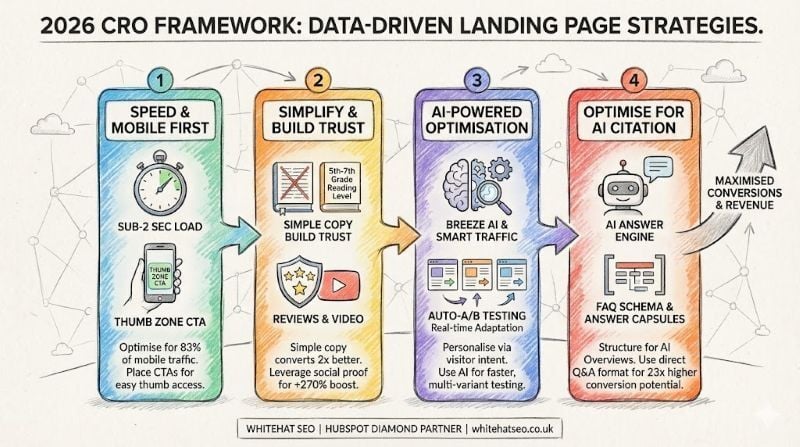
This guide covers what the research actually shows—conversion benchmarks by industry and traffic source, the design fundamentals that haven't changed, the AI capabilities worth using, and how to optimise for both human visitors and the AI systems increasingly mediating their searches.
Conversion benchmarks: what "good" actually looks like
The most authoritative benchmark data comes from Unbounce's analysis of 57 million conversions across 41,000 landing pages and 464 million visitors. The median conversion rate of 6.6% serves as a baseline, but performance varies dramatically by industry.
| Industry | Median Rate | Good (75th %ile) |
|---|---|---|
| Events & Entertainment | 12.3% | 40.8% |
| Financial Services | 8.4% | 15.6% |
| Professional Services | 4.6% | 11.4% |
| E-commerce | 4.2% | 11.4% |
| SaaS | 3.8% | 10.2% |
Traffic source matters enormously. Email converts at 16.9-18%—making it 5-6x more effective than paid traffic. Among social platforms, Instagram leads at 17.9%, Facebook at 13%, whilst LinkedIn converts at just 3.1%.
The implication? Landing page optimisation should be paired with email list building for maximum ROI. If you're driving cold paid traffic to pages and wondering why conversions are low, the traffic source may be as much a factor as the page itself.
Mobile accounts for 83% of traffic—but converts 8% worse
82.9% of landing page visitors now arrive via mobile devices, yet mobile converts 8% lower than desktop overall. This performance paradox costs businesses millions in lost conversions.
The thumb zone has become a critical design consideration. Research shows 75% of users touch screens with their thumb only, which means primary CTAs should sit in the lower third of the screen. Full-width buttons accommodate both left and right-handed users, with minimum touch targets of 44×44 pixels (Apple) or 48×48 pixels (Google Material Design).
Core Web Vitals targets for landing pages:
- LCP (Largest Contentful Paint): ≤2.5 seconds
- INP (Interaction to Next Paint): ≤200ms
- CLS (Cumulative Layout Shift): ≤0.1
The speed-conversion relationship is stark: pages loading in 1 second convert 3x higher than 5-second pages. Every 100ms improvement can deliver up to 10% conversion increase. Vodafone achieved 8% more sales by improving their LCP score by 31%.
If you're investing in website design without mobile-first performance as a foundational requirement, you're optimising the wrong things first.
Simple copy converts. Complicated copy doesn't.
This finding consistently surprises marketers who assume their sophisticated B2B audience requires sophisticated language. The data tells a different story.
Content at a 5th-7th grade reading level converts at 11.1% versus 5.3% for college-level writing. That's more than double the conversion rate from simpler language. Difficult words correlate with a 24.3% decrease in conversions—a 62% stronger negative correlation than was found in 2020.
Why? Attention spans have decreased from roughly 2.5 minutes in 2004 to just 47 seconds in 2024. Your visitors aren't reading; they're scanning. If they can't immediately understand what you're offering and why it matters, they leave.
"Pages with fewer words convert at 14.3% compared to 11.1% for text-heavy pages. Simple copy converts."
Form optimisation follows predictable patterns. Reducing form fields from 4 to 3 can increase conversions by 50%, though context matters—high-value B2B offers successfully use 7-10 fields to qualify leads. Multi-step forms outperform single-page forms significantly, generating 13.85% average conversions versus 4.53% for single-page versions.
The key insight: start with low-threat questions to build momentum before requesting sensitive information. Name and email first, budget and timeline later.
AI tools have matured from novelties to multipliers
The AI landing page builder market has evolved rapidly. Tools now generate complete, conversion-optimised pages from simple prompts—transforming what took days into minutes.
Unbounce's Smart Traffic uses machine learning to automatically route visitors to highest-converting page variants, with customers reporting approximately 30% average conversion improvement. The system starts optimising with as few as 50 visits, considering attributes like device type, location, and timezone.
For HubSpot users, the Breeze AI platform represents the most comprehensive AI integration in a major marketing platform. The Breeze Content Agent can generate complete landing pages from prompts describing page purpose, target audience, ICP, industry context, and brand voice.
Within the landing page editor, slash commands enable AI generation of headings, images, paragraphs, and lists. Highlight commands allow text refinement—expand, shorten, rewrite, or change tone. The AI-powered A/B testing beta automatically generates suggested copy variations, creating variants with one click.
For more sophisticated testing, Adaptive Testing allows up to 5 variations simultaneously, with AI automatically shifting traffic to better-performing versions using a multi-armed bandit algorithm. This eliminates the traditional wait for statistical significance while reducing lost conversions during testing periods.
Personalisation has evolved from basic dynamic text replacement to sophisticated real-time adaptation. AI now adjusts page elements based on visitor intent—LinkedIn ad visitors might see case studies while Google Ads clicks trigger discount offers. The ROI statistics are compelling: personalisation can reduce customer acquisition costs by up to 50% and deliver £20 return for every £1 spent.
AI answer engines are changing how landing pages get discovered
With ChatGPT reaching 800 million weekly active users and Google AI Overviews appearing in approximately 30% of all searches, optimising for AI citation has become essential. This isn't future planning—it's current reality.
AI traffic converts at 23x higher rates than traditional organic traffic, with visitors from AI platforms showing conversion rates exceeding 10%. When an AI engine recommends your solution, visitors arrive pre-qualified and pre-sold.
The most effective structure for AI citation is the "answer capsule" format. Pages using this approach achieve 40% more AI citations. The format uses question-format headings (H2/H3) followed by a direct 2-3 sentence answer (134-167 words optimal for self-contained answers), then detailed explanation with supporting data.
Practical AEO tips for landing pages:
- Implement FAQ schema—pages with FAQ schema are 40% more likely to appear in Google AI Overviews
- Use question-format headings followed by direct, extractable answers
- Include original statistics and specific data points (cited content gets 4.1x more AI citations)
- Keep content fresh—content updated within 3 months averages 6 citations versus 3.6 for outdated content
- Don't block GPTBot or PerplexityBot in robots.txt
For a comprehensive approach to answer engine optimisation, the technical requirements are straightforward but often overlooked: server-side rendering (many AI crawlers struggle with JavaScript-heavy sites), sub-3-second load times, and structured data that helps AI systems understand your content.
Trust signals remain underutilised despite proven impact
Displaying reviews can boost conversions up to 270%, yet 76.8% of marketers overlook social proof on landing pages. Trust badges increase conversions by 12.6% overall and 22% among new visitors. PayPal's A/B test showed trust signals increased sign-ups by 34%.
Video can increase conversions by 80-86%, though the impact varies by industry and product complexity. Video works best for solutions requiring demonstration, with video testimonials outperforming text testimonials by the same margin.
Personalised CTAs convert 202% better than generic ones. The contrast between "Start My Free Trial" and generic "Submit" represents real conversion opportunity. Pages with single links convert at 13.5% versus 10.5% for pages with 5+ links, reinforcing the importance of focused design.
Why landing pages beat homepages (every time)
The fundamental difference is purpose: landing pages exist for single conversion actions while homepages serve brand discovery and exploration. Landing pages should have minimal or no navigation (removing navigation can double conversion rates), while homepages require comprehensive navigation for diverse visitor needs.
Sending paid traffic to homepages remains one of the costliest mistakes businesses make. Dedicated landing pages achieve nearly 3x the conversion rate of homepages, with lower CPC and cost per conversion. Over 98% of PPC campaigns have poor message match between ads and landing pages, wasting ad spend on visitors who bounce from cluttered homepages.
The 1:1 attention ratio principle is critical: one link per conversion goal. Adding a second conversion goal can drop conversions by 266%. Only 16% of landing pages are actually free of navigation, suggesting widespread optimisation opportunity.
The volume effect is significant too. Businesses with 31-40 landing pages generate 7x more leads than those with only 5. Each campaign, offer, and audience segment deserves its own optimised page rather than routing everything to a multipurpose homepage.
What to do with this information
The research points to clear priorities:
- Speed first: Optimise to under 2 seconds for immediate conversion lift
- Mobile-first design: Proper thumb-zone CTA placement addresses the 83% of visitors arriving on mobile devices
- Form reduction: 5 fields or fewer unless qualifying high-value B2B leads
- Add customer testimonials near CTAs: Leverage the trust signal opportunity most marketers miss
- Simplify copy: 5th-7th grade reading level doubles conversion potential
- Implement FAQ schema: 40% more likely to appear in AI Overviews
- Create self-contained answer sections: Position pages for AI citation
- Stop sending paid traffic to homepages: The data is unambiguous on this
The gap between what the data recommends and what most businesses do represents the largest single opportunity for conversion improvement. The median 6.6% conversion rate is a baseline, not a target—top performers exceed it by 3-4x through systematic optimisation.
Need help building landing pages that convert?
As a HubSpot Diamond Partner, we help B2B companies create landing pages that connect campaigns to pipeline—with attribution your CFO will trust.
Explore our servicesReferences
- Unbounce (2024). Conversion Benchmark Report. Analysis of 57 million conversions across 41,000 landing pages.
- Unbounce (2024). Average Conversion Rates for Landing Pages. Q4 2024 data.
- Google (2024). Core Web Vitals. Official performance metrics documentation.
- HubSpot (2024). Breeze AI Platform. Product documentation.
- OpenAI (2025). ChatGPT Usage Statistics. 800 million weekly active users announcement.
Related reading
Whitehat SEO
London-based HubSpot Diamond Partner helping UK B2B companies turn marketing into measurable revenue. We run the world's largest HubSpot User Group and deliver SEO, AEO, and HubSpot implementations that connect every campaign to pipeline. professional website design website audit view our pricing
Learn more about our services →