
| Last Updated: 24 January 2026
How to Create an eBook for B2B Lead Generation: The Complete 2026 Guide
By Clwyd Probert, CEO at Whitehat SEO Ltd | HubSpot Diamond Partner
Creating an eBook for B2B lead generation involves transforming your expertise into a professionally designed downloadable resource, then distributing it through a gated landing page that captures contact information in exchange for valuable content. According to NetLine's 2024 research, eBooks account for 39.5% of all B2B content demand, with registrations growing 34.5% year-over-year. This guide from Whitehat SEO covers everything from design tools to HubSpot integration and UK GDPR compliance.
Why eBooks Remain Effective for B2B Lead Generation in 2026
Despite predictions that eBooks would become obsolete, B2B buyers continue downloading them at increasing rates. The Content Marketing Institute's 2024 research found that 58% of B2B marketers reported increased sales directly attributable to content marketing efforts, with eBooks consistently ranking among the top-performing lead magnets.
The effectiveness comes down to perceived value exchange. When someone downloads an eBook, they're signalling genuine interest in solving a specific problem. Heinz Marketing's analysis shows that gated content leads convert to sales-qualified leads (SQLs) at rates 31% higher than leads from ungated content or social media engagement.
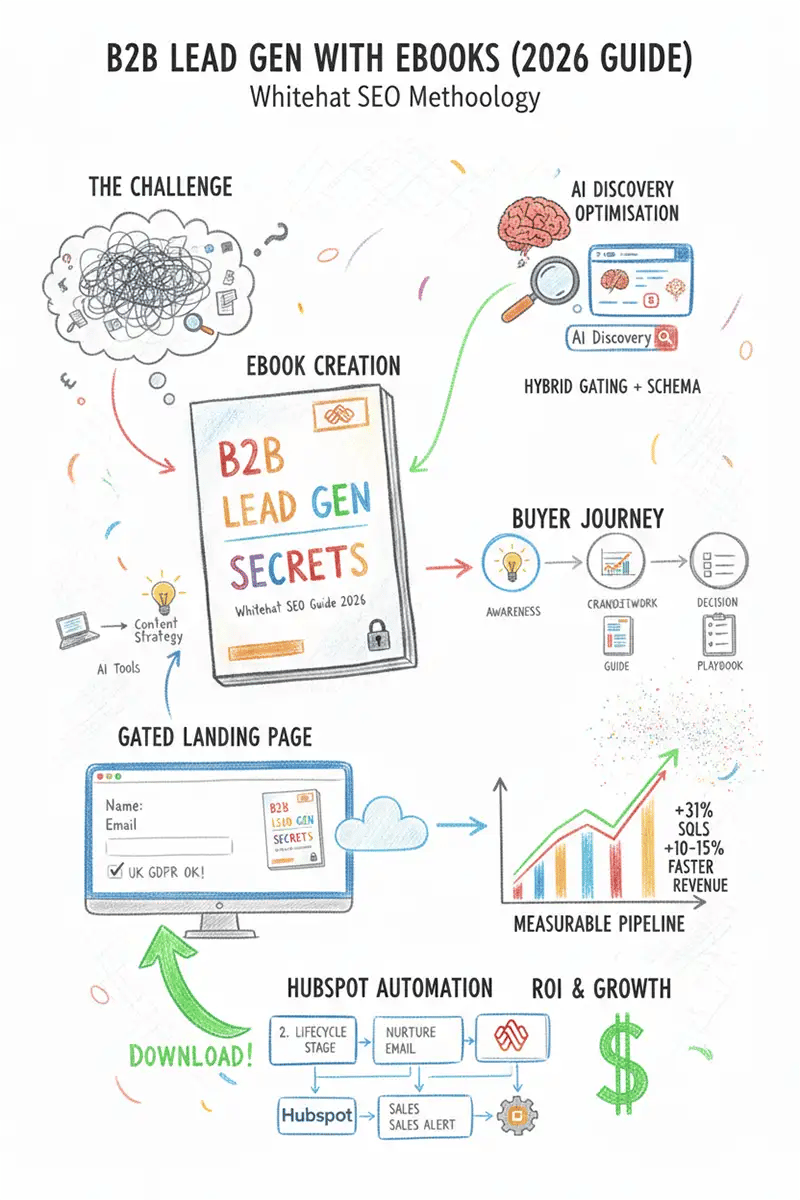
Key eBook Performance Statistics (2024-2025):
- 39.5% of all B2B content demand comes from eBooks (NetLine 2024)
- 34.5% year-over-year growth in eBook registrations
- 10-15% conversion rate for well-optimised gated landing pages
- 36% higher MQL-to-SQL conversion for gated content leads
- 62% of form-fillers actually consume the downloaded content
For UK B2B companies using HubSpot for marketing automation, eBooks integrate seamlessly into lead nurturing workflows. When a prospect downloads your eBook, HubSpot can automatically update their lifecycle stage, trigger personalised follow-up sequences, and alert sales teams when engagement thresholds are reached.
Planning Your eBook Content Strategy
The most common eBook mistake is repurposing blog posts without considering the reader's context. Blog visitors scan for quick answers; eBook readers commit time in exchange for comprehensive guidance. Whitehat SEO recommends starting with your buyer persona's specific challenge, then working backwards to structure content that genuinely solves their problem.
Matching eBook Topics to Buyer Journey Stages
B2B buyers typically consume 13 pieces of content before making a purchasing decision, according to FocusVision research. Your eBook should align with where prospects are in their journey:
| Journey Stage | eBook Format | Example Topic |
|---|---|---|
| Awareness | Educational guide | "The Complete Guide to B2B Content Marketing" |
| Consideration | Comparison or framework | "HubSpot vs Salesforce: Which CRM Suits Your Business?" |
| Evaluation | Implementation playbook | "90-Day HubSpot Implementation Roadmap" |
| Decision | ROI calculator or template | "Marketing Attribution Workbook with Templates" |
Your content marketing strategy should include eBooks at multiple funnel stages. Awareness-stage eBooks cast a wider net, while decision-stage resources attract prospects closer to purchase. According to the Content Marketing Institute, top-performing B2B organisations allocate 40% of their marketing budget to content creation.
Best eBook Creation Tools for 2026
The eBook creation landscape has transformed with AI-powered design tools. You no longer need graphic design expertise to produce professional results. Whitehat SEO's content team regularly uses these tools for client deliverables and internal resources.
Recommended Tools by Use Case
Canva — Best for marketing teams without design resources. Magic Design AI suggests layouts automatically, while Magic Write generates draft copy. The free tier works for basic eBooks; Pro (£12/month) unlocks brand kit features and premium templates.
Designrr — Purpose-built for eBook creation. Imports content directly from URLs, Word documents, or Google Docs, then auto-formats into professional layouts. Particularly strong for repurposing blog content. Starts at £23/month.
Visme — Combines presentation and document design with interactive elements. Embed videos, add clickable buttons, and include data visualisations. The AI document generator produces structured drafts from prompts.
Beacon — WordPress integration specialists. Automatically imports blog posts and converts them into lead magnets with minimal manual formatting. Free tier available; paid plans from £15/month.
For interactive eBooks with embedded video, forms, and analytics, consider Foleon or FlippingBook. These platforms cost more but provide engagement tracking that integrates with HubSpot—you'll see exactly which pages prospects read and how long they spent. Interactive content generates 2x higher conversions than static PDFs, according to Content Marketing Institute research.
Step-by-Step eBook Creation Process
Follow this Whitehat SEO methodology to transform your expertise into a lead-generating eBook. The process works whether you're starting from scratch or converting existing content.
Step 1: Structure Your Content for Readability
Before touching design software, organise your content with the reader's experience in mind. Divide your material into logical chapters with clear headings and subheadings. Each chapter should address a specific question or challenge. Aim for 2,000-5,000 words total—long enough to provide genuine value, short enough to be consumed in a single sitting.
Proofread thoroughly before proceeding. Typos and grammatical errors undermine your authority. Consider reading aloud to catch awkward phrasing, or use tools like Grammarly for UK English spelling and grammar checking.
Step 2: Design Your Cover and Template
Your cover is the first impression—it appears in landing pages, email previews, and social shares. Include your title (concise but compelling), optional subtitle for clarification, author or company name, and a relevant visual element. Use your brand colours and fonts consistently; if you're using HubSpot website design, match your site's visual identity.
For interior pages, maintain consistent margins, font sizes, and heading styles throughout. Most eBook tools provide templates—choose one that balances visual interest with readability. Leave white space; cramped pages feel overwhelming.
Step 3: Enhance with Visuals
Images, charts, and diagrams break up text walls and illustrate complex concepts. Use visuals that add genuine value, not decorative filler. Good sources for royalty-free stock images include Unsplash, Pexels, and Pixabay. For data visualisations, Canva and Visme both include chart-building tools.
Name image files descriptively with hyphens (e.g., "content-marketing-roi-chart.jpg") for accessibility and potential SEO benefit if the PDF gets indexed. Ensure all images include alt text for screen reader compatibility.
Step 4: Add Navigation Elements
Include a clickable table of contents immediately after your cover page. List all chapter titles with hyperlinks to their starting pages. For longer eBooks, add page numbers and running headers showing the current chapter. These elements improve user experience and help readers locate specific sections when returning to the document.
Step 5: Export and Test
Export your eBook as PDF for maximum compatibility. Test the file on multiple devices—desktop, tablet, and mobile—to ensure formatting remains intact. Check that all hyperlinks work and that the table of contents navigation functions correctly. Keep file sizes under 10MB for fast downloads; compress images if necessary.
HubSpot Landing Page and Workflow Setup
Your eBook becomes a lead generation asset only when connected to a conversion system. HubSpot provides everything needed: landing pages, forms, file hosting, thank-you pages, and automated follow-up workflows. Whitehat SEO's HubSpot implementations typically see 55% of top-performing blog submissions come from eBook offers.
Landing Page Best Practices
Keep your landing page focused on a single action: downloading the eBook. Remove navigation menus that could distract visitors. Include an eBook mockup image, a benefit-focused headline, 3-5 bullet points explaining what readers will learn, and your form above the fold.
Form optimisation significantly impacts conversion rates. Research shows that reducing form fields from 11 to 4 can increase conversions by 160%. For most eBooks, collect only first name, email address, company name, and job title. Use HubSpot's progressive profiling to gather additional information on subsequent visits rather than overwhelming first-time downloaders.
Post-Download Workflow Automation
Configure HubSpot workflows to trigger automatically when someone downloads your eBook. A typical sequence includes: immediate delivery email with download link, lifecycle stage update (Lead → Marketing Qualified Lead), internal notification to sales team, and a nurture sequence starting 39 hours later (the average time prospects take to consume downloaded content, according to NetLine research).
HubSpot's 2024 lead scoring update introduced AI-assisted scoring that recommends criteria based on your successful conversions. Assign points for eBook downloads, then use score thresholds to trigger sales handoffs. Most successful implementations use a 0-100 scale with "sales-ready" defined at 70+ points.
UK GDPR Compliance for Gated Content
UK data protection requirements differ from other jurisdictions, and getting them wrong carries serious penalties. The ICO issued £4.426 million in fines during 2024, with £1.1 million specifically for PECR (Privacy and Electronic Communications Regulations) violations. Understanding the rules ensures your eBook generates leads legally.
The B2B Marketing Exception
Good news for B2B marketers: PECR electronic mail rules do not apply to corporate subscribers (registered companies and LLPs). You can send B2B marketing emails without explicit consent, provided you don't disguise your identity and you provide a valid opt-out mechanism. However, sole traders and partnerships are treated as individuals and require consent.
For B2B contacts, legitimate interest typically provides lawful basis for processing. The ICO confirms that "business contacts are more likely to reasonably expect the processing of their personal data in a business context." Document your Legitimate Interest Assessment (LIA) to demonstrate compliance.
Form Design Requirements
UK GDPR Compliance Checklist for eBook Forms:
- No pre-ticked consent boxes—all opt-ins require affirmative action
- Separate checkboxes for different consent purposes (e.g., newsletter vs. sales contact)
- Clear purpose statement explaining why you're collecting data
- Visible link to privacy policy before form submission
- Data minimisation—only collect fields genuinely necessary
- Time-stamped consent records for audit trail
- Easy withdrawal mechanism via simple unsubscribe
The Data (Use and Access) Act 2025 introduced additional requirements from June 2025. ICO guidance continues evolving—monitor ico.org.uk for updates. Whitehat SEO's AI and compliance consulting helps UK businesses navigate these evolving requirements.
Optimising eBook Landing Pages for AI Discovery
Over 50% of B2B buyers now use AI tools like ChatGPT and Perplexity to research purchases before visiting vendor websites. Your eBook landing page should be structured for both human visitors and AI citation. This emerging discipline—Answer Engine Optimisation (AEO)—ensures your content gets recommended when prospects ask AI for advice.
The Gating Challenge for AI Visibility
Here's the tension: gated content converts better, but AI search engines cannot access it. Search Engine Land research found that gated content receives 94% fewer AI citations than ungated content. The solution is a hybrid approach: provide substantial ungated preview content on your landing page while keeping the full eBook gated.
Structure your landing page with answer-first formatting. Lead with the key insight in your opening paragraph (40-60 words). Include FAQ sections with direct answers to common questions. Use descriptive headers that match natural language queries. These elements give AI engines quotable content while preserving your lead capture mechanism.
Schema Markup for Enhanced Visibility
Implement structured data on your eBook landing pages to help AI and search engines understand your content. Article schema identifies the page as editorial content with clear authorship. FAQPage schema marks up your frequently asked questions for potential featured snippet and AI citation. Together, these signal content quality and relevance.
Frequently Asked Questions About Creating eBooks
How long should a B2B lead generation eBook be?
B2B eBooks typically perform best at 2,000-5,000 words (10-25 pages). This length provides enough depth to demonstrate expertise while remaining consumable in a single sitting. Focus on delivering genuine value rather than padding content—quality matters more than page count for conversion rates.
What's the best file format for eBooks?
PDF remains the most versatile format for B2B marketing eBooks, ensuring consistent display across all devices. For distribution on eReader platforms like Kindle, convert to ePub or Mobi formats. Interactive flipbook formats (HTML5) work well for engagement tracking but require compatible hosting platforms.
Should I gate or ungate my eBook content?
The 2026 consensus favours hybrid approaches—76% of B2B marketers now use this strategy. Provide substantial ungated preview content on landing pages for SEO and AI visibility, while keeping the complete resource gated. This balances lead capture with brand awareness and search discoverability.
Do I need design skills to create a professional eBook?
No—modern eBook creation tools like Canva, Designrr, and Visme include AI-powered design features and professional templates that eliminate the need for graphic design expertise. Focus on creating valuable content; the tools handle visual presentation automatically.
How do I measure eBook lead generation ROI?
Track eBook performance through your CRM using closed-loop attribution. In HubSpot, monitor form submissions, content downloads, lead score changes, and pipeline contribution. The most meaningful metrics are MQL-to-SQL conversion rate and revenue attributed to eBook-sourced leads—not just download counts.
Can I repurpose blog posts into an eBook?
Yes, but restructure the content rather than simply compiling posts. Blog readers scan for quick answers; eBook readers expect comprehensive guidance. Add connecting narrative, update statistics, ensure consistent tone throughout, and include new material that justifies the download exchange.
Next Steps: Creating Your Lead-Generating eBook
eBooks remain one of the most effective B2B lead generation formats in 2026, but success requires more than good content. Your eBook strategy must integrate with your marketing automation platform, comply with UK data protection regulations, and increasingly consider AI discoverability alongside traditional SEO.
Whitehat SEO helps UK B2B companies build content marketing systems that generate qualified leads and demonstrate clear ROI. As a HubSpot Diamond Partner, we combine SEO expertise with CRM integration to ensure every eBook download contributes to measurable pipeline growth. Get in touch to discuss how we can help you turn your expertise into a lead generation engine.
References and Citations
- NetLine Corporation. (2024). 2024 State of B2B Content Consumption and Demand Generation Report. netline.com
- Content Marketing Institute. (2024). B2B Content Marketing: Benchmarks, Budgets, and Trends. contentmarketinginstitute.com
- Heinz Marketing. (2024). B2B Content Marketing: Why eBooks Remain a Key Asset in 2025. heinzmarketing.com
- Information Commissioner's Office. (2025). Guide to PECR: Electronic Mail Marketing. ico.org.uk
- Cognism. (2025). Gated vs Ungated Content: The Great Marketing Debate. cognism.com
- HubSpot. (2024). Lead Magnets: 20 Ideas and Examples. blog.hubspot.com
- DMA UK. (2025). Email Benchmarking Report 2025. dma.org.uk
Ready to turn your expertise into qualified leads?
Whitehat SEO helps UK B2B companies build content marketing systems that generate measurable pipeline growth. view our pricing
Book a Discovery Call