
22 March 2026 | By Clwyd Probert |
How to Create High-Converting Landing Pages in HubSpot: The Complete UK Guide for 2026
Creating high-converting landing pages in HubSpot requires combining focused design principles with the platform's built-in tools, including Breeze AI for rapid page generation and smart forms for lead capture. The median conversion rate sits at 6.6% across industries, though B2B SaaS companies typically achieve 3.8%—well-optimised pages can push beyond 10%.
Whether you're building your first HubSpot landing page or optimising existing campaigns, understanding current best practices makes the difference between mediocre results and genuine pipeline impact. As a HubSpot Platinum Partner, Whitehat has implemented hundreds of landing pages for UK B2B companies.
Key Takeaway
Landing pages with five or fewer form fields convert 120% better than longer forms. This single optimisation often doubles conversion rates for B2B campaigns.
Why Landing Pages Matter for UK B2B Marketing in 2026
Landing pages represent one of the highest-ROI marketing assets in any B2B company's arsenal. Unlike generic website pages, landing pages focus visitor attention on a single conversion objective.
Companies using landing pages see email engagement increase by 50%, and well-designed pages generate leads at 40% lower cost than paid search.
For UK B2B companies, landing pages support sophisticated nurture workflows. A prospect can be automatically enrolled in a 5-email sequence, delivered to sales, and tracked through your entire CRM pipeline.
Landing pages also unlock ABM opportunities. HubSpot's Smart Content lets you personalise by company domain, showing different value propositions to enterprise vs SMB visitors.
What Conversion Rates Should UK B2B Companies Expect in 2026?
Unbounce's 2024 Conversion Benchmark Report analysed 57 million conversions across 41,000+ landing pages.
| Industry | Median Conversion Rate | UK/EMEA Advantage |
|---|---|---|
| Events & Entertainment | 12.3% | +15% |
| Financial Services | 8.4% | +15% |
| Professional Services | 3.5% | +15% |
| B2B SaaS | 3.8% | +15% |
| Overall Median | 6.6% | Your Target |
EMEA outperforms the Americas by 15% in conversions and APAC by 49%.
Email converts at 19.3%—60% higher than paid social. When Whitehat implements inbound marketing campaigns, email-driven pages consistently outperform.
19.3%
Email Conversion Rate
Highest of all traffic sources
12.1%
Organic Search Rate
Tied with paid social
10.8%
Paid Search Rate
77% lower than email
8.5%
Direct Traffic Rate
Lowest converting source
Source: Unbounce 2024 Conversion Benchmark Report (57M conversions, 41K+ pages)
HubSpot's Content Hub Landing Page Features for 2026
Landing pages now sit within HubSpot's Content Hub rather than Marketing Hub.
Breeze AI generates complete landing pages including AI copy, images, forms, and meeting links.
Smart Content rules enable personalisation based on eight criteria: ad source, country, device type, referral source, preferred language, contact list membership, lifecycle stage, and query parameters.
Avoid This Mistake
Progressive profiling is only available in HubSpot's legacy form editor—not the new modern editor. If progressive profiling is essential, use legacy forms or implement workarounds.
HubSpot's form builder now offers multi-level conditional logic, up to 100 rules, AI-powered form translation, live field validation, and Breeze Intelligence form shortening.
Breeze AI Content Agent
Generate complete landing pages from text prompts or uploaded documents with AI copy, images, forms and CTAs.
Smart Content Personalisation
Serve custom content blocks based on visitor device, location, lifecycle stage, traffic source and more.
A/B Testing & Mobile Preview
Test headline variations, CTAs, form fields and layouts. Design mobile-first with real-time responsive preview.
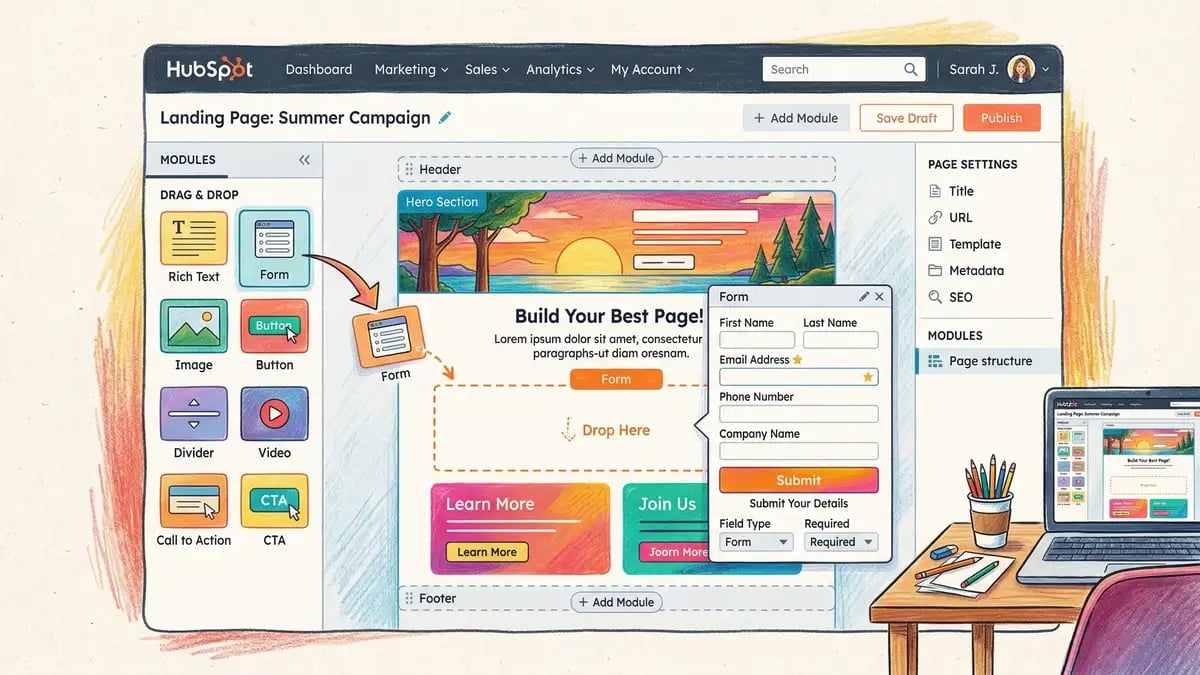
Form Optimisation: The Biggest Conversion Lever
HubSpot's analysis of 40,000+ landing pages reveals a conversion cliff after three fields. Five or fewer fields convert 120% better.
Phone numbers cause 37% of users to abandon forms when required (Zuko Analytics 2024).
Multi-step forms convert 86% higher than single-step (HubSpot research).
CTA text matters: "Submit" causes 3% more abandonment. When implementing through HubSpot automation workflows, always test CTA copy.
120%
Better Conversion
With 5 fields vs longer forms
86%
Higher Conversion
Multi-step vs single-step
37%
User Abandonment
When phone number required
Mobile Optimisation and Page Speed Requirements
82.9% of landing page traffic comes from mobile—yet desktop converts 8% better.
Mobile-friendly pages show 50% higher conversion rates. Test on actual devices.
A 0.1-second improvement delivers 10.1% conversion increase. Pages at 0-1 seconds achieve 31.79% conversion.
53% of mobile visitors abandon pages over 3 seconds. A website audit should always include page speed analysis.
| Load Time | Conversion Rate | Mobile Abandonment |
|---|---|---|
| 0-1 second | 31.79% | 7% |
| 1-2 seconds | 27.5% | 15% |
| 2-3 seconds | 19.8% | 26% |
| 3+ seconds | 14.6% | 53% |
Thank You Page Optimisation: The Overlooked Conversion Opportunity

Thank you page design elements
Thank you pages are post-conversion real estate. Amazon's Prime customers convert at 74% for additional purchases on thank you pages.
Include: content access, social sharing links, secondary CTAs, and auto-response email confirmation.
Open content downloads in a new tab. When building through HubSpot website design projects, Whitehat ensures thank you pages receive equal strategic attention.
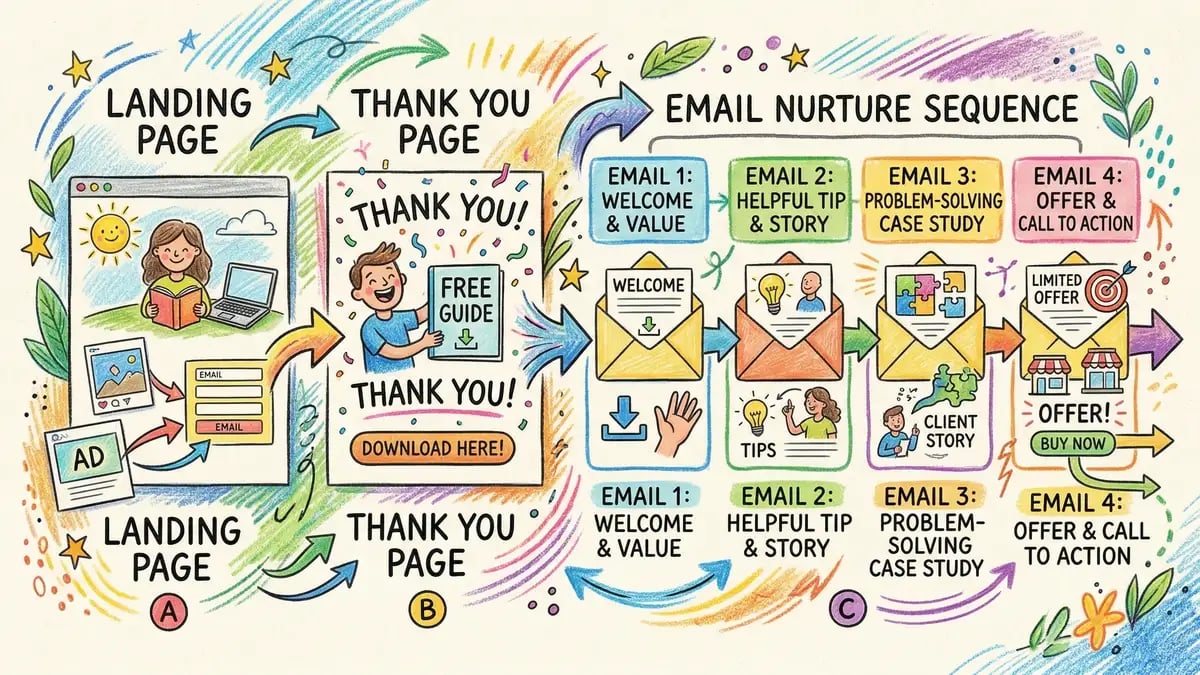
Content Delivery & Sharing
Provide a direct download link or preview of the promised resource. Add one-click social sharing buttons for LinkedIn, Twitter, and Facebook to amplify organic reach from every conversion.
Secondary Conversion & Next Steps
Include a complementary offer—webinar registration, consultation booking, or product trial. Add newsletter signup as secondary lead capture and clear guidance on what happens next (email confirmation, follow-up timeline).
UK GDPR Compliance Requirements for Landing Page Forms
UK landing pages must comply with UK GDPR, PECR, and the Data (Use and Access) Act 2025. Penalties reach £17.5 million or 4% of global turnover.
ICO guidance requires: unticked checkboxes, separate checkboxes per use, freely given consent, accessible privacy policy, and easy withdrawal.
For B2B, legitimate interest may apply but PECR consent rules apply for electronic marketing. HubSpot's GDPR tools require proper configuration.
Consent & Transparency
Display unticked opt-in checkboxes (pre-ticked banned). Link accessible Privacy Policy near form. Provide separate consent options for each data use. Implement one-click unsubscribe in follow-up emails.
Documentation & Compliance
Maintain timestamped consent audit trail via HubSpot GDPR tools. Implement cookie consent banner for non-essential tracking. Document legal basis for each processing activity (consent, legitimate interest, or contract).
Step-by-Step: Creating a Landing Page in HubSpot
Here's how to build a landing page in HubSpot Content Hub. Most teams complete one in 2-3 hours; Breeze AI reduces that to 15-30 minutes.
Navigate to Landing Pages
Go to Content → Landing Pages. Click Create and select Landing page.
Choose Creation Method
Select from templates, use Breeze AI, or start blank.
Configure Settings
Set page title, URL slug, meta description. Enable A/B testing.
Build Your Form
Create in Marketing → Forms. Aim for 3-5 fields with GDPR checkboxes.
Create Thank You Page
Build before publishing. Include content delivery, secondary CTA, social sharing.
Test and Publish
Preview on desktop and mobile. Test submission and verify workflows.
Frequently Asked Questions
How many landing pages can I create in HubSpot?
Starter allows 20 with branding. Professional and Enterprise support up to 10,000 without branding.
Can I use Breeze AI to generate landing pages?
Yes, on Professional and Enterprise tiers. Generates complete pages from prompts or uploaded documents.
What's the optimal number of form fields?
Research shows 3-5 fields optimal. Sharp conversion drop after three fields.
Do I need separate thank you pages?
Dedicated pages offer secondary CTAs, upsell opportunities, social sharing, and better analytics.
How do I ensure UK GDPR compliance?
Unticked consent checkboxes, privacy policy links, granular consent options, and easy withdrawal mechanisms.
Landing pages vs website pages?
Landing pages are campaign-specific with minimal navigation. Website pages have full navigation for permanent content.
Resources and References
- Unbounce Conversion Benchmark Report 2024
- HubSpot – Create and Customise Pages
- HubSpot – Breeze AI Landing Pages
- ICO – UK GDPR Consent Guidance
- HubSpot – Page Load Time Statistics
Ready to Build High-Converting Landing Pages?
As a HubSpot Platinum Partner, Whitehat specialises in landing page systems that drive genuine pipeline impact. Book a free HubSpot Health Check.
Clwyd Probert
CEO, Whitehat SEO Ltd
Clwyd is CEO of Whitehat SEO Ltd, a HubSpot Platinum Partner based in London. Since 2016, Clwyd has led over 300+ HubSpot implementations for UK B2B companies. He runs the world's largest HubSpot User Group (7,000+ members) and is a guest lecturer at UCL on digital marketing strategy.