
Updated for 2026 • Whitehat (London) • Veterinary practice marketing
How do you market a veterinary practice online in 2026?
To market a veterinary practice online in 2026, focus on local visibility and trust: build a fast, mobile-friendly website, optimise your Google Business Profile, collect and respond to reviews, publish answer-first content that AI search can cite, and use targeted PPC for urgent demand. Measure bookings, not just traffic, and iterate monthly.
Author: Whitehat Marketing Team • Last updated: 9 January 2026
1) How pet owners choose a vet in 2026 (and why AI matters)
Pet owners still want someone competent, kind, and nearby. What’s changed is how they decide: a phone screen full of map listings, reviews, and (increasingly) AI summaries.
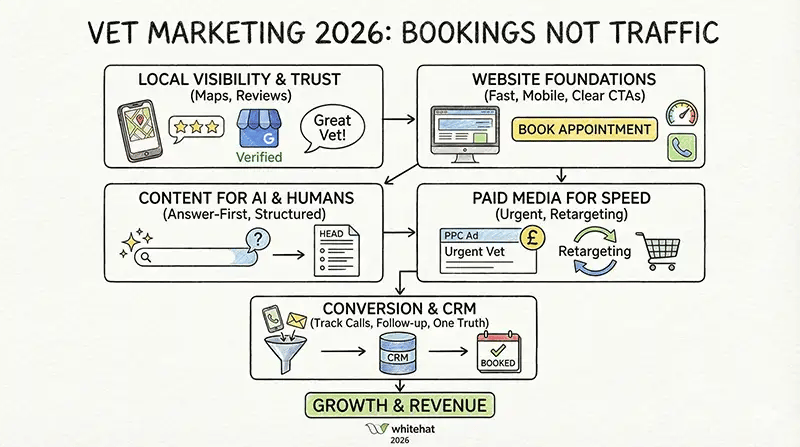
Ofcom reports UK adults spend an average of 4.5 hours online per day, mostly on smartphones, and Google Search is used by 82% of adults. It also notes around 30% of searches now show AI overviews. Translation: your visibility needs to work in classic search and AI-generated answers.
The opportunity is big. PDSA’s Animal Wellbeing Mini Report 2025 estimates the UK has 11.1 million pet dogs and 10.5 million pet cats. If your practice isn’t showing up when owners search “vet near me”, “vaccinations for puppies”, or “cat dental cleaning cost”, somebody else is taking the booking.
2) Website foundations that turn visits into bookings
Your website has one job: make it ridiculously easy to book. That means fast load times, clear navigation, and obvious calls-to-action (call, book, request an appointment).
Quick win checklist (foundations)
- Put your phone number and “Book appointment” button in the header (mobile sticky if possible).
- Add dedicated pages for your core services (vaccinations, neutering, dentals, emergencies, health plans).
- Show trust signals above the fold: reviews, accreditations, clinician bios, and what makes you different.
- Make your site quick. Core Web Vitals are still table-stakes (we’ve got a plain-English guide here).
If your site is slow, confusing, or built like it’s 2014, your marketing spend becomes a tax you pay to send people to a leaky bucket. Start with a website audit to prioritise fixes by impact, not by what’s fashionable this month.
If you’re on HubSpot, a properly built site can connect calls, forms, and bookings to your CRM so you can see what actually drives revenue. Our HubSpot website design work is built around that.
3) Local SEO for vets: dominate the map pack
If you’re a veterinary clinic, local SEO is the highest ROI channel for most practices. When someone searches “vet near me”, Google often shows a map and three listings before anything else. That’s where you want to live.
Backlinko’s 2025 local SEO stats highlight why: 76% of consumers who search “near me” visit a business within a day. For urgent needs, that “within a day” is often “within an hour”.
The Google Business Profile basics (do these first)
- Categories: choose the correct primary category (e.g., “Veterinarian”) and add relevant secondary services.
- Services list: include the terms people actually search (vaccinations, microchipping, neutering, dental, emergencies).
- Photos: real team and facility photos beat stock images every day of the week.
- Q&A: answer common questions before someone else does (parking, emergency cover, out-of-hours).
- Posts: publish short updates (seasonal reminders, flea/tick campaigns, new services).
Then support your profile with location pages and consistent citations. If you serve multiple areas, don’t mash everything into one page. Build separate, helpful pages that match the real world: services, locations, and clear booking options.
Need help with the full system—technical SEO, local pages, and authority building? That’s exactly what our SEO services are designed for. (Yes, we’re biased. But we’re also right.)
4) Reviews and reputation: your unfair advantage
Vets aren’t selling widgets. You’re asking someone to trust you with a family member. Reviews are the fastest way to communicate that trust at scale—because they’re not you talking about you.
BrightLocal’s 2025 Local Consumer Review Survey found that only 4% of consumers say they never read online reviews, and 74% use two or more websites when checking reviews. So if you’ve got a glowing Google profile but your Facebook page looks abandoned, that inconsistency can quietly cost you bookings.
One more 2026 reality check: the Competition and Markets Authority has proposed reforms to improve price transparency in the UK veterinary market. That means clearer pricing and communication will matter even more—not just for trust, but for conversion. If a pet owner can’t quickly understand what happens next (and what it might cost), they’ll keep searching.
A review system that doesn’t rely on luck
- Ask at the right moment: 24–48 hours after a successful appointment is the sweet spot.
- Reduce friction: use a short link or QR code that goes straight to your review form.
- Respond to every review: simple, professional, and never defensive.
- Learn from patterns: if multiple reviews mention waiting times or pricing confusion, fix the system.
One extra 5-star review won’t change your world. A consistent review pipeline will. Combine it with local SEO and you’ll feel the difference in the diary.
5) Content that ranks, converts and gets cited by AI (AEO/GEO)
Content that doesn’t get discovered (or doesn’t lead to bookings) is just expensive journalling. The goal: match real search questions and make the next step obvious.
In 2026, you’re not only writing for Google’s blue links—you’re writing for AI summaries and answer engines. Ofcom’s 2025 data shows AI overviews appear on about 30% of searches. These systems prefer content that is structured, specific, and easy to extract. That’s why we recommend “answer-first” pages (direct response, then detail).
The vet clinic content framework (that actually works)
- Service pages (commercial): “Dog dental cleaning”, “Puppy vaccinations”, “Emergency vet”, "Dog Care Guides".
- Location pages (local): areas you genuinely serve, with practical info and booking options.
- Support content (informational): questions that lead to services (e.g., “Signs of dental disease in dogs”).
- Trust content (evaluation): team bios, pricing principles, what to expect, case stories, FAQs.
You can publish educational content without giving personal medical advice: use clear disclaimers, focus on when to call, and guide people to book. If you want your content to show up in AI answers, structure it with short, self-contained sections and FAQ-style headings.
If you want to go all-in on AI visibility, take a look at our explanation of Answer Engine Optimisation (AEO) and the practical tactics behind it. We also break down the bigger shift here: AI search optimisation.
Core Web Vitals still matter for UX and conversions. If you want the quick version, read our Core Web Vitals guide.
6) PPC and paid social: when to pay for speed
SEO compounds, but it takes time. PPC buys speed. The smartest practices use paid media to cover the gap while organic visibility builds—and to push specific services when capacity allows.
Where paid tends to work best for veterinary clinics:
- High-intent services: “emergency vet”, “out of hours vet”, “vaccinations”, “neutering”.
- Local radius targeting: only pay for the area you can realistically serve.
- Retargeting: bring back visitors who checked prices or opening hours but didn’t book.
A practical warning: ad spend can evaporate if tracking is poor. If you can’t attribute calls and bookings, you can’t optimise. That’s why we treat PPC and analytics as one system.
If you want help structuring campaigns around bookings and profitability (not vanity clicks), our PPC management service is built on the same “measure what matters” principle.
7) Conversion + CRM: stop leaking enquiries
Most clinics don’t have a marketing problem—they have a follow-up problem. Calls get missed, forms sit in an inbox, and the pet owner books the next clinic on the list.
Fixing this is less about “more leads” and more about system:
- Call tracking: know which pages and campaigns generate calls.
- Speed to response: set a standard and automate where appropriate (confirmations, reminders, FAQs).
- One source of truth: store enquiries, outcomes and follow-up notes in one place.
HubSpot can be the connective tissue between website, campaigns and actual revenue. If you want your site to behave like a proper growth engine (not an online brochure), see our HubSpot website design approach.
How Whitehat helps veterinary clinics grow (without the fluff)
Whitehat is a London-based digital marketing agency (and HubSpot Diamond Partner) built around one idea: marketing should be measurable. For veterinary practices, that means we care about bookings and calls—not vanity metrics.
Typically, the quickest wins for clinics come from:
- A focused local SEO programme (Google Business Profile + local pages + technical fixes)
- A review system that runs every week, not “when we remember”
- Content and FAQs that match real pet-owner questions (and are structured for AI citation)
- Tracking that tells you what’s generating revenue
If you’re not sure where to start, start small and smart: a website audit gives you a prioritised list of what’s holding you back. From there, we can build an integrated plan using Whitehat’s marketing services—SEO, inbound marketing, AEO, PPC, and site improvements—matched to your capacity and goals.
Want to see how we think about healthcare-style local growth? Our 2026 guide on dental practice marketing strategies is a useful parallel, and our optometry digital marketing plan shows the same local-first, trust-first approach in another healthcare setting.
Ready for more bookings?
If you want a no-nonsense view of what’s working, what’s broken, and what to do next, book a free call. We’ll look at your local visibility, website conversion, and how AI search is treating your brand.
Speak to WhitehatFrequently Asked Questions (vet practice digital marketing)
What’s the single most important marketing channel for a veterinary clinic?
For most clinics, it’s local search: Google Business Profile optimisation plus local SEO. That’s where high-intent “near me” demand shows up, and it converts quickly. Build that foundation first, then layer on reviews, content and PPC to accelerate growth.
How long does vet clinic SEO take to work?
You can often see local improvements within 4–8 weeks once your Google profile, on-page fundamentals and citations are cleaned up. Stronger organic rankings typically take 3–6+ months, depending on competition. The aim is compounding growth: each month builds on the last.
What should a veterinary practice website include to increase bookings?
Make booking effortless: clear phone number, online booking or request form, service pages, opening hours, pricing principles (where possible), directions/parking, and trust signals like reviews and clinician bios. Keep it fast, mobile-first and focused on the next action, not just information.
How do we get more (and better) Google reviews without annoying clients?
Use a simple system: ask after a positive outcome, send one reminder 24–48 hours later, and provide a direct link. Don’t beg—invite feedback and make it quick. Then respond to every review professionally. Over time, consistency beats the occasional “review push”.
Do we need paid ads if we’re doing SEO?
Not always, but PPC is useful for urgent demand and for promoting specific services when you have capacity. SEO is the long game; PPC is the accelerator. The best setup uses both, with tracking in place so you can see which campaigns drive calls, bookings and revenue.
How does AI search change veterinary marketing?
AI overviews and chat-style search are compressing the journey: users get a summary and shortlist faster. To be visible, your content needs clear answers, strong local signals, and trustworthy authority. That’s the goal of AEO/GEO—earning citations and recommendations, not just rankings.
How do we measure whether marketing is working?
Track outcomes: calls, appointment requests, booked consultations, and revenue by channel. Rankings and traffic are leading indicators, not the finish line. If you connect your website and campaigns to a CRM, you can see what actually turns into paying clients—and double down on it.
Medical disclaimer: this article is about marketing. It is not veterinary advice and should not be used to diagnose or treat any condition. Always consult a qualified veterinary professional.
References (verified links)
- PDSA (2025). UK pet populations of dogs, cats and rabbits. https://www.pdsa.org.uk/what-we-do/pdsa-animal-wellbeing-report/uk-pet-populations-of-dogs-cats-and-rabbits
- Ofcom (Published 10 December 2025). From apps to AI search: how the UK goes online in 2025. https://www.ofcom.org.uk/media-use-and-attitudes/online-habits/from-apps-to-ai-search-how-the-uk-goes-online-in-2025
- BrightLocal (2025). Local Consumer Review Survey 2025. https://www.brightlocal.com/research/local-consumer-review-survey/
- Backlinko (Updated 2025). 24 Must-Know Local SEO Statistics. https://backlinko.com/local-seo-stats
- Reuters (15 October 2025). UK watchdog proposes sweeping reforms of veterinary services market. https://www.reuters.com/world/uk/uk-regulator-calls-major-reforms-veterinary-services-market-2025-10-15/