
Dental marketing in the UK has changed fundamentally. With over 50% of adults struggling to access NHS dental care, private practices are competing harder than ever for patients—and the practices that win are the ones with a clear digital marketing strategy. Whether you run a single-chair practice in a small town or a multi-location group across a major city, the principles are the same: be visible where patients search, build trust before they walk through the door, and convert enquiries into long-term relationships.
This guide covers every marketing channel available to UK dental practices in 2026, with practical implementation advice, realistic cost expectations, and compliance guidance. It's designed as a companion to our comprehensive dental SEO guide, which covers the technical foundations. Here, we focus on strategy—the decisions that determine whether your marketing budget generates patients or gets wasted.
What Marketing Channels Work Best for Dental Practices?
Not all marketing channels deliver equal results for dentists. The UK dental market has specific characteristics—local search dominance, high patient lifetime value, strict regulatory requirements—that make some channels far more effective than others.
Here's how the major channels compare for UK dental practices:
| Channel | Cost per Patient | Time to Results | Best For | Difficulty |
|---|---|---|---|---|
| Organic SEO | £50–£200 | 3–6 months | Sustainable long-term patient acquisition | Medium |
| Google Ads | £150–£400 | Immediate | Emergency dentistry, high-intent keywords | High |
| Referral programmes | £10–£50 | Ongoing | Highest-quality patients, lowest cost | Low |
| Content marketing | £30–£100 | 3–9 months | Authority building, long-tail keywords | Medium |
| Social media | £150–£500 | 1–3 months | Brand awareness, cosmetic dentistry | Low–Medium |
| Email marketing | £20–£50 | 1–4 weeks | Patient retention and reactivation | Low |
| Reputation mgmt | £0–£30 | 4–8 weeks | Local search ranking, trust building | Low |
The most effective dental marketing strategies combine multiple channels. SEO provides the foundation, Google Ads delivers immediate results, referral programmes offer the best ROI, and reputation management amplifies everything else. The exact mix depends on your practice size, location, and growth stage.
The highest-performing dental practices don't rely on a single channel. They allocate roughly 50% of budget to organic SEO (foundation), 25% to Google Ads (quick wins), 15% to social media and content (brand building), and 10% to referral and email programmes (retention). This mix delivers both immediate patient flow and compounding long-term growth.
How Should a Dental Practice Build Its Online Presence?
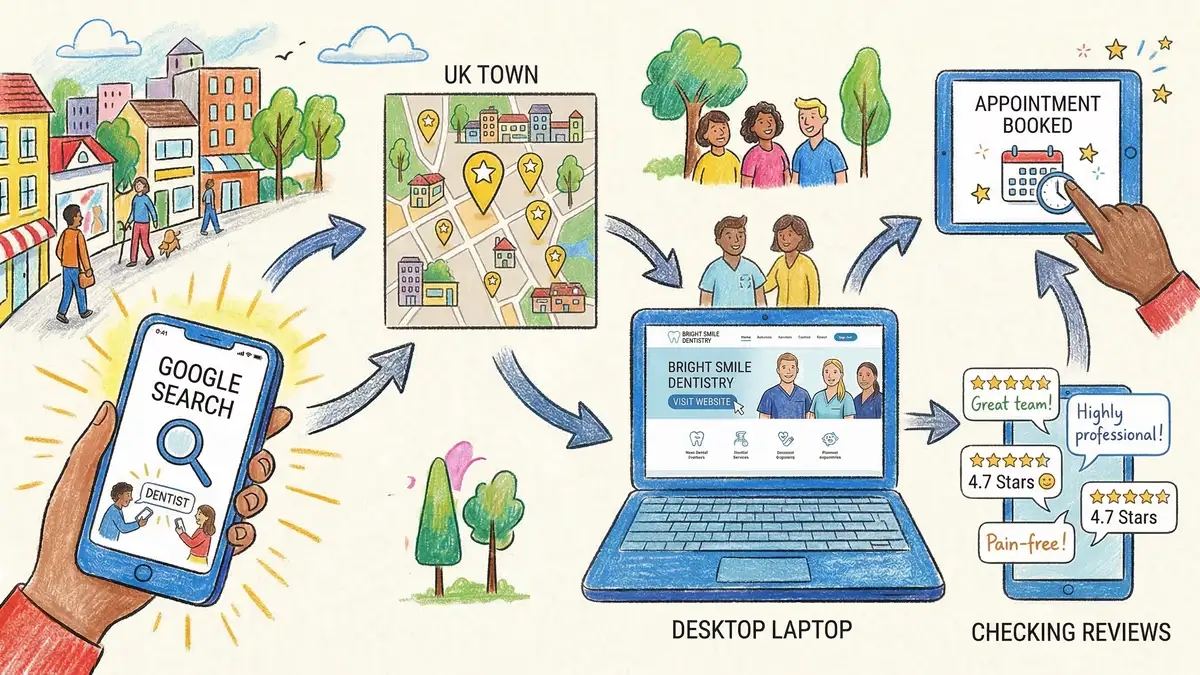
Your online presence is the sum of every touchpoint a potential patient encounters before booking. Most dental patients interact with 3–5 digital touchpoints before making an appointment: a Google search, your Google Business Profile, your website, online reviews, and possibly your social media. Each touchpoint either builds trust or erodes it.
The foundation is your website. A dental website needs to do three things exceptionally well: rank in search engines (SEO), convert visitors into enquiries (UX), and demonstrate credibility (E-E-A-T). For detailed technical guidance on website structure and SEO, see our dental SEO pillar guide.
Beyond your website, your Google Business Profile (GBP) is arguably more important for local patient acquisition. GBP listings appear in the Map Pack, which captures 70–80% of clicks for local dental searches. Optimising your GBP is covered in detail in our local SEO guide for dentists, but the essentials are: complete every field, add high-quality photos monthly, respond to every review within 48 hours, and post updates weekly.
What Content Should Dental Practices Create?
Content marketing is the most cost-effective long-term strategy for dental practices. A well-maintained blog with 30–50 optimised posts can drive 50+ qualified leads per month, at a fraction of the cost of paid advertising. But not all content is equal—you need to write what patients actually search for, in a format that both Google and AI search engines can parse.
Dental content clusters around four pillars:
- Patient education. Treatment explainers, symptom guides, and prevention advice. These target long-tail keywords like "do I need a root canal," "gum disease symptoms," and "how to stop grinding teeth at night." Educational content builds E-E-A-T signals (Experience, Expertise, Authoritativeness, Trustworthiness) that Google rewards for healthcare sites.
- Treatment cost guides. Pricing transparency is one of the most searched topics for UK dental patients. Articles like "dental implant cost UK," "teeth whitening prices," and "NHS vs private dental treatment cost" attract patients with high commercial intent. Always include a call-to-action for a free consultation, since pricing varies by case.
- Local community content. Location-specific posts like "best dentist in Manchester" or "dental care options in Birmingham" reinforce local SEO signals. Include mentions of local landmarks, community events your practice sponsors, and partnerships with local schools or health organisations.
- Practice updates. New services, team introductions, technology upgrades, and patient success stories (with consent). These humanise your practice and build trust. They also provide fresh content signals for Google's crawlers.
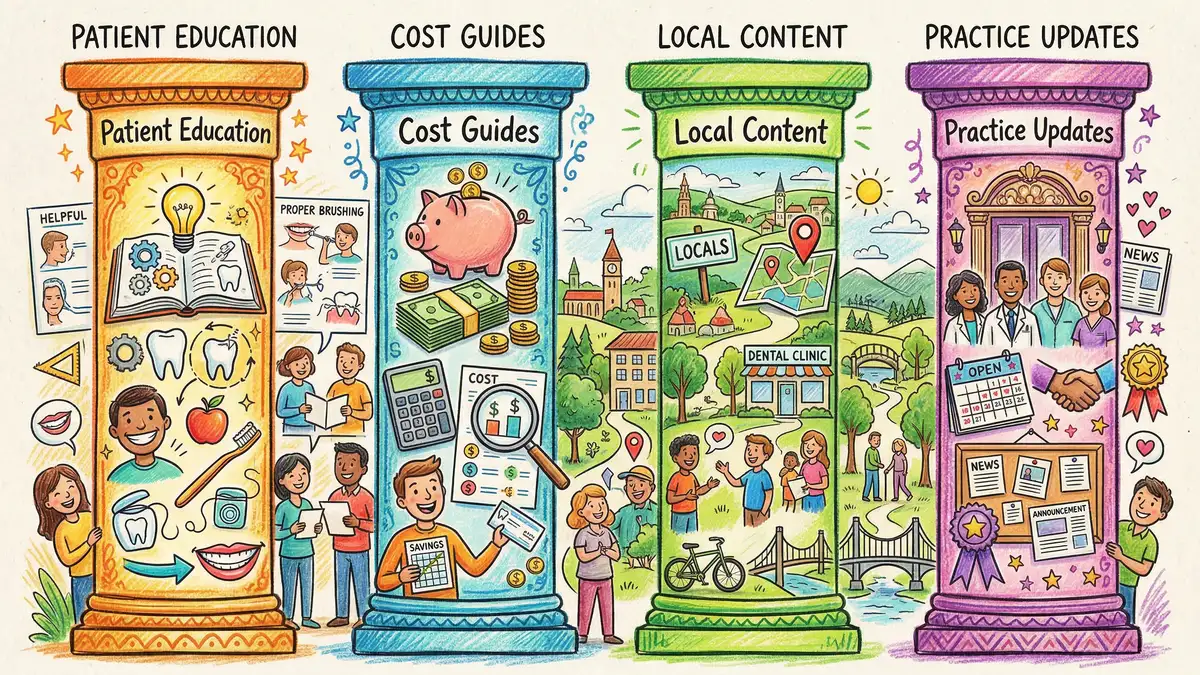
The four content pillars for dental marketing ensure you capture patients at every stage of their decision journey, from initial symptom research to booking.
Each blog post should aim for 1,500–2,500 words, target one primary keyword plus 3–5 related terms, include FAQ schema markup, and link internally to your relevant service pages. Structure posts with H2 headings that mirror patient questions—this optimises for both traditional search and AI-generated answers. For comprehensive guidance on structuring content for AI citation, see our dental content marketing and AEO guide.
Content timing matters significantly for dental practices. Emergency dental searches spike during winter months and weekends. Cosmetic dentistry enquiries peak in spring (before summer holidays) and autumn (before Christmas parties). Orthodontics interest surges in January (New Year resolutions). Plan your editorial calendar around these seasonal patterns to capture patients at peak search intent.
Our content marketing team builds SEO-optimised editorial calendars, writes AEO-ready blog posts, and manages ongoing content production for dental practices across the UK.
How Do Referral Programmes and Reputation Management Drive Growth?
Referral programmes consistently deliver the highest-quality patients at the lowest cost. Referred patients arrive pre-sold on your practice—they've already heard a positive recommendation from someone they trust. They're more likely to book, less likely to price-shop, and more likely to become long-term patients themselves. The typical cost per referred patient is £10–£50, compared to £150–£400 for a paid advertising acquisition.
A simple but effective referral structure for dental practices:
- Two-way incentive: Both the referrer and new patient receive a benefit (e.g., "Refer a friend and you both get £15 credit toward your next treatment").
- Easy sharing: Provide referral cards with QR codes at checkout, email templates patients can forward, and a dedicated referral page on your website.
- Automated tracking: Use your practice management system or CRM to track referral sources, so you can measure ROI and identify your most active referrers.
- Compliance: Ensure incentives comply with GDC advertising standards—no misleading claims, transparent terms and conditions, and genuine recommendations only.
Reputation management is the other high-ROI, low-cost strategy. Online reviews are a top-three ranking factor for Google's local search algorithm, and 89% of patients check reviews before choosing a dentist. A practice with 100+ Google reviews averaging 4.7 stars will dramatically outperform a competitor with 10 reviews, regardless of how good the competitor's clinical work is.
The key to review generation is systematic follow-up. Send an automated email or SMS 24–48 hours after each appointment asking for feedback, with a direct link to your Google review page. Train reception staff to mention reviews to satisfied patients. Display QR codes linking to your review page in your waiting area and at the front desk. Respond to every review—positive and negative—within 48 hours. Google's algorithm rewards responsiveness, and potential patients notice when a practice engages with feedback.
Should Dental Practices Use Google Ads or Focus on SEO?
This is the most common question dental practice owners ask, and the answer is: both, but with different purposes and timelines.
Google Ads delivers immediate visibility. Someone searching "emergency dentist near me" at 10 PM on a Sunday needs help now—they're not going to browse through organic results. Google Ads puts your practice at the top of the page within hours of setup. High-converting ad categories for dental practices include emergency services, specific procedures (teeth whitening, dental implants), and "dentist near me" variants.
The downside is cost. Dental keywords are competitive, with cost-per-click (CPC) ranging from £2–£8 depending on keyword and location. London dental terms can exceed £10 per click. At a typical 5–10% conversion rate, that translates to £40–£160 per patient enquiry from Google Ads. You also stop getting leads the moment you stop spending.
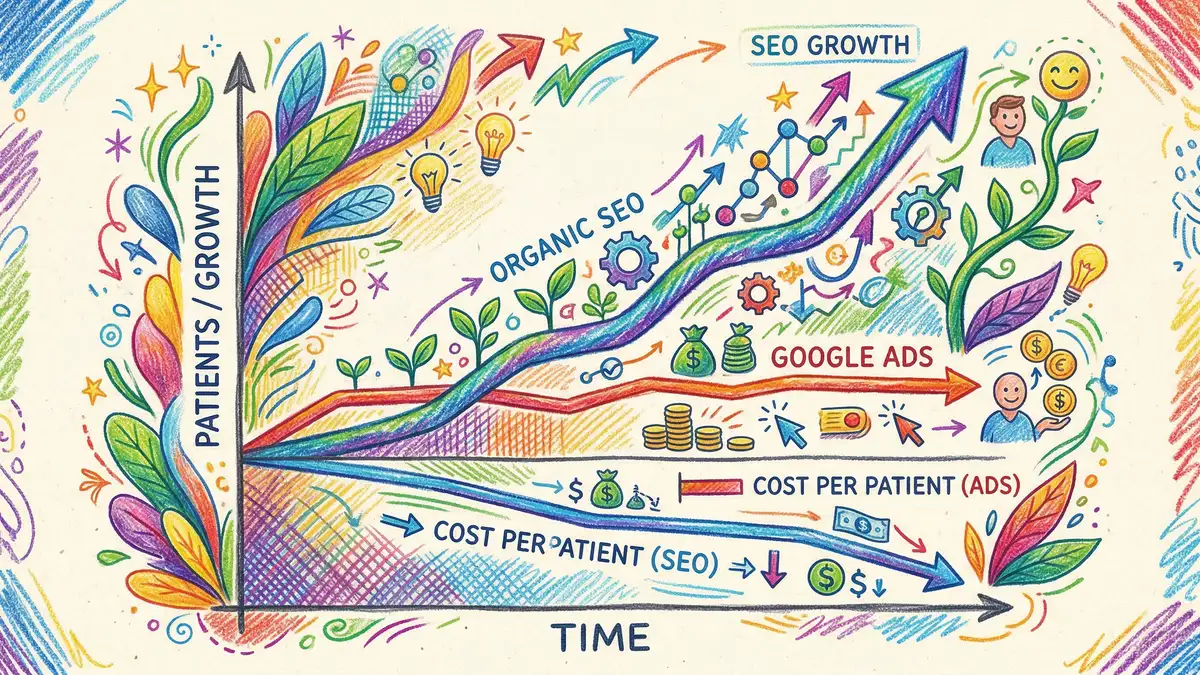
Organic SEO compounds over time while paid advertising delivers consistent but flat returns. The strongest practices invest in both simultaneously.
Organic SEO takes longer—typically 3–6 months for meaningful results—but delivers dramatically lower cost per patient over time. Once you rank on page 1 for "dentist in [your area]," you receive a stream of free traffic that converts into patients month after month. The compounding effect means your cost per patient decreases over time, while Google Ads costs stay flat or increase.
The smart strategy is to run both in parallel. Use Google Ads to fill your appointment book immediately while SEO builds your organic presence. As organic rankings improve and start delivering patients, gradually reduce ad spend on terms where you now rank organically. Many practices maintain Google Ads indefinitely for high-intent emergency keywords while letting SEO handle the rest.
For specific Google Ads strategies and campaign setup guidance, see our dental Google Ads and PPC guide.
How Can Social Media Marketing Help Dental Practices?
Social media doesn't drive direct bookings the way SEO and Google Ads do. Instead, it builds brand awareness, humanises your practice, and keeps you visible between appointments. For cosmetic dentistry practices, social media can be transformative—before-and-after content on Instagram and TikTok regularly generates significant enquiry volumes.
Platform priorities for UK dental practices in 2026:
| Platform | Audience | Best Content Types | Posting Frequency |
|---|---|---|---|
| 25–45, cosmetic focus | Before/after, team spotlights, Reels, patient testimonials | 3–5 posts/week | |
| 35–65, families | Community updates, patient reviews, educational posts, events | 2–4 posts/week | |
| TikTok | 18–35, cosmetic | Smile transformations, dental myths, day-in-the-life, education | 3–7 videos/week |
| B2B, corporate dental | Industry insights, practice growth, recruitment, partnerships | 1–2 posts/week | |
| YouTube | All ages, education | Procedure explainers, practice tours, dentist Q&A, patient stories | 1–2 videos/week |
The most important compliance consideration for dental social media is GDC advertising standards. Before-and-after photos require explicit patient consent. You cannot make unsubstantiated clinical claims ("guaranteed whiter teeth"). Include disclaimers like "Results vary by individual" on treatment showcase posts. For detailed compliance guidance, see our dental marketing compliance guide.
For a deep dive into platform-specific strategy and content calendars, see our dental social media marketing guide.
How Should Dental Practices Allocate Their Marketing Budget?
Budget allocation is where most dental practices go wrong. They either spend everything on a single channel (usually Google Ads) or spread budget so thin across channels that nothing gets enough investment to work properly. The right allocation depends on your practice's growth stage.
| Practice Stage | Monthly Budget | Recommended Allocation | Primary Goal |
|---|---|---|---|
| New/launch | £1,000–£2,000 | 60% Google Ads, 30% local SEO/GBP, 10% social media setup | Fill appointment book quickly |
| Growth (1–3 yrs) | £2,000–£4,000 | 40% SEO + content, 30% Google Ads, 20% social + video, 10% email + referral | Build organic pipeline |
| Established (3+ yrs) | £3,000–£7,500+ | 50% SEO + content + AEO, 20% Google Ads, 20% social + brand, 10% referral + retention | Dominate local market |
Notice the shift: new practices lean heavily on paid advertising for immediate results, then gradually shift toward organic channels as SEO and content marketing start delivering returns. Established practices invest heavily in SEO because the compounding returns make it by far the most cost-effective channel over time.
A good rule of thumb for dental marketing spend: allocate 5–10% of your target annual revenue to marketing. A practice targeting £500,000 in annual revenue should spend £25,000–£50,000 per year (£2,000–£4,200/month) on marketing. This investment typically delivers 5–15 new patients per month, generating £240,000–£1,275,000+ in patient lifetime value annually.
For detailed pricing breakdowns by tier, see our dental SEO cost guide.
What Marketing Technology Do Dental Practices Need?
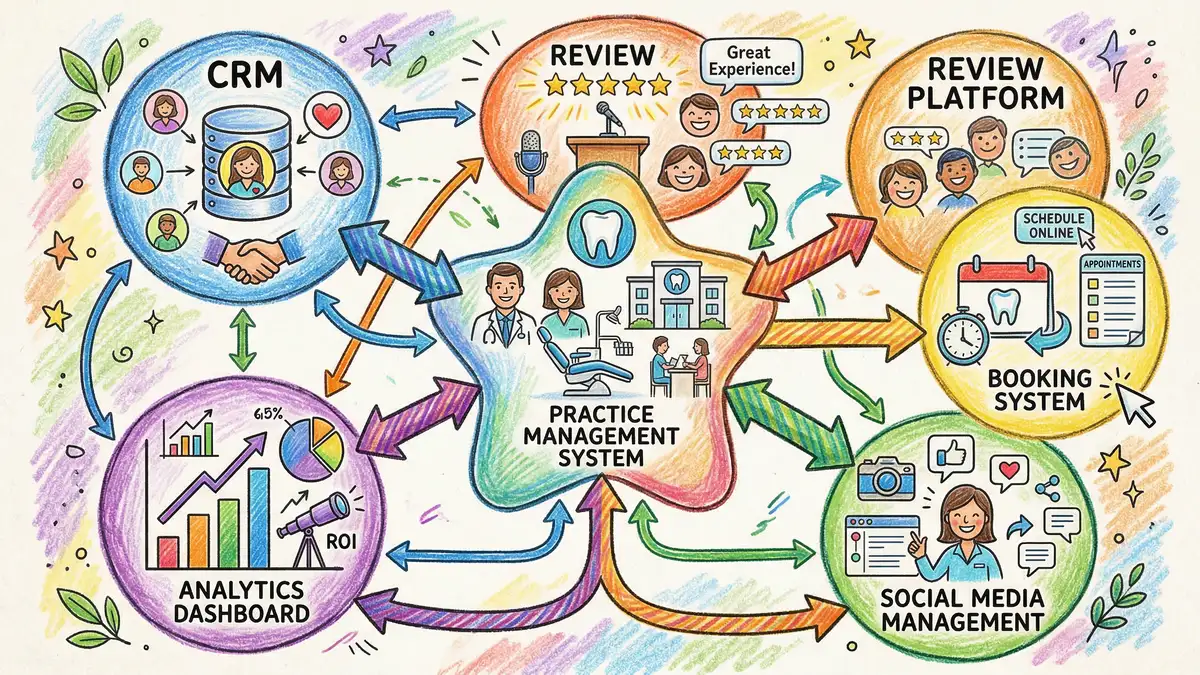
The right technology stack streamlines your marketing operations and makes measurement possible. You don't need enterprise-level tools—a focused set of platforms handles everything most practices require.
- Practice management system (PMS). Software like Dentally, SOE, or Software of Excellence manages patient records, appointments, and billing. Most modern PMS platforms include basic patient communication tools (appointment reminders, recall notifications). This is your operational core.
- CRM and marketing automation. HubSpot, Mailchimp, or ActiveCampaign for email marketing, lead nurturing, and referral tracking. A CRM lets you segment patients by treatment type, track marketing attribution, and automate follow-up sequences.
- Review management platform. Tools like Trustpilot, Podium, or BirdEye automate review requests, centralise review monitoring across platforms, and help you respond promptly. Some integrate directly with your PMS to trigger review requests after appointments.
- Analytics and tracking. Google Analytics 4 and Google Search Console are essential (and free). They tell you where patients come from, which pages convert, and how your search rankings change over time. Set up conversion tracking for appointment form submissions and phone calls.
- Online booking. A booking system on your website (Dentally, MyDentist, or custom integration) converts visitors to patients. Practices with online booking convert 30–50% more web visitors than those requiring phone calls during business hours.
- Social media management. Buffer, Hootsuite, or Later for scheduling posts, managing multiple platforms, and tracking engagement metrics from a single dashboard.
- No tracking or attribution. Without analytics, you don't know which channels deliver patients. Set up Google Analytics 4 with conversion tracking before spending on marketing.
- Relying only on Google Ads. Paid advertising is expensive and stops working when you stop paying. Build organic channels in parallel for sustainable growth.
- Ignoring reviews. Practices without active review generation and response strategies lose ranking authority to competitors with fewer clinical skills but better online reputations.
- Generic content. Copying competitor blog posts or publishing thin, unresearched content won't rank. Invest in original, data-backed content that demonstrates genuine expertise.
- Non-compliant advertising. GDC, ASA, and CMA regulations carry real penalties. Every marketing claim must be substantiated, every testimonial genuine, every before-and-after properly consented. See our compliance guide.
Frequently Asked Questions About Dental Marketing
What is the most effective marketing strategy for dental practices?
A combination of local SEO, Google Business Profile optimisation, and active reputation management delivers the best ROI for most UK dental practices. SEO provides the foundation (lowest long-term cost per patient), while Google Ads fills gaps with immediate results. Referral programmes offer the highest-quality patients at the lowest cost. The best strategy combines all three with content marketing for long-term authority building.
How much should a dental practice spend on marketing?
Most dental marketing experts recommend 5–10% of target annual revenue. A practice targeting £500,000 in revenue should budget £25,000–£50,000 per year (£2,000–£4,200/month). New practices should allocate toward the higher end, while established practices with strong organic rankings can operate at the lower end. The key metric is cost per patient acquisition—aim for under £200 per new patient through a blended channel strategy.
Should I hire a dental marketing agency or do it in-house?
Most single-location practices benefit from hiring a specialist dental marketing agency. In-house marketing requires hiring a full-time marketer (£30,000–£50,000 salary) plus tools and training, which only makes sense for multi-location groups. An agency provides a team of specialists (SEO, content, PPC, social) for £1,500–£5,000/month. Choose an agency with specific dental industry experience—healthcare marketing has unique compliance, messaging, and patient psychology requirements that generalist agencies often miss.
How long does it take for dental marketing to show results?
Google Ads delivers results within days. Referral programmes start generating patients within weeks. Local SEO improvements (GBP optimisation, review generation) typically show results in 4–8 weeks. Organic SEO and content marketing take 3–6 months for meaningful traffic and patient acquisition. A comprehensive strategy should deliver measurable ROI within 90 days through a combination of quick wins (ads, referrals) and medium-term organic growth.
Is TikTok worth it for dental practices?
TikTok is increasingly valuable for cosmetic dentistry practices targeting patients under 35. Smile transformation videos, dental myth-busting content, and day-in-the-life clips can generate substantial reach. However, TikTok requires consistent video production (3–7 videos per week) and the ROI is harder to measure than search-based channels. Start with Instagram Reels first—the content format is similar but easier to attribute to patient acquisition—then expand to TikTok once you've built a content production workflow.
What marketing regulations apply to UK dental practices?
The General Dental Council (GDC), Advertising Standards Authority (ASA), and Competition and Markets Authority (CMA) all regulate dental marketing. Key rules: no unsubstantiated clinical claims, genuine reviews only (no incentives), GDC registration transparency, patient consent for before-and-after images, and GDPR compliance for patient data. Penalties for violations can include GDC sanctions, ASA enforcement, and fines up to £17.5 million for GDPR breaches. Always verify current guidance directly with GDC and ASA before launching campaigns.
Ready to Grow Your Dental Practice?
We build comprehensive marketing strategies for UK dental practices—from SEO and content to Google Ads and reputation management. Get a free audit showing where your practice stands and what it takes to dominate your local market.
Sources: Data from Whitehat SEO client analysis (2024–2026), General Dental Council advertising guidance, BDA market insights, Google Search Quality Evaluator Guidelines, and DataForSEO keyword research platform. professional dental SEO services