
This comprehensive guide covers everything UK marketing teams need to build websites that convert visitors into qualified leads whilst meeting the technical requirements of both traditional search and AI answer engines. Whether you're planning a complete redesign or optimising existing pages, Whitehat's HubSpot website design service has implemented these principles across hundreds of B2B projects since 2011.
How to Design a B2B Website That Attracts, Converts, and Generates Pipeline
B2B inbound marketing website design is the practice of building websites engineered to attract qualified traffic through valuable content, convert visitors with strategic user experiences, and generate measurable pipeline through CRM integration. According to HubSpot's 2024–2025 State of Marketing report, website, blog, and SEO now rank as the number one ROI channel for B2B brands—making inbound-focused website design essential for UK businesses seeking sustainable growth.
the bottom line
B2B buyers now complete 61% of their purchase journey before ever speaking to sales, and 94% use AI tools during research. Your website must be optimised not just for Google, but for ChatGPT, Perplexity, and Google AI Overviews.
If your website feels like an expensive digital brochure that generates sporadic enquiries rather than predictable pipeline, you're not alone. Most B2B websites fail because they're designed for the company rather than the buyer—showcasing services instead of solving problems, and prioritising aesthetics over conversions.
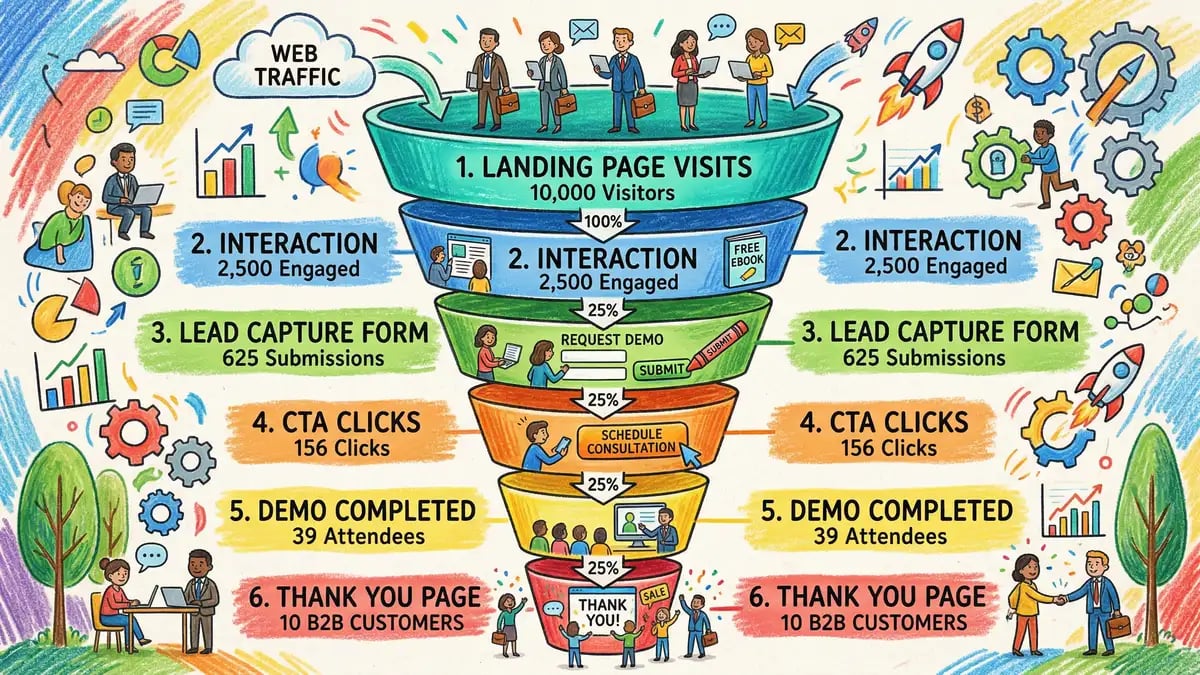
Why B2B Buyer Behaviour Demands a Different Website Approach in 2026
B2B buyers have fundamentally changed how they research and purchase, with 61% preferring a rep-free buying experience and 94% using AI tools during their journey. Your website must now serve as the primary sales tool whilst being optimised for extraction by AI answer engines.
The Self-Service Buyer: Updated Statistics
The shift toward self-directed buying has accelerated dramatically. According to Gartner's June 2025 Sales Survey of 632 buyers, 61% of B2B buyers prefer a rep-free buying experience—a notable refinement from earlier estimates. This represents the most reliable current benchmark for self-service buying preference.
Perhaps more significantly, 6sense's 2025 research reveals that 80% of the time, the vendor contacted first wins the deal—and 95% of the time, the winning vendor is already on the buyer's Day One shortlist. This means your website's role isn't just conversion; it's ensuring you appear in that initial consideration set before buyers ever contact your sales team.
61%
Prefer Rep-Free Buying
Gartner, June 2025
94%
Use AI During Buying
6sense, 2025
80%
First Vendor Wins
First contact advantage
| Metric | 2025–2026 Data | Source |
|---|---|---|
| Prefer rep-free buying | 61% | Gartner, June 2025 |
| Use AI/LLMs during buying | 94% | 6sense, 2025 |
| Journey complete before sales contact | 61% | 6sense, 2025 |
| Average buying committee size | 10+ stakeholders | 6sense, 2025 |
| Millennial/Gen Z B2B buyers | 71% | Sopro, 2025 |
Sources: Gartner June 2025, 6sense Buyer Experience Report 2025, Sopro 2025
How AI Is Reshaping B2B Research
The rise of AI-powered search represents the most significant shift in B2B buying behaviour since the advent of Google. According to Google's October 2025 B2B Buyer Journey research, approximately 60% of B2B respondents use ChatGPT or Gemini to build initial vendor lists. This fundamentally changes how websites must be structured.
AI systems use Retrieval-Augmented Generation (RAG), chunking content into 200–500 word passages and matching by semantic similarity. They evaluate content across five dimensions: authority, recency, relevance, structure, and factual density. Your content isn't competing for clicks—it's competing to be extracted and cited in AI-generated responses.
Whitehat's Answer Engine Optimisation service helps UK B2B companies structure content for AI citation, implementing the technical foundations and content architecture that AI engines need to recommend your brand confidently.
The Buying Committee Challenge: Designing for 10+ Stakeholders
Modern B2B purchases involve an average of 10+ stakeholders, each with different concerns, evaluation criteria, and content preferences. Your website must serve the Marketing Director seeking ROI proof, the IT Manager evaluating security, the CFO examining total cost of ownership, and the end users assessing usability.
This requires role-specific content paths, shareable executive summaries, technical documentation, compliance information, and persona-targeted landing pages. The websites that win aren't designed for "the buyer"—they're designed for every member of the buying committee. Our inbound marketing strategy guide covers persona development in detail.
10 Essential Elements of a High-Converting B2B Inbound Website
High-converting B2B websites share common characteristics: mobile-first responsive design, Core Web Vitals compliance, clear value propositions, strategic CTAs matched to buyer journey stages, and content architecture optimised for both human visitors and AI extraction.
1. Mobile-First Responsive Design (With B2B Nuance)
Whilst overall web traffic is 60% mobile, B2B traffic runs counter at 68% desktop according to SQ Magazine 2025 research. Desktop users view 33% more pages per visit and spend 77–79% longer per session. However, 79% of B2B buyers use mobile devices for research, particularly at early awareness stages.
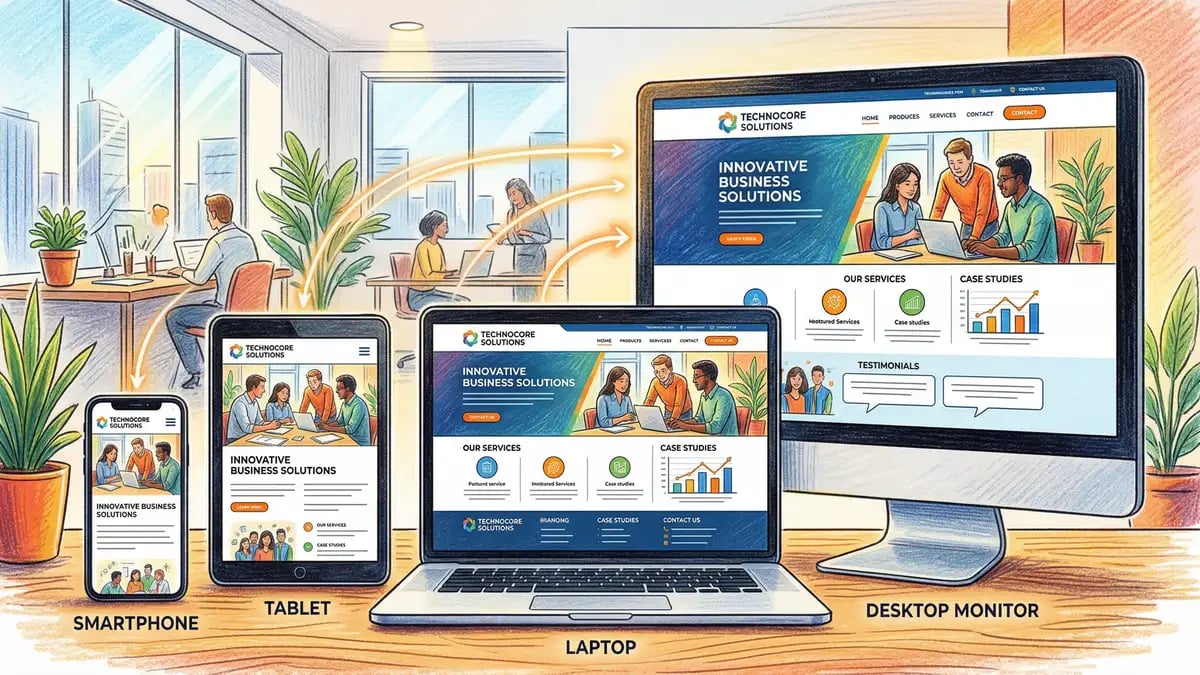
The practical implication: mobile drives top-of-funnel awareness whilst desktop dominates consideration and conversion. Your site must perform flawlessly on both, with mobile optimised for quick scanning and desktop optimised for deep evaluation. Whitehat's responsive design guide covers implementation in detail.
2. Core Web Vitals and Page Speed
Only 47% of websites pass all three Core Web Vitals according to CrUX data analysis—creating significant competitive opportunity. The current thresholds are LCP under 2.5 seconds, INP (which replaced FID in March 2024) under 200ms, and CLS under 0.1.
common pitfall
A 100ms delay reduces conversions by 7%. Moving from Poor to Good CWV status correlates with 25% conversion increase and 35% bounce reduction. Vodafone improved LCP by 31% and saw an 8% increase in online sales.
3. Value Proposition Clarity
Your homepage must pass the five-second test: can visitors understand what you do, who you serve, and why they should care within five seconds of landing? Effective B2B value propositions lead with outcomes rather than services, include specific quantification where possible, and speak directly to buyer pain points. "We increase your organic traffic by 40% in 12 months" outperforms "We provide SEO services."
4. Strategic CTAs Matched to Buyer Journey Stages
Most B2B websites over-rely on high-commitment CTAs like "Request a Demo" or "Speak to an Expert." These work for the 5% of buyers in-market today but repel the 95% still researching. Effective conversion architecture includes CTAs appropriate to each journey stage: awareness (educational downloads, assessments), consideration (comparison guides, ROI calculators), and decision (demo requests, consultation bookings).
5. Landing Page Architecture
HubSpot's research shows that companies with 40+ landing pages generate 12× more leads than those with fewer than five. The median B2B landing page converts at 6.6% according to Unbounce's analysis of 57M+ conversions. Multi-step forms improve completion by 20–30% versus single-page forms. Using action-specific CTA text like "Get My Quote" rather than generic "Submit" improves conversions by 25–30%.
6. Content for Every Buyer Journey Stage
According to the Content Marketing Institute's 2025 B2B report, 58% of B2B marketers report content marketing generated sales or revenue in the last 12 months. The most effective content types are case studies (69% rate most effective), short articles, and videos. Topic clusters—pillar pages supported by related blog posts—drive approximately 30% more organic traffic than disconnected content strategies.
Want to see how your website stacks up against these 10 elements? Get a free audit from our team.
Book Free Site Audit7. Trust Signals and Pricing Transparency
B2B buyers increasingly expect pricing guidance on websites. Whilst exact quotes may require discovery, providing ranges, starting points, or pricing models reduces friction and qualifies prospects before they contact sales. Trust signals include client logos, case studies with metrics, certifications (HubSpot partner tiers, ISO, industry-specific), press mentions, and genuine testimonials.
8. AI-Powered Personalisation and Chatbots
Approximately 60% of B2B companies use chatbot software according to Tidio 2025 research, with adoption growing 4.7× between 2020 and 2025. HubSpot reports that personalised CTAs convert 202% better than default versions, whilst companies implementing personalisation effectively generate 40% more revenue according to McKinsey.
9. Accessibility Compliance (WCAG 2.2)
This is the most underserved area in B2B website design. According to WebAIM 2025 research, 94.8% of the top one million homepages contain WCAG failures. Only approximately 1% of websites fully meet accessibility requirements. The European Accessibility Act (EAA) came into force 28 June 2025 and applies to UK businesses selling into EU markets. Over 14 million people in the UK (20%+ of population) have a disability. Accessibility isn't just compliance—it's market expansion.
10. AEO-Ready Content Structure
With zero-click searches rising from 56% to 69% between May 2024 and May 2025 according to Similarweb, optimising for AI answer engines is no longer optional. The Princeton GEO study found optimisation methods can boost content visibility by up to 40% in generative engine responses. Key techniques include answer capsules (30–60 word direct answers immediately after headings), specific statistics with named sources, structured FAQ sections, and proper schema markup. Whitehat's AEO service implements these structures systematically.
How to Design a B2B Website That Generates Leads
Lead-generating B2B websites require strategic architecture combining persona-based content, multiple conversion paths, CRM integration for attribution, and continuous optimisation based on performance data.
Phase 1: Strategy Foundation
Before designing a single page, document your ideal customer profiles with specific detail: company size, revenue range, technologies used, team structure, budget authority, and crucially, the specific problems they're trying to solve. Map the buyer journey for each persona, identifying the questions they ask at each stage, the content formats they prefer, the objections they raise, and the proof points that matter to them.
Phase 2: Launchpad Website
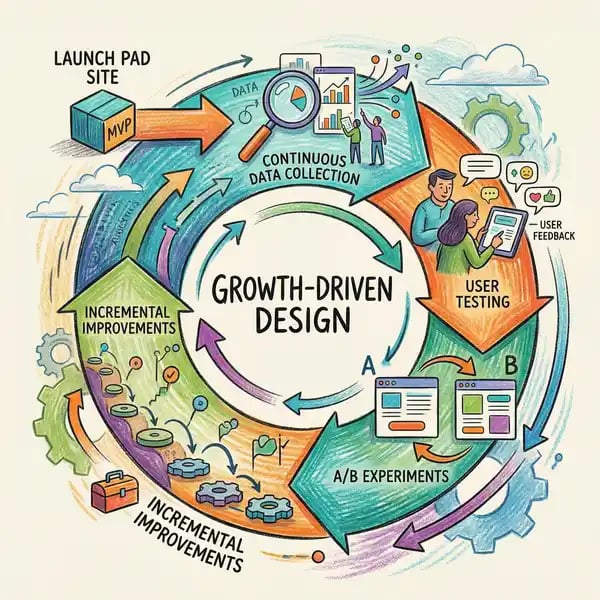
Using Growth-Driven Design methodology, build a minimum viable site with core pages optimised for your primary persona and highest-intent keywords. The goal isn't perfection—it's getting real user data as quickly as possible. Target launch within 60 days. Essential pages include homepage, primary service/product pages, about page, contact page, and initial blog posts targeting your core topic cluster.
Phase 3: Continuous Improvement
With real traffic data flowing into your CRM, identify highest-impact improvements. Which pages have high traffic but low conversion? Which content drives qualified leads versus tyre-kickers? Prioritise improvements using an impact/effort matrix. Our ranking improvement guide details the continuous optimisation process.
Growth-Driven Design vs Traditional Website Redesign
Growth-Driven Design (GDD) is a website development methodology that launches quickly then continuously improves based on real data, contrasting with traditional redesigns that attempt perfection before launch.
| Factor | Growth-Driven Design | Traditional Redesign |
|---|---|---|
| Average launch time | 60 days | 108 days |
| Budget performance | On budget | Typically over budget |
| Post-launch approach | Continuous improvement | Set and forget |
| Design decisions based on | Real user data | Assumptions and HiPPO |
| Risk profile | Lower (iterative) | Higher (big-bang launch) |
HubSpot teaches approximately 1,000 agencies across 50 countries how to use Growth-Driven Design methodology. When these agencies compared results, GDD projects launched on time, on budget, and continually improved with real user data. Traditional projects averaged two weeks late and suffered from "set it and forget it" mentality.
Choosing Your CMS: HubSpot Content Hub vs WordPress in 2026
HubSpot rebranded CMS Hub to Content Hub in April 2024, positioning it as an AI-powered content marketing platform rather than simply a CMS. Within 12 months, Content Hub achieved Gartner Magic Quadrant Leader status for Content Marketing Platforms.
key takeaway
WordPress powers 43% of all websites globally but experienced 7,966 new vulnerabilities in 2024—a 34–68% increase from the previous year—with 93% originating from plugins.
HubSpot's closed ecosystem means zero plugin vulnerabilities, managed security, and 24/7 support included.
The total cost of ownership calculation often favours HubSpot despite higher subscription fees.
For a detailed comparison, see our HubSpot vs WordPress guide, or explore our comprehensive Content Hub analysis.
HubSpot Content Hub Capabilities for B2B Inbound Marketing
HubSpot Content Hub is an AI-powered content marketing platform offering website building, blog management, video hosting, AI content generation, and multichannel distribution—all integrated with the Smart CRM for closed-loop attribution from first visit to closed deal.
Breeze AI Integration
Breeze operates on three layers. Breeze Assistant (Copilot) is a personal AI companion for content drafting, meeting prep, and record summarisation—free to all users. Breeze Agents handle multi-step workflows: Content Agent drafts blogs, emails, and landing pages; Customer Agent resolves 50%+ of support tickets; Prospecting Agent researches leads and crafts personalised outreach. Breeze Intelligence provides Clearbit-powered data enrichment and buyer intent scoring.
Content Hub Pricing 2026
| Tier | Price | Seats Included |
|---|---|---|
| Free | £0/month | Unlimited |
| Starter | ~£12/month per seat | 1 |
| Professional | ~£400/month | 3 |
| Enterprise | ~£1,200/month | 5 |
Source: HubSpot pricing page, March 2026. Most companies negotiate 30-35% below list prices according to Tropic procurement data.
Emerging B2B Website Design Trends for 2026–2027
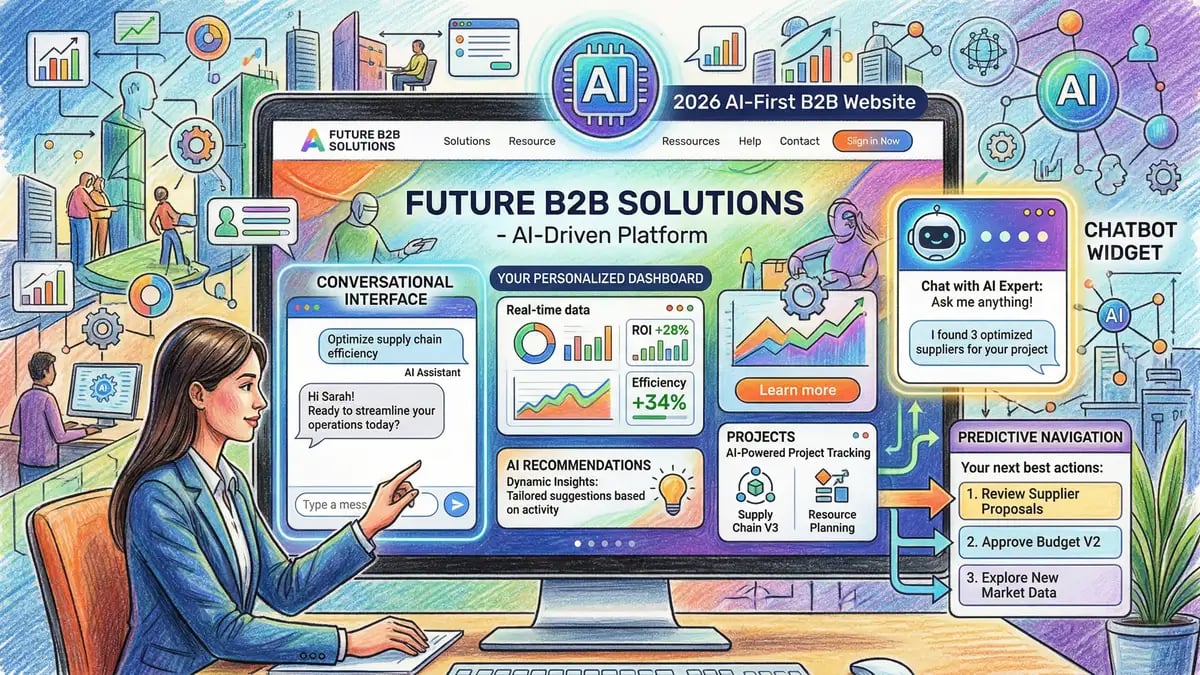
Four trends will dominate B2B website design through 2027: AI-first design with agentic chatbots, privacy-first data strategies, interactive content like ROI calculators, and accessibility as competitive advantage.
AI-First Website Design
According to Sagefrog 2025 research, 94% of marketers report using generative AI in workflows. Nine out of ten web designers have used AI in their routines. Key applications include agentic AI chatbots (Intercom's "Fin" has handled 13M+ queries), AI-powered personalisation, and AI-assisted development (tools like Relume generate wireframes from prompts, accelerating launches from weeks to days).
Privacy-First Data Strategies
Google officially ended the Privacy Sandbox initiative in October 2025 after six years—third-party cookies remain enabled in Chrome indefinitely. Despite this, the privacy-first direction is irreversible: 72% of users now block cookies or use privacy tools according to Statista 2025. First-party data strategies deliver 92% customer recognition versus 65% for third-party data.
Video and Interactive Content
92% of businesses plan to spend the same or more on video marketing in 2026 according to Wyzowl. Interactive tools achieve even higher engagement: ROI calculators and configurators achieve conversion rates 2.3× higher than static content, with average engagement time of 4:27 minutes—three times typical static content.
Personalisation Without Third-Party Cookies
77% of B2B buyers won't make a purchase without personalised content according to BusinessDasher. HubSpot's smart content and progressive profiling tools enable CRM-powered personalisation that doesn't depend on cookie consent. Read more about B2B inbound marketing trends.
How Much Does a B2B Website Cost in 2026 (UK Benchmarks)
| Project Type | UK Cost Range | Source |
|---|---|---|
| Small business website | £1,500–£6,000 | Multiple UK agencies, 2025–26 |
| B2B website (SME/mid-market) | £11,500–£61,000 | HubSpot/Axon Garside, 2025 |
| London agency corporate website | ~£85,000 average | ProfileTree, 2025 |
| HubSpot template build | £4,000–£8,000 | Axon Garside, 2025 |
| Agency hourly rates UK | £50–£200/hour | DesignBox, 2025 |
Whitehat's HubSpot website projects start from £10,000 for SME sites with 10–30 pages, including custom responsive design, CRM integration, SEO foundation, and team training. Unlike template solutions, this includes bespoke theme development to ensure your site reflects your brand positioning rather than looking like a template.
Measuring What Matters: 2026 Conversion Benchmarks and KPIs
2.9%
Avg B2B Website Conversion
First Page Sage, Sep 2025
6.6%
Landing Page Median
Unbounce, 2024–25
223%
CRO Tool ROI
Predictable Profits, 2025
| Metric | Benchmark | Source |
|---|---|---|
| Average B2B website conversion | 2.9% | First Page Sage, Sep 2025 |
| B2B landing page median | 6.6% | Unbounce, 2024–25 |
| Desktop conversion rate | ~5.06% | WordStream, 2025 |
| Mobile conversion rate | ~2.49% | WordStream, 2025 |
| CRO tool ROI | 223% | Predictable Profits, 2025 |
Important nuance: these benchmarks measure different things. The 2.9% average measures full-site visitor-to-lead rates whilst the 6.6% median measures dedicated landing page conversions. Top performers can achieve 10%+ on well-optimised landing pages.
Revenue Attribution Metrics
Beyond conversion rates, sophisticated B2B measurement tracks influenced pipeline (opportunities your website touched), first-touch attribution (which content started the journey), multi-touch attribution (full journey credit), and time-to-conversion. HubSpot's closed-loop reporting enables tracking from anonymous first visit through to closed revenue—the "CFO-trusted attribution" our SEO analytics guide details.
Frequently Asked Questions
What is B2B inbound marketing website design?
B2B inbound marketing website design is the practice of building websites specifically engineered to attract, engage, and convert business buyers through valuable content, strategic user experience, and CRM integration. Unlike traditional brochure-style websites, inbound-focused sites support the self-directed buyer journey with educational resources, conversion paths, and measurable attribution.
How long does a B2B website redesign take?
Using Growth-Driven Design methodology, B2B websites typically launch in 60 days with a minimum viable site that continuously improves based on real user data. Traditional website redesigns average 108 days and often exceed budget. Whitehat's HubSpot website projects deliver in 8-12 weeks including custom design, CRM integration, and team training.
What conversion rate should a B2B website achieve?
The average B2B website conversion rate is 2.9% across all industries according to First Page Sage's September 2025 research. Industry rates range from 1.1% for B2B SaaS to 7.4% for legal services. B2B landing pages achieve a median 6.6% conversion rate. Companies using CRO tools report 223% ROI on optimisation investments.
Should we use HubSpot or WordPress for our B2B website?
HubSpot Content Hub is optimal for B2B companies prioritising marketing-sales alignment, built-in attribution, and native CRM integration. WordPress remains viable for companies needing maximum design flexibility or complex e-commerce. HubSpot experienced zero security vulnerabilities in 2024 whilst WordPress had 7,966 plugin vulnerabilities. Choose based on your marketing technology stack and integration requirements.
How much does a B2B website cost in the UK?
UK B2B website costs range from £11,500 to £61,000 for SME and mid-market companies according to HubSpot and Axon Garside 2025 research. London agencies average £85,000 for corporate websites. HubSpot template builds cost £4,000-£8,000. Whitehat's HubSpot website projects start from £10,000 including custom responsive design, CRM integration, and staff training.
What is Growth-Driven Design?
Growth-Driven Design (GDD) is a website development methodology that launches a minimum viable site quickly then continuously improves based on real user data and analytics. Agencies using GDD report launching sites in 60 days versus 108 days for traditional approaches, with projects completing on time and budget whilst delivering progressive measurable results.
How do we optimise our website for AI search engines?
AI search optimisation requires answer-first content structure with 30-60 word answer capsules, schema markup implementation, FAQ sections matching natural language queries, and technical configuration allowing AI crawler access. Research shows 85% of AI Overview citations come from content published within two years. Whitehat's AEO service implements these structures systematically.
How do we design for the B2B buying committee?
Modern B2B purchases involve an average of 10+ stakeholders according to 6sense 2025 research. Design for multiple personas by creating role-specific content paths, providing shareable executive summaries, including technical documentation for IT evaluators, and offering compliance information for legal teams. Each stakeholder type needs content addressing their specific concerns and evaluation criteria.
Ready to Build a Website That Generates Pipeline?
Whitehat builds HubSpot websites from £10,000 that connect every page view, form submission, and click directly to your CRM—delivered in 8–12 weeks by a Diamond Partner in the top 3% globally.
Clwyd Probert
CEO and Founder, Whitehat SEO Ltd
Clwyd Probert is CEO and Founder of Whitehat SEO Ltd, a London-based HubSpot Diamond Solutions Partner. He leads the world's largest HubSpot User Group (London HUG) and serves as a guest lecturer at UCL on digital marketing strategy. Whitehat helps UK B2B companies build websites and marketing programmes that prove ROI.