
Web Design & Development SEO audit
What Is Responsive Web Design? The Complete UK Business Guide for 2026
Author: Clwyd Probert, CEO & Founder, Whitehat SEO Ltd
Published: 15 January 2026 | Last Updated: 15 January 2026
Reading time: 10 minutes
Responsive web design is a development approach that creates websites adapting automatically to any screen size—desktop, tablet, or mobile. With 62.54% of global web traffic now coming from mobile devices and Google's mobile-first indexing complete as of July 2024, responsive design has shifted from competitive advantage to business survival requirement for UK companies.
How Responsive Web Design Works
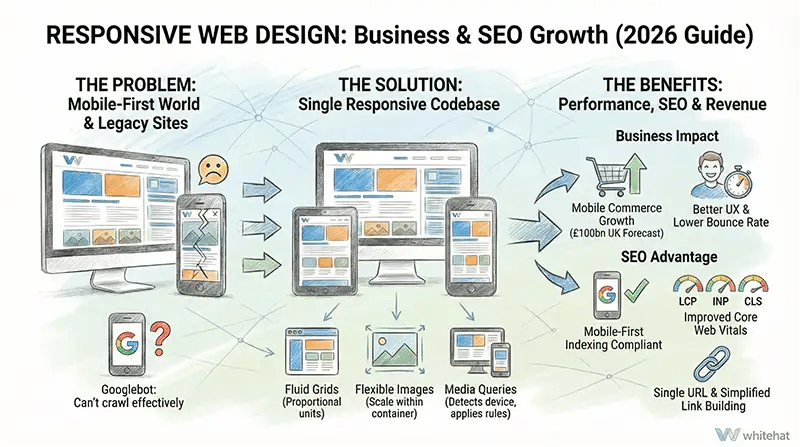
Responsive web design uses three core technical components to create layouts that adapt fluidly to any device. Fluid grids replace fixed-pixel layouts with proportional units, allowing content containers to resize based on screen dimensions. Flexible images scale within their containers using CSS max-width properties, preventing images from exceeding their boundaries on smaller screens. CSS media queries detect device characteristics and apply different styling rules accordingly.
When a visitor accesses a responsive website, the browser evaluates screen width and applies the appropriate CSS rules. A three-column desktop layout might transform into a single-column mobile layout, with navigation collapsing into a hamburger menu. The same HTML content serves all devices—only the presentation changes. This approach differs fundamentally from older methods that required separate mobile websites (m.example.com) or served different HTML based on user agents.
Google explicitly recommends responsive design over alternative mobile configurations. According to Google's official documentation, responsive design simplifies indexing because search engines need only crawl one URL and one set of HTML. For UK businesses investing in professional SEO services, responsive design provides the technical foundation for sustainable organic growth.
Why Responsive Design Matters in 2026
The business case for responsive web design has never been stronger. Google completed its transition to 100% mobile-first indexing on 5 July 2024—meaning all websites are now crawled exclusively by Googlebot Smartphone. Sites not accessible on mobile devices will not be indexed at all, regardless of their desktop performance. This represents the definitive end of desktop-first web development.
Mobile commerce in the UK is projected to reach £100 billion in 2025, with 70% of online orders now placed via mobile devices, according to Expert Market research. Yet mobile conversion rates (2.25%) lag significantly behind desktop (4.81%), indicating substantial revenue potential for businesses that optimise their mobile experience effectively.
User expectations have evolved dramatically. Research from Google indicates that 53% of mobile visitors abandon websites taking longer than three seconds to load, whilst bounce probability increases 123% at ten seconds. Responsive design, when properly implemented, addresses both technical performance and user experience requirements simultaneously. Whitehat's HubSpot website design service builds responsive sites optimised for both conversion and search visibility from the ground up.
UK Mobile Usage Statistics for 2026
Understanding the UK mobile landscape helps contextualise why responsive design is non-negotiable for British businesses. The data paints a compelling picture of mobile-dominant behaviour across demographics and industries.
| Metric | UK Figure | Source |
|---|---|---|
| UK mobile traffic share | 54.7% | StatCounter 2025 |
| UK smartphone penetration | 94% | Ofcom 2024 |
| UK m-commerce forecast 2025 | £100 billion | Statista |
| Mobile cart abandonment rate | 80% | Statista Q3 2024 |
| B2B buyers using mobile at work | 80% | Klizer 2024 |
For B2B companies specifically, mobile usage patterns have shifted considerably. 71% of B2B buyers are now Millennials or Gen Z, according to Sopro's 2025 research—generations that expect seamless mobile experiences as standard. UK/Ireland B2B buyers control 57% of their purchasing journey before any vendor contact, much of which occurs on mobile devices during research phases.
Core Web Vitals and Responsive Design Performance
Google's Core Web Vitals measure three critical aspects of user experience that directly impact both rankings and conversions. Responsive websites must meet these thresholds on mobile devices to achieve optimal search visibility—and only 47% of websites currently pass all Core Web Vitals, according to Magnet.co's 2025 analysis.
LCP (Largest Contentful Paint): Measures loading performance. Target: under 2.5 seconds. The largest content element—typically a hero image—should render quickly on responsive layouts.
INP (Interaction to Next Paint): Replaced FID in March 2024. Measures responsiveness throughout the page visit. Target: under 200 milliseconds. Responsive sites must handle touch interactions smoothly.
CLS (Cumulative Layout Shift): Measures visual stability. Target: under 0.1. Responsive layouts must prevent content from shifting unexpectedly as images and fonts load.
The business impact of Core Web Vitals optimisation is substantial. Vodafone achieved an 8% increase in sales through a 31% LCP improvement, whilst Swappie reported 42% higher mobile revenue after CWV optimisation. A comprehensive website audit identifies Core Web Vitals issues and provides prioritised recommendations for improvement.
John Mueller, Google's Search Advocate, provides important context: "A perfect score is a fun technical challenge... but it's not going to make your site's rankings jump up." Core Web Vitals serve as a tiebreaker between pages with similar content quality—meaningful in competitive sectors, but secondary to content relevance and authority.
SEO Benefits of Responsive Websites
Responsive web design provides significant advantages for search engine optimisation beyond mobile-first indexing compliance. Google explicitly recommends responsive design as the preferred mobile configuration, and the SEO benefits compound across multiple ranking factors.
- Single URL structure: Responsive sites use one URL per page, consolidating link equity and avoiding duplicate content issues that plague separate mobile sites (m.domain.com)
- Improved crawl efficiency: Google's crawlers need only index one version of your content, making better use of crawl budget—particularly important for larger sites
- Enhanced user signals: Lower bounce rates and higher engagement metrics from mobile visitors send positive signals to search algorithms
- Simplified link building: Inbound links point to a single URL rather than being split between desktop and mobile versions
- Social sharing: Shared links work consistently across all devices, improving content distribution and referral traffic
For UK businesses serious about organic search performance, responsive design forms the technical foundation upon which all other SEO efforts build. Whitehat's SEO services integrate responsive design assessment into comprehensive site audits, ensuring technical infrastructure supports content and authority-building strategies.
Responsive Design vs Adaptive Design: Understanding the Difference
Responsive design uses a single, fluid layout that automatically adjusts to any screen size using CSS media queries and flexible grids. Adaptive design creates multiple fixed layouts for specific breakpoints (typically 320, 480, 760, 960, 1200, and 1600 pixels). Both approaches serve mobile users, but they differ fundamentally in implementation and maintenance requirements.
| Factor | Responsive | Adaptive |
|---|---|---|
| Development approach | Single flexible layout | Multiple fixed layouts |
| Future device compatibility | Automatic | Requires new breakpoints |
| Maintenance effort | Lower | Higher (multiple versions) |
| Google recommendation | Preferred | Supported |
| Initial load speed | Good with optimisation | Can be faster (targeted assets) |
Responsive design has become the clear industry standard in 2026. According to web design statistics, 90% of websites globally are now responsive. The maintenance advantages, SEO benefits, and future-proofing against new device sizes make responsive design the sensible default choice for most UK businesses.
How to Implement Responsive Web Design
Implementing responsive design requires attention to both foundational technical elements and modern CSS capabilities. The following components form the core of any responsive implementation:
Essential Technical Elements
Viewport meta tag: Every responsive page requires the viewport meta tag in the HTML head: <meta name="viewport" content="width=device-width, initial-scale=1.0">. This instructs browsers to render the page at the device's actual width rather than a desktop simulation.
Fluid grids: Replace fixed pixel widths with relative units. CSS Grid and Flexbox provide modern, powerful tools for creating flexible layouts that adapt naturally to available space. The CSS clamp() function enables fluid typography that scales smoothly between minimum and maximum sizes.
Media queries: Define breakpoints where layouts should change. Common breakpoints include 576px (mobile), 768px (tablet), 992px (laptop), and 1200px (desktop). Modern development increasingly uses container queries—with 93% browser support in 2026—enabling components to adapt based on their parent container rather than viewport width.
Responsive images: Use the srcset attribute to serve appropriately-sized images for different screen sizes. Convert images to modern formats (WebP, AVIF) and implement lazy loading for images below the fold.
For businesses lacking in-house development resources, Whitehat's HubSpot website design service delivers responsive, CRM-connected websites in 8-12 weeks—including custom design, Core Web Vitals optimisation, and staff training.
Responsive Web Design Costs in the UK
Website design costs in the UK vary significantly based on project complexity, required features, and agency expertise. The following price ranges reflect typical market rates for responsive website development in 2026:
| Project Type | UK Price Range | Typical Scope |
|---|---|---|
| Template-based site | £500–£2,000 | 5-10 pages, basic customisation |
| Small business custom | £2,000–£5,000 | 10-20 pages, bespoke design |
| Mid-range bespoke | £5,000–£15,000 | 20-50 pages, CMS, integrations |
| Corporate website | £15,000–£50,000 | Complex functionality, CRM integration |
| Enterprise/e-commerce | £50,000–£100,000+ | Custom development, multi-site |
Whitehat's HubSpot website projects start from £10,000 for SME sites with 10-30 pages, including custom responsive design, CRM integration, SEO foundation, and team training. Unlike template-based solutions, HubSpot CMS includes hosting, security, and ongoing platform costs within the £300-£1,200 monthly subscription—eliminating separate hosting bills and security plugin requirements.
Regional pricing varies considerably: London agencies average £85,000 for corporate projects, whilst Birmingham and Manchester typically range £30,000-£75,000 for comparable scope. Ongoing maintenance typically adds £150-£3,000 annually depending on support level required.
Should You Build a Mobile App or Responsive Website?
For most UK B2B businesses, a responsive website should precede any mobile app development. The decision framework is straightforward: responsive websites cost £2,000-£50,000 versus £16,000-£150,000+ for native apps, whilst providing full SEO benefits and instant access without downloads.
Consider native app development only when you have: a proven engaged user base, budget for ongoing iOS and Android maintenance, clear use cases requiring native device features (GPS, camera, push notifications), and a high-frequency engagement model that justifies app store discovery challenges.
Progressive Web Apps (PWAs) offer a middle ground—app-like experiences at website development costs. Starbucks' PWA is 99.84% smaller than their native app whilst achieving 2x daily active users. For most B2B companies, a well-optimised responsive website delivers superior ROI to native app investment.
Frequently Asked Questions About Responsive Web Design
Is responsive design still relevant in 2026?
Yes—responsive design is more critical than ever. With Google's mobile-first indexing complete and 62.54% of web traffic from mobile devices, responsive design is a baseline requirement. 74% of users are likely to return to mobile-optimised sites, whilst 40% switch to competitors after poor mobile experiences. No credible alternative exists for businesses seeking search visibility.
How does responsive design affect page speed?
Responsive sites can download full desktop content even on mobile, potentially increasing page weight. However, properly optimised responsive design improves speed through responsive images with srcset, modern formats (WebP, AVIF), lazy loading, code minification, and CDN implementation. Google recommends under 2 seconds total page load on mobile—achievable with correct implementation.
What is mobile-first design vs responsive design?
Mobile-first is a design strategy that starts with the smallest screen, then progressively enhances for larger screens. Responsive is the technical implementation using fluid layouts. Mobile-first design is always responsive, but responsive design isn't always mobile-first (may be designed desktop-first, then scaled down). Best practice: mobile-first responsive design.
Does responsive design help SEO?
Yes—Google explicitly recommends responsive web design. Benefits include: alignment with mobile-first indexing, improved user experience signals (lower bounce rates, higher engagement), single URL structure (no duplicate content issues), easier Core Web Vitals optimisation, and simplified maintenance. Sites not optimised for mobile may see significant ranking drops.
What are Core Web Vitals and why do they matter for responsive sites?
Core Web Vitals are three metrics measuring loading (LCP ≤2.5s), interactivity (INP ≤200ms), and visual stability (CLS ≤0.1). They are confirmed ranking factors accounting for approximately 10-15% of ranking signals. Only 47% of websites currently pass—creating competitive opportunity. Responsive sites must meet these thresholds on mobile specifically, as that's what Google indexes.
Ready to Build a Website That Performs on Every Device?
Whitehat builds responsive HubSpot websites that connect every page view, form submission, and click directly to your CRM. As a HubSpot Diamond Partner—top 3% globally—we deliver websites in 8-12 weeks that prove marketing ROI, not just look good.
What you get: Custom responsive design from £10,000, CRM integration with full attribution, SEO foundation built in, Core Web Vitals optimisation, and team training included.
References & Sources
- Statista: Global mobile traffic share 2024
- Google Search Central: Mobile-First Indexing Best Practices
- Think with Google: Page Load Time Statistics
- web.dev: Business Impact of Core Web Vitals
- Ofcom Communications Market Report 2024 (PDF)
- Google Developers: Understanding Core Web Vitals
- web.dev: INP Becomes Core Web Vital
- Expert Market: UK Mobile Commerce Statistics