
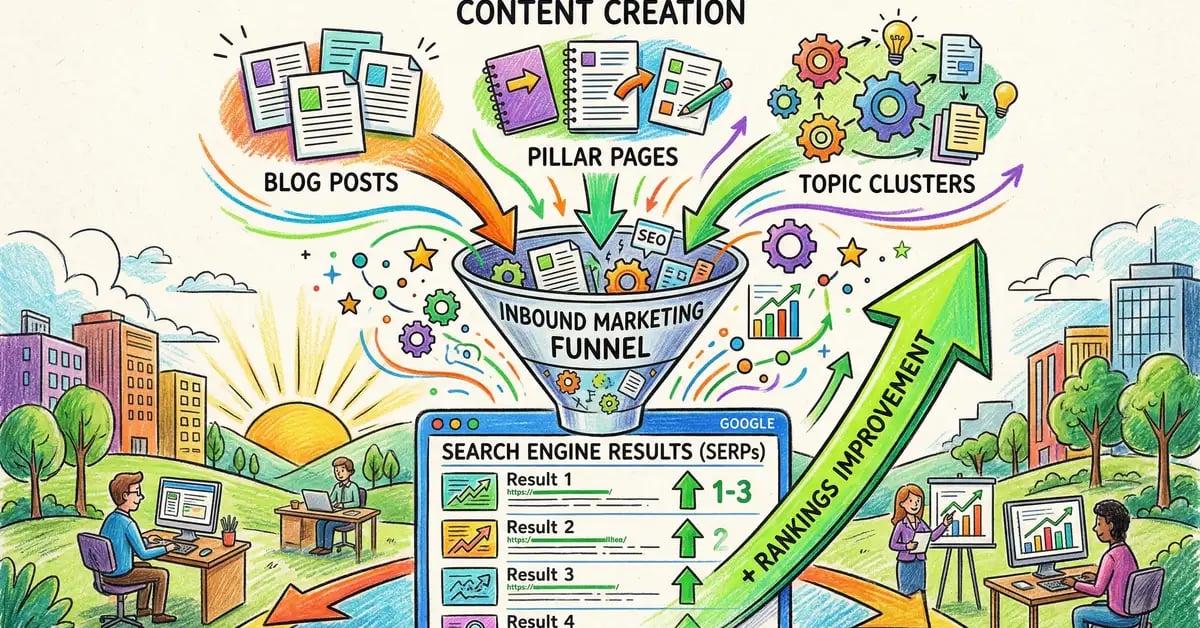
Direct Answer
Inbound marketing improves Google rankings by building topical authority through quality content that attracts organic backlinks, signals E-E-A-T (Experience, Expertise, Authoritativeness, Trustworthiness), and demonstrates subject expertise through topic clusters. For B2B companies, this approach drives 76% of website traffic through organic and paid search combined—making it the most cost-effective path to sustainable, predictable growth.
If you're a B2B marketing director watching competitors dominate search results, you're not alone. Many UK businesses invest heavily in SEO without truly understanding the fundamental connection between inbound marketing methodology and sustainable ranking performance. The relationship is strategic, but it requires a coordinated, thoughtful approach that most agencies overlook.
In 2024, website and blog-driven SEO efforts were rated the #1 ROI channel for B2B brands, according to HubSpot's State of Marketing Report. Yet Google made four major core algorithm updates that year, each emphasizing content quality and user value over technical manipulation tricks. The message to the industry is absolutely clear: sustainable, long-term rankings come from earning Google's trust through genuine expertise and E-E-A-T signals, not gaming the system with shortcuts.
This comprehensive guide explains exactly how inbound marketing methodology—attract, engage, delight—translates into measurable ranking improvements, why the traditional "blog and hope" approach no longer works, and what UK B2B companies must do differently in 2026 to capture both traditional search visibility and emerging AI-powered discovery channels.
Key Takeaways
- Inbound marketing combines SEO with strategic content creation, demonstrating E-E-A-T signals that Google's algorithms now prioritize above traditional ranking factors.
- Topic clusters create topical authority: pillar pages connected to multiple cluster content pieces signal expertise across a domain, directly improving rankings for core keywords.
- Google's 2024 updates now penalize low-quality content by 45%, making content excellence non-negotiable for competitive visibility.
- Expect 6+ months for measurable ranking improvements, with compounding results over 12–18 months as your content library grows and backlinks accumulate.
- AI Overviews now drive zero-click searches; optimizing for Answer Engine Optimization (AEO) is essential for visibility in both traditional search and AI systems.
What Is Inbound Marketing and How Does It Relate to SEO?
Inbound marketing is a methodology that attracts prospects by creating valuable content and experiences tailored to their needs, rather than interrupting them with unwanted advertising. The core philosophy: provide genuine value upfront, build trust through education, and conversion follows naturally. SEO is a critical component—but inbound encompasses far more than search optimization alone.
The relationship works like this: SEO ensures your content can be discovered through search engines when prospects actively search for solutions to their problems. Inbound marketing provides the strategic framework for what content to create, how to structure it for maximum impact, and how to nurture visitors into customers. SEO without inbound strategy means you rank for keywords no one is buying from. Inbound without SEO means prospects never discover your content. Together, they create sustainable growth.
Content marketing costs 62% less than outbound marketing and generates three times more leads, according to Demand Metric research. 91% of marketers report that SEO improved their website performance, per Conductor's 2024 study. B2B buyers consume 3-5 pieces of content before speaking with sales, per Demand Gen Report research. The combination—strategic content guided by inbound principles, optimized for search visibility—creates compounding returns that paid advertising simply cannot match.
For UK B2B companies with long sales cycles, this matters enormously. Your prospects don't want to speak with sales immediately. They want to research, evaluate, and self-educate. Inbound marketing gives them the resources they need to move through their buying journey independently whilst simultaneously signaling to Google that your company has genuine expertise worth ranking.
Moving beyond tactical blog posts requires coordinated content strategy that demonstrates expertise across your entire business domain. When done properly, you're not just ranking for keywords—you're building an asset library that educates prospects at every stage of their journey whilst earning Google's algorithmic trust through topical authority and E-E-A-T signals.
How Google Evaluates Content Quality in 2025
Google's March 2024 core update fundamentally changed how the search engine evaluates content. The algorithm now integrates the "Helpful Content Update" directly into core ranking systems, reducing low-quality content in results by 45% according to Google's official announcement. For B2B companies, content quality is no longer just a ranking factor—it's the primary ranking factor.
This shift happened for a reason. Over the past decade, massive amounts of thin, repetitive, AI-generated content filled search results. Listicles written purely for keyword targets. Blog posts that never took a position. Product comparison guides designed to serve affiliate links rather than genuinely help readers. Google got tired of it. The company is now using machine learning to identify when content was created for search engines rather than humans—and ranking it accordingly.
Google evaluates content using E-E-A-T: Experience, Expertise, Authoritativeness, and Trustworthiness. The first "E" was added in late 2022—Google now explicitly values whether content demonstrates first-hand experience, not just theoretical knowledge. Your content must demonstrate:
- Experience: First-hand involvement with the topic. Have you actually done this? This distinguishes real expertise from plagiarised knowledge.
- Expertise: Deep, verifiable knowledge from professional credentials, advanced education, or years of practical work in the field.
- Authoritativeness: Recognition within your industry; cite credible references, link to authoritative sources, and demonstrate you're trusted by peers.
- Trustworthiness: Factual accuracy verified against sources, transparent author information, clear citations, and content that prioritizes user benefit over commercial gain.
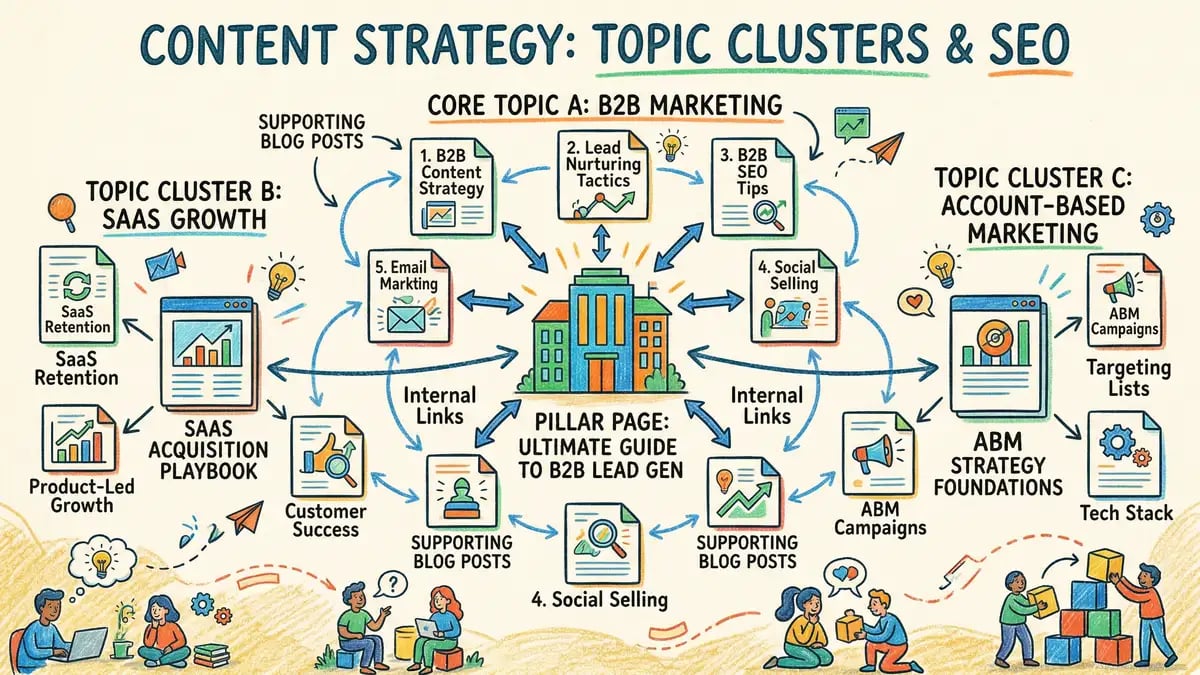
The practical implication: your content must be written for humans first, search engines second. Google's algorithms detect when content prioritizes keyword rankings over user value—and penalize it. Authentic expertise, original insight, and demonstrated first-hand experience are what separate ranking content from invisible content in 2025.
Author credentials matter significantly in Google's evaluation. Include author bylines with professional credentials, job titles, company affiliation, and links to relevant profiles. If writing about B2B SaaS implementation, the author should have demonstrable SaaS experience. This signals expertise to both Google's algorithms and human readers, increasing both ranking probability and reader trust simultaneously.
For B2B companies, this means your content shouldn't just answer questions—it should demonstrate your unique perspective and proprietary insights gained through client work. Include specific case studies, data from your own research, and perspectives that only your team could provide. This transforms content from generic information into genuine expertise assets that Google rewards and readers genuinely value.
The Topic Cluster Strategy That Builds Ranking Authority
Publishing individual blog posts without strategic connection is inefficient and leaves ranking potential on the table. Topic clusters—one comprehensive pillar page linked to multiple related cluster content pieces—signal topical authority to Google and improve rankings for both pillar and cluster keywords.
Traditional SEO treated each piece of content as independent. Inbound marketing treats your content library as an interconnected ecosystem. When a user lands on a cluster article about "How to Build a Topic Cluster," they can follow internal links to the pillar page on "Content Marketing Strategy," which links back to related clusters on content calendars, keyword research, and competitor analysis. This creates both user value and algorithmic signals.
How topic clusters work:
- Pillar page: A comprehensive 3,000-5,000 word article covering a broad topic (e.g., "Content Marketing Strategy for B2B Companies"). This should be accessible to readers new to the subject while providing enough depth for experienced marketers.
- Cluster content: 8-12 articles (1,500-2,500 words each) diving deeper into specific subtopics (e.g., "How to Create Effective Topic Clusters," "Building a Content Calendar That Drives SEO Results," "Measuring Content ROI"). Each cluster article focuses on a specific keyword and related concepts.
- Internal linking: Cluster pages link to the pillar page (reinforcing core topic), the pillar links to all cluster pages (showing breadth), and related cluster pages link to each other (creating a web that demonstrates comprehensive coverage).
Google rewards this structure because it mirrors how human experts organize knowledge. When a visitor lands on your cluster content and follows internal links to related resources, they stay engaged longer. Dwell time, pages per session, and internal link depth all contribute to ranking signals that Google tracks. Moreover, topical authority signals compound across your content library—as more cluster articles rank, the pillar page benefits from amplified authority, creating a virtuous cycle that accelerates ranking improvements.
For B2B companies, topic clusters are particularly effective because sales cycles are long. A prospect might encounter your cluster content on "How to Choose an SEO Agency," find your pillar page on "SEO Services for B2B Companies," and over several months, return multiple times via different cluster articles as their evaluation progresses. This extended engagement builds both topical authority and trust—two critical E-E-A-T signals.
Creating Content That Earns Links and Signals Expertise
Backlinks remain one of Google's strongest ranking signals, but in 2025, the quality bar has risen dramatically. Generic blog posts no longer attract links from authoritative sites. The content that earns natural backlinks shares specific characteristics: original research, data-backed insights, comprehensive guides that become industry references, and unique perspectives that challenge conventional thinking.
B2B websites receive 64.1% of their traffic from organic search, according to BrightEdge's 2024 Channel Share Report. That traffic comes predominantly to content that others deem worthy of citation. When you publish original research—even surveying your customers about their challenges—you create a linkable asset that journalists, bloggers, and industry sites will reference.
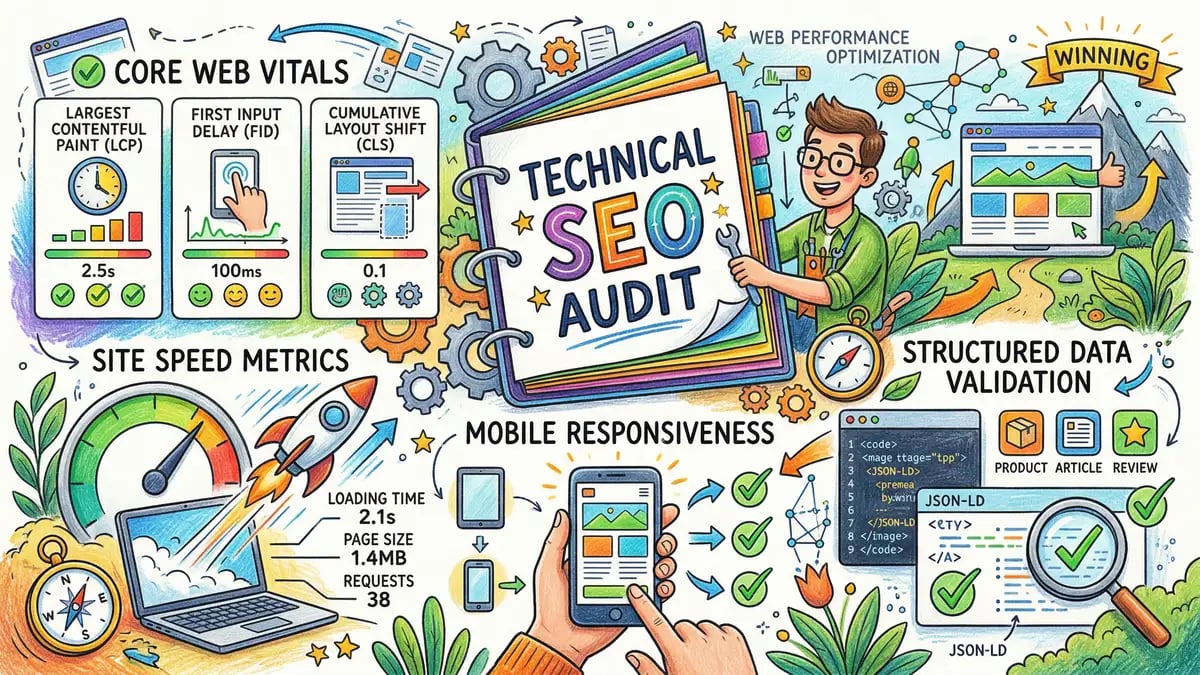
The most effective link-earning content types for B2B companies include:
- Original research and studies: Survey your customers, analyse trends in your sector, publish findings with charts and data.
- Comprehensive guides (3,000+ words): The definitive resource on a topic; when done well, these become industry references that others cite.
- Case studies with measurable outcomes: Document client success with specific metrics, challenges, and solutions.
- Proprietary frameworks or methodologies: Original models or processes developed through your expertise become differentiators that competitors cannot replicate.
The key is moving beyond self-promotional content to genuinely valuable resources. Content created to share knowledge rather than sell products naturally attracts more links, generates more shares, and builds more authority.
Author expertise signals matter more than ever. Beyond bylines, use schema markup to include author credentials—job title, company affiliation, educational background. This helps Google connect your content to proven expertise. For B2B topics, include LinkedIn profiles or industry certifications that demonstrate your authority in the subject matter.
B2B companies that commit to this approach—publishing case studies, original research, and proprietary frameworks—gain significant competitive advantage because these assets earn links naturally and cannot be easily replicated by competitors.
How Long Does Inbound Marketing Take to Improve Rankings?
Expect 6+ months for measurable ranking improvements, with compounding results over 12-18 months as your content library grows and backlinks accumulate. This timeline frustrates many B2B marketers accustomed to paid advertising's immediate results, but it reflects how Google's evaluation process actually works:
- Months 1-3: Content crawl and indexation; initial topical authority signals emerge. Traffic remains minimal as your library is still small.
- Months 4-6: First ranking improvements appear for less competitive keywords; traffic begins growing noticeably. Core cluster begins showing authority.
- Months 7-12: Significant improvements for established content; new clusters launch and begin ranking. Backlinks accumulate from earlier successful pieces.
- 12-18+ months: Compounding authority; early content benefits amplified by newer supporting articles; traffic becomes predictable and sustainable. ROI typically becomes positive.
Unlike paid advertising—where investment stops delivering the moment you stop spending—inbound content compounds indefinitely. Once published, your content continues ranking, generating traffic, attracting backlinks, and converting prospects years into the future. A blog post published in 2024 can still generate qualified leads in 2027 and beyond. This compounding effect is what makes inbound marketing's long-term ROI so dramatically superior to paid channels.
The key is consistency and strategic focus. Companies that publish sporadically or chase trending topics without building topical depth struggle to gain authority traction. Those committed to comprehensive coverage with regular publishing schedules—typically 2-4 pieces monthly—see predictable, sustainable results that justify the patience required. Within 18 months, most committed B2B organizations see measurable business impact from inbound marketing, making the investment worthwhile.
Beyond Google: Optimizing for AI Visibility in 2025
Here's the shift most UK B2B companies haven't grasped yet: 58.5% of Google searches now end without a click, according to SparkToro's 2025 research. Google's AI Overviews, featured snippets, and knowledge panels answer questions directly in results. Meanwhile, ChatGPT alone has 800 million weekly active users who never see your Google rankings at all.
This creates a visibility problem. Your rankings matter less if searchers get answers before clicking. Simultaneously, millions of users ask questions directly to AI assistants instead of visiting Google. If your content doesn't appear in AI-generated responses, you're missing massive discovery opportunities.
Answer Engine Optimization (AEO)—also called Generative Engine Optimization (GEO)—is structuring content so AI systems like ChatGPT, Perplexity, Claude, and Google's AI Overviews cite and recommend your brand. The principles differ significantly from traditional SEO:
- Direct answers first: AI systems need the answer within the first sentence, not buried in the fifth paragraph. No preamble, no context-setting—just the answer.
- Standalone sections: Each section must make sense without reading surrounding content; AI uses "chunking" to extract individual paragraphs or sections as answers.
- Clear definitions: Define key terms explicitly; AI systems cite sources that provide clear, self-contained definitions.
- Original data and insights: AI systems prefer citing sources with unique research and original data over content that simply rehashes competitor information.
The good news: quality content optimized for AEO also performs exceptionally well in traditional search. The strategies are complementary, not competing. Companies that master both traditional SEO and AEO simultaneously gain visibility across Google search, AI systems, and emerging discovery channels. In 2025, this dual optimization is becoming standard practice for competitive B2B markets.
Measuring Inbound Marketing's SEO Impact
Demonstrating inbound marketing's business impact requires tracking both SEO performance and business outcomes. Many organizations measure rankings and traffic but fail to connect them to pipeline and revenue—which is where true impact lives.
Key performance indicators:
- Organic traffic growth: Month-over-month and year-over-year increases show content's cumulative impact. Target: 20-30% monthly growth in established programmes, 50%+ in new initiatives.
- Keyword rankings: Track position improvements for 50-100 target keywords across your topic clusters. Expect competitive keywords to reach top-10 within 6-12 months; less competitive keywords within 3-6 months.
- Inbound lead volume: Connect organic traffic to form submissions via Google Analytics and HubSpot. Compare cost per lead from organic vs. paid channels—organic typically costs 40-60% less than paid.
- Lead-to-customer conversion: Organic leads typically convert 2-3x higher than paid leads and have 20-40% higher lifetime value because they've self-educated through your content before contacting sales.
- Pipeline contribution and revenue attribution: Connect inbound leads to pipeline value and closed deals. This is the metric that justifies continued investment to finance and sales leadership.
Use Google Analytics, Google Search Console, and SEO tools to monitor progress. Set up UTM parameters on internal links within your content to understand how readers navigate between cluster and pillar pages. Always connect SEO metrics to business outcomes—pipeline contribution and customer acquisition cost—not just vanity metrics like rankings or traffic.
For B2B companies, the business case becomes clear within 12-18 months. A company that invests £100,000 in inbound marketing typically sees £300,000-£500,000 in pipeline contribution within 18 months, translating to £60,000-£100,000+ in closed revenue at standard B2B conversion rates. As your content library grows, returns compound, making inbound marketing one of the highest-ROI marketing investments available.
The Strategic Path Forward
Inbound marketing's impact on Google rankings is no longer theoretical—it's a proven, measurable business strategy that drives predictable pipeline growth. Google's algorithm evolution has made E-E-A-T and topical authority non-negotiable for competitive visibility. The companies that dominate search results in 2026 are committing now to quality content, strategic organization, and authentic expertise signals.
The operational pathway is straightforward but requires discipline: publish content demonstrating genuine expertise, organize it strategically around topic clusters, earn backlinks by addressing real information gaps, and optimize for both traditional search and AI discovery simultaneously. The initial timeline requires patience—6-12 months for competitive traction—but the ROI compounds indefinitely as your content library grows and backlink profile strengthens.
For UK B2B companies facing increasing competition and rising customer acquisition costs, inbound marketing represents the most sustainable path to predictable, profitable organic growth. Unlike paid advertising where results evaporate the moment you stop spending, content compounds. A blog post published today can still generate traffic and leads five years from now, making inbound marketing one of the highest-ROI investments available.
The question isn't whether to invest in inbound marketing—it's whether you can afford not to. Your competitors are already building topical authority. Those that move quickly will capture the search real estate, earn the backlinks, and establish the expertise signals that Google now requires for visibility. The time to start is now.
About the Author
Clwyd Probert is the founder of Whitehat, a London-based SEO and inbound marketing agency and HubSpot Diamond Partner. With over 15 years of experience in digital marketing strategy, he helps B2B companies across the UK build sustainable organic growth through data-driven approaches.