
The shift to AI-powered sales isn't coming—it's already here. According to Gartner's 2025 research, 89% of revenue organisations now use AI tools, up dramatically from just 34% in 2023. This represents a fundamental change in how B2B sales teams operate, not an incremental improvement.
How AI Is Transforming the Way Deals Get Closed
AI now influences 94% of B2B buying decisions, buying committees have grown to 10–11 stakeholders, and 77–80% of deals go to the vendor contacted first—before buyers ever speak to sales. Winning in 2026 requires a properly configured CRM with AI capabilities, clean data foundations, and response workflows that engage prospects within five minutes of their first enquiry.
the bottom line
Companies using properly configured HubSpot implementations with AI capabilities are generating 3x more closed deals than those attempting self-implementation. The difference isn't the technology—it's the configuration quality.
The B2B sales landscape has fundamentally transformed. Sales cycles have lengthened by 22% since 2022, buyers complete 61–70% of their journey before contacting sales, and CFOs now hold final decision-making power in 79% of purchases. These shifts demand a complete rethink of how businesses manage leads and close deals.
This guide covers the research, statistics, and practical frameworks you need to configure your CRM for the AI-transformed B2B environment of 2025–2026.
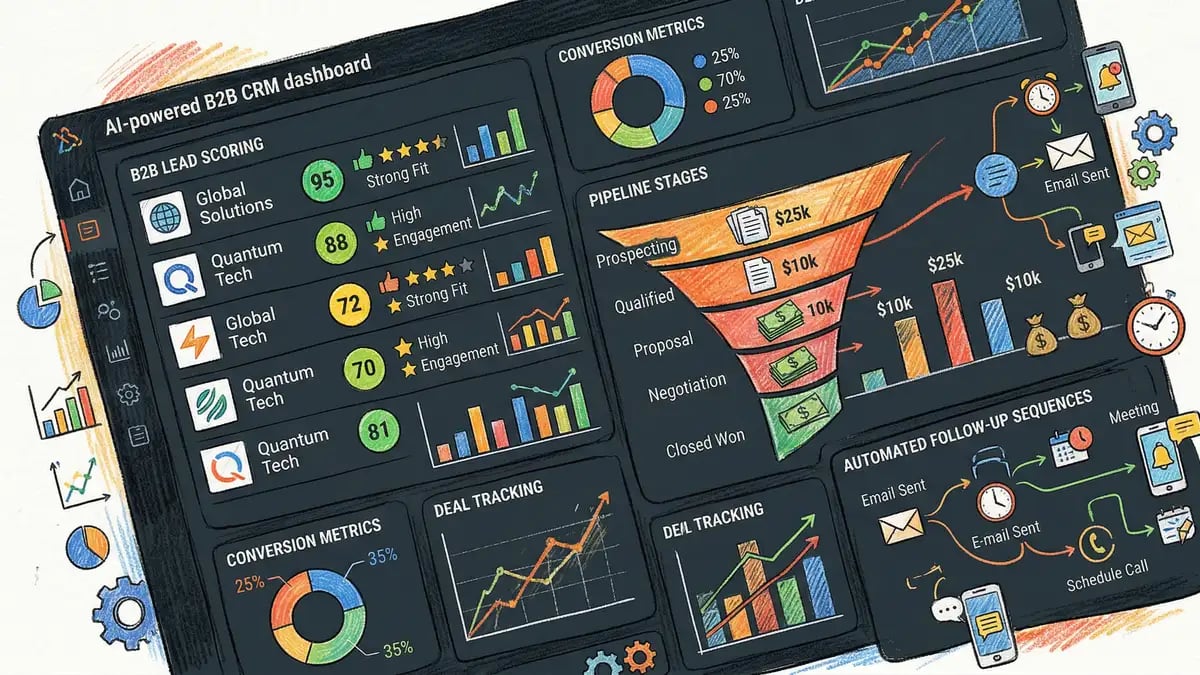
AI Adoption in B2B Sales Has Reached Critical Mass
Sales professionals using AI daily are twice as likely to exceed their targets, according to LinkedIn's 2025 State of Sales report. The productivity gains are substantial: Bain & Company found that AI can double active selling time from 25% to 50% of the workday by automating data entry, research, and follow-ups.
89%
Revenue Orgs Using AI
Up from 34% in 2023
12 hrs
Time Saved Per Week
Average with AI tools
3.7x
More Likely to Hit Quota
With AI-powered CRM
| Metric | Statistic |
|---|---|
| Revenue organisations using AI tools | 89% (up from 34% in 2023) |
| Sales teams deploying AI | 81% |
| Time saved per week with AI | 12 hours average |
| Likelihood to meet quota with AI | 3.7x higher |
| Deal cycles for frequent AI users | 78% shorter |
Sources: Gartner 2025, LinkedIn State of Sales 2025, Bain & Company 2025
Gartner predicts that by 2028, AI agents will outnumber human sellers tenfold, with 90% of B2B buying intermediated by AI agents channelling more than $15 trillion in spending. However, their research also warns of a value ceiling—fewer than 40% of sellers will report that AI agents improved their productivity, suggesting that implementation quality matters more than AI quantity.
B2B Buyer Behaviour Has Fundamentally Shifted
Understanding how B2B buyers actually make decisions in 2025 is essential for configuring effective lead management. The data reveals three critical shifts that most sales organisations have failed to adapt to.
Self-service preferences are now universal
According to Gartner and Sopro's 2025 research, 61–75% of B2B buyers prefer a rep-free experience for most of their journey. TrustRadius found that 100% of buyers want self-service options for all or part of their buying process. This doesn't mean human sales is dead—but it does mean the role of salespeople has shifted from information provision to strategic consultation.
The 6sense Buyer Experience Report 2025 identified a significant change: buyers are now contacting sellers 6–7 weeks earlier than in 2024. This suggests they want validation and support sooner, but still on their own terms. The point of first contact shifted from about 69% of the journey to 61%—meaning there's a larger window for meaningful engagement than previously thought.
Buying committees have grown substantially
The average B2B buying committee now includes 10–11 stakeholders, with large enterprise deals involving 15–20+ individuals. Younger decision-makers under 40 involve nearly twice as many stakeholders (6.8) as older executives (3.5), according to Sopro's research. This means lead management systems need to track multiple contacts per opportunity and provide content relevant to different roles within the buying committee.
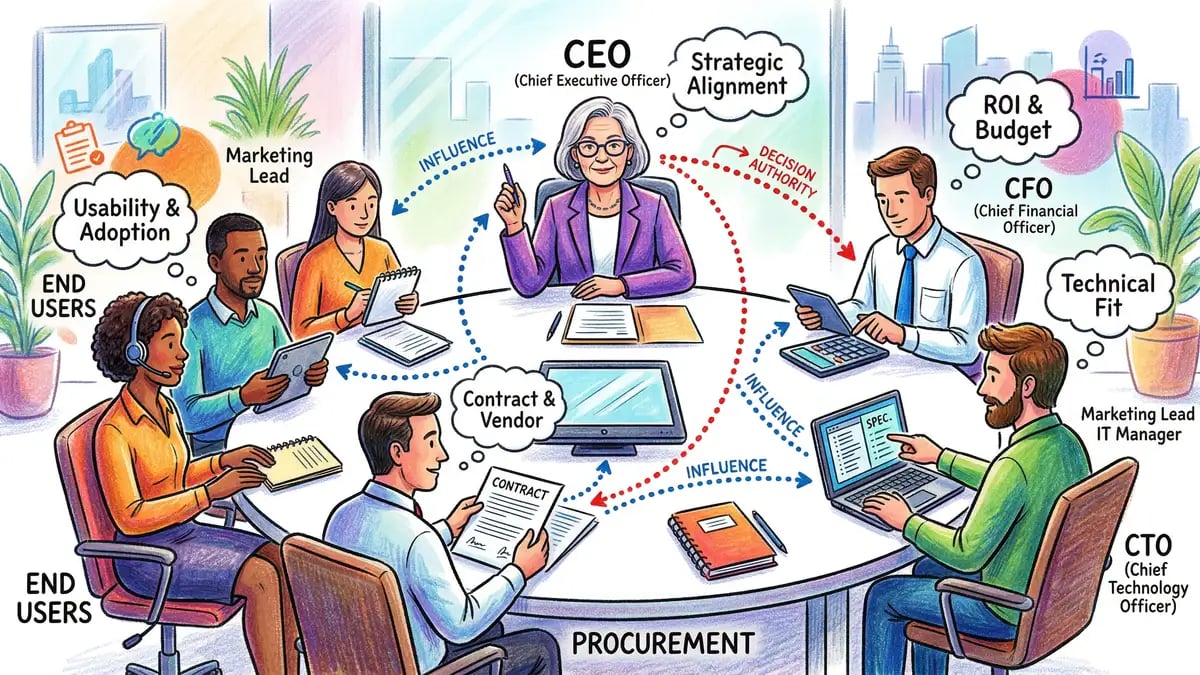
| Committee Size | Context |
|---|---|
| 10–11 stakeholders | Average buying committee |
| 15–20+ individuals | Large enterprise deals |
| 19 external stakeholders | Deals over £200,000 |
| 79% of purchases | CFO holds final decision power |
AI is reshaping how buyers research vendors
Perhaps the most significant shift is that 94% of B2B buyers now use large language models during their buying process, according to 2025 research. GenAI chatbots have become the number one influence on vendor shortlists at 17.1%—ahead of review sites at 15.1%. Sales conversions from ChatGPT recommendations are up 436%.
watch out
Just 5 brands capture 80% of top AI-generated responses per B2B category. If your company isn't appearing in AI search results, you're invisible to a growing portion of your potential buyers.
This creates both opportunity and risk. Whitehat's Answer Engine Optimisation services help UK businesses address this visibility gap.
Lead Response Time Remains the Critical Conversion Factor
Despite all the AI sophistication, one fundamental truth remains: speed wins. Research consistently shows that responding within 5 minutes makes you 21x more likely to qualify a lead, while responding after 30 minutes reduces your chances 100x compared to that 5-minute window.

The numbers are stark: responding within 1 minute delivers a 391% boost in conversions. Yet the average B2B response time remains 42–47 hours, and 55% of companies take 5+ days to respond to inbound enquiries. This represents an enormous competitive advantage for businesses that get their lead routing and notification systems configured properly.
The practical implication is clear: your CRM needs automated lead routing, instant notification systems, and clear escalation workflows. This is why Whitehat's HubSpot onboarding process prioritises workflow configuration in the first 30 days—not as an afterthought.
Is your lead response time costing you deals? Find out how HubSpot automation can get your team responding in under 5 minutes.
Explore HubSpot OnboardingHubSpot's Breeze AI Transforms CRM Capabilities
HubSpot launched Breeze AI at INBOUND 2024 and significantly expanded it at INBOUND 2025, positioning it as a unified AI system across the entire platform. Understanding these capabilities is essential for any business evaluating or optimising their CRM in 2025–2026.
Breeze Agents automate sales workflows
HubSpot now offers AI agents that operate as autonomous teammates across marketing, sales, and service. The Prospecting Agent monitors buying signals, researches target accounts, and sends personalised outreach using your brand voice. The Customer Agent resolves over 50% of support tickets automatically and works across WhatsApp, email, and Messenger. The new Closing Agent, launched in late 2025, answers buyer pricing and product questions 24/7.
| Agent | Function |
|---|---|
| Prospecting Agent | Researches accounts, identifies buying signals, crafts personalised outreach |
| Customer Agent | Resolves 50%+ of support tickets, works across multiple channels |
| Content Agent | Generates blogs, case studies, podcasts aligned with brand voice |
| Closing Agent | 24/7 availability to answer pricing and product questions |
| Data Agent | Automates research across CRM, calls, emails, and web insights |
Breeze Intelligence powers data enrichment
Powered by HubSpot's Clearbit acquisition, Breeze Intelligence provides data enrichment across 200+ million buyer and company profiles with 40+ firmographic attributes. The Buyer Intent feature uses reverse-IP lookup to identify high-fit companies visiting key pages like pricing—enabling proactive outreach to prospects who are actively researching solutions.
Predictive lead scoring changes qualification
HubSpot's predictive lead scoring, available on Enterprise tier, uses machine learning to calculate "likelihood to close" percentages within 90 days. This requires a minimum of 100 customers and 1,000 non-customers in your database to generate reliable predictions. Companies using AI-powered lead scoring report 77% higher lead generation ROI than those without, according to HubSpot's research.
The practical challenge is configuration. Whitehat's experience across 100+ B2B implementations shows that partner-guided implementations typically accelerate timelines by 20–40%, completing in 45–60 days versus HubSpot's standard 90-day direct onboarding path. Learn more about our HubSpot onboarding services.
B2B Conversion Benchmarks for 2026
Understanding where your conversion rates sit relative to industry benchmarks helps identify where to focus optimisation efforts. These benchmarks reflect current performance across B2B sales and marketing functions.
| Stage | Benchmark |
|---|---|
| Website visitor to Lead | 1.4–2.9% |
| Lead to MQL | 39–41% |
| MQL to SQL | 13–21% |
| SQL to Opportunity | 42% |
| Opportunity to Close | 37–39% |
| Overall Lead to Customer | Approx 2.7% |
Lead source significantly impacts conversion rates. Website leads convert at 31.3% to opportunity, referrals at 24.7%, webinars at 17.8%, and purchased lists at just 2.5%. This data supports a content-led inbound strategy focused on organic traffic and referral relationships rather than purchased databases.
Sales cycle lengths vary dramatically by segment
Sales cycles have lengthened 22% since 2022, with 43% of B2B sales leaders reporting further increases over the past 12 months. SMB deals under £12,000 ACV typically close in 14–30 days, mid-market deals (£12,000–£80,000) take 60–120 days, and enterprise deals above £80,000 extend to 90–180+ days.
Industry matters too: SaaS and technology companies average 67 days with a 22% win rate, manufacturing averages 124 days with a 19% win rate, and real estate/construction averages 147 days with a 16% win rate.
Sales-Marketing Alignment Delivers Measurable Revenue Impact
208%
Higher Marketing Revenue
With strong alignment
38%
Higher Win Rates
Aligned sales and marketing
24%
Faster Revenue Growth
Over three years
Only 8% of companies have strong sales-marketing alignment, yet the revenue impact of getting this right is substantial. Companies with strong alignment generate 208% higher marketing-attributed revenue, achieve 38% higher win rates, and see 24% faster three-year revenue growth.
The cost of misalignment is equally stark: companies lose 10%+ of revenue annually from B2B misalignment, totalling an estimated $1 trillion globally. This makes alignment configuration a direct revenue lever, not a nice-to-have process improvement.
Achieving alignment requires shared definitions of lifecycle stages, agreed lead handover criteria, and unified reporting that both teams trust. Whitehat's CRM configuration approach prioritises these alignment foundations—defining lifecycle stages on day one, agreeing core properties on day two, and building shared dashboards before any marketing campaigns launch.
UK-Specific CRM Market Insights
The UK CRM market reached $5.2 billion in 2025 with approximately 9% annual growth, ranking third worldwide for CRM software revenue. However, significant opportunity remains: 32% of UK SMEs still use spreadsheets for customer data management, and 69% of UK SMEs in education, financial services, and IT sectors are not using any CRM system.
For UK businesses evaluating CRM platforms, the total cost of ownership analysis typically favours HubSpot over Salesforce for mid-market companies. A mid-sized company with 20–25 users will typically see Salesforce cost 2–3x more than HubSpot over three years, driven by higher implementation costs (£24,000–£80,000+ vs £4,000–£16,000), required add-ons, and ongoing administration requirements.
UK businesses also need to consider GDPR and PECR compliance requirements that affect CRM configuration, particularly around consent management, email marketing permissions, and data retention policies. HubSpot's native compliance features simplify this, but proper configuration during onboarding is essential.
Practical Recommendations for 2026
Based on this research and Whitehat's implementation experience across UK B2B businesses, here are the priority actions for CRM and lead management optimisation:
1. Configure sub-5-minute lead response workflows
The 78% first-responder advantage is too significant to ignore. Implement automated lead routing, instant notifications across multiple channels (email, Slack, mobile), and clear escalation paths for unactioned leads. Test your actual response times monthly.
2. Implement AI-powered lead scoring
If you have sufficient data (100+ customers, 1,000+ non-customers), predictive lead scoring should be active. If not, implement behavioural scoring based on engagement signals—page visits, content downloads, email opens—to prioritise sales effort on highest-intent prospects.
3. Optimise for AI search visibility
With 94% of B2B buyers using LLMs in their research, visibility in ChatGPT, Claude, and Perplexity matters as much as Google rankings. Ensure your content is structured for AI extraction with clear definitions, specific statistics, and expert credentials.
4. Build multi-stakeholder tracking
With 10–11 stakeholders in average buying committees, your CRM needs to track multiple contacts per deal and provide content relevant to different roles. Configure contact roles, stakeholder mapping, and role-based content recommendations.
5. Establish clean data foundations
71% of RevOps professionals say data quality negatively impacts go-to-market execution. Clean data before go-live, establish data governance policies, and implement validation rules that prevent bad data entering your system. Organisations with clean data foundations see 26–29% faster CRM setup than those requiring significant pre-migration cleanup.
Frequently Asked Questions
What percentage of B2B buyers use AI in their purchasing decisions?
94% of B2B buyers now use large language models like ChatGPT during their buying process, according to 2025 research. AI chatbots have become the number one influence on vendor shortlists at 17.1%, surpassing traditional review sites. This shift means B2B vendors need to optimise their content for AI visibility alongside traditional search engines.
How quickly should B2B companies respond to inbound leads?
Within 5 minutes. Research shows responding in this window makes you 21x more likely to qualify a lead, while responding within 1 minute delivers a 391% boost in conversions. Companies that respond first win 78% of deals regardless of other factors. Yet average B2B response time remains 42-47 hours—representing a significant competitive advantage for faster responders.
What is HubSpot Breeze AI and how does it help with lead management?
Breeze AI is HubSpot's unified AI system comprising Breeze Agents (autonomous teammates for prospecting, customer service, and content creation), Breeze Intelligence (data enrichment across 200+ million profiles), and Breeze Copilot (conversational AI assistant). The Prospecting Agent identifies buying signals and sends personalised outreach, while predictive lead scoring calculates likelihood to close within 90 days.
How many stakeholders are typically involved in B2B purchasing decisions?
The average B2B buying committee includes 10-11 stakeholders, with large enterprise deals involving 15-20+ individuals. CFOs hold final decision-making power in 79% of purchases. Younger decision-makers under 40 involve nearly twice as many stakeholders (6.8) as older executives (3.5), meaning this complexity is increasing as leadership demographics shift.
What ROI can businesses expect from CRM implementation?
Industry research shows CRM systems deliver £7.11 for every £1 spent on average. Companies with strong sales-marketing alignment through their CRM generate 208% higher marketing-attributed revenue and achieve 38% higher win rates. However, 50-70% of CRM projects fail to achieve planned objectives—success depends heavily on proper implementation and user adoption.
Ready to Transform Your B2B Lead Management?
Whitehat helps UK B2B businesses configure HubSpot for faster lead response, AI-powered qualification, and reliable revenue attribution. As a HubSpot Diamond Partner running the world's largest HubSpot User Group, we see what works across hundreds of implementations.
Clwyd Probert
CEO and Founder, Whitehat SEO Ltd
Clwyd Probert is CEO and Founder of Whitehat SEO Ltd, a London-based HubSpot Diamond Solutions Partner. He leads the world's largest HubSpot User Group (London HUG) and serves as a guest lecturer at UCL on digital marketing strategy. Whitehat helps UK B2B companies build CRM-powered marketing programmes that prove ROI.