
Direct Answer
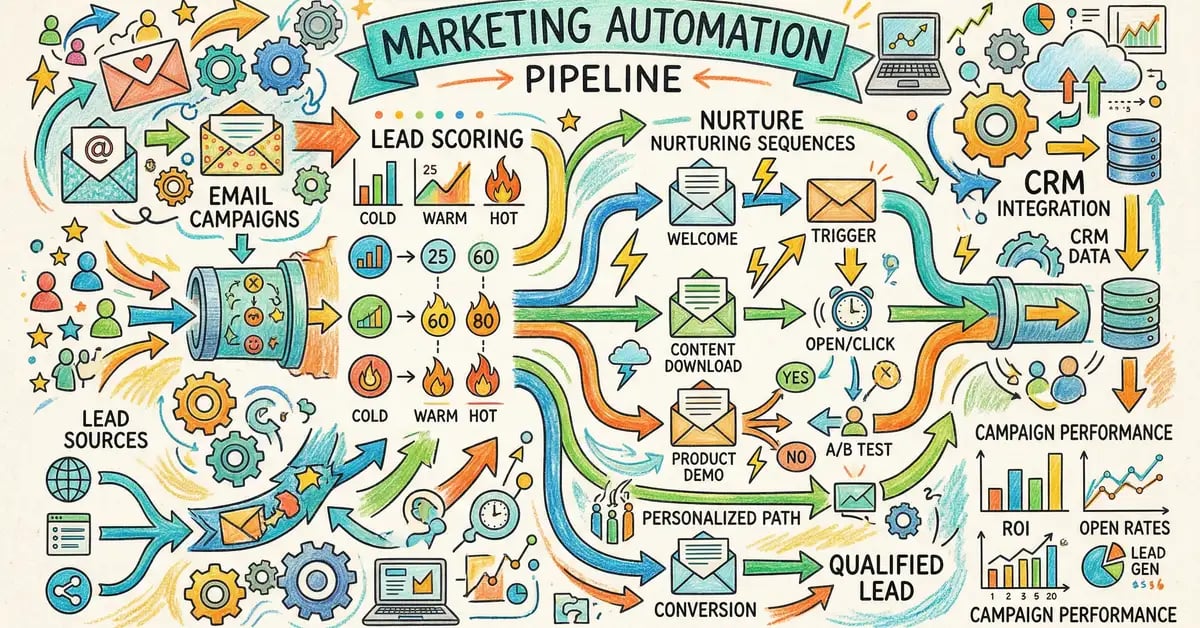
Marketing automation streamlines repetitive marketing tasks through software platforms, enabling businesses to nurture leads, personalise communications at scale, and deliver the right message at precisely the right moment in the buyer's journey. With 76% of businesses now using some form of marketing automation globally and the UK market valued at £385-464 million, these platforms have become essential infrastructure for B2B growth in 2026.
Key Takeaways
- Marketing automation delivers £5.44 return for every £1 spent, with 76% of companies achieving positive ROI within 12 months
- The Data (Use and Access) Act 2025 recognises direct marketing as legitimate interest whilst increasing PECR fines to £17.5 million maximum
- AI integration is now standard, with 77% of marketers using automation tools with AI to create personalised content
- Lead scoring and email automation should be your first implementation priorities for highest ROI
- UK businesses prioritise GDPR compliance, data residency options, and local support availability when choosing platforms
What Marketing Automation Actually Does
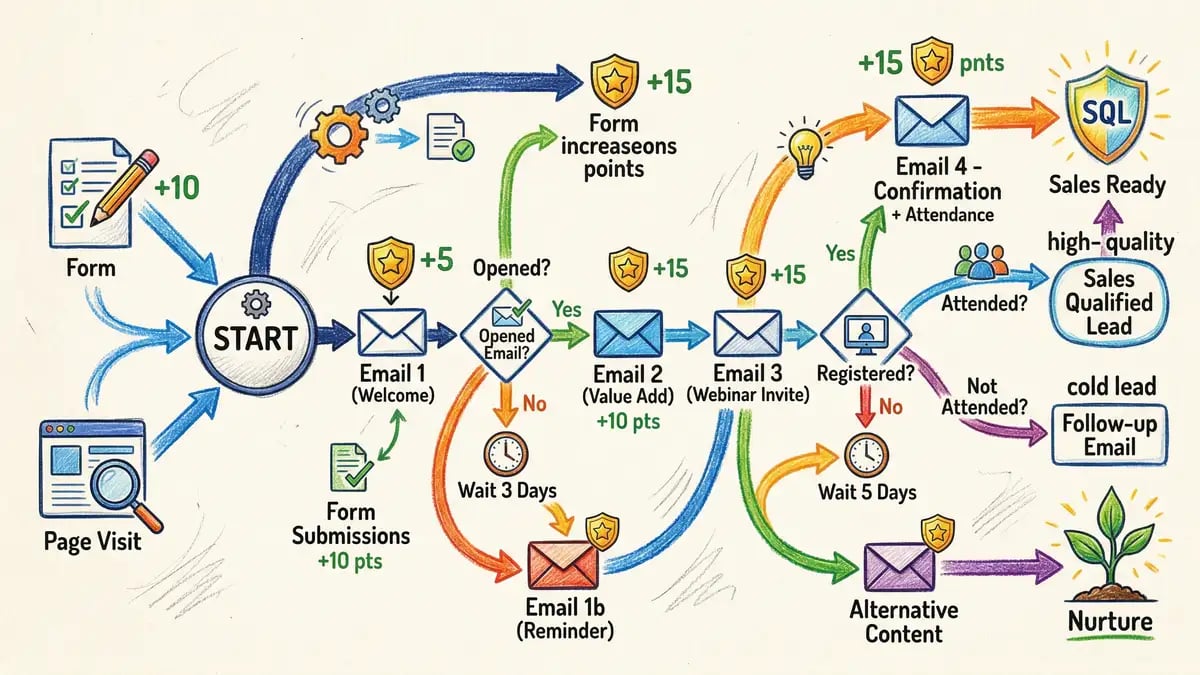
Marketing automation platforms handle the repetitive tasks that consume hours of your marketing team's time. These systems automatically send emails based on specific triggers, score leads based on their behaviour, segment your database dynamically, and deliver personalised content to different audience segments without manual intervention.
The core capabilities include email campaign automation, lead nurturing sequences, lead scoring and grading, automated social media posting, landing page and form management, and comprehensive analytics and reporting. Modern platforms like HubSpot integrate these capabilities with your CRM system, creating a unified view of every prospect from first touch to closed deal.
Whitehat's inbound marketing approach leverages marketing automation to move prospects through the buyer's journey efficiently. Rather than interrupting potential customers with outbound tactics, automation delivers valuable content when prospects are actively seeking solutions.
The ROI Reality: What Results You Can Actually Expect
Marketing automation delivers measurable returns when implemented properly. Research from Nucleus Research shows a £5.44 return for every £1 spent on marketing automation. More importantly, 76% of companies see positive ROI within 12 months, with 44% achieving returns within just 6 months.
The performance benchmarks tell a compelling story. 80% of users report increased leads, whilst 77% experience higher conversion rates. Oracle's research demonstrates that automation-based lead nurturing drives a 451% increase in qualified leads. These aren't marginal improvements—they're transformational changes to pipeline generation.
451%
Increase in qualified leads through automation-based lead nurturing, according to Oracle research
For UK B2B companies specifically, the ROI extends beyond direct revenue. Marketing automation creates efficiency gains that allow small teams to compete with larger organisations. Lead qualification happens automatically through scoring models, sales teams receive notifications when prospects hit key engagement thresholds, and marketing can demonstrate clear attribution from activity to revenue.
Budget Trends and Investment Reality
The budget landscape has moderated from earlier predictions. Statista's February 2024 survey reveals that 68% of marketing decision-makers plan to increase automation budgets. This represents realistic investment, with 21% maintaining current spend and 11% decreasing investment.
For UK SMEs specifically, marketing investment remains strong. UK SMEs are prepared to spend £35.1 billion on marketing in 2026, with 33% prioritising marketing investment above other areas. However, 73% of UK SMBs remain unsure if their marketing strategy is working—positioning marketing automation as the solution to that measurement gap.
Platform pricing varies significantly. HubSpot's Marketing Hub starts with a free tier suitable for basic automation, scaling to £800+ monthly for advanced features. ActiveCampaign offers accessible pricing from £70/month for smaller businesses. Salesforce's Marketing Cloud Growth Edition specifically targets UK B2B SMBs with mid-market pricing.
The investment extends beyond software licences. Implementation typically requires 6 months according to 36% of businesses. Additional costs include training, content creation for nurture sequences, and ongoing optimisation. Whitehat's HubSpot onboarding services accelerate this process, ensuring your team gains proficiency quickly whilst avoiding common implementation pitfalls.
AI Integration: From Optional to Essential
AI integration has become table stakes in marketing automation. 77% of marketers now use automation tools with AI to create personalised content, whilst 75% of marketers are experimenting with or have fully implemented AI across their marketing operations. High-performing teams are 2.5 times more likely to have fully integrated AI according to Salesforce's State of Marketing 2026.
The statistics reveal how quickly AI adoption has accelerated. 73% of new martech tools launched since May 2023 are AI-based—1,498 of 2,042 total launches according to Scott Brinker's Martech analysis. This isn't gradual evolution; it's rapid transformation of the entire category.
Practical AI applications in marketing automation include predictive lead scoring that identifies which prospects are most likely to convert, AI content generation for email sequences and social posts, sentiment analysis to gauge prospect engagement, agentic AI that handles workflow automation without explicit programming, and dynamic personalisation that adapts messaging based on real-time behaviour.
Scott Brinker, VP Platform Ecosystem at HubSpot, explains the distinction: "Workflow automations ran according to deterministic rules and steps that were programmed by a human. AI agents apply their own intelligence to decide which tools to call when—without an explicit plan dictated to them by humans." This shift from rule-based to intelligent automation represents the most significant change to the category in a decade.
However, Brinker also warns against over-automation: "There's a segment of marketing excited to set AI agents loose to call, email, text people without humans. That's not going to create joy and delight for buyers." The balance between automation efficiency and human oversight remains critical, particularly for complex B2B sales cycles where relationship quality matters.
UK Compliance: Data (Use and Access) Act 2025
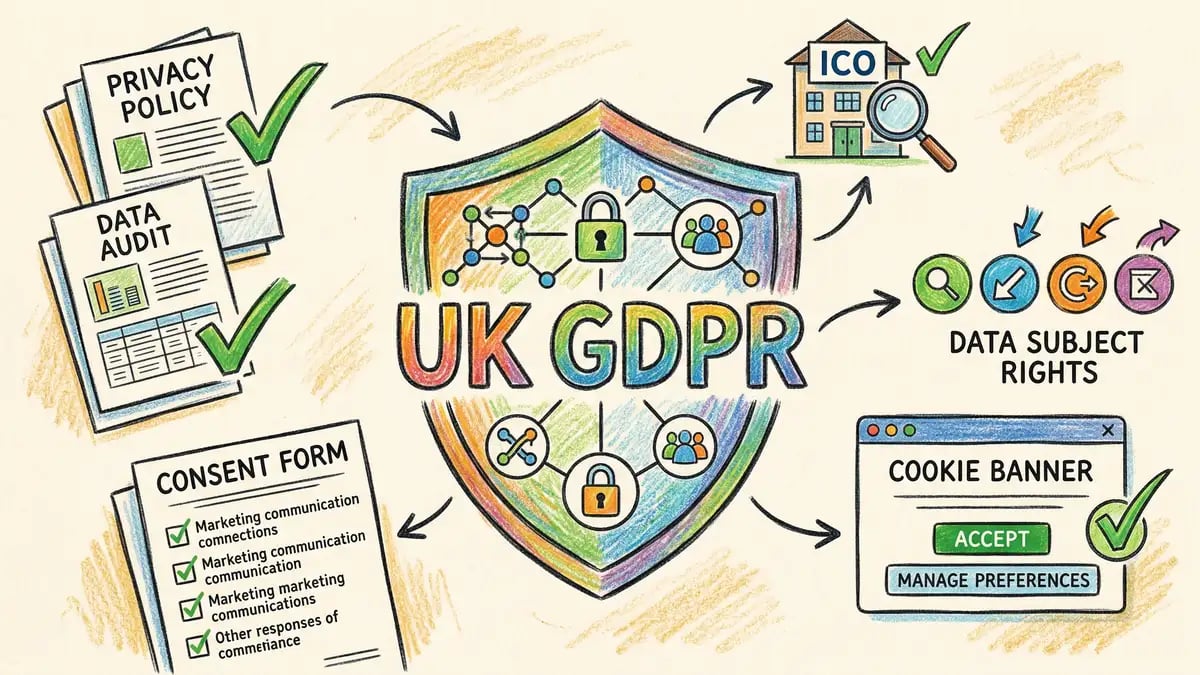
The UK compliance landscape shifted significantly with the Data (Use and Access) Act 2025, which received Royal Assent on 19 June 2025. This represents the first major changes to UK GDPR since Brexit, with implementation expected by mid-June 2026.
The critical changes for marketing automation include direct marketing now explicitly listed as "recognised legitimate interest," simplifying lawful basis requirements for B2B email campaigns. PECR fines have increased dramatically—the maximum is now £17.5 million or 4% of global turnover. Non-intrusive cookies for analytics and security can be used without explicit consent if users can opt out. Automated decision-making restrictions have been relaxed, allowing automation with "meaningful human involvement."
ICO enforcement has intensified. Over 90% of ICO penalties in 2024 were for unlawful direct marketing, with £2.59+ million in fines issued since April 2023. Notable 2024 fines include HelloFresh (£140,000 for 79 million spam emails), Breathe Services Ltd (£170,000 for 4+ million unlawful calls), and Poxell Ltd plus Skean Homes Ltd (£250,000 combined for unsolicited calls).
Key compliance failures triggering fines include sending marketing after subscription ended, marketing to TPS-registered numbers, using consent for one channel for another (email consent does not equal SMS consent), insufficient opt-out mechanisms, and no valid consent records. Marketing automation platforms must maintain detailed consent records, implement proper opt-out mechanisms, segment databases by consent type, and provide clear audit trails.
Platform Selection: What Actually Matters
With 13,080+ martech tools available according to Scott Brinker's analysis, platform selection can feel overwhelming. The market shows clear consolidation, with HubSpot dominating at 35-38% global market share, particularly strong for SMBs requiring all-in-one solutions.
For UK B2B businesses, several platforms warrant consideration based on specific needs:
HubSpot
Best for: SMBs and mid-market companies requiring all-in-one solution
Strengths: Native CRM integration, free tier available, extensive app marketplace, EU data centres available
UK-specific: Strong UK support presence, GDPR compliance built-in, Sterling pricing available
Salesforce Marketing Cloud
Best for: Enterprise organisations with complex requirements
Strengths: Sophisticated segmentation, advanced AI capabilities, enterprise-grade security
UK-specific: Growth Edition launched September 2024 for UK B2B SMBs, UK/EU data residency options
ActiveCampaign
Best for: Email-focused SMBs with limited budgets
Strengths: Affordable pricing from £70/month, strong email capabilities, good automation workflows
UK-specific: EU data centres available, GDPR-compliant features
Brevo (formerly Sendinblue)
Best for: Budget-conscious SMBs, agencies managing multiple clients
Strengths: Generous free tier, France-headquartered with strong GDPR focus
UK-specific: EU data hosting, pricing in Sterling, strong UK support
The critical evaluation criteria include CRM integration capability (native integration versus API connections), data residency options for UK/EU compliance, GDPR compliance verification and audit trails, hidden costs including onboarding, user licences, and overage charges, and UK support availability including timezone coverage and local expertise.
Research from 2024 reveals that 70% of marketers report being unhappy with their automation software. The primary reasons include poor integration with existing systems (43%), lack of expertise to use the platform effectively (55.6%), and delivering personalised content at scale (44%). These barriers highlight why proper implementation and training matter as much as platform selection.
Implementation Strategy: What to Automate First
The overwhelming nature of marketing automation leads many businesses to either never start or try to automate everything simultaneously. Both approaches fail. The effective strategy involves starting with high-ROI, low-complexity workflows and expanding methodically.
Email marketing automation should be your first priority. Email delivers £36 return for every £1 spent—the highest ROI of any marketing channel. Start with welcome sequences for new subscribers, nurture campaigns for leads at different stages, and re-engagement campaigns for inactive contacts.
Lead scoring represents the second implementation priority. Assign points based on demographic fit (company size, industry, job title) and behavioural engagement (email opens, website visits, content downloads). HubSpot's native lead scoring or Salesforce's Einstein Scoring automate this process, helping sales teams focus on prospects most likely to convert.
The third phase involves automated workflows for specific scenarios: abandoned cart recovery for e-commerce businesses, event registration and follow-up sequences, content upgrade delivery, and sales notification triggers when leads hit key thresholds.
Social media scheduling and posting automation should wait until email and lead scoring workflows are functioning properly. Whilst automation platforms offer social capabilities, these deliver lower direct ROI than email nurturing for B2B companies.
The "one workflow at a time" principle matters. Implement a welcome sequence, measure performance for 30 days, optimise based on results, then move to the next workflow. This approach prevents overwhelm whilst building your team's automation expertise progressively. Sales and marketing alignment improves when both teams see workflows delivering measurable results before expanding scope.
Common Implementation Barriers and Solutions
Marketing automation implementation faces predictable obstacles. Understanding these barriers before starting prevents costly delays and team frustration.
Lack of expertise represents the primary barrier, cited by 55.6% of businesses according to Liana Technologies research. Most marketing teams lack technical experience with automation platforms. This knowledge gap leads to underutilisation—businesses paying for sophisticated platforms whilst using only basic features. The solution involves structured training programmes, potentially through HubSpot coaching or platform-specific certification courses.
Insufficient human resources (48.1%) compound the expertise problem. Marketing automation requires dedicated attention—someone must build workflows, create content for sequences, analyse performance, and optimise continuously. Many businesses attempt to "bolt on" automation responsibilities to existing roles without reducing other workload. This approach inevitably fails.
Delivering personalised content at scale (44%) challenges even experienced teams. Marketing automation enables personalisation technically, but someone must create the variants. A nurture sequence with three audience segments, five emails per sequence, means 15 unique pieces of content before considering A/B testing. Content strategy must account for this multiplication effect.
System integration challenges (43%) affect businesses with established technology stacks. Marketing automation platforms must connect with your CRM, website, analytics tools, and potentially advertising platforms. API connections sometimes break, data synchronisation fails, or duplicate records appear. Budget for integration troubleshooting and maintenance.
Interestingly, budget constraints rank lowest (19%) amongst implementation barriers. Businesses understand marketing automation costs less than hiring additional staff to handle tasks manually. The challenge isn't affording the software—it's investing in successful implementation.
Measuring Success: Essential Metrics
Marketing automation's value lies in measurability. Unlike traditional marketing activities where attribution remains unclear, automation platforms provide detailed tracking from first touch to revenue.
Lead generation metrics form the foundation. Track total leads generated through automated forms and landing pages, lead generation by source (organic, paid, referral, social), cost per lead by channel, and lead quality scores based on your scoring model. These metrics reveal which automated campaigns attract prospects worth pursuing.
Conversion metrics demonstrate nurturing effectiveness. Monitor conversion rates at each funnel stage (visitor to lead, lead to MQL, MQL to SQL, SQL to customer), average time to conversion by segment, email nurture sequence performance (open rates, click rates, conversion rates), and landing page conversion rates for different offers.
Revenue attribution connects marketing activity to business results. Marketing-sourced revenue shows total pipeline generated through marketing automation efforts. Multi-touch attribution models reveal which touchpoints contribute to closed deals. Customer lifetime value by acquisition source identifies which automated campaigns attract the most valuable customers. Sales cycle length by lead source shows whether automation-nurtured leads close faster.
Efficiency metrics quantify automation's operational impact. Time saved through automated workflows (measured in hours per week), cost savings compared to manual execution, marketing spend as percentage of revenue, and team capacity gained for strategic work rather than repetitive tasks all demonstrate automation's business case beyond direct revenue.
Scott Brinker notes an important consideration: "Even if innovation stopped today, it would still take five years for most companies to absorb the tools already available." This "absorption gap" means businesses should focus on maximising their current platform's capabilities before seeking additional tools. Measure utilisation rates—what percentage of your platform's features are you actually using effectively?
The CRM and Automation Relationship
Marketing automation and CRM systems work together but serve distinct purposes. Understanding this relationship prevents confusion and ensures proper implementation.
Your CRM manages relationships from the point someone becomes a known lead through the entire customer lifecycle. It stores contact information, tracks sales interactions, manages pipeline and deals, and provides sales teams with context for every conversation. The CRM is your source of truth for customer relationships.
Marketing automation handles top-of-funnel activities before someone becomes a sales-ready lead. It attracts anonymous website visitors through content, converts visitors to known leads through forms and offers, nurtures leads through automated email sequences, and scores leads based on behaviour and fit. Marketing automation qualifies prospects before sales engagement.
The integration between these systems creates powerful capabilities. When a website visitor downloads a whitepaper, the marketing automation platform captures their details, triggers a nurture sequence, tracks their subsequent behaviour (website visits, email engagement, content downloads), and assigns a lead score. Once that score reaches a threshold—say 75 points—the platform automatically creates or updates a record in the CRM and notifies the assigned salesperson. The sales rep sees complete history: every email opened, every page visited, every content piece downloaded.
HubSpot pioneered this integrated approach with its free CRM and Marketing Hub combination. Salesforce offers integration between Marketing Cloud and Sales Cloud, though setup complexity increases with enterprise-grade platforms. For UK businesses, data residency considerations matter—ensure both systems store data in compliant locations if serving EU customers.
The bottom line: B2B businesses need both systems. Marketing automation without CRM means losing leads once they're sales-ready. CRM without marketing automation means sales teams waste time on unqualified prospects. The integration transforms both tools into a unified revenue engine.
UK Market Perspective: What's Different Here
The UK marketing automation market shows distinct characteristics compared to US and broader European markets. UK businesses face unique challenges and opportunities worth understanding.
The UK holds 34% of European market share, valued at £385-464 million in 2026 according to Mordor Intelligence. The market is growing at 14.2% CAGR through 2035, reaching substantial values according to Market Research Future projections. This represents substantial growth opportunity, particularly for B2B software and professional services sectors.
UK SMBs demonstrate higher AI adoption rates than most markets, with over 50% using AI in some capacity for marketing alongside Canada and ANZ. However, confidence remains low—81% of UK SMBs express concern about economic impact on business (highest of all surveyed regions), and 73% remain unsure whether their marketing strategy works effectively.
This confidence gap creates opportunity for marketing automation providers and agencies like Whitehat. When SMBs can see clear attribution from marketing spend to revenue, confidence increases. Marketing automation platforms provide this transparency through closed-loop reporting—tracking every lead from first website visit through closed deal.
UK businesses prioritise different features compared to US counterparts. GDPR compliance verification takes precedence—businesses want audit trails, consent management, and opt-out mechanisms built into platforms rather than added afterwards. Data residency options matter more post-Brexit, particularly for companies serving both UK and EU markets. Sterling pricing transparency helps with budgeting compared to dollar-denominated invoicing with variable exchange rates.
UK support availability influences platform selection. Time zone alignment, local customer success managers, and UK-based training resources reduce implementation friction. Platforms with strong UK presence—HubSpot, Salesforce, and UK-focused providers—gain advantage through local expertise and relationship building.
The regulatory environment differs meaningfully. The Data (Use and Access) Act 2025 diverges from EU GDPR in specific areas, creating compliance complexity for businesses operating across borders. Marketing automation platforms must handle these regional variations, tracking consent separately for UK versus EU contacts and applying appropriate rules to each audience.
Frequently Asked Questions
How can AI improve my marketing automation in 2026?
AI enhances marketing automation through predictive lead scoring that identifies prospects most likely to convert, AI content generation for email sequences and social posts, agentic AI that handles workflow automation without explicit programming, sentiment analysis to gauge engagement levels, and dynamic personalisation that adapts messaging based on real-time behaviour. The key is balancing automation efficiency with human oversight—87% of B2B marketers now use or test AI, but the most successful implementations maintain meaningful human involvement to preserve relationship quality in complex sales cycles.
Is marketing automation GDPR compliant in the UK?
Marketing automation platforms can be GDPR compliant when configured properly. The Data (Use and Access) Act 2025 now recognises direct marketing as "legitimate interest," simplifying some requirements. However, businesses must implement consent management, preference centres, data subject rights workflows, and Google Consent Mode v2. Article 22 rules apply to automated decision-making. Verify your platform provides GDPR-specific features including audit trails, opt-out mechanisms, and data retention controls. PECR fines have increased to £17.5 million maximum, making compliance essential for UK businesses.
What's the difference between CRM and marketing automation?
CRM systems manage post-lead sales relationships—they store contact information, track pipeline, manage deals, and provide sales context. Marketing automation handles top-of-funnel activities—attracting visitors, converting to leads, nurturing through sequences, and qualifying prospects. Think of marketing automation as filling your CRM with qualified leads. B2B businesses need both: marketing automation identifies sales-ready prospects, then hands them to the CRM for sales team engagement. Integrated systems like HubSpot combine both capabilities, creating unified visibility from first website visit to closed deal.
How do you measure ROI from marketing automation?
Measure ROI through lead generation metrics (total leads, cost per lead, lead quality scores), conversion metrics at each funnel stage (visitor to lead, lead to MQL, MQL to SQL, SQL to customer), revenue attribution showing marketing-sourced pipeline and closed deals, and efficiency gains in time saved through automated workflows. Use multi-touch attribution models to understand which automated touchpoints contribute to revenue. Industry benchmarks show £5.44 return per £1 invested, with 76% of companies achieving positive ROI within 12 months. Set up tracking before implementation to establish baseline metrics for comparison.
Is marketing automation worth it for small businesses?
Yes—small businesses often see the biggest proportional impact from marketing automation. Pricing is accessible with free tiers (HubSpot, Brevo) to £70/month entry points (ActiveCampaign). Time savings alone justify investment: businesses report saving 6+ hours weekly on repetitive tasks. For UK SMBs with limited marketing resources, automation handles email nurturing, lead scoring, and social scheduling whilst your team focuses on strategy and content creation. Start small with email automation and welcome sequences, then expand as you prove ROI. The "start small" approach works—implement one workflow, measure results, optimise, then add complexity progressively.
How do I choose the right marketing automation platform?
Start with business needs assessment: What problems are you solving? CRM integration capability matters—native integration beats API connections. Verify GDPR compliance features for UK operations including audit trails and consent management. Calculate total cost including onboarding, user licences, and overage charges—not just monthly subscription. Check data residency options if serving EU customers. Evaluate UK support availability and timezone coverage. For most UK B2B SMBs, HubSpot offers the best balance of features, usability, and support. Enterprise businesses should evaluate Salesforce. Budget-conscious SMBs should consider ActiveCampaign or Brevo. Take platform demos with specific use cases rather than generic walkthroughs.
What marketing tasks should I automate first?
Prioritise email marketing automation first—it delivers £36 ROI per £1 spent, the highest of any channel. Start with welcome sequences for new subscribers, nurture campaigns for leads at different stages, and re-engagement campaigns for inactive contacts. Second, implement lead scoring based on demographic fit and behavioural engagement. Third, add automated workflows for specific scenarios: event registration sequences, content delivery, and sales notifications. Avoid automating social media until email workflows function properly. Follow the "one workflow at a time" principle: implement, measure for 30 days, optimise, then expand. This prevents overwhelm whilst building team expertise progressively.
Getting Started with Marketing Automation
The path to successful marketing automation follows a predictable sequence. Begin with assessment: What manual processes consume most time? Which leads fall through cracks? Where do prospects disengage? These answers reveal your highest-priority automation opportunities.
Platform selection comes next, guided by business needs rather than feature lists. Most UK B2B SMBs succeed with HubSpot's all-in-one approach or ActiveCampaign's email-focused platform. Budget 6 months for full implementation according to industry benchmarks, though basic workflows can launch within weeks.
Implementation requires dedicated resources—either internal team members with protected time or external expertise through agencies like Whitehat. Attempting to "bolt on" automation to existing roles without reducing other work predictably fails. Plan for training, content creation, and ongoing optimisation.
Start with one high-impact workflow. A welcome sequence for new subscribers, a nurture campaign for whitepaper downloads, or an abandoned cart recovery sequence all deliver quick wins. Measure performance rigorously: open rates, click rates, conversion rates, and revenue attribution. Optimise based on data, then expand to the next workflow.
The compounding returns matter most. Marketing automation improves incrementally—each optimised workflow makes the next implementation easier. Your team gains expertise, your database grows, and your attribution models become more sophisticated. Companies that started automation 12-18 months ago now operate at efficiency levels impossible through manual execution.
Whitehat helps UK B2B businesses implement inbound marketing strategies powered by marketing automation. From initial HubSpot onboarding through ongoing optimisation, we ensure your automation investment delivers measurable pipeline growth. Our approach combines technical implementation with content strategy, ensuring your automated workflows have quality content that resonates with prospects.
About the Author
Whitehat SEO Team
The Whitehat SEO team specialises in HubSpot implementation, inbound marketing strategy, and marketing automation for UK B2B businesses. With expertise in lead nurturing, compliance, and conversion optimisation, we help companies transform marketing processes into revenue engines. Our data-driven approach ensures every automated workflow delivers measurable results aligned with business objectives.
Ready to Transform Your Marketing with Automation?
Let Whitehat help you implement marketing automation that generates qualified pipeline. From platform selection through ongoing optimisation, we ensure your investment delivers measurable revenue growth.