
HubSpot & Email Marketing
The narrative that email is declining is demonstrably false. Global email users reached 4.59 billion in 2025, with 99% checking inboxes daily. More significantly for B2B marketers, 77% of B2B buyers prefer email as their primary communication channel, and 59% of B2B marketers cite email as their top revenue-generation channel.
B2B Email Strategies, Tools, and Compliance for HubSpot Users
B2B email marketing in 2026 delivers £36–£42 for every £1 spent, making it the highest-ROI digital channel available to marketers. With AI-powered personalisation now driving 41% revenue increases and Google's authentication mandates making DMARC, DKIM, and SPF setup non-negotiable, Whitehat's analysis shows that organisations using HubSpot's Breeze AI capabilities alongside sophisticated nurture strategies are positioned to capture this opportunity—particularly when marketing to B2B buying committees of 10–11 stakeholders across 3–9 month sales cycles.
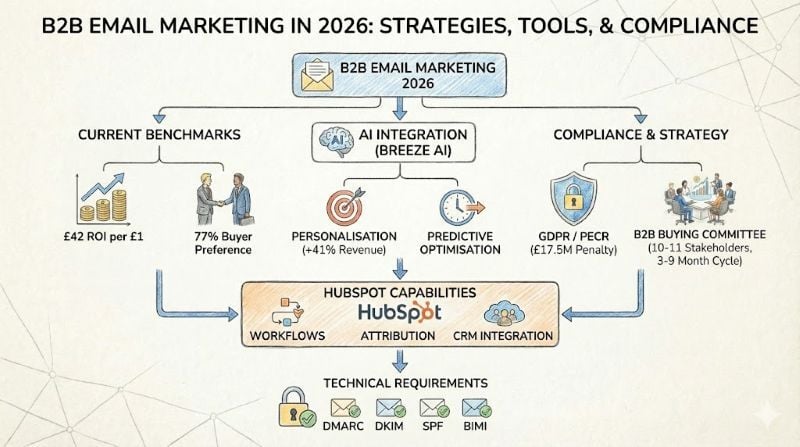
Current benchmarks reveal B2B email outperforms expectations
According to Whitehat's analysis of client campaigns and industry benchmarks, whilst B2B open rates appear lower than B2C, click-through rates are 52% higher—indicating more engaged, action-oriented audiences. This makes email particularly valuable for organisations running HubSpot-powered marketing automation.
B2B-specific performance metrics (2024–2025)
| Metric | B2B Average | B2B Technology | Professional Services |
|---|---|---|---|
| Open Rate | 39.5% | 38.14% | 45–48% |
| Click-Through Rate | 3.18% | 2.5% | 2–3% |
| Click-to-Open Rate | 21–23% | 6.18% | 7–8% |
| Unsubscribe Rate | 0.12% | — | — |
Critical insight: Open rate data requires careful interpretation due to Apple Mail Privacy Protection inflating figures by 15–20 percentage points across approximately 57% of email client market share. Whitehat recommends focusing on click-through rates as your primary engagement indicator.
ROI varies significantly by sector
The often-cited "£42 return per £1" figure requires nuance. Current 2025 data from the Data & Marketing Association and industry sources shows:
- Retail and e-commerce: £45 per £1 (highest)
- Marketing and advertising agencies: £42 per £1
- Software and technology: £36 per £1
- Media and publishing: £32 per £1
Automated email sequences dramatically outperform one-off sends, generating 320% more revenue whilst representing only 2% of total sends. This makes workflow automation—a core strength of HubSpot implementations—particularly valuable for B2B organisations with limited resources.
Optimal B2B sending times
Research converges on clear patterns: Tuesday, Wednesday, and Thursday between 9:00–11:00 AM in the recipient's time zone. For cold email outreach, Thursday mornings achieve 44% open rates—the highest of any time slot. Remote work has shifted some engagement earlier; testing 7–8 AM sends may capture professionals before morning meetings.
AI integration has moved from novelty to necessity
Artificial intelligence adoption in email marketing reached 63–64% of marketers in 2025, with 87% of AI adopters specifically applying it to email campaigns. The performance improvements justify the investment—and organisations that delay adoption risk falling behind competitors already capturing these gains.
Measurable AI impact on email performance
| AI Application | Performance Improvement |
|---|---|
| AI-driven personalisation | +41% revenue, +13.44% CTR |
| AI subject line optimisation | +10–50% open rates |
| Predictive send-time optimisation | +47% open rates (case studies) |
| AI-powered segmentation | 760% more revenue vs generic sends |
The shift is from simple personalisation tokens (first name, company name) to sophisticated hyper-personalisation that analyses browsing history, engagement patterns, firmographic data, and real-time intent signals. Modern AI tools can generate 50,000 slightly different emails from a single campaign, each tailored to individual subscriber behaviours.
HubSpot Breeze AI capabilities for email marketers
HubSpot's unified AI layer, Breeze, comprises four components relevant to email marketers. Whitehat's HubSpot onboarding services include configuration of these capabilities during the first 30 days:
Breeze Assistant (Copilot) is available on all plans including free, enabling AI-generated email drafts, subject line suggestions, and content refinement through slash commands. Generation limits are 30 times per minute, 1,000 times daily.
Breeze Prospecting Agent (Professional/Enterprise only) autonomously conducts prospect research, identifies buying signals such as leadership changes and funding rounds, and crafts personalised outreach in your brand voice.
Breeze Intelligence enriches contact data using over 200 million company and buyer profiles, detecting buyer intent through visitor behaviour tracking and enabling form optimisation. Pricing runs from £25/month for 100 credits to £580/month for 10,000 credits.
AI-Powered Email (announced at INBOUND 2025) generates unique content for each recipient within a campaign, predicting engagement likelihood and automatically optimising based on CRM context.
Three highest-return AI applications for B2B
- Predictive send-time optimisation: Analyses individual subscriber patterns to identify optimal engagement windows—moving beyond "10 AM Tuesday" to personalised timing per contact
- AI-driven lead scoring: Combines explicit signals (job title, company size) with implicit behavioural data and predictive modelling
- Subject line and content generation: A/B testing capabilities have expanded from comparing two variations to simultaneously testing 10–20+ subject lines
UK and European compliance landscape has tightened significantly
The regulatory environment requires careful attention, with significant 2024–2025 changes affecting email marketers operating in the UK and EU. The Data (Use and Access) Act 2025, which received Royal Assent on 19 June 2025, dramatically increased PECR penalties—elevating compliance to a board-level concern.
GDPR email marketing fundamentals
Email addresses constitute personal data under GDPR. Two legal bases apply to email marketing:
Consent remains the gold standard, requiring affirmation that is freely given, specific, informed, and unambiguous. Pre-ticked boxes are prohibited, consent must be separate from general terms and conditions, and withdrawal must be as easy as giving consent.
Legitimate interest can apply to existing customer communications but requires a documented Legitimate Interests Assessment covering purpose, necessity, and balancing individual rights. This approach works better for existing customers than cold prospect outreach.
The ePrivacy Directive adds a soft opt-in exception for existing customers: contact details obtained during sale or negotiations can be used for marketing similar products/services, provided an opt-out was offered at collection and appears in every message.
UK-specific requirements under PECR
The Privacy and Electronic Communications Regulations 2003 govern UK email marketing with distinctions between subscriber types:
Individual subscribers (B2C) require specific consent or soft opt-in criteria. Sole traders and some partnerships are treated as individuals.
Corporate subscribers (LLPs, limited companies, government bodies) can receive email without prior consent, though named individuals at corporate addresses still require UK GDPR compliance. Best practice maintains "do not contact" lists for all opt-outs.
⚠️ Critical 2025 Change: PECR Penalties Increased
The Data (Use and Access) Act 2025 increased PECR penalties from a maximum of £500,000 to £17.5 million or 4% of global turnover—aligned with UK GDPR levels. This represents a 35x increase in potential fines for email marketing violations. Organisations must now treat PECR compliance with the same rigour as data protection compliance.
Apple Mail Privacy Protection demands new metrics
Since September 2021, Apple's MPP pre-loads email content including tracking pixels, making emails appear "opened" regardless of actual user interaction. With Apple controlling approximately 57–65% of email client market share, this fundamentally undermines open rate as a reliable metric.
Whitehat recommends these adaptation strategies:
- Focus on click-through rates as the primary engagement indicator
- Segment Apple Mail users separately in analytics
- A/B test using click metrics rather than opens
- Build composite engagement scores from multiple signals
- Collect zero-party data through surveys and preference centres
iOS 18 introduces additional complications: AI-generated inbox previews, new categorisation (Primary, Updates, Promotions), and Link Tracking Protection that strips UTM parameters from links.
B2B email strategy differs fundamentally from B2C
The assumption that B2C best practices transfer to B2B leads to underperformance. Several structural differences demand tailored approaches—and this is where Whitehat's inbound marketing methodology proves particularly valuable.
Buying committee complexity shapes content strategy
Modern B2B purchases involve 10–11 stakeholders on average, with complex enterprise solutions reaching 15 decision-makers. Research shows 79% of purchase decisions involve CFO participation, 82% are consensus-driven, and 86% of purchases stall at some point due to misalignment among stakeholders.
This complexity demands multi-threading across the buying committee:
| Role | Priority Focus |
|---|---|
| End Users | Ease of implementation, usability |
| Champions | Internal advocacy enablement content |
| Economic Buyers | ROI, budget justification, financial metrics |
| Technical Buyers | Security, integrations, compliance |
| Executive Sponsors | Strategic alignment, long-term value |
Account-Based Marketing email strategies generate 6x more transactions through account-level personalisation, with successful programmes reporting 500% increases in closed-won opportunities.
Nurture sequences for extended sales cycles
With B2B sales cycles spanning 3–9 months (12+ months for enterprise), nurture sequences typically contain 30+ emails mapped across the buyer journey. Whitehat's recommended structure:
- Weeks 1–2: Two emails in the first week covering welcome and high-level value proposition
- Weeks 3–8: Weekly educational content and industry insights
- Months 2–3: Weekly case studies and deeper product information
- Months 3–4: Bi-weekly comparison guides and ROI tools
- Months 4–6: Bi-weekly decision support and social proof
- After 6 months: Monthly touchpoints, transferring to re-engagement sequences if engagement drops
Nurtured leads generate 20% more sales opportunities versus non-nurtured leads, yet 79% of marketing leads never convert due to inadequate nurturing.
Content approach prioritises value over promotion
B2B audiences respond to an 80/20 content mix: 80% educational, 20% promotional. Top-performing content types include case studies with quantifiable results, industry research and thought leadership (48% of decision-makers spend 1+ hour weekly on thought leadership), ROI calculators and tools, and comparison guides.
Plain text emails outperform HTML for sales outreach sequences because they feel like one-to-one communication. However, mixed media newsletters combining text with video or imagery generate the highest overall engagement rates for brand communications.
HubSpot capabilities match B2B requirements
HubSpot's Marketing Hub provides comprehensive email capabilities, though features vary significantly by tier. As a HubSpot Diamond Partner, Whitehat helps clients select the appropriate tier based on their specific email marketing requirements.
Feature availability across tiers
| Capability | Starter | Professional | Enterprise |
|---|---|---|---|
| Monthly send limit | 5x contacts | 10x contacts | 20x contacts |
| A/B testing | ❌ | ✅ | ✅ |
| Smart content | ❌ | ✅ | ✅ |
| Workflows | 10 actions | 300 workflows | 1,000 workflows |
| Revenue attribution | ❌ | ❌ | ✅ |
| Breeze AI Credits | None | 2,500/month | 5,000/month |
Professional tier (£740/month, 3 seats, 2,000 contacts) adds critical capabilities: A/B testing, smart content based on lifecycle stage and list membership, 300 workflows with multichannel automation, campaign attribution reporting, and send-time optimisation. A mandatory £2,500 onboarding fee applies.
Enterprise tier (£3,000/month, 5 seats, 10,000 contacts) adds multi-touch revenue attribution across six models, customer journey analytics, email approval workflows, and predictive lead scoring. The onboarding fee is £5,800.
CRM integration enables sophisticated personalisation
HubSpot's unified CRM-marketing platform enables personalisation using 200+ default contact properties including lifecycle stage, lead status, source, and last activity. Company properties allow account-level personalisation (industry, revenue, employee count), whilst deal properties enable context-aware communications as opportunities progress through the pipeline.
For B2B organisations with longer sales cycles and multiple touchpoints, attribution matters significantly. HubSpot's multi-touch revenue attribution—available only at Enterprise tier—offers six models: first-touch, last-touch, linear, U-shaped, W-shaped, and time decay. This helps demonstrate email's contribution to revenue, justifying continued investment.
Technical requirements have become mandatory
Google and Yahoo's February 2024 sender requirements, with enhanced enforcement since November 2025, have made proper authentication non-negotiable for inbox placement. Microsoft Outlook adopted similar requirements in May 2025, making compliance essential across all major email providers.
Authentication standards now required
For all senders:
- SPF record configured and valid
- DKIM signing enabled (minimum 1024-bit key, 2048-bit recommended)
- Valid forward and reverse DNS records
- Owned domain in From address (never @gmail.com or @yahoo.com)
For bulk senders (5,000+ emails/day):
- DMARC record published (minimum p=none, p=reject recommended)
- SPF and DKIM alignment with From domain
- One-click unsubscribe header (RFC 8058 compliant)
- Visible unsubscribe link in message body
- Spam complaint rate below 0.3% (target under 0.1%)
- Unsubscribe requests processed within 2 days
BIMI delivers brand visibility benefits
Brand Indicators for Message Identification (BIMI) displays verified brand logos next to emails in supported inboxes. Prerequisites include DMARC at enforcement level (p=quarantine or p=reject at 100%), SPF and DKIM configuration, logo in SVG Tiny 1.2 format, and a Verified Mark Certificate (VMC) or Common Mark Certificate (CMC).
Implementation delivers up to 21% increase in open rates and displays a blue verification checkmark in Gmail (with VMC). Gmail began supporting the lower-cost CMC option in September 2024, making BIMI accessible to organisations without trademarked logos.
Email accessibility requirements often overlooked
With 15% of the global population having some form of disability, accessibility represents both ethical obligation and practical opportunity—yet 43% of email marketers rarely or never consider it. WCAG 2.1 Level AA compliance requires:
- Colour contrast of 4.5:1 minimum for normal text
- Alt text on all meaningful images (empty alt="" for decorative images)
- Semantic HTML with logical heading hierarchy
- Font sizes of 14px minimum, with 16px recommended for body text
- Descriptive link text rather than "click here"
Dark mode compatibility has become essential, with 35% of email opens occurring in dark mode and 81.9% of mobile users preferring it. Avoid pure black (#000000) and pure white (#FFFFFF); use dark grey (#1A1A1A) and off-white (#F5F5F5) instead.
Frequently asked questions
What ROI should B2B companies expect from email marketing in 2025?
B2B email marketing typically returns £36–£42 for every £1 spent, though this varies by sector. Software and technology companies average £36 per £1, whilst marketing agencies average £42 per £1. Automated email sequences generate 320% more revenue than one-off sends, making workflow automation particularly valuable for B2B organisations.
How has UK email marketing law changed in 2025?
The Data (Use and Access) Act 2025, which received Royal Assent on 19 June 2025, increased PECR penalties from £500,000 to £17.5 million or 4% of global turnover—a 35x increase aligned with UK GDPR levels. This makes email marketing compliance a board-level concern for UK businesses.
What email authentication is required for bulk senders in 2025?
Google, Yahoo, and Microsoft now require bulk senders (5,000+ emails daily) to have SPF, DKIM, and DMARC properly configured. Additional requirements include one-click unsubscribe headers, spam complaint rates below 0.3%, and unsubscribe processing within 2 days. Without proper authentication, emails will not reach inboxes.
How does HubSpot Breeze AI improve email marketing performance?
HubSpot's Breeze AI enables AI-generated email drafts, predictive send-time optimisation, and sophisticated segmentation. Breeze Intelligence enriches contact data using 200+ million profiles and detects buyer intent signals. AI-driven personalisation delivers 41% revenue increases and 13.44% higher click-through rates compared to generic campaigns.
What is the optimal email frequency for B2B nurture campaigns?
Whitehat recommends 2–4 emails per month for B2B nurture sequences, with weekly newsletters performing well for engaged audiences. For extended sales cycles (3–9 months), nurture sequences typically contain 30+ emails: two emails in week one, then weekly through month two, transitioning to bi-weekly for months three to six.
Prioritise automation, authentication, and audience understanding
The 2026 email marketing landscape rewards organisations that master three fundamentals. First, authentication compliance is now table stakes—without proper DMARC, DKIM, and SPF configuration, emails simply won't reach inboxes. Second, AI-powered automation delivers measurable performance improvements, with HubSpot's Breeze capabilities making sophisticated personalisation accessible to mid-market B2B organisations. Third, deep audience understanding—recognising that B2B purchases involve 10+ stakeholders with 3–9 month consideration cycles—shapes content strategy, nurture architecture, and success metrics.
For UK and European marketers, the regulatory environment demands meticulous consent management, with PECR penalties now reaching £17.5 million. Apple's privacy measures have rendered open rates unreliable, shifting focus to click-through rates and downstream conversions as primary performance indicators.
The organisations succeeding with email in 2026 share common characteristics: they treat email as integrated infrastructure rather than a standalone channel, they invest in proper technical setup, and they recognise that the £36–£42 return per pound spent only materialises with strategic execution. With 77% of B2B buyers preferring email contact, the channel's relevance is secure—the question is whether your organisation will execute well enough to capture that opportunity.
Ready to maximise your HubSpot email performance?
Whitehat's HubSpot onboarding includes Breeze AI configuration, email workflow setup, and compliance configuration—getting your team productive in 45–60 days.
Book a Discovery CallReferences and sources
- Data & Marketing Association (2025). Email Benchmarking Report 2025. dma.org.uk
- HubSpot (2025). Marketing Hub Pricing Guide. blog.hubspot.com
- Mayer Brown (2025). PECR Reform: Rules relating to electronic marketing and cookies in the UK. mayerbrown.com
- HubSpot (2025). Understanding HubSpot Credits and Billing. knowledge.hubspot.com
- Simple Machines Marketing (2025). HubSpot AI 2025: What's Actually Useful. simplemachinesmarketing.com
- Verified Email (2025). 2025 Email Marketing Performance Benchmarks & Statistics. verified.email
- Didomi (2025). The Data (Use and Access) Act 2025 Compliance Guide. didomi.io