
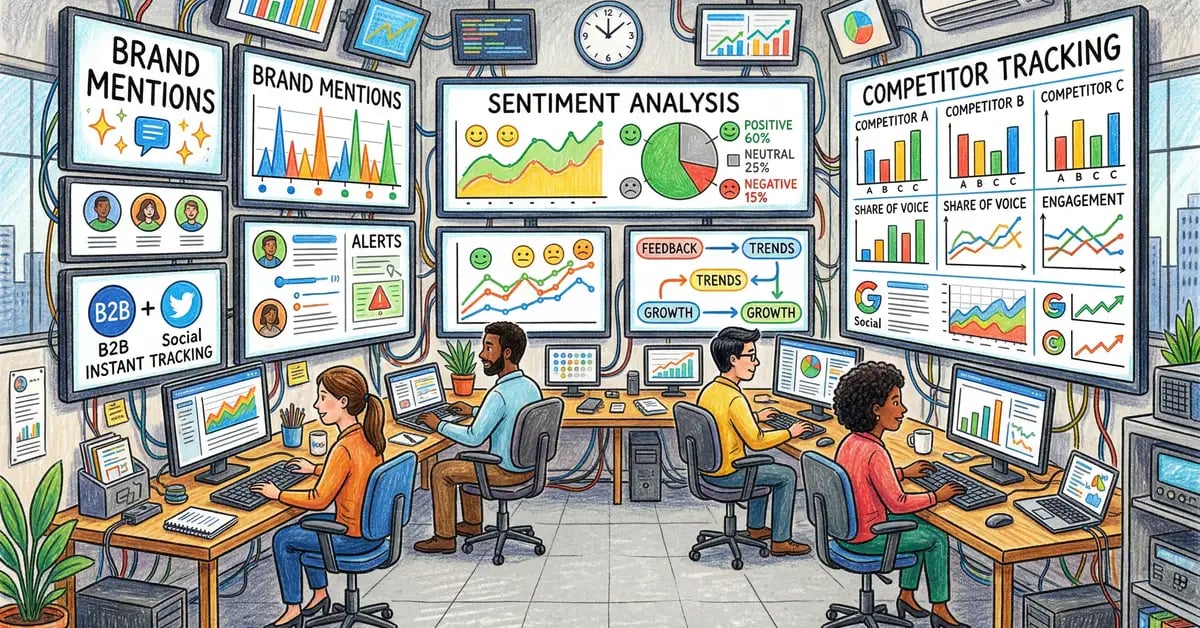
Social media monitoring for B2B companies tracks brand mentions, customer conversations, competitor activity, and industry discussions across social platforms. It enables rapid response, identifies sales opportunities, prevents crises, and delivers 268% ROI over three years. For UK B2B companies, LinkedIn dominates—80% of social leads originate there—with response speeds directly impacting customer retention and revenue.
Key Takeaways
- Social listening market exceeds $9.6 billion and is projected to reach $18.4 billion by 2030
- 73% of consumers will switch to competitors if brands fail to respond on social media
- Expected response time: 30 minutes; actual average: 5 hours—a critical gap driving customer churn
- LinkedIn generates 80% of B2B social leads with 192% ROI for paid and 229% for organic efforts
- AI-powered monitoring identifies crises, forecasts trends, and improves customer need understanding by 25%
- HubSpot's native tools integrate directly with CRM but lack broader web monitoring and advanced sentiment analysis
The Business Case for Social Monitoring Has Crystallised
Social media monitoring has transformed from brand protection into revenue infrastructure. The global social listening market now exceeds $9.6 billion and is projected to nearly double to $18.4 billion by 2030. For B2B marketing directors and RevOps leaders, Forrester research demonstrates that social monitoring investments deliver 268% ROI over three years with payback in under six months.
The stakes extend beyond efficiency gains. Research indicates that 73% of consumers will switch to competitors if a brand fails to respond on social media, whilst proactive companies see 20-40% revenue increases. With over 18.7 million businesses now using social listening—a 26% increase from 2022—those without monitoring capabilities fall behind an industry that increasingly treats social intelligence as foundational infrastructure.
Response Time Expectations Have Compressed Dramatically
Today's B2B buyers expect near-immediate acknowledgement. Over one-third of UK consumers expect responses within 30 minutes, whilst 73-76% globally expect resolution within 24 hours. The gap between expectations and reality remains stark: whilst customers expect sub-hour responses, the average brand response time sits at approximately 5 hours.
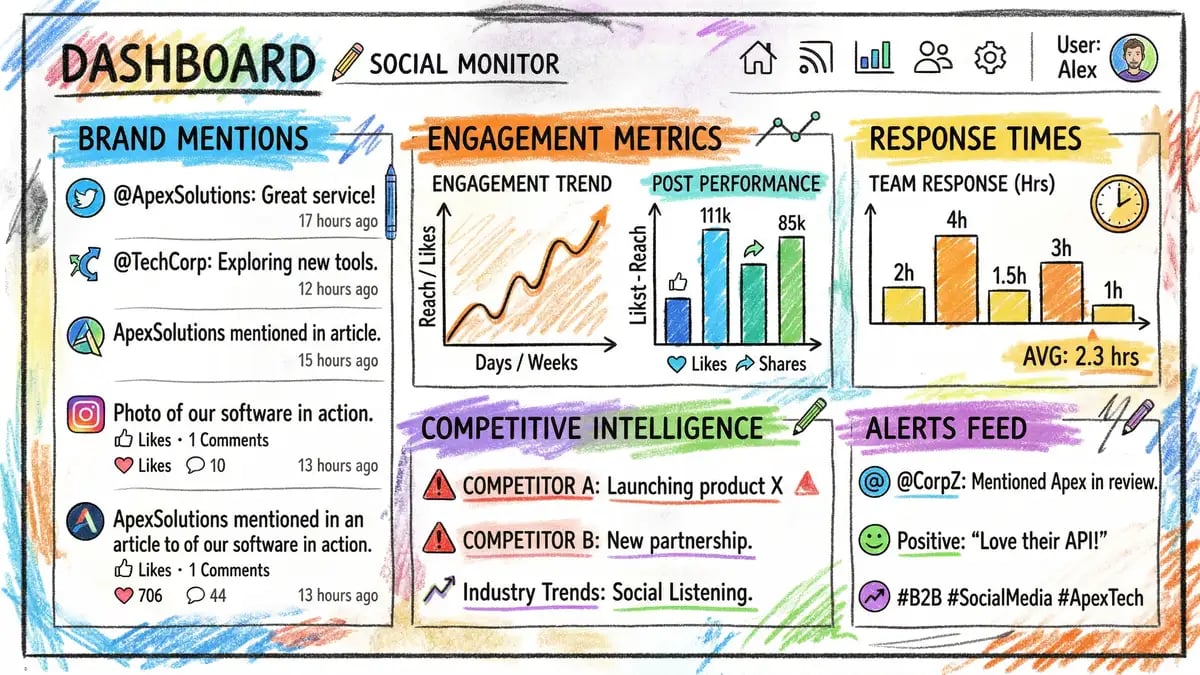
This disconnect carries measurable consequences. Research indicates that 52% of customers will stop purchasing from companies with slow response times, whilst 88% are less likely to buy from brands that leave complaints unanswered entirely. Twitter/X users demonstrate particularly acute expectations, with 72% anticipating responses within one hour when posting complaints.
Top-performing customer service accounts respond to half their incoming messages in four hours or less, maintaining median response times of roughly one hour and seven minutes on Twitter/X. For B2B companies, the implications extend beyond customer service into relationship dynamics. 82% of B2B buyers review LinkedIn profiles before accepting meetings, and 84% of C-level executives are influenced by social media when making purchase decisions. Slow or absent social engagement signals organisational dysfunction to these high-value prospects.
LinkedIn Dominates B2B Social Monitoring Priorities
Platform prioritisation for B2B social monitoring has clarified considerably, with LinkedIn emerging as the undisputed leader. 97% of B2B marketers now use LinkedIn for content marketing, with 44% identifying it as their single most important platform. The numbers justify this focus: 80% of B2B leads from social media originate on LinkedIn, and the platform delivers 192% ROI for paid social and 229% for organic efforts over three years.
LinkedIn engagement metrics have strengthened meaningfully, with 44% year-over-year increases in engagement rates. The platform's 1.2 billion members generate over 2 billion monthly interactions with company pages, and users who post weekly see 5.6× more followers than monthly posters.
Twitter/X presents a more complex picture. The platform has lost an estimated 32 million users and seen advertising revenue decline by up to 60%, prompting over 100 major advertisers to pause spending. However, Twitter/X retains genuine customer service utility—median response times of just over one hour significantly outpace other platforms, and 83% of users report having issues addressed effectively through the channel.
Platform Comparison for B2B Monitoring
LinkedIn: 80% of B2B social leads. Primary value: Decision-maker access and professional intent signalling.
Twitter/X: Real-time monitoring with fastest response times (1 hour 7 minutes median).
Facebook: 44% B2B usage. Messenger provides customer service with 88% open rates.
How HubSpot's Monitoring Compares to Dedicated Platforms
HubSpot's social media tools within Marketing Hub provide integrated management tied directly to CRM data—a genuine differentiator for companies already invested in the HubSpot ecosystem. The platform enables publishing across LinkedIn, Facebook, Instagram, Twitter/X, and YouTube with AI-powered post generation, whilst the social inbox consolidates interactions across connected platforms with keyword monitoring and competitor tracking capabilities.
The HubSpot Advantage: Native CRM Integration
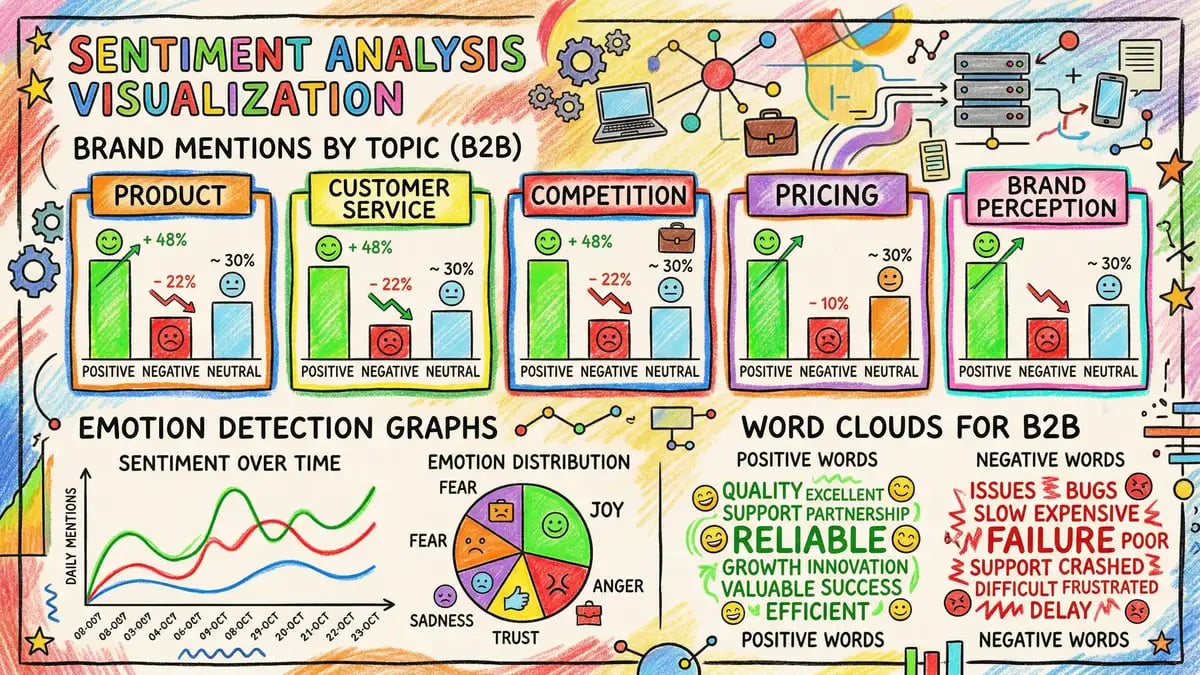
Social interactions automatically link to contact records, enabling attribution of leads and customers to social activities. Sales teams can receive alerts when prospects mention specific keywords, and marketing can demonstrate ROI tied to actual revenue rather than engagement proxies. Recent Breeze AI additions include sentiment insights, AI-generated replies, and brand voice consistency features.
HubSpot's Monitoring Limitations
Whilst HubSpot excels at CRM integration, it has notable gaps. Keyword monitoring is limited to Twitter/X for external feeds. Competitor tracking covers only three competitors maximum. Sentiment analysis lacks the sophistication of dedicated platforms, and there is no broad web monitoring, forum coverage, or blog mention tracking. HubSpot functions as social media management rather than enterprise-grade social listening.
For companies requiring broad web monitoring, forum coverage, or advanced analytics, HubSpot works best as a CRM integration layer. The market offers several complementary options for HubSpot-centric organisations:
Oktopost: B2B-specific social listening with native HubSpot integration, employee advocacy, and lead attribution—purpose-built for B2B sales alignment.
Sprout Social: Comprehensive listening and analytics as a G2 Leader, with HubSpot integration for companies needing robust monitoring beyond HubSpot's native capabilities.
Brand24: Cost-effective AI-powered monitoring with 100+ language support at approximately £79/month, suitable for supplementing HubSpot's limited listening capabilities.
Hootsuite/Talkwalker: Acquired in April 2024, now providing enterprise-grade listening covering 150+ million websites across 187 languages.
AI Transforms Monitoring from Reactive to Predictive
The integration of artificial intelligence has fundamentally expanded what social monitoring can accomplish. Over 80% of social media content recommendations now rely on AI, and companies using AI-powered social listening report 25% improvement in understanding customer needs alongside equivalent boosts to campaign ROI through better targeting.
Current AI capabilities extend well beyond basic sentiment scoring. Advanced platforms now offer aspect-based sentiment analysis that evaluates opinions about specific product features separately, emotion detection identifying states beyond positive/negative/neutral (happiness, frustration, excitement, sarcasm), and visual listening using image recognition to identify brand logos and products in photos and videos. The sentiment analysis market alone is projected to reach $6.12 billion by 2028.
Three AI-Powered Use Cases Transforming Social Monitoring
Crisis Detection: AI identifies crisis indicators before situations escalate by detecting unusual spike patterns in negative sentiment, volume surges, and coordinated campaign signals. This enables proactive intervention rather than reactive damage control.
Trend Forecasting: Predictive algorithms forecast emerging trends based on conversation patterns, enabling proactive content strategy rather than reactive response. Companies can position content before trends reach mainstream saturation.
Prospect Identification: AI filters high-intent signals within social conversations, identifying prospects showing explicit buying signals within natural discussions. This enables sales teams to prioritise engagement on genuine opportunities rather than generic mentions.
Implementing Social Monitoring: Strategic Priorities for UK B2B Companies
Implementation success depends on aligning monitoring tools with strategic priorities. For most UK B2B companies, a tiered approach works best: begin with HubSpot's native tools for CRM-integrated customer service and lead identification, particularly if LinkedIn engagement is the primary focus. Layer dedicated listening platforms only if your strategy requires broad web monitoring, advanced sentiment analysis, or multi-competitor tracking.
Set response time targets below market averages. If competitors respond in 5 hours, target 2 hours for customer complaints and 30 minutes for direct mentions. Invest in team training on tone and context—response speed without quality engagement delivers no competitive advantage. Assign ownership: designate specific team members for each platform rather than hoping monitoring alerts prompt action.
Most critically, integrate social monitoring into your CRM and pipeline. A mention that doesn't reach sales is a missed opportunity. Social signals indicating buying intent should trigger immediate outreach workflows. At Whitehat, we integrate social monitoring as a core component of the "Delight" phase, ensuring existing customers receive rapid, contextually relevant responses that strengthen retention and generate advocacy.
The Verdict: Why B2B Companies Can No Longer Ignore Social Monitoring
The evidence is overwhelming: social monitoring is not a marketing nice-to-have but rather revenue infrastructure. With 73% of consumers switching to competitors following poor social response, and 268% ROI documented over three years, companies without monitoring capabilities are directly hemorrhaging revenue and market share.
For UK B2B companies, the implementation path is clear: begin with LinkedIn as your primary monitoring platform, implement response protocols well below the current 5-hour market average, and integrate monitoring directly with your CRM and sales workflows. Whether you choose HubSpot's native tools or layer dedicated listening platforms, the strategic imperative is identical: social conversations are customer and prospect conversations, and ignoring them carries measurable business consequences.
The question is no longer whether to monitor social media, but rather how systematically and at what speed. The companies answering fastest will capture the competitive advantage.
About the Author
Clwyd Probert is the founder of Whitehat, a London-based SEO and inbound marketing agency and HubSpot Diamond Partner. With over 15 years of experience in digital marketing strategy, he helps B2B companies across the UK build sustainable organic growth through data-driven approaches.