
Social publishing amplifies inbound marketing's Attract phase by distributing valuable content where your ideal customers already spend time. For B2B companies, LinkedIn delivers 80% of social leads whilst consistent posting generates 2× engagement. Here's how Whitehat helps you build a social publishing strategy that turns strangers into qualified prospects.
Key Takeaways
- LinkedIn dominates B2B social publishing, delivering 80% of B2B social leads and 2× engagement lift for consistent posting
- HubSpot's integrated social tools eliminate fragmented workflows, connecting social activity directly to pipeline and revenue
- Thought leadership content (educational, research-driven) outperforms promotional material by 64% for B2B buyer preference
- 38% of B2B marketers now use AI tools like Breeze to maintain consistency without proportionally expanding team size
- Attribution tracking from social engagement through closed deals proves ROI—HubSpot users report 505% ROI over three years
Why social publishing is the engine of inbound marketing's Attract phase
Social publishing sits at the heart of the Attract phase within HubSpot's proven inbound methodology. Whilst traditional outbound marketing interrupts potential customers with unwanted messages, social publishing positions your expertise where prospects are already looking for solutions. The methodology follows a clear path: Attract strangers with valuable content, Convert them into leads through compelling offers, Close those leads into customers with personalised engagement, and Delight customers to become promoters.
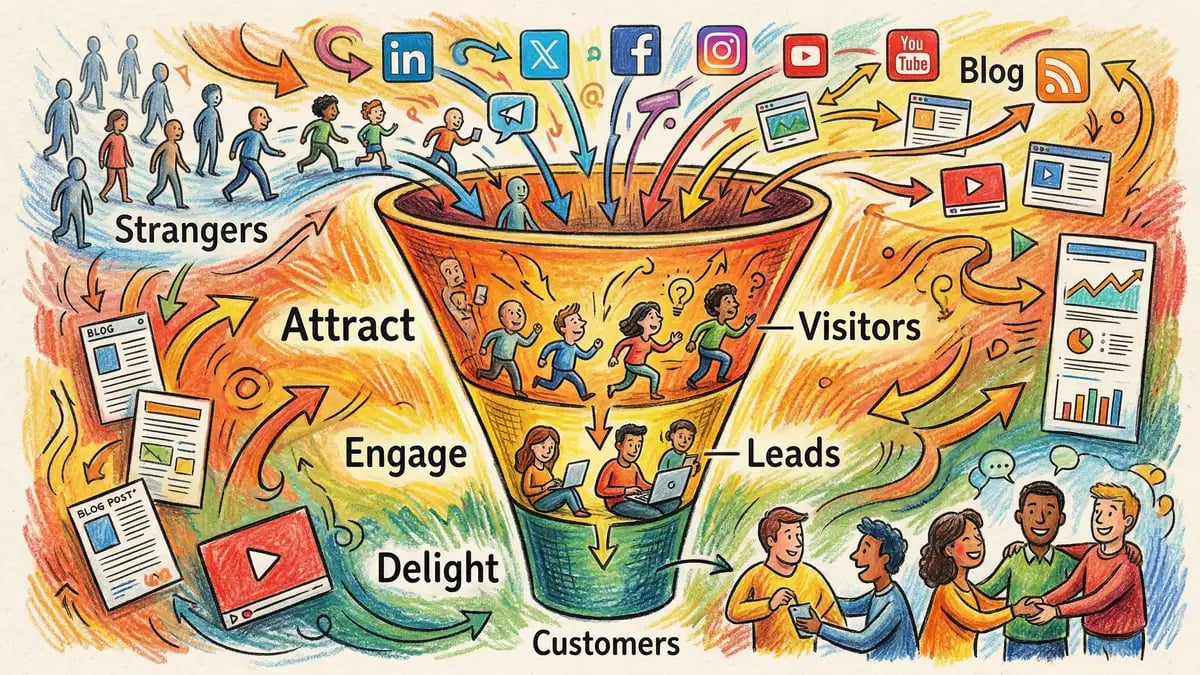
The effectiveness gap between these approaches is dramatic. Inbound marketing is 10× more effective for lead conversion than outbound methods, according to HubSpot's 2024 State of Marketing report. This isn't surprising—when you publish content that educates, informs, and solves real problems, you attract prospects who are actively researching solutions rather than interrupting them during unrelated tasks.
Social publishing functions as your content distribution mechanism, not merely promotion. You're not shouting about products on social media—you're sharing insights, research, how-to guides, and industry perspectives that establish your organisation as a trusted authority. Understanding the complete inbound methodology reveals why this content-first approach works: it aligns with how modern B2B buyers actually make purchasing decisions.
As a HubSpot Diamond Solutions Partner, Whitehat integrates social publishing directly into your inbound strategy, ensuring every post serves a strategic purpose within your broader marketing funnel. This integrated approach means your social content doesn't exist in isolation—it connects to your blog, landing pages, and CRM, creating a complete view of how social engagement drives pipeline.
90% of B2B marketers use social media as their number one content distribution channel
According to Content Marketing Institute's 2024 research. Your competitors are already there—the question is whether you're doing it strategically.
Which platforms deliver the best B2B social publishing results in 2026?
Not all social platforms deliver equal value for B2B marketing. The data is unambiguous: LinkedIn dominates B2B social lead generation, delivering 80% of B2B social media leads and earning recognition from 84% of B2B marketers as the platform delivering the best value among organic social channels.
LinkedIn: The B2B publishing powerhouse
LinkedIn's effectiveness for B2B companies stems from its professional context. Decision-makers visit LinkedIn specifically to research industry trends, evaluate potential partners, and discover solutions to business challenges. When you publish thought leadership content on LinkedIn, you're reaching buyers in a research mindset—exactly when they're most receptive to your expertise.
The platform's algorithm favours content that generates meaningful discussion, not just passive engagement. Educational posts, industry analysis, and original research perform exceptionally well. Companies posting at least weekly on LinkedIn see 2× engagement lift compared to sporadic posting, according to LinkedIn's own research. Consistency signals authority and keeps your brand visible throughout the extended B2B buying cycle.
Platform selection criteria
Choose social platforms based on where your specific buyer personas spend time:
- LinkedIn: Essential for all B2B companies. Executives, marketing directors, and RevOps managers are active here daily.
- X (formerly Twitter): Valuable for real-time industry commentary and thought leadership. Best for tech-savvy audiences.
- YouTube: Long-form educational content performs exceptionally. Product demonstrations and how-to guides build authority.
- Facebook: Still relevant for B2C and some local B2B services, though declining for enterprise B2B.
- Instagram: Growing for B2B brand building through behind-the-scenes content and company culture.
Whitehat's approach focuses resources where they'll deliver measurable ROI. For most B2B clients, this means building a comprehensive LinkedIn strategy first, then selectively expanding to complementary platforms based on persona research and content performance data.
Jay Baer, President of Convince & Convert:
"Content is fire, social media is gasoline."
How HubSpot's social publishing tools transform your Attract strategy
HubSpot's integrated social publishing tools eliminate the fragmented workflow that plagues most marketing teams. Rather than juggling separate scheduling platforms, analytics dashboards, and CRM systems, HubSpot connects social activity directly to your lead generation and revenue goals. This integration is where 72% of B2B marketers who use social publishing tools find their competitive advantage.
Multi-platform scheduling and publishing
HubSpot's social tool allows you to compose, schedule, and publish content across LinkedIn, Facebook, Instagram, and X (formerly Twitter) from a single interface. The bulk scheduling feature supports CSV uploads, enabling you to plan entire campaigns weeks in advance. This centralised approach saves hours each week whilst ensuring consistent brand voice across platforms.
Breeze AI Social Media Agent: 2025-2026's game-changer
HubSpot's newest feature, the Breeze AI Social Media Agent, represents the next evolution in social publishing efficiency. This AI-powered tool analyses your best-performing content, understands your brand voice, and generates post recommendations tailored to your audience. Whilst human oversight remains essential, the AI dramatically accelerates content creation for teams stretched thin across multiple priorities.
Key Breeze AI capabilities include:
- Optimal posting time suggestions based on when your audience is most active
- Auto-share functionality that publishes new blog posts to social channels automatically
- Content variation generation for testing different messaging approaches
- Brand voice consistency checking to ensure all posts align with your guidelines
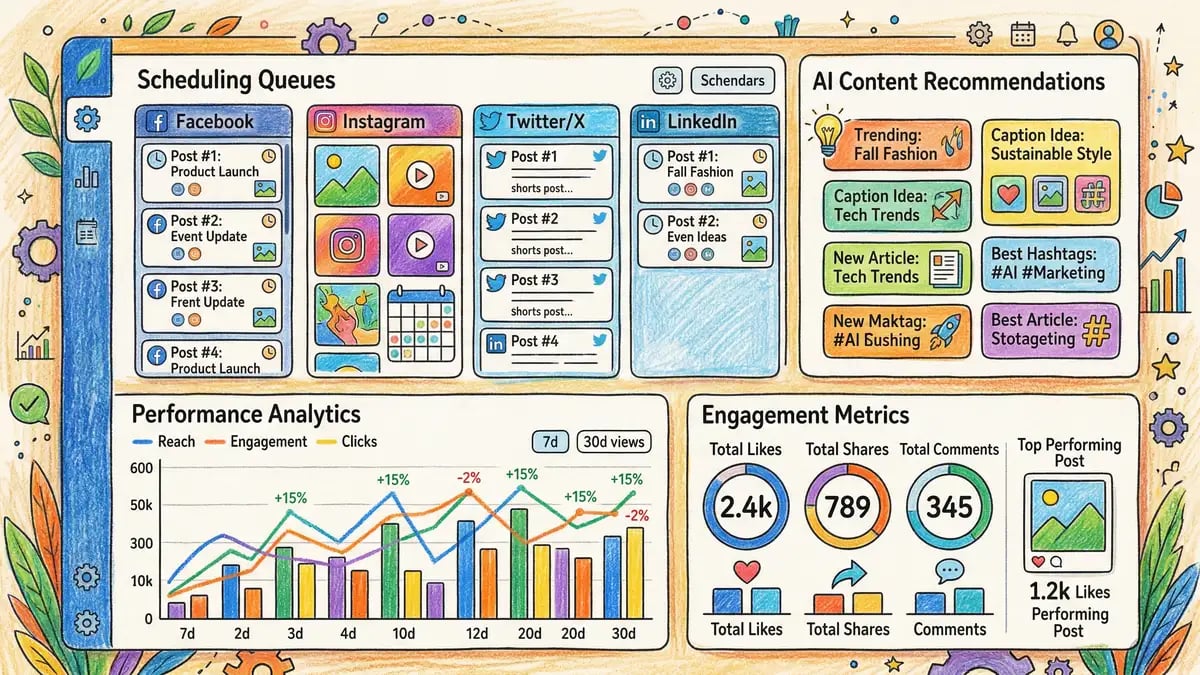
The adoption of AI tools in B2B marketing is accelerating rapidly—38% of B2B marketers now use AI-powered social media tools, according to the Content Marketing Institute's 2025 research. This isn't about replacing human creativity; it's about amplifying your team's capacity to maintain consistent social presence without burning out.
Social inbox for engagement management
Publishing content is only half the equation—responding to comments, messages, and mentions completes the engagement cycle. HubSpot's social inbox consolidates all interactions from connected platforms into a single stream, ensuring no conversation falls through the cracks. Your team can assign conversations, set reminders, and track response times, turning social engagement into a systematic process.
Campaign attribution and ROI tracking
Here's where HubSpot's social tools genuinely differentiate from standalone platforms: every social interaction connects to your CRM contacts, enabling true attribution tracking from social engagement through to closed deals. When someone clicks your LinkedIn post, visits your website, downloads a guide, and eventually becomes a customer, HubSpot tracks the complete journey.
Campaign association links specific social posts to broader marketing initiatives, showing exactly which social content contributed to pipeline and revenue. This attribution clarity is what HubSpot users report when achieving 505% ROI over three years, according to HubSpot's documented customer outcomes.
As a HubSpot Diamond Solutions Partner running the world's largest HubSpot User Group, Whitehat helps clients unlock these advanced features through our comprehensive HubSpot onboarding service. We configure social publishing workflows, establish tracking parameters, and train your team to maximise the platform's capabilities—accelerating your time-to-value significantly.
Creating content that attracts and converts through social channels
Social publishing success hinges on content quality, not volume. The data is clear: 64% of B2B buyers favour thought leadership content over promotional material when evaluating vendors, according to LinkedIn and Edelman's research. Your social content must educate, inform, and demonstrate expertise—not shout about product features.
Buyer persona-driven content creation
Generic content attracts generic attention. Effective social publishing targets specific buyer personas with content addressing their unique challenges. A Marketing Director at a B2B SaaS company faces different pressures than a RevOps Manager at a professional services firm—your content should reflect this specificity.
Consider what keeps your target persona awake at night. For a Marketing Director struggling with HubSpot ROI, content about "5 HubSpot Attribution Reports That Prove Marketing Value" resonates far more than "10 Marketing Tips for Success." The former speaks directly to their pain point; the latter could apply to anyone.
Content types that perform
Different content formats serve different purposes within your Attract strategy:
- Industry analysis and commentary: Establishes thought leadership and demonstrates you understand market dynamics
- Original research and statistics: Highly shareable and positions you as a primary source of industry insights
- How-to guides and tutorials: Provides immediate value whilst showcasing your methodology
- Case studies and customer success stories: Offers social proof whilst remaining educational
- Behind-the-scenes content: Humanises your brand and builds authentic connections
Remember that 46% of B2B buyers use social media at the beginning of their buying journey, according to Gartner's 2024 research. They're not ready to buy—they're researching, learning, and building their shortlist of credible providers. Your content should serve this education-first phase rather than pushing for premature conversion.
Employee advocacy and social selling
Authentic voices carry more weight than corporate accounts. Employee advocacy—encouraging team members to share company content from their personal profiles—extends your reach exponentially. A post shared by ten employees reaches ten different networks, multiplying visibility without additional spend.
HubSpot's social tools make employee advocacy systematic rather than ad-hoc. You can suggest posts for team members to share, track who's most active, and measure the collective impact of your organisation's social presence. This transforms social publishing from a marketing-only initiative into an organisation-wide capability.
Ann Handley, Chief Content Officer, MarketingProfs:
"Good content isn't about good storytelling. It's about telling a true story well."
Whitehat's inbound marketing services include content strategy development specifically designed for social distribution. We help you identify the topics that will resonate with your personas, create compelling content that balances education with subtle positioning, and establish workflows that maintain consistent publishing without overwhelming your team.
Measuring social publishing ROI within your inbound funnel
Social publishing's value isn't measured in likes and shares—it's measured in leads, pipeline, and revenue. HubSpot's integrated approach enables attribution models that track social activity through your complete funnel, connecting publishing efforts directly to business outcomes. This measurement capability is critical, as 66% of B2B marketers now see ROI from social media marketing, a dramatic increase driven by better attribution tools.
Attribution models for social → lead → customer tracking
HubSpot supports multiple attribution models to understand social's contribution:
- First-touch attribution: Credits the initial interaction that brought someone into your system—often a social post
- Last-touch attribution: Credits the final interaction before conversion—useful for understanding what closes deals
- Multi-touch attribution: Distributes credit across all touchpoints—the most accurate reflection of B2B buying journeys
For most B2B companies, multi-touch attribution provides the clearest picture. A prospect might discover you through a LinkedIn post (first touch), return via organic search (middle touch), and convert after receiving an email campaign (last touch). All three touchpoints contributed to the conversion—your attribution model should reflect this reality.
HubSpot reporting capabilities
HubSpot's social analytics dashboard answers the questions executives actually care about:
- Which social posts generated the most leads?
- What's the average deal value from socially-sourced leads?
- How does social engagement correlate with deal velocity?
- Which campaigns drove the highest ROI across all channels including social?
These insights enable data-driven optimisation. If LinkedIn posts about HubSpot integration consistently generate high-quality leads whilst posts about general marketing trends don't, you adjust your content mix accordingly. This feedback loop transforms social publishing from creative guesswork into strategic science.
Key metrics beyond vanity engagement
Track metrics that connect to revenue, not just activity:
| Metric | Why It Matters |
|---|---|
| Click-through rate | Measures how many people take action beyond passive scrolling |
| Lead conversion rate | Percentage of social visitors who complete lead forms |
| Marketing-qualified leads | Social leads meeting your qualification criteria |
| Sales-accepted leads | MQLs that sales agrees to pursue |
| Pipeline value | Total potential revenue in deals influenced by social |
Whitehat configures HubSpot reporting dashboards tailored to your specific business model and sales cycle. We identify which metrics matter most for your organisation, establish baseline benchmarks, and set up automated reporting that keeps stakeholders informed without manual data compilation. Our approach through HubSpot CRM integration ensures social data flows seamlessly into your broader marketing analytics.
Building your social publishing workflow for consistent results
Consistency beats perfection in social publishing. A steady stream of valuable content outperforms sporadic bursts of activity, no matter how brilliant individual posts might be. The challenge most marketing teams face isn't knowing what to publish—it's establishing a sustainable workflow that maintains momentum through busy periods, team changes, and competing priorities.
Posting frequency benchmarks
Research provides clear guidance on optimal posting frequency. Companies posting at least weekly on LinkedIn see 2× engagement lift compared to sporadic posting. This doesn't mean you should spam your audience—quality remains paramount—but regular presence keeps your brand visible throughout the extended B2B consideration cycle.
Recommended starting frequency by platform:
- LinkedIn: 2-5 posts per week for optimal results without overwhelming followers
- X (Twitter): 1-3 posts daily given the platform's faster content velocity
- Facebook: 3-5 posts per week for business pages
- Instagram: 3-5 posts per week plus Stories for behind-the-scenes content
These benchmarks represent starting points, not rigid rules. Monitor your analytics to identify what frequency your specific audience responds to best, then adjust accordingly. Some audiences prefer daily insights whilst others find this excessive—let data guide your decisions.
Content calendar planning
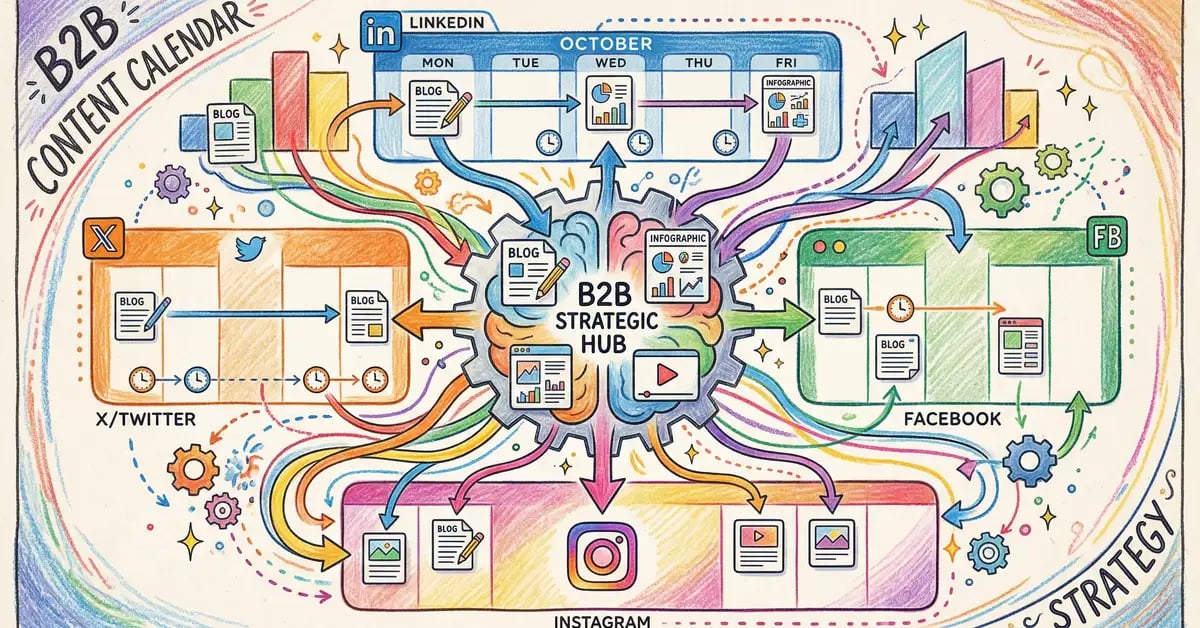
A content calendar transforms social publishing from reactive scrambling into strategic execution. Plan content at least two weeks in advance, ideally four weeks for complex campaigns. This forward planning enables you to:
- Align social content with blog publication schedules and product launches
- Ensure balanced content mix across educational, promotional, and engagement posts
- Identify and fill gaps before they become missed publishing opportunities
- Coordinate with team members responsible for different content types
HubSpot's social calendar view displays your planned posts across all platforms in a single interface, making gaps and overlaps immediately visible. This bird's-eye perspective prevents common mistakes like publishing three product announcements in a row or going silent for two weeks unintentionally.
Repurposing blog content for social
Your blog is a goldmine of social content waiting to be unlocked. A single 2,000-word blog post can generate:
- 5-7 LinkedIn posts highlighting different insights
- 10-15 tweets pulling quotable statistics and key points
- 2-3 Instagram carousel posts visualising main concepts
- 1 video summarising the blog's core message
HubSpot's auto-share feature publishes new blog posts to your social channels automatically, though we recommend customising the message rather than using auto-generated text. The best approach combines automated distribution with strategic amplification—schedule additional posts over the following weeks that highlight different aspects of the same blog content.
AI tools for workflow efficiency
The statistic bears repeating: 38% of B2B marketers now use AI-powered social media tools. This adoption reflects AI's genuine utility in maintaining publishing consistency without proportionally expanding team size. HubSpot's Breeze Social Media Agent exemplifies how AI augments human creativity rather than replacing it.
Use AI for:
- Generating post variations for A/B testing
- Suggesting optimal posting times based on historical engagement
- Identifying trending topics relevant to your industry
- Drafting initial post copy for human review and refinement
The key is maintaining editorial oversight. AI accelerates content creation; humans ensure brand voice, strategic alignment, and quality standards. This division of labour allows your team to publish consistently without sacrificing the authenticity that makes social content effective.
Getting started with Whitehat: Our HubSpot onboarding service includes social publishing workflow configuration as standard. We help you establish sustainable content calendars, configure automation where appropriate, train your team on HubSpot's social tools, and set up reporting dashboards that track what matters. This foundation accelerates results whilst preventing the common pitfall of starting enthusiastically only to lose momentum within weeks.
Frequently asked questions about social publishing and inbound marketing
How often should B2B companies post on social media?
LinkedIn research shows companies posting at least weekly see 2× engagement lift compared to sporadic posting. For optimal results, aim for 2-5 posts per week on LinkedIn, focusing on quality thought leadership content over high-frequency promotional posts. Consistency matters more than volume—establish a sustainable cadence your team can maintain long-term.
Which social platform generates the most B2B leads?
LinkedIn dominates B2B social lead generation, delivering 80% of B2B social media leads according to Oktopost's 2024 research. Additionally, 84% of B2B marketers report it delivers the best value among organic social platforms. This dominance stems from LinkedIn's professional context—decision-makers visit specifically to research business solutions and evaluate potential partners.
Can I schedule social posts directly in HubSpot?
Yes. HubSpot's social publishing tools allow bulk scheduling across LinkedIn, Facebook, Instagram, and X (Twitter) from a single interface. Features include CSV upload for campaign planning, optimal time suggestions based on audience activity, and auto-sharing when new blog posts publish. This eliminates the need for separate scheduling platforms whilst ensuring all social activity connects to your CRM.
How do I measure social media ROI in HubSpot?
HubSpot connects social interactions to CRM contacts, enabling attribution tracking from social engagement through to closed deals. Campaign association links specific posts to marketing initiatives for accurate ROI measurement. The platform supports first-touch, last-touch, and multi-touch attribution models, showing precisely which social activity contributed to pipeline and revenue.
What type of content performs best for B2B social publishing?
Thought leadership content significantly outperforms promotional material—64% of B2B buyers prefer educational content when evaluating vendors, according to LinkedIn and Edelman research. Focus on industry insights, original research, how-to guides, and expert perspectives. Educational content establishes authority whilst attracting prospects in the research phase before they're ready for sales conversations.
Should B2B companies use AI for social media management?
AI adoption is accelerating—38% of B2B marketers now use AI-powered social media tools, according to Content Marketing Institute 2025 research. HubSpot's Breeze Social Media Agent generates content recommendations, suggests optimal posting times, and drafts posts for human review. The key is using AI to augment human creativity rather than replace editorial oversight and strategic thinking.
How does social publishing connect to inbound lead generation?
Social publishing is the distribution mechanism for inbound marketing's Attract phase. It drives traffic to blog content and landing pages where visitors convert to leads through forms and CTAs. HubSpot's integration tracks this complete journey—from social post click through website behaviour to lead conversion and eventual customer status—providing full-funnel visibility that proves social's contribution to revenue.
Transform your social publishing into a strategic inbound asset
Social publishing stops being random acts of marketing when you integrate it systematically into your inbound methodology. The data proves the opportunity: LinkedIn delivers 80% of B2B social leads, consistent publishing generates 2× engagement, and companies with strategic approaches see measurable ROI. The question isn't whether social publishing works—it's whether you're approaching it strategically or tactically.
As a HubSpot Diamond Solutions Partner running the world's largest HubSpot User Group, Whitehat brings both platform expertise and practical experience helping B2B companies unlock social publishing's full potential. We don't just teach you the tools—we configure your HubSpot instance, establish workflows your team will actually use, and demonstrate how social activity connects to the pipeline metrics your executives care about.
Whether you're just beginning your inbound journey or optimising existing efforts, our team can help you build a social publishing strategy that attracts the right prospects, demonstrates clear ROI, and integrates seamlessly with your broader marketing operations.
Ready to transform your social publishing strategy?
Speak with our HubSpot experts about building an integrated inbound approach that delivers measurable results.
Book Your Free ConsultationAbout Whitehat SEO
Whitehat SEO is a HubSpot Diamond Solutions Partner based in London, specialising in inbound marketing, SEO, and marketing automation for B2B companies. Since 2011, we've helped hundreds of organisations attract, convert, and delight customers through integrated inbound methodology and HubSpot expertise.
We run the world's largest HubSpot User Group and maintain deep platform expertise across CRM, marketing automation, sales tools, and customer service solutions.
Continue learning about inbound marketing
- → Inbound Methodology: Complete Step-by-Step Guide
Master the full inbound framework from attract to delight
- → The Inbound Marketing Blueprint for B2B Success
Strategic planning framework for inbound programmes
- → Developing an Effective Social Media Marketing Strategy
Build comprehensive social strategies aligned with business goals
- → HubSpot Onboarding Services from Diamond Partners
Expert implementation and training for maximum HubSpot ROI