
Last Updated: January 2026
How to Build a Standardised Sales Process That Actually Works
A standardised sales process is a repeatable, documented framework that guides your sales team through each stage from prospecting to close. According to Salesforce's 2024 State of Sales report, B2B companies with a defined sales process see 19-32% higher win rates than those without one. Whitehat's HubSpot implementations build this foundation into your CRM from day one.
Why B2B Sales Teams Need a Standardised Process in 2025
The 2024-2025 B2B sales landscape reveals a troubling performance gap. According to Hyperbound's 2025 B2B Sales Performance Benchmark Report, up to 70% of sales reps missed quota in 2024, with average quota attainment hovering around just 43%. The average B2B win rate has dropped to 20-21%, down from pre-2021 baselines of 25-30%.
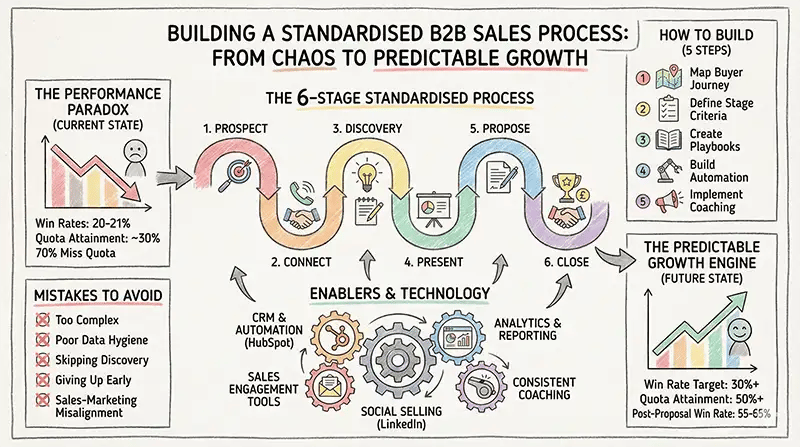
This "performance paradox" shows that while many companies increased overall revenue, individual rep effectiveness continues to decline. The gap between top performers (30%+ win rates) and average performers grows wider each quarter. A standardised sales process addresses this by creating consistency—ensuring every rep follows proven steps rather than improvising.
HubSpot's 2024 analysis found that the average B2B close rate is 29%, with a median deal size of £3,200. Companies using structured CRM workflows through platforms like HubSpot Sales Hub report significantly higher conversion rates because every interaction is tracked, timed, and optimised.
The 6 Stages of an Effective B2B Sales Process
Every B2B sales process follows a predictable journey from initial awareness to closed deal. The most effective sales organisations break this journey into distinct stages with clear entry and exit criteria. Here is the proven six-stage framework that top-performing B2B teams use:
Stage 1: Prospecting and Lead Generation
Prospecting identifies potential buyers who match your ideal customer profile. According to 2024 research, B2B buyers now use an average of 10 different channels during their research phase. Effective prospecting combines inbound leads from marketing with targeted outbound activity. Track all prospects in your CRM immediately—HubSpot CRM's free tier captures contact details, company information, and source attribution automatically.
Stage 2: Connect and Qualify
The connect stage establishes first meaningful contact with prospects. Data shows that only 2% of cold calls result in appointments, but response within 60 seconds of an inbound enquiry dramatically increases conversion rates. Qualification determines whether the prospect has budget, authority, need, and timeline (BANT). Use lead scoring in HubSpot to automatically prioritise which prospects deserve immediate attention versus nurturing sequences.
Stage 3: Discovery and Needs Analysis
Discovery calls uncover the prospect's specific challenges, goals, and decision-making process. According to Gong's research, problem-focused sellers are 30% more effective than solution-focused sellers—yet only 13% of reps take this approach. Ask about business impact: "What happens if this problem isn't solved in the next 6 months?" Document every discovery insight in your CRM deal record for team visibility.
Stage 4: Presentation and Demonstration
Presentations should directly address the challenges uncovered during discovery. Research shows that buyers spend only 17% of their time meeting with suppliers, so every interaction must deliver value. Customise demonstrations to the prospect's specific use case rather than following a generic script. Record demos using tools like Vidyard integrated with HubSpot to track engagement and share with decision-makers who weren't present.
Stage 5: Proposal and Negotiation
Proposals formalise your solution and pricing. According to Norwest's 2024 Sales Benchmark Report, post-proposal win rates range from 31-50% for companies with structured proposal processes. Use templates in HubSpot to ensure consistency while allowing customisation. Track when proposals are opened and which sections receive attention—this intelligence informs follow-up conversations and negotiation strategy.
Stage 6: Close and Handoff
Closing converts proposals into signed contracts. The data on follow-up persistence is compelling: 80% of sales are made on the 5th to 12th contact, yet 48% of salespeople give up after just one follow-up attempt. Create automated task sequences in HubSpot that ensure consistent follow-up cadence. Upon closing, trigger automated handoff workflows to customer success teams with all relevant deal context.
Sales Process Metrics to Track in 2025
A standardised sales process only works if you measure it consistently. According to Martal Group's 2025 B2B Sales KPI analysis, by 2026, 65% of B2B sales organisations will outpace competitors by using data-driven strategies rather than intuition. Here are the essential metrics every B2B sales team should track:
| Metric | 2024-25 Benchmark | Top Performer Target |
|---|---|---|
| Win Rate | 20-21% | 30%+ |
| Close Rate | 29% | 35-40% |
| Quota Attainment | 30% of reps | 50%+ of reps |
| Post-Proposal Win Rate | 31-50% | 55-65% |
| Median Deal Size | £3,200 | £5,000+ |
Whitehat's HubSpot implementations include custom reporting dashboards that track these metrics automatically. Sales managers gain real-time visibility into pipeline health, conversion rates by stage, and individual rep performance—without manual spreadsheet work.
How to Build Your Sales Process Step-by-Step
Creating a standardised sales process requires documenting what currently works, identifying gaps, and building repeatable systems. Salesforce research indicates that sales leaders' top growth strategy for 2025 is improving enablement and training—and that starts with process definition. Follow these steps to build a sales process your team will actually use:
Step 1: Map your current buyer journey. Interview your last 10 closed-won customers about their decision process. What triggered their search? Who was involved? What nearly stopped them from buying? This reveals the stages that matter to your specific buyers, not generic frameworks.
Step 2: Define stage criteria and exit requirements. Each sales stage needs clear criteria for entry and exit. For example, a lead only moves from "Qualified" to "Discovery" after completing a 30-minute call where BANT criteria are confirmed. Document these criteria in your CRM pipeline settings.
Step 3: Create playbooks for each stage. Sales playbooks document exactly what activities, messaging, and materials to use at each stage. According to research, sales coaching delivers £4.53 return for every £1 invested and leads to 19-32% increases in win rates—but only when reps have clear guidance to follow.
Step 4: Build automation and sequences. Automate repetitive tasks so reps focus on selling. HubSpot workflows can automatically create follow-up tasks, send nurture emails, update deal stages based on activities, and alert managers when deals stall. Automation increased sales efficiency by 10-15% according to 2024 studies.
Step 5: Implement consistent coaching rhythms. Weekly pipeline reviews and monthly coaching sessions ensure process adherence. Data shows coaching leads to 21-28% improvement in quota attainment. Use recorded calls from HubSpot for coaching examples rather than relying on rep self-reporting.
Essential Technology for Sales Process Management
Technology enables sales process consistency at scale. According to Salesforce's 2024 State of Sales report, 81% of sales teams now use AI in some capacity, with 70% using AI for real-time selling advice. The right technology stack eliminates manual work and provides the data needed for continuous improvement.
CRM Platform: Your CRM is the foundation of sales process management. HubSpot CRM offers free pipeline management with unlimited users, while paid tiers add automation, sequences, and advanced reporting. The key requirement is that every customer interaction—calls, emails, meetings—is automatically logged without rep input.
Sales Engagement Tools: Email sequences, calling tools, and meeting schedulers reduce friction in the sales process. HubSpot's 2024 data shows that 3-email campaigns generate an average 9% reply rate, and the ideal follow-up cadence is 2 emails for B2B outreach. Sales engagement tools automate this cadence while personalising each touchpoint.
Analytics and Reporting: Real-time dashboards show pipeline health, conversion rates, and forecast accuracy. Companies with RevOps functions report 87% higher win rates and 21% shorter sales cycles according to Ebsta's 2024 B2B Sales Benchmarks. Whitehat builds attribution reporting into every HubSpot implementation so you see exactly which activities drive revenue.
Integrating Social Selling Into Your Process
Social selling has become essential for B2B sales success. Research shows that 75% of B2B buyers say social media influences their purchasing decisions, and 91% conduct decision research on social platforms. Reps who incorporate social selling create 45% more opportunities than those who don't.
The statistics on social selling effectiveness are compelling: social sellers are 51% more likely to hit quota than peers who don't use social channels. LinkedIn remains the primary platform for B2B, with 64% of top sellers using social networks to identify decision-makers. Using common connections increases appointment bookings by 70%.
Integrate social selling activities into your standardised process by adding LinkedIn touchpoints to your sales sequences. HubSpot's social tools connect LinkedIn activity to contact records, giving you complete visibility into how prospects engage with your content and your reps' outreach across channels.
Common Sales Process Mistakes to Avoid
Even well-designed sales processes fail when implementation goes wrong. Based on Whitehat's experience implementing HubSpot Sales Hub for dozens of B2B companies, these are the most common mistakes that undermine sales process effectiveness:
- Making the process too complex. If reps need a manual to understand the stages, they won't follow them. Limit yourself to 5-7 stages maximum with clear, memorable criteria.
- Not enforcing data hygiene. A process only works with accurate data. Require mandatory fields before deals can advance stages, and review data quality weekly.
- Skipping the discovery stage. Research shows 60% of customers say no four times before saying yes—but many reps rush to present solutions before understanding needs.
- Giving up on follow-up too early. With 80% of sales made on the 5th-12th contact and 48% of reps giving up after one attempt, persistence is a competitive advantage.
- Failing to align sales and marketing. B2B buyers consume an average of 3+ pieces of content before contacting sales. Marketing and sales need shared definitions of qualified leads.
Frequently Asked Questions
How long does it take to implement a standardised sales process?
A basic sales process can be defined in 1-2 weeks, but full implementation including CRM configuration, playbook creation, and team training typically takes 6-8 weeks. Whitehat's HubSpot Sales Hub implementations follow a structured 90-day programme that includes process definition, technical setup, and ongoing coaching to ensure adoption.
What is a good win rate for B2B sales in 2025?
The average B2B win rate in 2024-2025 is 20-21%, with top performers achieving 30% or higher. Post-proposal win rates range from 31-50% for companies with structured processes. If your win rate falls below 20%, your sales process likely has gaps in qualification or discovery stages that need addressing.
How many follow-ups should sales reps make before giving up?
Research shows 80% of sales are made on the 5th to 12th contact, yet 48% of salespeople give up after just one follow-up. For B2B email outreach specifically, 2-3 emails generate optimal response rates. Build automated sequences in your CRM to ensure consistent follow-up without relying on rep memory.
Does HubSpot support custom sales processes?
Yes, HubSpot's pipeline management is fully customisable. You can create multiple pipelines for different products or sales motions, define custom deal stages with probability percentages, set required properties for stage advancement, and build automation workflows triggered by stage changes. Whitehat configures HubSpot pipelines to match your specific sales process and reporting requirements.
What is the ROI of sales coaching and training?
Sales coaching delivers measurable returns: research shows an average of £4.53 return for every £1 invested. Companies with structured coaching programmes report 19-32% increases in win rates and 21-28% improvements in quota attainment. The key is consistent coaching rhythms—weekly pipeline reviews and monthly skill development sessions.
How do I get my sales team to follow the process?
Adoption requires three elements: simplicity (processes with fewer than 7 stages have higher compliance), enforcement (CRM validation rules that prevent shortcuts), and incentive alignment (compensation tied to process metrics, not just revenue). Involve top performers in process design so the team sees it as enabling rather than restrictive.
Build Your Sales Process with Whitehat
A standardised sales process is the foundation of predictable B2B revenue growth. With 70% of reps missing quota and average win rates at just 21%, companies that invest in process development gain significant competitive advantage. The combination of clear stages, consistent coaching, and enabling technology separates top performers from the rest.
Whitehat's HubSpot implementations include sales process definition, CRM configuration, automation setup, and team training—everything needed to build a revenue engine that scales. As a HubSpot Diamond Partner, we've helped dozens of B2B companies transform their sales operations. Book a discovery call to discuss your sales process challenges. HubSpot CRM view our pricing
Sources and References
- Hyperbound – 2025 B2B Sales Performance Benchmark Report
- Salesforce – State of Sales, 6th Edition (2024)
- HubSpot – 97 Key Sales Statistics (2024-2025)
- Ebsta x Pavilion – 2024 B2B Sales Benchmarks
- Norwest – 2024 Sales & Marketing Benchmark Report
- Martal Group – Top B2B Sales KPIs for 2025
- Gong – Discovery Call Research (2024)