
HubSpot & Marketing Strategy
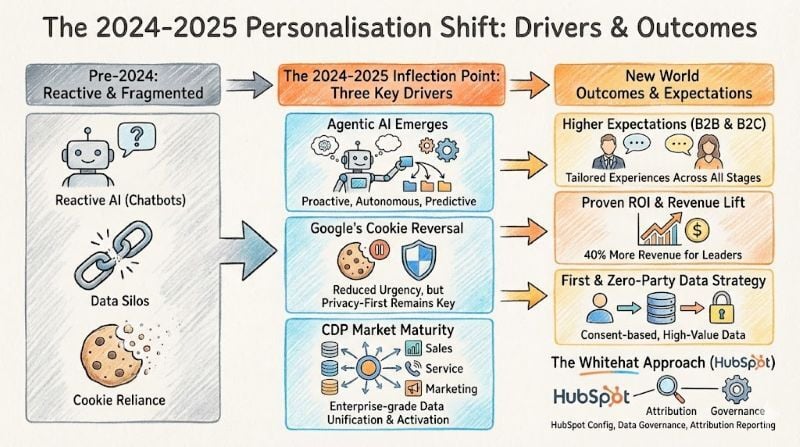
The personalisation landscape has transformed dramatically over the past 18 months. Three significant developments have reshaped how B2B marketers approach contextual marketing: the emergence of agentic AI, Google's unexpected reversal on third-party cookie deprecation, and the maturation of Customer Data Platforms with their first-ever analyst evaluations from Gartner and Forrester.
Personalisation in Contextual Marketing: What the 2024-2025 Research Really Shows
AI-driven personalisation has moved from competitive advantage to baseline expectation, with 92% of businesses now deploying AI-powered tactics. According to McKinsey's January 2025 research, companies excelling at personalisation generate 40% more revenue from these activities than average performers—while 62% of consumers will abandon brands that fail to deliver personalised experiences.
For marketing leaders using HubSpot to drive pipeline growth, understanding this research isn't academic—it directly informs how you configure your marketing automation, structure your content strategy, and allocate budget between brand-building and activation. This guide synthesises the most significant 2024-2025 findings into actionable insights for B2B marketers.
Consumer personalisation expectations have reached an inflection point
The data on consumer personalisation expectations has remained remarkably consistent, but the stakes have intensified significantly. McKinsey's ongoing research confirms that 71% of consumers expect companies to deliver personalised interactions, whilst 76% express frustration when this doesn't happen. What's changed is the consequence: the proportion of consumers who will abandon brands failing to personalise has grown to 62%, up from previous years.
Generational differences reveal important nuances that B2B marketers shouldn't ignore. Nearly half of Gen Z consumers (49%) report they're less likely to purchase from brands providing impersonal experiences, with 27% stating they would stop engaging entirely. As these buyers move into decision-making roles—which is happening now—their expectations are reshaping B2B purchasing behaviour.
Perhaps most relevant for Whitehat's clients: the B2B landscape has converged with B2C expectations. Forrester's December 2024 "State of B2B Personalization" report found that 82% of global B2B marketing decision-makers agree buyers now expect tailored sales and marketing experiences. Remarkably, B2B customers have higher expectations than B2C at every journey stage:
- 68% expect personalisation when getting help (customer service touchpoints)
- 66% expect personalisation when buying (sales conversations, proposals)
- 59% expect personalisation during research (content, website experience)
- 57% expect personalisation in discovery (initial awareness touchpoints)
However, only 25% of B2B customers feel their personalisation expectations are being met—representing a significant opportunity gap for companies who execute well. Investment patterns reflect this urgency: marketers now allocate approximately 40% of their budgets to personalisation, nearly double the 22% reported in 2023. For organisations using HubSpot CRM to manage customer relationships, this represents the core business case for proper platform configuration and data hygiene.
The ROI from personalisation is now well-documented
The business case for personalisation has moved beyond theoretical to empirically validated. McKinsey's research demonstrates that companies excelling at personalisation generate 40% more revenue from these activities than average performers. The specific financial impacts documented across multiple studies include:
| Impact Area | Improvement |
|---|---|
| Revenue lift | 5-15% (up to 25% for strong executors) |
| Marketing ROI improvement | 10-30% |
| Customer acquisition cost reduction | Up to 50% |
| ROI on marketing spend | 5-8x for well-executed programmes |
Adobe's 2024 Personalisation Report, surveying 1,770 global decision-makers, found that 68% reported personalisation initiatives exceeded revenue targets. The Twilio State of Customer Engagement Report from April 2024 revealed that consumers spend 54% more on brands that personalise experiences effectively.
Channel-specific performance data validates granular investments—and these benchmarks directly inform how Whitehat configures inbound marketing campaigns for clients:
- Personalised CTAs convert 202% better than default versions (HubSpot analysis of 330,000+ CTAs)
- Personalised emails deliver 6x higher transaction rates with 29% higher open rates and 41% higher click-through rates
- Product recommendations account for only 7% of traffic but drive 24% of orders and 26% of revenue
- Shoppers clicking personalised recommendations are 4.5x more likely to complete purchases
Agentic AI emerges as the defining development of 2024-2025
The most significant shift from 2023 is the transition from reactive AI tools to autonomous, proactive AI agents. This represents what industry analysts describe as a "generational change" in customer engagement technology—and it's already reshaping how marketing platforms like HubSpot operate.
Cisco's May 2025 research predicts that 68% of customer experience interactions will be handled by agentic AI by 2028, with 93% of respondents expecting these systems to enable more personalised, proactive, and predictive services. Gartner forecasts that by 2027, 40% or more of enterprise customer experiences will be orchestrated by agentic systems.
The World Economic Forum characterised this shift as transformative for customer experience design: the emergence of the agentic internet means consumers gain what amounts to a personal digital concierge that works with business AI agents to orchestrate complex tasks across the purchase journey.
Major platform vendors have responded with significant product launches. HubSpot Breeze AI, launched in Autumn 2024, introduced four specialised agents—Content, Prospecting, Customer, and Social Media—alongside Breeze Intelligence drawing from 200+ million company profiles. Whitehat's HubSpot onboarding methodology now includes Breeze configuration as a standard component, recognising that proper AI setup is foundational to platform success.
Early Breeze AI adopters report meaningful results: Sandler achieved 25% higher engagement and 4x sales leads; Aerotech saw 67% higher win rates and 56% faster deal closings. The operational impact is substantial: real-time AI personalisation delivers 20% higher conversion than batch processing approaches, whilst companies using targeted AI-driven promotions see 1-2% lift in sales and 1-3% improvement in margins.
Google's cookie reversal reshapes privacy strategy
Perhaps the most unexpected development of 2024 was Google's July announcement that it would not deprecate third-party cookies in Chrome as originally planned. Instead, Google will introduce user-choice settings for tracking preferences via Privacy Sandbox. Given Chrome's 65-67% global browser market share, this reversal significantly altered the industry's urgency around cookieless solutions.
However, privacy-first personalisation remains essential. Safari and Firefox already block third-party cookies by default, affecting approximately 47% of web traffic. The regulatory landscape continues expanding: by 2025, 20+ US states have enacted comprehensive privacy laws, and Google Consent Mode v2 became mandatory for EU users in March 2024.
The strategic response has been accelerated adoption of first-party and zero-party data strategies. First-party data delivers measurable advantages: 2.9x greater revenue increases, 1.5x cost savings, and 2x conversion rates with 30% lower customer acquisition costs. Usage has grown from 31% of brands in 2021 to 37% in 2022, with 61% now preferring first-party data for personalisation strategy. 78% of marketers consider first-party data their most valuable personalisation resource.
Zero-party data—information customers intentionally share through surveys, preference centres, and interactive experiences—has emerged as a privacy-compliant personalisation opportunity. 83% of customers will share data in exchange for personalised experiences, whilst 69% appreciate personalisation based on data they explicitly provided. For HubSpot users, this means properly configured forms, progressive profiling, and smart content become critical capabilities. Consent-based marketing shows positive performance indicators: 20% surge in customer engagement using consent-orchestrated AI personalisation and 26% higher email open rates with properly consented first-party data.
Customer Data Platforms reach market maturity
The CDP market achieved a significant milestone in 2024 with both Gartner and Forrester publishing their inaugural evaluations of the category. Market size estimates range from £2.1 billion to £5.9 billion (depending on methodology), with CAGR projections of 21-40% through 2032.
The analyst evaluations established clear market leaders. Gartner Magic Quadrant 2024 Leaders include Salesforce Data Cloud (deep CRM integration, Einstein AI extensibility), Tealium (market-neutral flexibility, 1,300+ integrations), and Treasure Data (cross-CRM profile unification, robust AI framework). Forrester Wave B2C CDP Q3 2024 Leaders include ActionIQ/Uniphore, Adobe, Salesforce, and Treasure Data.
ROI documentation has strengthened the CDP business case. Users report 9.1x greater annual growth in customer satisfaction versus non-users, 2.9x greater year-over-year revenue growth, and specific implementations achieving 802% ROI over three years. 80% of CDP adopters emphasise the critical role of real-time data for business objectives.
For HubSpot users specifically, whilst HubSpot does not offer a standalone CDP, multiple integration options exist: Hightouch (composable CDP), RudderStack (real-time data collection), CustomerLabs CDP, Segment (Twilio), and Leadspace CDP all offer native HubSpot connectivity. Whitehat's CRM implementation work increasingly involves advising on these integrations for clients with complex data unification requirements.
Channel personalisation benchmarks for 2026
Email personalisation
Email remains the highest-ROI personalisation channel when executed well. Personalised emails generate 6x higher transaction rates compared to non-personalised communications. Segmented and personalised campaigns drive a 760% revenue increase over generic sends, with 58% of all email revenue coming from targeted campaigns.
Subject line personalisation has become standard practice: 65% of marketing professionals now personalise more than half their campaign subject lines. Dynamic content blocks—product recommendations, countdown timers, recently viewed items—represent the most effective personalisation tactic for 65% of marketers. For HubSpot users, this means fully utilising email marketing capabilities including smart content and personalisation tokens.
Website personalisation
B2B web personalisation drives an average 80% conversion rate increase, whilst 40% of consumers report purchasing more due to personalised website experiences. 93% of businesses see uplift in conversion rates from website personalisation.
Best practices have evolved toward real-time behavioural personalisation (used by 76% of businesses), contextual factors beyond demographics (device type, time of day, referral source), and progressive zero-party data collection through interactive experiences. A/B testing remains essential—personalisation strategies require continuous optimisation rather than "set and forget" implementation.
Omnichannel orchestration
Cross-channel coordination delivers compounding returns. Omnichannel retailers retain 91% more customers than single-channel counterparts, whilst personalisation leaders are 71% more likely to report improved customer loyalty. Organisations achieving personalisation across all touchpoints report 300%+ ROI, compared to fragmented approaches. However, the implementation gap remains significant: only 6% of companies can consolidate data into a single customer view across channels, and just 11% have cross-functional teams executing personalisation across every channel. This is precisely why Whitehat emphasises attribution reporting and unified data governance in HubSpot implementations.
What's changed since 2023
The personalisation landscape has evolved substantially across several dimensions that B2B marketers need to understand:
From reactive to agentic AI: The 2023 conversation centred on chatbots and basic AI assistance. By late 2024, autonomous AI agents capable of independent decision-making, continuous learning, and proactive customer engagement became the defining technology trend.
From cookie panic to strategic calm: Google's July 2024 reversal on third-party cookie deprecation reduced immediate urgency, but accelerated first-party and zero-party data strategies as best practice rather than emergency response.
From marketing tool to enterprise infrastructure: CDPs evolved from marketing department solutions to enterprise-wide platforms serving sales, service, and cross-functional use cases. The first analyst evaluations formalised vendor selection criteria.
From personalisation scepticism to proven ROI: The debate over whether personalisation "works" has been settled. The 2024-2025 research focuses on optimisation, scale, and implementation quality rather than justifying investment.
Budget prioritisation shift: Marketing teams increased personalisation budget allocation from 22% (2023) to approximately 40% (2024), signalling strategic commitment rather than experimental investment. Only 13% of brands currently use predictive personalisation, representing significant competitive differentiation opportunity for early movers.
Key statistics summary
| Metric | Statistic | Source |
|---|---|---|
| Consumer expectation | 71% expect personalised interactions | McKinsey 2025 |
| AI adoption | 92% of businesses use AI-driven personalisation | Twilio Segment 2024 |
| Revenue impact | 40% more revenue for personalisation leaders | McKinsey 2024 |
| B2B buyer expectations | 82% expect tailored experiences | Forrester 2024 |
| CTA conversion | 202% better for personalised CTAs | HubSpot |
| Email performance | 6x higher transaction rates | Experian/DemandSage |
| Agentic AI projection | 68% of CX interactions by 2028 | Cisco 2025 |
| First-party data ROI | 2.9x revenue increase | CMSWire |
| Omnichannel retention | 91% better customer retention | Contentful |
Frequently asked questions
What percentage of marketing budget should be allocated to personalisation?
Current research indicates marketers allocate approximately 40% of their budgets to personalisation activities, nearly double the 22% reported in 2023. This reflects the shift from experimental to strategic investment, with 69% of brands increasing personalisation spending despite economic headwinds.
How does HubSpot support personalisation without a standalone CDP?
HubSpot's Smart CRM provides native personalisation capabilities including smart content, personalisation tokens, lead scoring, and behavioural tracking. For organisations requiring additional data unification, HubSpot integrates with CDPs like Hightouch, RudderStack, CustomerLabs, Segment, and Leadspace through native connectors and APIs.
What ROI can B2B companies realistically expect from personalisation?
According to McKinsey's research, personalisation typically drives 10-15% revenue lift, with strong executors achieving 5-25%. Companies excelling at personalisation generate 40% more revenue from these activities than average performers, with marketing ROI improvements of 10-30%.
Are third-party cookies still relevant after Google's reversal?
Google's July 2024 decision not to deprecate third-party cookies in Chrome reduced immediate urgency, but privacy-first strategies remain essential. Safari and Firefox already block third-party cookies (affecting 47% of traffic), regulatory requirements continue expanding, and first-party data delivers 2.9x greater revenue increases regardless of cookie status.
What is agentic AI and how does it affect marketing personalisation?
Agentic AI refers to autonomous systems capable of independent decision-making, continuous learning, and proactive customer engagement—moving beyond reactive chatbots to digital concierges that orchestrate complex tasks. Cisco predicts 68% of customer experience interactions will be handled by agentic AI by 2028. HubSpot's Breeze AI represents this shift, with early adopters reporting 25% higher engagement and significantly improved sales metrics.
Ready to implement personalisation that actually delivers?
Whitehat helps B2B companies configure HubSpot for real-world personalisation—from proper data governance and smart content setup to attribution reporting that proves ROI. Whether you're implementing HubSpot for the first time or optimising an existing portal, we can help you close the gap between personalisation expectations and delivery.
Explore HubSpot OnboardingReferences and citations
- McKinsey & Company. (2025, January 30). Unlocking the next frontier of personalized marketing. https://www.mckinsey.com/capabilities/growth-marketing-and-sales/our-insights/unlocking-the-next-frontier-of-personalized-marketing
- McKinsey & Company. (2021, November). The value of getting personalization right—or wrong—is multiplying. https://www.mckinsey.com/capabilities/growth-marketing-and-sales/our-insights/the-value-of-getting-personalization-right-or-wrong-is-multiplying
- Forrester Research. (2024, December 13). The State of B2B Personalization, 2024. https://www.forrester.com/report/the-state-of-b2b-personalization-2024/RES181860
- HubSpot. (2024). State of Marketing 2024. https://www.hubspot.com/state-of-marketing
- Salesforce. (2024). State of Marketing (9th Edition). https://www.salesforce.com/resources/research-reports/state-of-marketing/
- Adobe. (2025, February). 2025 AI and Digital Trends Report. https://business.adobe.com/resources/digital-trends-report.html
- Twilio Segment. (2024). State of Personalization 2024. https://segment.com/state-of-personalization-report/
- Gartner. (2024, February). Magic Quadrant for Customer Data Platforms. https://www.gartner.com/en/documents/5197463
About the author
Clwyd Probert is CEO and Founder of Whitehat SEO, a HubSpot Diamond Solutions Partner based in London. He leads the world's largest HubSpot User Group (London HUG) and serves as a guest lecturer at UCL. With over 15 years' experience in B2B digital marketing, Clwyd helps marketing directors and business owners transform their marketing from random acts into predictable pipeline. HubSpot CRM view our pricing