
Email Marketing · HubSpot
B2B email marketing is the strategic use of email to nurture business prospects, convert leads into customers, and retain existing clients within a business-to-business context. Unlike B2C email marketing, B2B campaigns typically address buying committees rather than individuals, feature longer sales cycles (often 60–90+ days), and focus on demonstrating ROI rather than emotional appeal.
The Complete 2026 B2B EMAIL MARKETING Guide
B2B email marketing in 2025 delivers £29–£34 ROI for every £1 spent, making it one of the highest-returning channels available to marketing teams. The average B2B open rate is 39.5% (though Apple Mail Privacy Protection inflates this figure), with click-through rates averaging 3.18%. Success now depends on proper authentication (SPF, DKIM, DMARC), AI-powered personalisation, and strategic segmentation—with HubSpot Breeze AI enabling 63% of marketers to automate what previously took weeks. This guide from Whitehat SEO, a HubSpot Diamond Partner, covers everything B2B marketers need to build email campaigns that convert.
What is B2B email marketing?
According to HubSpot's 2025 State of Marketing report, 87% of B2B marketers plan to maintain or increase their email investment this year, and email ranks as the second-highest ROI channel after organic search. When integrated with a CRM like HubSpot, email becomes the connective tissue between marketing activity and revenue attribution—allowing teams to prove exactly which campaigns influenced pipeline.
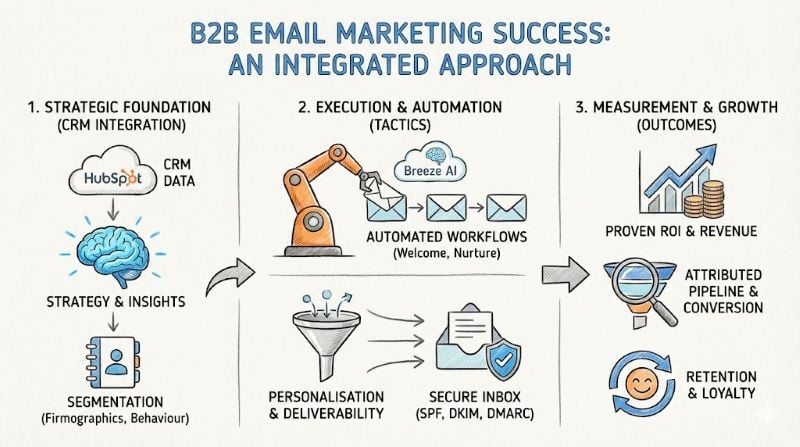
Whitehat SEO's approach to B2B email marketing treats email not as a standalone tactic but as an integral component of inbound marketing strategy. Every email should move prospects through awareness, consideration, and decision stages—with clear attribution back to the content and campaigns that generated engagement. This requires tight integration between your email platform and CRM, which is why HubSpot's unified approach outperforms bolted-together point solutions.
B2B email marketing benchmarks for 2026
Understanding current performance benchmarks helps B2B marketing teams set realistic targets and identify optimisation opportunities. GetResponse's 2024 Email Marketing Benchmarks report, analysing 4.4 billion emails, provides the most comprehensive current data available.
| Metric | 2025 Average | B2B Specific | Top Performer |
|---|---|---|---|
| Open Rate | 42.35% | 39.5% | 45%+ |
| Click-Through Rate (CTR) | 3.25% | 3.18% | 5%+ |
| Click-to-Open Rate | 8.62% | 8–10% | 20%+ |
| Bounce Rate | 2.33% | Under 2% | Under 1% |
| Unsubscribe Rate | 0.15% | 0.15–0.22% | Under 0.1% |
| Email Marketing ROI | £29–£34 per £1 | Same | £57+ per £1 |
Important: Apple Mail Privacy Protection (MPP), introduced in iOS 15, now accounts for approximately 55% of email opens and automatically loads tracking pixels—inflating open rates artificially. B2B marketers should prioritise click-through rate (CTR) and click-to-open rate (CTOR) as more reliable engagement metrics.
Email type performance comparison
Not all B2B emails perform equally. According to Litmus's 2025 State of Email report, automated and triggered emails significantly outperform batch newsletters:
- Welcome emails: 83.63% open rate, 16.60% CTR (highest performers)
- Triggered/automated emails: 45.38% open rate, 5.02% CTR
- Newsletters: 40.08% open rate, 3.84% CTR
- Automated emails generate 320% more revenue than non-automated campaigns
Whitehat SEO's HubSpot onboarding process prioritises setting up automated email workflows early—welcome sequences, lead nurturing paths, and re-engagement campaigns—because the data consistently shows these outperform manual sends by significant margins.
How to improve B2B email open rates
Improving email open rates requires attention to three key areas: subject line optimisation, send timing, and sender reputation. Here's what the 2025 data tells us about each element.
Subject line best practices
Research from Campaign Monitor and HubSpot's analysis of millions of emails reveals clear patterns for effective B2B subject lines:
- Optimal length: 30–50 characters (6–10 words)
- Mobile visibility: Keep critical information within the first 33 characters
- Short subject lines under 20 characters achieve 29.9% average open rates
- Preview text adds 13.72% to open rates when optimised
- Personalised subject lines see 26% higher open rates
- Emojis: Use sparingly (one maximum)—they often perform worse than no emoji for B2B audiences
Optimal send times for B2B
Send timing significantly impacts B2B email performance. Based on aggregate data from HubSpot, Mailchimp, and GetResponse:
- Best days: Tuesday and Wednesday (highest engagement)
- Best times: 9–11 AM or 1–3 PM in recipient's local time zone
- Peak performance: Tuesday at 10 AM consistently shows highest open and click rates
- Avoid: Monday mornings (inbox backlog) and Friday afternoons
- Optimal frequency: 2–4 emails per month for B2B audiences
HubSpot's send-time optimisation feature, powered by Breeze AI, analyses your specific contact data to recommend optimal send times per recipient—moving beyond generic best practices to individualised timing based on actual engagement patterns.
Email personalisation and segmentation strategies
Email segmentation divides your subscriber list into smaller groups based on criteria such as demographics, behaviour, or engagement level. Segmented campaigns consistently outperform batch-and-blast approaches—achieving 30% higher open rates, 50% higher click-through rates, and revenue increases of up to 760% according to Campaign Monitor research.
Effective B2B segmentation criteria
For B2B organisations, Whitehat SEO recommends segmenting by the following criteria within HubSpot CRM:
- Firmographics: Company size, industry, revenue band, location
- Buyer journey stage: Awareness, consideration, decision, customer
- Engagement level: Active, dormant, at-risk, churned
- Job function: Marketing, sales, operations, C-suite
- Content interests: Topics engaged with, downloads, webinar attendance
- Lead score: High-intent vs. early-stage research
Personalisation impact data
Personalisation extends beyond using {first_name} tokens. The 2025 data shows significant returns from deeper personalisation:
- Personalised subject lines: 26% higher open rates
- Dynamic content blocks: 29% higher unique opens, 41% higher unique clicks
- Behaviour-triggered emails: 152% higher click rates than batch campaigns
- 71% of consumers expect personalised interactions from brands
- 80% of marketers report personalisation improves email performance
In HubSpot, personalisation tokens pull directly from CRM properties—enabling dynamic content based on company name, industry challenges, recent website behaviour, or lifecycle stage. This is where having clean CRM data becomes essential: garbage in, garbage out applies doubly when personalisation is involved.
Email automation and HubSpot Breeze AI
Email automation uses technology to send targeted messages based on triggers, timing, or subscriber behaviour—rather than manual, one-off sends. According to Litmus, automated emails generate 320% more revenue than non-automated campaigns, making automation the single highest-impact investment for most B2B email programmes.
AI and automation statistics for 2026
AI adoption in email marketing has accelerated rapidly. The HubSpot State of Marketing 2025 report reveals:
- 63% of marketers already use AI in email marketing
- 49% of marketers use generative AI for email copy creation
- 340% increase in marketers using AI-powered image generation (2024–2025)
- AI-driven personalisation delivers 13% higher CTR and 41% revenue increases
- Only 6% of teams now require more than 2 weeks to produce an email (down from 62% in 2024)
- 70% of marketers predict up to half of email operations will be AI-driven by 2026
HubSpot Breeze AI capabilities for email
HubSpot's Breeze AI, with over 75,000 weekly active users, transforms email marketing workflows through three integrated components:
- Breeze Copilot: Context-aware AI assistant that drafts email copy, summarises contact history before sends, and suggests subject line variations based on CRM data
- Breeze Prospecting Agent: Automated prospect research and personalised email outreach using your brand voice—HubSpot reports 48% faster deal velocity for teams using this agent
- Breeze Intelligence: Real-time data enrichment that improves personalisation accuracy by unifying first-party and third-party data, delivering 92% improvement in data quality
Whitehat SEO's HubSpot onboarding methodology prioritises Breeze configuration during the first two weeks of implementation. Proper setup of Brand Style Guides within HubSpot ensures all AI-generated content maintains consistent voice and messaging—critical for B2B organisations where off-brand communications damage credibility.
Essential B2B email automation workflows
Every B2B company using HubSpot should implement these core automated sequences:
- Welcome sequence: 3–5 emails introducing new subscribers to your value proposition and key resources
- Lead nurturing: Behaviour-triggered content based on pages visited, content downloaded, or forms submitted
- Re-engagement: Automated outreach to dormant contacts (90+ days without engagement)
- Sales handoff: Notifications and sequences triggered when contacts hit lead score thresholds
- Post-purchase onboarding: Customer success sequences for new clients
Email deliverability best practices and 2024 sender requirements
Email deliverability measures whether your emails successfully reach the inbox rather than spam folders or being blocked entirely. It's distinct from "delivery rate" which simply indicates the email was accepted by the receiving server—an email can be delivered but land in spam.
Google and Yahoo 2024 sender requirements (now enforced)
In February 2024, Google and Yahoo implemented strict new sender requirements. Microsoft joined with similar requirements in March 2025. Non-compliance results in emails being blocked or filtered to spam.
All senders must:
- Authenticate emails with SPF and DKIM
- Use valid reverse DNS records
- Support TLS encryption
Bulk senders (5,000+ emails/day) must also:
- Implement DMARC with minimum p=none policy
- Maintain spam complaint rate below 0.3% (aim for under 0.1%)
- Include one-click unsubscribe in email headers
- Honour unsubscribe requests within 2 days
- Pass DMARC alignment
How to improve email deliverability
Beyond authentication requirements, these practices protect your sender reputation:
- Set up proper authentication: Configure SPF, DKIM, and DMARC records in your DNS
- Maintain list hygiene: Remove inactive subscribers (no engagement in 12+ months) and hard bounces immediately
- Use double opt-in: Confirms subscriber intent and reduces spam complaints
- Avoid spam trigger words: "Free," "Guarantee," "Act now" in subject lines
- Keep bounce rates below 2%: Under 1% for best-in-class programmes
- Warm up new IP addresses gradually: Start with engaged segments, increase volume over 4–6 weeks
- Monitor Google Postmaster Tools: Track domain reputation and spam rates
UK GDPR and PECR compliance for B2B email
B2B email marketing in the UK operates under both UK GDPR and the Privacy and Electronic Communications Regulations (PECR). Key requirements include:
- Business email addresses containing personal names (e.g., john.smith@company.com) are considered personal data under GDPR
- Corporate-only data (info@company.com) without individual identifiers falls outside GDPR scope
- Legitimate interest can be used for B2B marketing but requires documented reasoning
- Under UK PECR, corporate subscribers don't require consent for marketing emails (with caveats)
- Only 24% of marketers are fully compliant with current email standards
- GDPR fines reached €3 billion in 2025
How to measure B2B email marketing success
Effective B2B email measurement connects email engagement to pipeline and revenue outcomes—not just vanity metrics. With Apple Mail Privacy Protection inflating open rates, modern email programmes must focus on metrics that indicate genuine business impact.
Key metrics to track
| Metric | Target | Why It Matters |
|---|---|---|
| Click-Through Rate | Above 2.5% | True engagement indicator (unaffected by MPP) |
| Click-to-Open Rate | 8%+ (strong: 15%+) | Content relevance to those who opened |
| Conversion Rate | 1–5% (varies by offer) | Actual business outcomes from email |
| Bounce Rate | Below 2% | List quality and deliverability health |
| Unsubscribe Rate | Below 0.5% | Content/frequency alignment with expectations |
| Revenue per Email | Campaign-specific | Direct ROI measurement |
HubSpot's attribution reporting connects email interactions to closed-won deals using multi-touch attribution models. This moves email measurement from "how many people clicked" to "how much revenue did this campaign influence"—the metric that matters to CFOs and leadership teams.
Frequently asked questions about B2B email marketing
What is a good email open rate for B2B?
A good B2B email open rate is between 25–40%, with the 2025 average at 39.5%. However, Apple Mail Privacy Protection inflates open rates by automatically loading tracking pixels, making click-through rate (CTR) and click-to-open rate (CTOR) more reliable engagement metrics for B2B marketers.
What is the best time to send B2B marketing emails?
The best time to send B2B emails is Tuesday through Thursday between 9–11 AM or 1–3 PM in the recipient's local time zone. Tuesday at 10 AM consistently shows the highest open and click rates. Avoid Monday mornings (inbox backlog) and Friday afternoons when attention drops.
How do I improve email deliverability?
Improve email deliverability by setting up proper authentication (SPF, DKIM, DMARC), maintaining list hygiene by removing inactive subscribers, using double opt-in, avoiding spam trigger words, keeping bounce rates below 2%, and warming up new IP addresses gradually over 4–6 weeks.
What is email segmentation and why does it matter?
Email segmentation divides your subscriber list into smaller groups based on criteria like demographics, behaviour, or engagement level. It matters because segmented campaigns achieve 30% higher open rates, 50% higher click-through rates, and can increase revenue by up to 760% compared to batch sends.
How can I personalise B2B emails effectively?
Effective B2B email personalisation includes using the recipient's name and company, referencing industry-specific challenges, sending behaviour-triggered emails, personalising based on buyer journey stage, and targeting by job function and firmographic data. Personalised subject lines improve open rates by 26%.
What is the ROI of email marketing?
Email marketing delivers an average ROI of £29–£34 for every £1 spent, making it one of the highest-returning marketing channels. Automated emails generate 320% more revenue than non-automated campaigns, and top performers see returns of £57+ per £1 invested.
What metrics should I track for B2B email marketing?
Key B2B email metrics include click-through rate (aim for above 2.5%), click-to-open rate (8%+ is good), bounce rate (keep below 2%), unsubscribe rate (below 0.5%), conversion rate, and revenue per email sent. Due to Apple MPP, prioritise click-based metrics over open rates.
How often should I send B2B marketing emails?
For B2B email marketing, 2–4 emails per month is optimal for most audiences. Test frequency by monitoring unsubscribe rates and engagement metrics. If unsubscribes increase or engagement drops, reduce frequency. The key is providing consistent value rather than high volume.
Need help implementing these strategies in HubSpot?
Whitehat SEO is a HubSpot Diamond Partner with expertise in email marketing, CRM configuration, and marketing automation. Let's discuss how to transform your email programme.
Book a Discovery CallReferences and sources
- HubSpot State of Marketing 2025 — Email ROI data, AI adoption statistics, marketer investment trends
- GetResponse Email Marketing Benchmarks 2024 — Open rate, CTR, and engagement data from 4.4 billion emails analysed
- Litmus State of Email Reports 2025 — ROI benchmarks, automated email performance, industry trends
- Campaign Monitor Email Metrics Knowledge Base — CTR benchmarks, subject line best practices
- HubSpot Breeze AI Product Page — AI capabilities, weekly active user statistics
- PowerDMARC: Google & Yahoo Email Authentication Requirements — 2024 sender requirements breakdown
- Cognism GDPR Marketing Guide — B2B GDPR compliance, legitimate interest guidance
- Mailchimp Email Marketing Benchmarks — Industry-specific benchmark data
About Whitehat SEO
Whitehat SEO is a London-based HubSpot Diamond Solutions Partner and full-service inbound marketing agency. Founded in 2011, we help B2B organisations increase online visibility, generate qualified leads, and prove marketing ROI through integrated SEO, content, PPC, and HubSpot implementations. We operate the world's largest HubSpot User Group (London HUG) and CEO Clwyd Probert is a guest lecturer at UCL.
Related guides you may find useful: marketing services view our pricing