
Content Marketing
At Whitehat, we've implemented content strategy frameworks for B2B companies across SaaS, biotech, professional services, and financial services. The difference between random acts of marketing and predictable pipeline generation comes down to having a documented framework that connects every piece of content to business outcomes. This guide shares the complete methodology we use with clients—the same approach that has helped businesses achieve measurable improvements in lead quality, sales cycle reduction, and marketing-attributed revenue.
The Complete B2B Content Strategy Framework for 2026: A 10-Step Guide to Driving Revenue
A B2B content strategy framework is a documented system for planning, creating, distributing, and measuring content that aligns with business objectives and drives measurable revenue. According to Content Marketing Institute's 2025 research, organisations with documented content strategies are twice as likely to report success, yet only 29% of B2B marketers rate their current strategy as highly effective. This gap represents both a challenge and an opportunity: companies that build robust content frameworks gain significant competitive advantage in crowded markets.
What follows is a practical, step-by-step framework you can implement immediately. We'll cover everything from setting SMART goals and developing buyer personas to building topic clusters, integrating AI effectively, and measuring what actually matters.
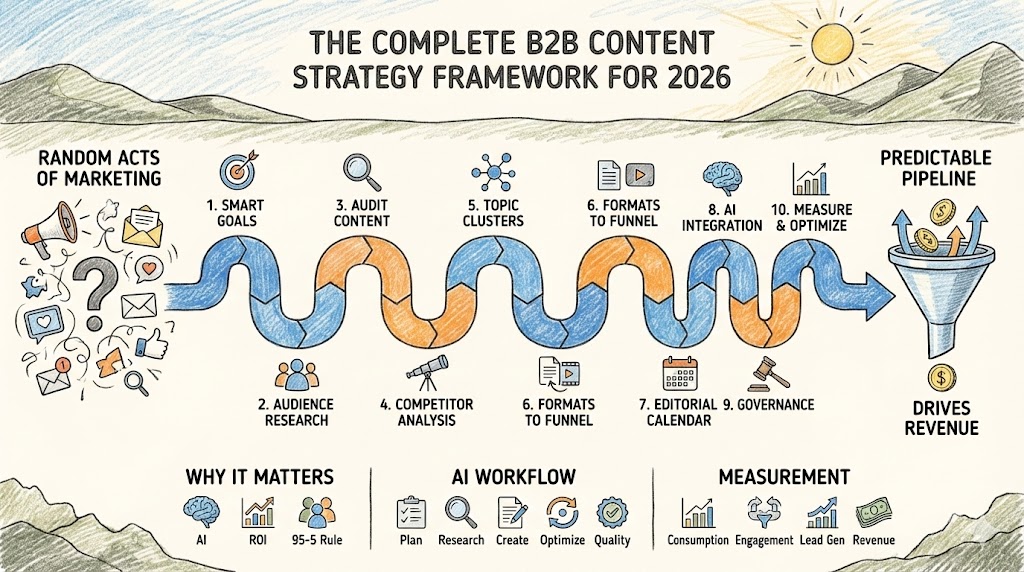
What Is a Content Strategy Framework?
A content strategy framework provides a structured approach to planning, creating, and measuring content that reaches your target audience and supports business objectives. Unlike ad-hoc content creation, a framework ensures every blog post, whitepaper, video, and social update connects to measurable goals and moves prospects through the buyer's journey.
The Content Marketing Institute defines content strategy as linking a content plan to audience and business objectives—covering what content to make, who it's for, how it's published, and who creates it. Semrush describes it as a carefully planned approach to planning, creating, optimising, and distributing content that reaches your target audience and supports business goals.
For B2B companies, a content strategy framework typically includes these components:
- Business objectives and success metrics that tie content to revenue
- Documented buyer personas based on actual customer research
- Topic clusters and pillar pages that establish topical authority
- Editorial calendar and workflows that ensure consistent output
- Governance policies for quality control and brand consistency
- Measurement systems that track leading and lagging indicators
The framework acts as your content operating system—providing the structure that transforms scattered marketing activities into a coordinated engine for growth. Without it, marketing teams default to reactive, request-driven content that rarely moves the needle on business metrics.
Why Content Strategy Frameworks Matter in 2025
The B2B content landscape has shifted dramatically. Research from the Content Marketing Institute reveals that 97% of B2B marketers now have a content strategy—but execution excellence remains rare. Only 29% rate their strategy as extremely or very effective, with 58% characterising theirs as merely moderately effective. The gap between having a strategy and having an effective one represents significant competitive opportunity.
Three developments make documented frameworks essential in 2025:
AI has raised the content floor—and the bar
With 81% of B2B marketers now using generative AI tools (up from 72% in 2023), the volume of content has exploded. Basic, commodity content no longer differentiates. The winners are those combining AI efficiency with human expertise, original research, and distinctive points of view. A framework ensures AI amplifies rather than replaces strategic thinking.
Attribution and ROI pressure have intensified
According to Gartner's 2025 CMO Spend Survey, marketing budgets have flatlined at 7.7% of company revenue, yet 46% of B2B marketers expect content marketing budget increases. This creates a paradox: do more with less, and prove every pound spent. Content Marketing Institute research shows 58% of B2B marketers report content marketing helped generate sales and revenue in the past year—up from 42% previously—but 56% still struggle to attribute ROI to content efforts. A documented framework connects activities to outcomes.
The 95-5 rule demands strategic patience
Research from the Ehrenberg-Bass Institute shows only 5% of B2B buyers are in-market at any given time. This means 95% of your audience isn't ready to buy today—but they will be eventually. Effective content strategy builds mental availability with the 95%, ensuring your brand is remembered when purchase intent emerges. This requires sustained, strategic investment rather than campaign-to-campaign thinking.
Step 1: Define SMART Business Goals
Content strategy effectiveness starts with goal clarity. Content Marketing Institute research shows that among B2B marketers who rate their strategy as moderately effective or worse, 42% attribute this to lack of clear goals. Without defined objectives, content becomes activity without direction—busy work that doesn't move business metrics.
SMART goals for content strategy should be Specific, Measurable, Achievable, Relevant, and Time-bound. More importantly, they should connect directly to revenue and pipeline metrics that matter to leadership.
Examples of effective B2B content goals
- Pipeline contribution: Generate £500,000 in marketing-attributed pipeline from organic content within 12 months
- Lead quality: Increase marketing qualified lead (MQL) to sales qualified lead (SQL) conversion rate from 15% to 25% through better content targeting
- Sales enablement: Reduce average sales cycle length by 20% through decision-stage content assets
- Authority building: Achieve top-3 rankings for 10 priority commercial keywords within 18 months
- Engagement: Grow email subscriber base by 50% with a minimum 2.5% click-through rate on nurture sequences
Note how each goal connects content activity to business outcomes. "Publish 50 blog posts" is not a goal—it's a task. "Generate £500,000 in content-attributed pipeline" is a goal that drives strategic decisions about what to create, for whom, and where to distribute it.
Step 2: Research Your Audience and Develop Buyer Personas
Content Marketing Institute research consistently shows that understanding audience needs is the primary factor separating top performers from everyone else. 82% of the most successful B2B marketers attribute their success to understanding their audience—yet 35% still say their content doesn't align with the buyer's journey, and 39% struggle to create that alignment.
Effective B2B buyer personas go beyond demographics to capture the full complexity of business buying decisions.
Buyer persona components that actually matter
- Goals and KPIs: What are they measured on? What does success look like in their role?
- Pain points: What frustrates them daily? What problems keep them up at night?
- Information sources: Where do they research solutions? Which publications, communities, and platforms do they trust?
- Buying committee role: Are they the economic buyer, technical evaluator, end user, or champion?
- Objections: What concerns do they raise during the sales process?
- Decision timeline: How long does their typical evaluation process take?
For B2B organisations, remember that purchases involve buying committees—not individual consumers. Research from Gartner suggests B2B buying groups include 6-10 decision-makers on average, each with different information needs. Your content strategy must address multiple personas across the buying committee.
At Whitehat, we use a structured persona template that captures these dimensions, combined with customer interview data and CRM insights to build accurate profiles. The quality of your persona work directly determines the relevance—and effectiveness—of every piece of content you create.
Step 3: Audit Your Existing Content
Before creating new content, audit what you already have. Most B2B organisations sit on years of accumulated blog posts, whitepapers, case studies, and landing pages—much of it outdated, underperforming, or cannibalising other content. A comprehensive audit reveals opportunities to refresh high-potential assets and prune content that drags down site performance.
The three-bucket content audit framework
Categorise every piece of existing content into one of three buckets:
Keep
Performing well, still accurate, aligned with current strategy. Ensure proper internal linking and featured snippet optimisation.
Improve
Has potential but needs updating—outdated statistics, thin content, poor optimisation, or missing CTAs. Prioritise for refresh.
Remove
No traffic, no backlinks, irrelevant to current strategy, or duplicative. 301 redirect to relevant pages or noindex.
Audit criteria that matter
Evaluate each piece against these dimensions:
- Performance: Organic traffic, rankings, conversions, engagement metrics
- E-E-A-T signals: Does content demonstrate Experience, Expertise, Authoritativeness, and Trustworthiness?
- Accuracy: Are statistics, examples, and information current?
- Strategic fit: Does it serve a current persona and business objective?
- Technical health: Page speed, mobile experience, proper schema markup
A thorough content audit typically reveals that 20-30% of content drives 70-80% of results. This insight should inform resource allocation—double down on what works rather than spreading effort thin across hundreds of low-value pages. For detailed guidance on auditing your website, see our website audit services page.
Step 4: Analyse Competitor Content Strategies
Competitive analysis reveals content gaps you can exploit and successful formats you can learn from. The goal isn't to copy competitors—it's to find differentiation opportunities by understanding where they're strong, where they're weak, and where they're absent entirely.
What to analyse in competitor content
- Topic coverage: What subjects do they cover comprehensively? What do they ignore?
- Content formats: What types perform best for them? Video, long-form guides, tools, templates?
- Keyword overlap: Where do you compete for the same terms? Where can you own unique territory?
- Backlink sources: Who links to their content? Can you create something better to earn those links?
- Positioning angles: How do they frame their expertise? Where can you differentiate?
Finding content gaps
The most valuable competitive analysis reveals topics your audience searches for that competitors haven't covered well—or at all. These content gaps represent low-competition opportunities to establish authority.
Look for keyword clusters where search intent is clear but existing content is thin, outdated, or fails to address the query comprehensively. Industry-specific applications, integration guides, and use-case content often represent underserved territory that generalist competitors ignore.
Step 5: Build Topic Clusters and Pillar Pages
The topic cluster model has become the standard architecture for B2B content strategy. HubSpot's research demonstrated that interconnected content structure improves search rankings—more interlinking led to better SERP placement. The model organises content around comprehensive pillar pages linked to detailed cluster content on specific subtopics.
Pillar page structure
Pillar pages are comprehensive resources covering a broad topic in depth. They typically range from 3,000 to 10,000+ words and serve as the hub that links to and from related cluster content. Effective pillar pages:
- Target a broad, high-volume keyword your business should own
- Cover the topic comprehensively without going too deep into any subtopic
- Include clear navigation and jump links for user experience
- Link to 6+ cluster content pieces that explore subtopics in detail
- Get updated regularly to maintain freshness and accuracy
Cluster content strategy
Each cluster piece dives deep into a specific subtopic, targeting longer-tail keywords with clearer intent. Cluster content should:
- Address a specific question or problem within the broader topic
- Link back to the pillar page using relevant anchor text
- Cross-link to related cluster content where contextually appropriate
- Include clear calls-to-action appropriate to the buyer's journey stage
For example, a pillar page on "HubSpot implementation" might have cluster content covering HubSpot onboarding best practices, CRM migration strategies, HubSpot SEO features, workflow automation setup, and reporting configuration—each addressing a specific subtopic in depth while supporting the pillar's broader authority.
Step 6: Match Content Formats to Funnel Stages
Content Marketing Institute's 2025 research reveals that video now ranks as the most effective B2B content type (58% of marketers agree), surpassing case studies (53%), ebooks and whitepapers (45%), and research reports (45%). However, effectiveness varies significantly by funnel stage. Matching format to buyer intent ensures content meets prospects where they are in their journey.
| Funnel Stage | Buyer Intent | Best Content Formats |
|---|---|---|
| Top of Funnel (TOFU) | Problem aware, researching solutions | Blog posts, infographics, podcasts, educational videos, social content |
| Middle of Funnel (MOFU) | Solution aware, evaluating options | Webinars, whitepapers, comparison guides, case studies, templates |
| Bottom of Funnel (BOFU) | Vendor aware, ready to decide | Product demos, free trials, pricing guides, implementation roadmaps, ROI calculators |
Content Marketing Institute data shows 61% of B2B marketers expect increased video investment in 2025. For distribution, in-person events (52%) and webinars (51%) rate as most effective channels, while LinkedIn delivers best value among social platforms with 76% agreement among B2B marketers.
The key insight: don't create content formats because they're trendy—create them because they serve your audience's preferred way of consuming information at each stage of their journey.
Step 7: Create an Editorial Calendar and Workflow
An editorial calendar transforms strategy into execution. It assigns ownership, sets deadlines, and creates accountability for content production. Without it, content strategies remain theoretical documents that never translate to published work.
Essential calendar components
- Content title and topic cluster: What are we creating and where does it fit?
- Target persona and funnel stage: Who is this for and what journey stage does it serve?
- Primary keyword and search intent: What are we optimising for?
- Content format and word count: Blog post, video, ebook, etc.?
- Owner and contributors: Who writes, reviews, and approves?
- Draft deadline and publish date: When does it need to be ready?
- Distribution channels: Where will we promote it?
Sustainable publishing cadence
Consistency matters more than volume. Research from Orbit Media shows that the most successful B2B content strategies combine documented mission, original research, and regular publishing—but "regular" doesn't mean daily. A sustainable cadence that you can maintain long-term beats aggressive schedules that burn out teams and create quality issues.
For most B2B organisations, 2-4 high-quality pieces per week (blog posts, LinkedIn articles, video content) represents an achievable, effective cadence—supplemented by monthly pillar content updates and quarterly major assets like research reports or comprehensive guides.
Step 8: Integrate AI Effectively into Content Operations
AI adoption in B2B content marketing has accelerated dramatically. Content Marketing Institute research shows 81% of B2B marketers now use generative AI tools—up from 72% in 2023. Marketers report 44% higher productivity and an average of 11 hours saved per week when using AI effectively. Yet only 19% have AI fully integrated into daily processes, with 54% taking an ad-hoc experimental approach.
This integration gap creates significant competitive opportunity for organisations that move beyond experimentation to systematic implementation.
The human-AI collaboration workflow
The most effective approach treats AI as an amplifier for human expertise, not a replacement. Here's the workflow that delivers results:
- Strategic planning (human-led): Goal setting, audience research, topic prioritisation, positioning decisions. These require judgment that AI cannot replicate.
- Research and outlining (AI-assisted): Competitor analysis, data gathering, draft structure creation. AI accelerates these tasks significantly.
- Content creation (hybrid): Humans write expertise sections, thought leadership, and unique perspectives. AI handles structural content, summaries, and first-draft sections.
- Optimisation (AI-assisted): SEO recommendations, readability improvements, headline variations. AI tools excel at pattern-based optimisation.
- Quality control (human-led): Fact-checking, voice refinement, brand alignment, E-E-A-T review. Final quality decisions require human judgment.
This workflow typically reduces production time by 30-50% while maintaining—or improving—content quality.
AI governance considerations
Only 38% of organisations have established AI usage guidelines, according to Content Marketing Institute research. Effective governance should cover acceptable uses (78% of guidelines address this), security measures (66%), and data handling protocols (64%).
Google's official guidance confirms AI-generated content is not banned—the focus remains on quality over production method. However, Google's March 2024 core update targeted low-quality AI content, with sites relying on thin, unedited AI output seeing 40-60% traffic drops. Content must demonstrate E-E-A-T regardless of how it's produced. As Ann Handley advises: use AI to automate tasks that get in the way of creativity—don't offload your creativity to AI.
Step 9: Establish Content Governance
Content governance ensures quality, consistency, and accountability as your content operation scales. Without clear governance, teams produce inconsistent quality, duplicate effort, and publish content that doesn't meet brand standards.
The seven pillars of content governance
- Regular strategy reviews: Quarterly assessment of what's working and what needs adjustment
- Clear roles using RACI framework: Who is Responsible, Accountable, Consulted, and Informed for each content type?
- Standardised workflows: Documented processes from ideation to publication to promotion
- Content standards documentation: Style guides, brand voice guidelines, SEO requirements, quality checklists
- Stakeholder alignment and training: Ensuring everyone understands standards and processes
- Governance monitoring and auditing: Regular checks to ensure compliance with standards
- Appropriate tool selection: Technology stack that supports rather than complicates processes
Hybrid governance model
For mid-to-enterprise B2B companies, a hybrid governance model works best: centralised strategy with decentralised execution. The central team owns positioning, brand standards, editorial calendar priorities, and quality control. Regional or departmental teams execute within these guardrails, bringing local expertise and market-specific insights. This balances consistency with agility.
Step 10: Measure, Attribute, and Optimise
Measurement separates strategic content marketing from expensive guesswork. Yet 56% of B2B marketers still struggle to attribute ROI to content efforts, according to Content Marketing Institute research. The solution is building a measurement framework that tracks metrics across the full buyer's journey—not just vanity metrics like pageviews.
Metrics that matter (by category)
Consumption metrics (awareness indicators):
- Organic traffic by topic cluster
- Pageviews and unique visitors
- Search visibility and ranking positions
Engagement metrics (interest indicators):
- Time on page (target varies by content type)
- Bounce rate (target below 60% for blog content)
- Scroll depth and content completion rate
- Social engagement and shares
Lead generation metrics (conversion indicators):
- Conversion rate (target 2-5% for B2B content)
- Form submissions by content source
- Content-influenced contacts
Revenue metrics (business impact):
- Content-attributed pipeline value
- Content-assisted conversions
- Marketing contribution to closed revenue
Retention metrics (relationship building):
- Email subscriber growth rate
- Newsletter click-through rate (target 2-5%)
- Return visitor percentage
Attribution models for B2B
B2B sales cycles span an average of 211 days according to Dreamdata research, making attribution essential for understanding content's role. First-touch attribution credits the initial interaction; last-touch credits the final conversion point. Neither tells the complete story.
For B2B content strategy, multi-touch attribution models provide more accurate insight into how content influences long sales cycles. If you're running HubSpot, configuring proper attribution reporting should be a priority during implementation—it's the foundation for proving content ROI to leadership.
Ready to Build a Content Strategy That Drives Revenue?
Stop random acts of marketing. Whitehat helps B2B companies build content engines that generate predictable pipeline—with attribution your CFO will trust.
Explore Our Content Marketing ServicesFrequently Asked Questions
How long does it take to see results from a B2B content strategy?
Most B2B content strategies require 6-12 months to show meaningful results, with organic search typically taking longer than paid or email channels. Early indicators like traffic growth and engagement metrics often appear within 3-4 months, while pipeline impact and revenue attribution become clearer at the 9-12 month mark. The key is setting realistic expectations and tracking leading indicators while waiting for lagging revenue metrics.
What budget should we allocate to content marketing?
Gartner's 2025 CMO Spend Survey shows marketing budgets averaging 7.7% of company revenue, with 42% allocated to marketing programmes (which includes content). For B2B companies specifically, Forrester research suggests 8% of annual revenue goes to marketing overall. Within that, Content Marketing Institute data shows 46% of B2B marketers expect budget increases for content specifically in 2025—suggesting investment in the channel is growing despite overall budget constraints.
How does AI change B2B content strategy in 2025?
AI accelerates content production and enables better personalisation, but doesn't replace strategic thinking. The winning approach combines AI efficiency (for research, drafting, and optimisation) with human expertise (for strategy, thought leadership, and quality control). Content strategies must also now optimise for dual visibility—traditional search engines plus AI answer engines like ChatGPT and Google AI Overviews that increasingly influence B2B research behaviour.
What's the ideal content team size for B2B?
Content Marketing Institute research shows 76% of B2B organisations have a dedicated content marketing team or person, but 54% of those teams are just 2-5 people. Effective content operations depend less on team size than on clear processes, appropriate technology, and strategic outsourcing for specialised needs. Many successful B2B companies run lean internal teams supplemented by agency partnerships for execution capacity and specialist expertise.
How do I prove content marketing ROI to leadership?
Attribution reporting is essential. Configure your CRM and marketing automation platform (like HubSpot) to track content touchpoints throughout the buyer's journey. Report on content-influenced pipeline (deals that engaged with content during their journey) and content-attributed revenue (deals where content was a significant factor in conversion). Multi-touch attribution models work best for B2B's long sales cycles.
References and Further Reading
- Content Marketing Institute. (2025). B2B Content Marketing Benchmarks, Budgets, and Trends: Outlook for 2025. Content Marketing Institute Research.
- Gartner. (2025). 2025 CMO Spend Survey. Gartner Research.
- HubSpot. (2025). State of Marketing Report 2025. HubSpot Research.
- Semrush. (2024). Content Strategy Template and Guide. Semrush Blog.
- Orbit Media Studios. (2024). Content Strategy Framework for B2B. Orbit Media Blog.
- Dreamdata. (2025). B2B Go-to-Market Benchmarks. Dreamdata Research.
- Google Search Central. (2024). Creating Helpful, Reliable, People-First Content. Google Documentation.