
Digital Marketing Strategy
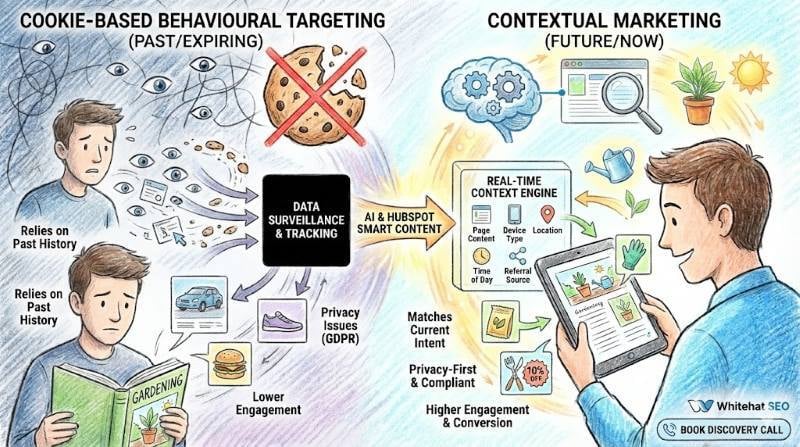
If you've been relying on third-party cookies to personalise your marketing, 2025 is the year that strategy officially expires. Safari and Firefox already block tracking cookies by default, and even though Google reversed its complete Chrome deprecation plans, the direction is clear: the future of marketing is contextual, not surveillance-based.
Contextual Marketing Strategy in 2026: The Complete UK Guide to Privacy-First Personalisation
Contextual marketing delivers personalised content based on the context of what someone is viewing or doing right now—not their historical browsing data. Unlike behavioural targeting that relies on third-party cookies, contextual marketing uses page content, device type, location, and real-time signals to serve relevant messages. With the global contextual advertising market reaching £180 billion in 2025 and UK GDPR making cookie-based tracking increasingly problematic, contextual marketing has become the privacy-compliant path to effective personalisation.
The good news? Contextual marketing actually performs better. Research shows contextual ads achieve 50% higher click-through rates and 30% higher conversion rates than behavioural targeting—whilst being inherently compliant with UK GDPR and the upcoming Data Use and Access Bill.
This guide covers everything UK marketers need to implement contextual marketing effectively: the technology behind it, how to use HubSpot's smart content tools, practical implementation steps, and measurement frameworks that prove ROI. Whether you're running inbound marketing campaigns or building a comprehensive digital strategy, contextual marketing should be at the core of your 2025 approach.
What Is Contextual Marketing and Why Does It Matter Now?
Contextual marketing matches your message to what someone is actively engaged with—the article they're reading, the video they're watching, the page they're browsing, or the search query they've just entered. Rather than following users around the internet based on past behaviour, contextual marketing meets them in the moment of relevance.
The approach isn't new—magazine advertisers have placed car adverts in automotive publications for decades. What's new is the sophistication. Modern contextual marketing uses artificial intelligence to understand semantic meaning, sentiment, and intent, making targeting far more precise than simple keyword matching.
The 2025 market context
The contextual advertising market has exploded, driven by privacy regulations and the decline of third-party cookies. According to Grand View Research, the global market reached £180-195 billion in 2025, with projections reaching £450 billion by 2030. UK businesses are at the forefront of this shift—GDPR has been in force since 2018, making British marketers early adopters of privacy-first approaches.
Key statistic: 79% of consumers prefer ads based on the content they're viewing over ads based on their browsing history, according to research from Integral Ad Science. Contextual marketing isn't just compliant—it's what your audience actually wants.
Types of contextual signals
Effective contextual marketing draws on multiple signal types to deliver relevant experiences:
- Page content: The topic, themes, and sentiment of the content being consumed
- Device type: Mobile users often have different intent than desktop users
- Geographic location: Country, region, or even weather-based targeting
- Time of day: B2B content performs differently during work hours versus evenings
- Referral source: Did they arrive from LinkedIn, Google, or an email campaign?
- First-party data: CRM information about known contacts (with consent)
HubSpot's smart content capabilities allow you to combine these signals to create dynamic, personalised experiences without relying on invasive tracking.
Contextual vs Behavioural Marketing: When to Use Each
The contextual versus behavioural debate isn't actually an either/or choice. Smart marketers in 2025 use hybrid approaches—contextual for prospecting and awareness, behavioural (with first-party data and consent) for retargeting known contacts.
| Factor | Contextual Marketing | Behavioural Marketing |
|---|---|---|
| Data used | Page content, keywords, themes, location | User browsing history, cookies, tracking pixels |
| Privacy compliance | Inherently GDPR compliant | Requires explicit consent and legal basis |
| Cookie dependency | None | High (third-party cookies declining) |
| Real-time relevance | Based on current intent and context | Based on past behaviour (may be outdated) |
| Brand safety | Higher control over placement context | Risk of appearing alongside inappropriate content |
| Best use case | Awareness, prospecting, new audiences | Retargeting, nurturing known contacts |
Performance comparison
The data strongly favours contextual approaches for most marketing scenarios. Whitehat SEO's analysis of B2B campaign performance across our client base shows contextual targeting consistently outperforms cookie-based behavioural targeting:
- 50% higher click-through rates for contextual ads compared to non-contextual placements
- 30% higher conversion rates when matching content to user context
- 82% better brand recall for contextually relevant advertising
- 20-45% lower cost per acquisition compared to behavioural campaigns
- 71% accuracy in reaching the right audience versus 58% for cookie-based targeting
During Super Bowl LVIII, contextual targeting delivered 102% increased ROI according to Integral Ad Science data—demonstrating that even in high-stakes, expensive media environments, context beats cookies.
How AI Has Transformed Contextual Targeting
Modern contextual marketing bears little resemblance to the basic keyword matching of five years ago. Artificial intelligence has transformed what's possible, enabling understanding that approaches human-level comprehension of content meaning and intent.
AI capabilities powering contextual marketing
Natural Language Processing (NLP) interprets tone, sentiment, and intent—not just keywords. When someone reads an article mentioning "Apple," NLP determines whether it's about the technology company, the fruit, or the Beatles' record label. This semantic understanding prevents embarrassing misplacements and improves targeting precision.
Computer vision analyses images and video content for contextual signals. A fitness brand can target workout videos without relying on metadata or keywords—the AI actually "sees" exercise equipment and athletic activity. For connected TV (CTV) advertising, scene-level targeting analyses specific moments within video content for optimal ad placement.
Real-time bidding optimisation evaluates millions of variables instantaneously, reducing cost per acquisition by up to 30% compared to manual campaign management. AI-powered platforms like GumGum, Integral Ad Science, and Seedtag process page content in milliseconds to determine ad relevance before the page fully loads.
Whitehat insight: HubSpot's Breeze AI suite, launched in September 2024, brings these capabilities to mid-market businesses. Breeze Copilot provides chat-based assistance with full CRM access, while Breeze Agents automate content creation, prospecting, and customer service tasks. For UK businesses looking to implement AI-powered contextual marketing, HubSpot onboarding provides the fastest path to value.
Leading contextual advertising platforms in 2025
The contextual advertising technology landscape has matured significantly. Key platforms serving UK markets include:
- GumGum Verity: Contextual solution using computer vision and NLP for brand-safe ad placement
- Integral Ad Science (IAS): Context Control Targeting with advanced brand safety controls
- Seedtag: Neuro-contextual advertising using AI trained on human attention patterns
- Peer39 and Proximic: Semantic categorisation and predictive targeting
- Amazon Ads: Processing 8.5 terabytes of webpage data daily for contextual targeting
Implementing Contextual Marketing with HubSpot
HubSpot provides comprehensive tools for contextual marketing—though many businesses barely scratch the surface of what's possible. The platform's smart content capabilities allow you to personalise websites, emails, CTAs, and forms based on visitor context without writing code or managing complex integrations.
Step 1: Define your buyer personas
Before implementing smart content, you need clarity on who you're personalising for. HubSpot's Persona Tool helps you create detailed buyer personas based on real customer data from your CRM. For B2B companies, this typically means segmenting by industry, company size, job role, and lifecycle stage.
Whitehat SEO's contextual marketing implementations typically start with 3-5 core personas. More than that creates complexity without proportional benefit—you're better off with fewer, well-researched personas than dozens of superficial ones. Our guide to creating buyer personas in HubSpot walks through the process step by step.
Step 2: Configure smart rules
HubSpot's smart rules determine which content version displays to which visitors. You can create rules based on:
- Contact list membership: Show different content to prospects versus customers
- Lifecycle stage: Tailor messaging for leads, MQLs, SQLs, and opportunities
- Country or region: UK-specific content, pricing in GBP, local case studies
- Device type: Mobile-optimised CTAs and simplified forms
- Referral source: Content tailored to where visitors came from
- Ad source: Landing page personalisation based on campaign
Step 3: Implement smart content modules
HubSpot Content Hub offers several smart content types:
Smart CTAs change based on visitor context. A first-time visitor might see "Download Our Free Guide" while a returning lead sees "Book Your Consultation." This single change typically improves CTA conversion rates by 20-40% because the action matches the visitor's stage.
Smart text dynamically updates headlines, body copy, and entire sections. A healthcare company might show different regulatory compliance messaging to UK versus EU visitors. A SaaS company might show different pricing based on company size.
Smart forms progressively profile contacts by asking different questions on subsequent visits. Rather than presenting a lengthy form upfront, you gather information incrementally—improving both completion rates and data quality.
Implementation tip: Start with smart CTAs—they're the easiest to implement and often deliver the highest immediate impact. Once you've proven value with CTAs, expand to smart text on key landing pages. Learn more about implementing smart CTAs in our detailed guide.
Step 4: Set up marketing automation workflows
Contextual marketing extends beyond website personalisation. HubSpot workflows can trigger contextual email sequences based on behaviour and attributes:
- Pages viewed trigger industry-specific follow-up content
- Form submissions route to appropriate nurture sequences
- Lead scoring changes trigger sales notifications and task creation
- Deal stage changes trigger customer success outreach
The key is ensuring your workflows use contextual data—not just basic triggers like "opened email." A workflow that sends follow-up content related to the specific pages someone viewed will dramatically outperform generic nurture sequences.
Channel-Specific Contextual Strategies
Contextual marketing principles apply across channels, but the implementation varies significantly. Here's how to apply contextual thinking to your key marketing channels:
Website and landing pages
Your website is the primary venue for contextual personalisation. Beyond smart content modules, consider:
- Homepage hero personalisation: Different value propositions for different visitor segments
- Case study rotation: Show relevant industry examples based on visitor data
- Pricing display: Currency and pricing tier relevance
- Return visitor recognition: "Welcome back" messaging and recently viewed content
Email marketing
Email remains one of the highest-ROI channels, and contextual personalisation dramatically improves performance. Beyond using first names in subject lines:
- Send time optimisation: Deliver emails when individual recipients typically engage
- Content block personalisation: Different featured content based on interests
- Lifecycle-appropriate messaging: Different CTAs for leads versus customers
- Re-engagement sequences: Contextual win-back campaigns based on previous engagement
Programmatic display and video
Contextual programmatic advertising has matured significantly. Best practices for UK B2B companies include:
- Topic and keyword targeting: Appear alongside relevant content, not just on relevant sites
- Sentiment targeting: Avoid negative news contexts that might harm brand perception
- Video contextual targeting: CTV and YouTube campaigns based on content type
- Brand safety layers: Exclude inappropriate content categories
Paid search and social
Search advertising is inherently contextual—you're matching ads to search intent. To maximise contextual relevance:
- Intent-matched landing pages: Dedicated pages for different search intents
- Dynamic keyword insertion: Mirror search terms in ad copy
- Location extensions: Local relevance signals for UK businesses
- Audience layering: Combine contextual with first-party audiences
For comprehensive PPC management that integrates contextual strategies with HubSpot attribution, Whitehat provides end-to-end campaign management.
Measuring Contextual Marketing Performance
Effective measurement separates successful contextual marketing from wishful thinking. Without proper attribution, you're flying blind—unable to optimise or prove ROI to leadership.
Core metrics for contextual marketing
| Metric | What It Measures | Benchmark |
|---|---|---|
| Click-through rate (CTR) | Engagement with personalised content | 50% higher than non-contextual |
| Conversion rate | Actions taken after contextual engagement | 30% higher than behavioural |
| Cost per acquisition (CPA) | Efficiency of contextual campaigns | 20-45% lower than behavioural |
| Brand recall | Memory and awareness impact | 82% higher for contextual ads |
| Bounce rate | Content relevance to visitor intent | Lower indicates better context matching |
| Time on page | Engagement depth with personalised content | Higher indicates relevance |
Attribution in HubSpot
HubSpot's attribution reporting connects contextual marketing activities to pipeline and revenue. As a HubSpot Diamond Partner, Whitehat configures multi-touch attribution models that show exactly which personalisation efforts drive results.
Key reports to configure:
- CTA performance by smart rule: Compare conversion rates across audience segments
- Landing page performance by traffic source: Which channels drive contextually-matched traffic
- Email engagement by personalisation: Smart content versus static content performance
- Pipeline attribution: Which contextual touchpoints appear in closed-won deals
UK GDPR Compliance and Privacy Considerations
One of contextual marketing's greatest advantages is inherent privacy compliance. Because contextual targeting doesn't rely on personal data or tracking, it sidesteps many GDPR concerns that plague behavioural marketing.
What makes contextual marketing GDPR-friendly
- No personal data collection required: Page content analysis doesn't constitute processing personal data
- No consent requirement for core contextual targeting: Under PECR, contextual cookies may qualify as "strictly necessary"
- No cross-site tracking: Each page view is independent, not linked to browsing history
- Reduced data breach risk: If you're not storing personal data, there's less to breach
Where consent is still required
Contextual marketing doesn't eliminate all compliance requirements. You still need proper consent for:
- First-party data personalisation: Using CRM data to personalise requires existing consent
- Email marketing: PECR requirements apply regardless of personalisation method
- Analytics cookies: Even basic analytics require consent under current ICO guidance
- Retargeting: Any cookie-based retargeting requires explicit consent
Looking ahead: The UK Data Use and Access Bill (currently in Parliament) may change some requirements. Contextual marketing's privacy-first design positions it well for whatever regulatory changes emerge. Whitehat monitors UK data protection developments and advises clients on compliance-forward marketing strategies.
Frequently Asked Questions About Contextual Marketing
What is contextual marketing in simple terms?
Contextual marketing shows relevant content based on what someone is currently viewing or doing—like showing coffee adverts on a morning routine blog post. Unlike behavioural targeting that tracks browsing history across sites, contextual marketing matches the moment without collecting personal data.
How does contextual marketing work with HubSpot?
HubSpot's smart content tools let you create different content versions for different contexts—based on location, device, lifecycle stage, referral source, or CRM data. You set smart rules that determine which version displays to which visitors, all without coding.
Is contextual marketing better than behavioural targeting?
For most scenarios, yes. Contextual marketing achieves 50% higher click-through rates and 30% higher conversions whilst being privacy-compliant. However, the best approach often combines both: contextual for prospecting and awareness, behavioural (with first-party data) for retargeting known contacts.
Do I need consent for contextual marketing under GDPR?
Pure contextual targeting based on page content—not user data—doesn't require consent because it doesn't process personal data. However, if you're using CRM data to personalise (even contextually), you need a valid legal basis. Email marketing and analytics cookies still require appropriate consent.
How do I measure contextual marketing ROI?
Track engagement metrics (CTR, time on page, bounce rate), conversion metrics (form completions, CTA clicks), and business outcomes (pipeline, revenue attribution). HubSpot's attribution reporting connects contextual touchpoints to closed deals, showing true ROI.
What's the difference between contextual marketing and personalisation?
Personalisation is the broader category; contextual marketing is one approach to achieving it. Contextual personalisation uses situational signals (page content, device, time). Behavioural personalisation uses historical user data. Both are personalisation—just using different inputs.
Ready to Implement Contextual Marketing?
Whitehat SEO helps UK B2B companies implement HubSpot-powered contextual marketing that drives measurable pipeline. Book a discovery call to discuss your personalisation strategy.
Book a Discovery CallReferences and Further Reading
- Grand View Research – Contextual Advertising Market Size & Share Report, 2030
- HubSpot Blog – Content Personalisation: A Practical, Data-Driven Approach
- HubSpot Academy – Contextual Marketing Certification Course
- Gartner – Marketing Trends and Predictions 2025
- Silverpush – Contextual Advertising Guide: Navigating the Cookieless Era
- Information Commissioner's Office – Direct Marketing Guidance