
What Are Smart CTAs and How Do They Work?
Smart CTAs are dynamic calls-to-action that display different content to different visitors based on predefined criteria. Unlike static CTAs that show the same message to everyone, Smart CTAs use data from your HubSpot CRM to deliver personalised experiences that match where each visitor sits in their buyer journey.
Key Takeaway
HubSpot's research across 330,000+ CTAs confirms that personalised Smart CTAs convert 202% better than static alternatives. With Breeze AI integration and Loop Marketing methodology, Smart CTAs now offer AI-powered optimisation that was previously available only to enterprise platforms — making them the single highest-leverage conversion tool for B2B HubSpot users.
HubSpot's Smart CTA functionality operates through "smart rules" — conditional logic that determines which version of a CTA appears based on visitor characteristics. When a contact visits your website, HubSpot checks their record against your smart rules and serves the most relevant CTA automatically.
The six personalisation criteria available in HubSpot's Smart CTAs are: contact list membership (show different CTAs to leads vs customers vs partners), lifecycle stage (match CTAs to subscribers, MQLs, SQLs, or customers), country (location-specific offers via IP geolocation), device type (optimise for desktop, mobile, or tablet), referral source (customise based on traffic source), and preferred browser language (serve CTAs in the visitor's language).
Smart CTAs are available in Marketing Hub Professional and Enterprise, as well as Content Hub Professional and Enterprise tiers. Whitehat's HubSpot services include Smart CTA configuration as part of our implementation methodology.
Why Do Personalised CTAs Outperform Static Alternatives by 202%?
202%
Better Conversion
Smart CTAs vs static alternatives
40%
More Revenue
From companies excelling at personalisation
371%
More Clicks
Single CTA emails vs multiple CTAs
82%
Expect Personalisation
B2B buyers want tailored experiences
Sources: HubSpot CTA Research (330,000+ CTAs), McKinsey Personalisation Study, Campaign Monitor Email Benchmarks, Forrester B2B Buyer Research 2024
The performance differential stems from relevance. When a first-time visitor sees "Download Our Beginner's Guide" whilst a returning customer sees "Book Your Strategy Session," each person receives a message aligned with their actual needs. Static CTAs force everyone through the same funnel regardless of where they are in their buying journey — a fundamental mismatch that kills conversion rates.

Beyond conversion rates, McKinsey research confirms that companies excelling at personalisation generate 40% more revenue than average performers, whilst reducing customer acquisition costs by up to 50%. For B2B companies with long sales cycles and multiple stakeholders, these efficiency gains compound significantly.
The Cost of Getting Personalisation Wrong
Common mistake: Turning on Smart CTAs without a segmentation strategy, resulting in personalisation that feels intrusive or irrelevant rather than helpful.
The reality: Gartner's 2024 survey of 1,464 B2B buyers found that 53% felt personalisation did more harm than good during their buying journey. Poorly-executed personalisation — intrusive, irrelevant, or creepy — damages trust and reduces purchase intent. Strategy before implementation is what separates Smart CTAs that convert from those that repel.
How Has HubSpot's CTA Technology Evolved in 2025–2026?
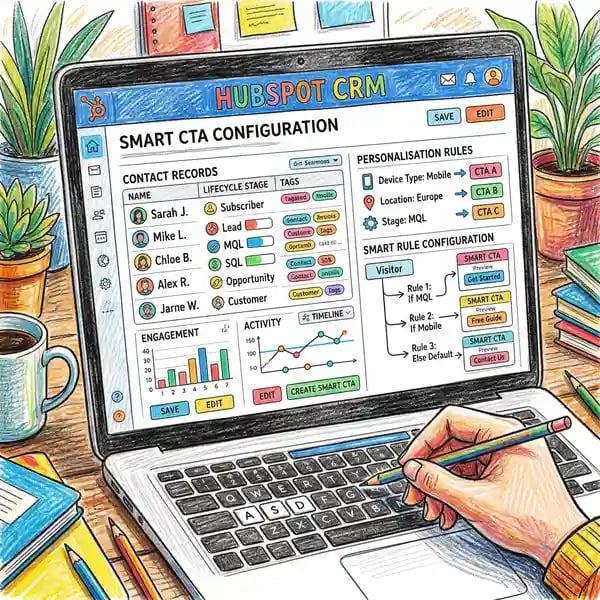
HubSpot's CTA infrastructure underwent substantial changes through 2024–2025 that transform what is possible with Smart CTAs. Understanding these updates is essential for marketing teams wanting to maximise their personalisation investment.
CTA Editor 2.0: HubSpot launched CTA Editor 2.0 with Smart CTAs going live in December 2024 and A/B testing entering public beta. The legacy CTA editor sunset has been indefinitely postponed — both editors remain available for existing accounts. However, accounts created after 17 March 2025 can only access the new editor. It offers improved design flexibility, better mobile responsiveness, and native integration with HubSpot's broader design system.
Breeze AI integration: The most transformative addition is Breeze AI, HubSpot's artificial intelligence ecosystem launched at INBOUND 2024 and expanded through 2025. Three capabilities directly impact Smart CTA effectiveness: Breeze Copilot (AI assistant with full CRM access to identify optimal CTA targeting), Breeze Agents (automated specialists that generate CTA copy variations for A/B testing), and Breeze Intelligence (real-time data enrichment and buyer intent signals that work with anonymous visitors using IP-based company data).
Loop Marketing methodology: At INBOUND 2025, HubSpot CEO Yamini Rangan introduced "Loop Marketing" as the new growth playbook, comprising four stages: Express → Tailor → Amplify → Evolve. Smart CTAs sit squarely within the "Tailor" stage, where the focus is on personalising experiences based on real-time signals. The Flywheel model remains valid — Loop Marketing builds on it with AI-enhanced personalisation.
What Segmentation Strategies Maximise Smart CTA Performance?
Basic lifecycle stage targeting — showing different CTAs to leads versus customers — captures only a fraction of Smart CTAs' potential. Advanced segmentation strategies layer multiple criteria to create highly-targeted experiences that feel genuinely relevant.
| Strategy | How It Works | Example |
|---|---|---|
| Behavioural | Trigger CTAs based on page engagement, content downloads, email interactions | Visitor viewed pricing page 3× → show "Pricing Consultation" CTA instead of "Contact Us" |
| Intent-based | Use Breeze Intelligence for competitor research signals and buyer intent | Visitor researching competitors on G2 → trigger comparison content CTA |
| ABM-tiered | Three tiers: 1:1 accounts, cluster accounts, programmatic segments | Tier 1: "See how [Company Name] can reduce implementation time by 40%" |
| First-party data | Progressive profiling and CRM data powers personalisation without cookies | First-party behavioural data improves CAC by 83% and boosts ROI by 72% |
The ABM-tiered approach deserves particular attention for B2B companies. Tier 1 (1:1 accounts) gets fully personalised CTAs mentioning the company by name. Tier 2 (cluster accounts) receives industry-specific CTAs for groups of 5–10 similar accounts. Tier 3 (programmatic) uses firmographic data — company size, industry, region — for segment-level personalisation. This ensures your highest-value targets receive maximum personalisation whilst maintaining scalable experiences for broader audiences.
Need help configuring Smart CTAs in your HubSpot portal? Explore our HubSpot services to see how we set up personalisation that converts.
View HubSpot ServicesHow to Create Effective Smart CTAs in HubSpot: Step by Step
Creating Smart CTAs in HubSpot's new editor follows a structured process, though strategic planning beforehand determines ultimate success. Here is how to implement Smart CTAs that actually convert.
Define Your Segmentation Strategy
Before touching the CTA editor, map your buyer journey stages to specific CTA offers. Document which offers align with each lifecycle stage and what triggers indicate a visitor is ready for each offer. This prevents the common mistake of creating Smart CTAs reactively rather than systematically.
Create Your Default CTA First
Navigate to Marketing → Lead Capture → CTAs. Click "Create CTA" and design your default version first — this appears when no smart rules match. Choose between button, banner, or pop-up CTAs depending on your placement strategy. The new editor supports custom fonts, colours, and styling inherited from your brand settings.
Activate Smart Rules and Create Variants
Click "Make Smart" to enable personalisation. Select your criterion — country, device type, referral source, language, list membership, or lifecycle stage. Then create alternative CTA versions for each segment. Start with lifecycle stage segmentation: one for unknown visitors (educational offer), one for leads/MQLs (consideration content), and one for SQLs/customers (consultation or upsell).
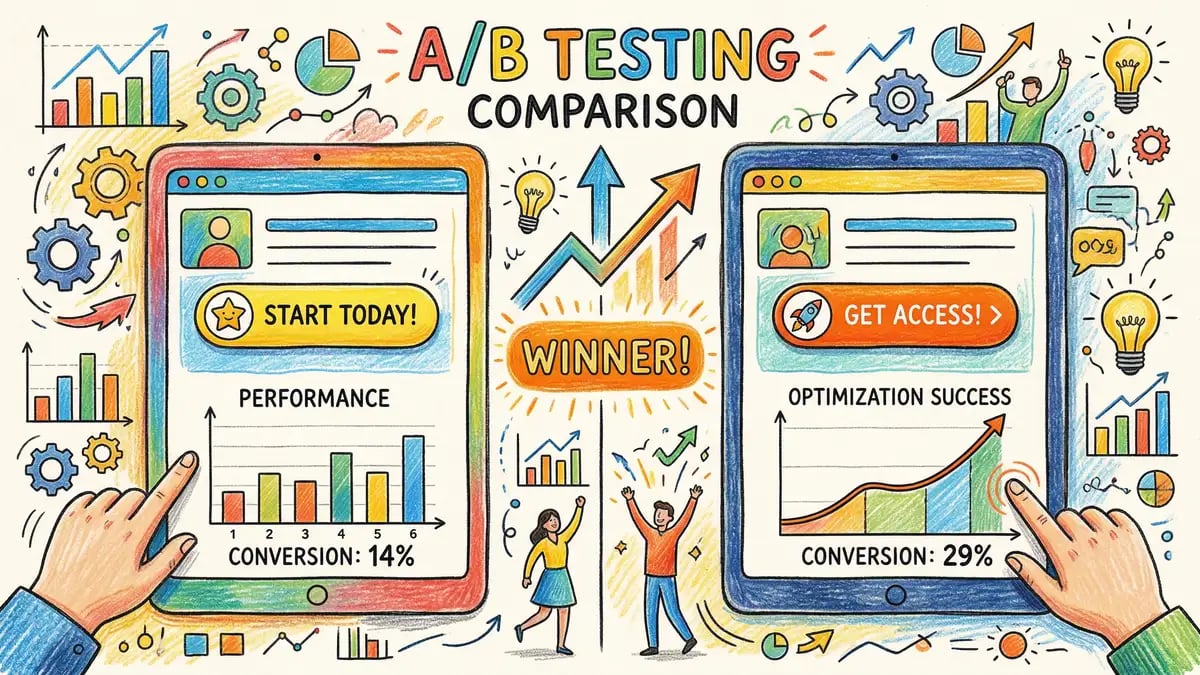
Configure A/B Testing
With A/B testing now in public beta, test different Smart CTA versions against each other. Test one variable at a time — copy, colour, offer, or design — to generate actionable insights. HubSpot's AI-powered testing through Breeze can auto-generate copy variations, accelerating your testing velocity significantly.
Place, Monitor, and Optimise
Embed Smart CTAs in blog posts, landing pages, website pages, and emails. Position CTAs both within content (contextual placement) and at natural decision points (end of sections, after key arguments). Monitor performance through HubSpot's CTA analytics dashboard, tracking views, clicks, and conversions by segment.
Smart CTA Best Practices for B2B Marketing
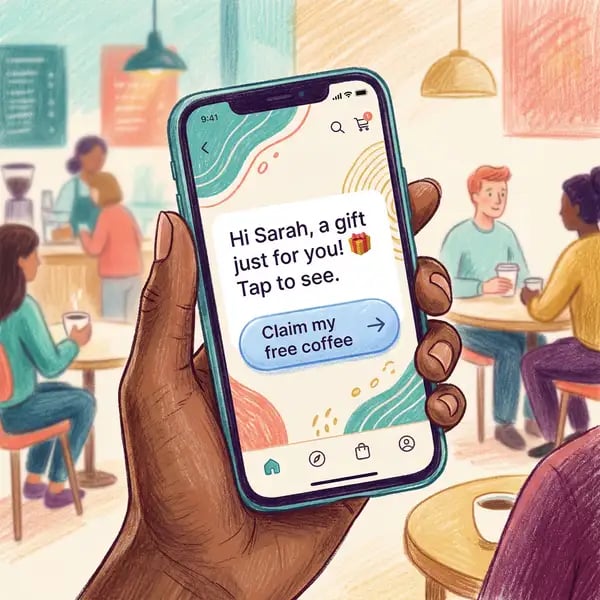
Implementing Smart CTAs effectively requires balancing personalisation depth with practical execution. Based on our experience across B2B HubSpot implementations, these practices deliver consistent results.
Match CTA offers to buyer journey stage. Awareness-stage visitors respond to educational content (guides, checklists, industry reports). Consideration-stage prospects want proof and comparison (case studies, ROI calculators, product demos). Decision-stage buyers need consultation and commitment pathways (strategy sessions, implementation discussions).
Use specific, outcome-focused copy. "Get Your Free HubSpot Audit" outperforms "Learn More." "See How [Industry] Companies Increased Pipeline 45%" beats "Read Case Study." Specificity signals relevance and value — marketers who consistently test CTAs see approximately 28% improvement in conversion performance.
Create a compelling default CTA. Your default (non-smart) version displays when no rules match. Make it strong enough to convert unknown visitors whilst not conflicting with your personalised versions.
Limit smart rules per CTA. Complexity increases maintenance burden and debugging difficulty. Start with 2–3 variations, prove the concept, then expand systematically. Integrate Smart CTAs with your content marketing strategy by mapping specific CTAs to specific content clusters.
The Bottom Line
First-party CRM data is the fuel for Smart CTAs. Despite Google's April 2025 reversal on Chrome cookie deprecation, Safari and Firefox already block third-party cookies by default. Research shows first-party behavioural data improves customer acquisition costs by 83% and boosts ROI by 72%. Building robust contact records through progressive profiling directly feeds Smart CTA effectiveness — this is why a well-configured HubSpot CRM is foundational to personalisation success.
Frequently Asked Questions About Smart CTAs
What HubSpot subscription do I need for Smart CTAs?
Smart CTAs require Marketing Hub Professional or Enterprise, or Content Hub Professional or Enterprise. The feature is not available in Starter tiers or the free CRM.
Can Smart CTAs personalise for anonymous visitors?
Yes, with limitations. Smart CTAs can personalise based on country (IP geolocation), device type, referral source, and browser language for anonymous visitors. With Breeze Intelligence, you can also target based on company and industry data derived from IP addresses. Full personalisation based on contact properties requires a known contact record.
How long does it take to see results from Smart CTAs?
Most B2B companies see meaningful conversion improvements within 30–60 days of implementation, assuming sufficient traffic volume. HubSpot's data shows companies that invest at least one month in planning and strategy achieve 34% better results than those who rush implementation. Statistical significance for A/B tests typically requires 100+ conversions per variation.
Should I use the new CTA editor or legacy editor?
If you have access to both (account created before March 2025), the new editor offers better design flexibility and Breeze AI integration. However, existing CTAs in the legacy editor continue working — migrate progressively rather than all at once. Accounts created after 17 March 2025 only have access to the new editor.
How do Smart CTAs fit with GDPR compliance?
Smart CTAs based on first-party CRM data (lifecycle stage, list membership, contact properties) are GDPR-compliant when you have appropriate consent for marketing. IP-based personalisation (country, device) uses technical data that typically falls under legitimate interest. Always document your legal basis and ensure your privacy policy reflects personalisation practices.
Ready to Implement Smart CTAs That Actually Convert?
Our HubSpot implementation includes Smart CTA configuration, segmentation strategy, and ongoing optimisation. As a HubSpot Platinum Partner running the largest London HubSpot User Group, we see what works across hundreds of businesses.
Clwyd Probert
Founder, Whitehat
Clwyd Probert is the founder of Whitehat, a London-based SEO and inbound marketing agency and HubSpot Platinum Partner since 2016. He specialises in helping B2B organisations leverage HubSpot for measurable pipeline growth.
Sources: HubSpot Personalised CTA Research, McKinsey Personalisation Study, Campaign Monitor Email Benchmarks, Sender CTA Statistics 2025, Forrester B2B Buyer Research