
The highest-performing B2B teams in 2026 are combining shorter, smarter forms with conversational AI, interactive tools, and intent-driven personalisation to convert prospects who increasingly arrive via AI answer engines rather than organic search alone. According to HubSpot's analysis, each form field beyond five costs approximately 4.1% in conversion rate, whilst multi-step formats deliver up to 300% higher conversion than single-step equivalents.
300%
Higher Conversion
Multi-step vs single-step forms
4.4x
Better Conversion
AI-referred visitors vs organic search
10.1 months
B2B Buying Cycle
Down from 11.3 months in 2024
Traditional web forms are no longer the centre of B2B conversion — they're one node in an AI-mediated, privacy-constrained, multi-channel engagement system. For mid-market companies running HubSpot, this means rethinking conversion architecture from the ground up.
Form Best Practices Have Shifted Toward Fewer Fields, More Steps
The core trade-off between conversion volume and lead quality remains, but the research consensus has sharpened. Formstack's 2025 study of 1,500 B2B decision-makers found forms exceeding seven fields hit a 67.8% abandonment rate. Field type matters as much as field count: phone number requests cause an 18.7% conversion drop, budget and revenue fields cost 12–15% each, and dropdowns generate 15.2% fewer abandonments than free-text inputs.
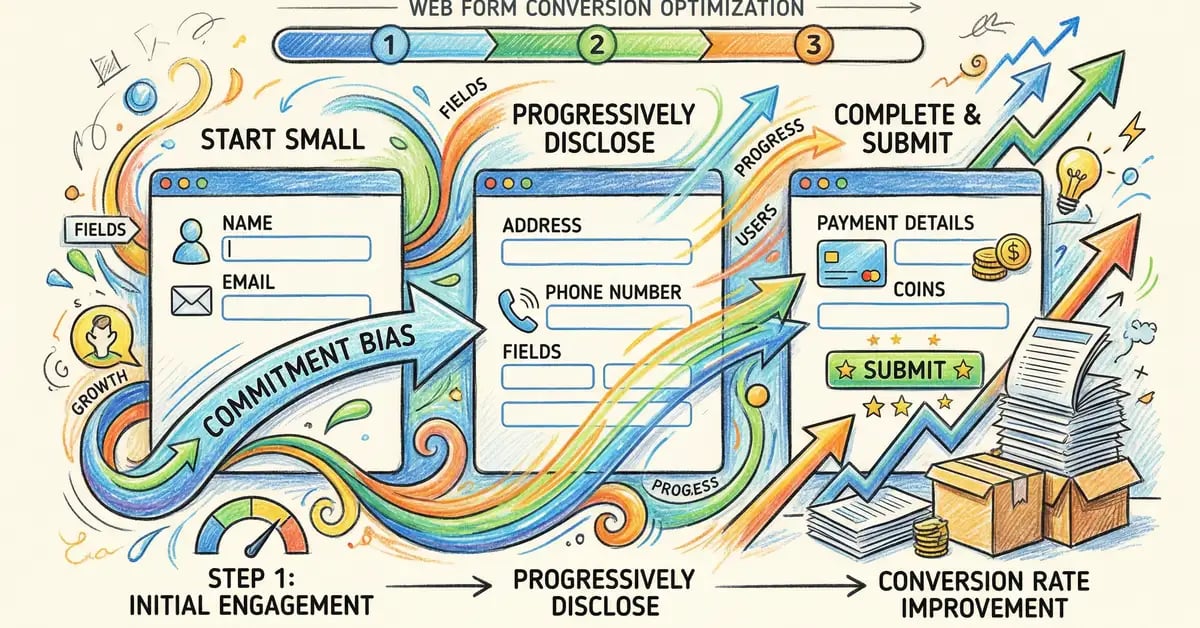
Multi-step forms are the single highest-impact structural change. Venture Harbour's replicated testing shows multi-step formats deliver up to 300% higher conversion. A consulting inquiry form jumped from 0.96% to 8.1% — a 743% increase — simply by splitting fields across steps. The psychology is straightforward: commitment bias kicks in after step one, progress indicators create momentum, and each step feels cognitively manageable.
| Field Type | Conversion Impact | Recommendation |
|---|---|---|
| Phone number | −18.7% | Defer to sales follow-up |
| Budget/revenue | −12–15% | Use progressive profiling |
| Free-text inputs | +15.2% abandonment | Replace with dropdowns |
| Personalised CTA buttons | +202% | Always use value-oriented text |
key takeaway
Progressive profiling increases conversion by 14–30% whilst building 32% more comprehensive lead profiles over time. Companies combining progressive profiling with lead scoring achieve 79% higher MQL-to-SQL conversion. The optimal cadence is 4–7 days between consecutive form interactions.
HubSpot's 2025–2026 Conversion Toolkit Centres on Breeze AI
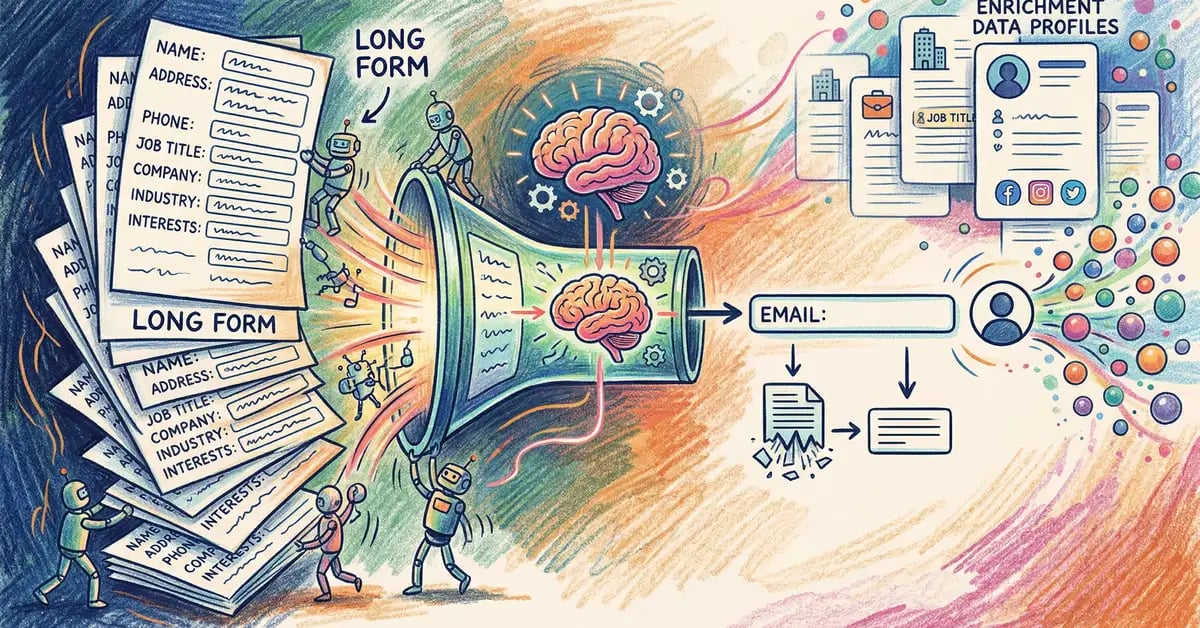
Breeze Intelligence form shortening is the headline feature for form optimisation. Powered by the Clearbit acquisition (200M+ buyer and company profiles), it checks a visitor's email against the enrichment database and dynamically hides fields that can be auto-filled. A seven-field form can shrink to a single email input whilst generating a complete firmographic profile. As of autumn 2025, data enrichment became free, enriching 40+ attributes including industry, company size, revenue, tech stack, and job title.
Breeze Customer Agent has evolved into a unified AI front-office concierge that qualifies leads, schedules meetings, resolves support tickets, and updates HubSpot CRM records across chat, WhatsApp, Facebook Messenger, email, and voice. HubSpot reports it resolves 50%+ of support tickets and reduces closing time by approximately 40%.
The Segments + Personalisation system analyses behaviour, activity, and CRM records to discover intent-rich audience clusters — patterns humans miss. Critically, it works for anonymous visitors using IP-derived company and industry data.
watch out
The autumn 2025 credit restructuring means enrichment is now free, but buyer intent, form shortening, Customer Agent interactions (~100 credits each), and Breeze-powered workflow triggers (~10 credits each) all consume HubSpot Credits. Most conversion-critical Breeze features require Professional or Enterprise tiers.
AI-Powered Conversion Is Delivering Measurable Pipeline Impact
Website personalisation platforms are producing the most dramatic results. Mutiny enables no-code personalisation based on firmographic data — Contractbook achieved a 971% increase in SQL conversions with an ROI calculator for ICP visitors, MarketerHire delivered a 5× conversion rate increase, and Automox recorded a 185% conversion lift from industry-specific copy.
Predictive lead scoring has become mainstream. Chronus combined Lift AI and 6sense to increase lead-to-opportunity conversion 11.6× (from 3.4% to 39.3%). 6sense processes over one trillion buyer signals daily and reports 25–30% conversion rate increases.
AI chatbots now convert 3–5× better than traditional forms. A B2B SaaS company replacing its homepage contact form with an AI chatbot saw a 210% increase in qualified leads within six weeks.
Want to see how AI-powered conversion could work for your HubSpot portal? Our Diamond Partner team can audit your current forms and recommend quick wins.
Get Your Free AuditGetting Conversion Content Cited by AI Answer Engines
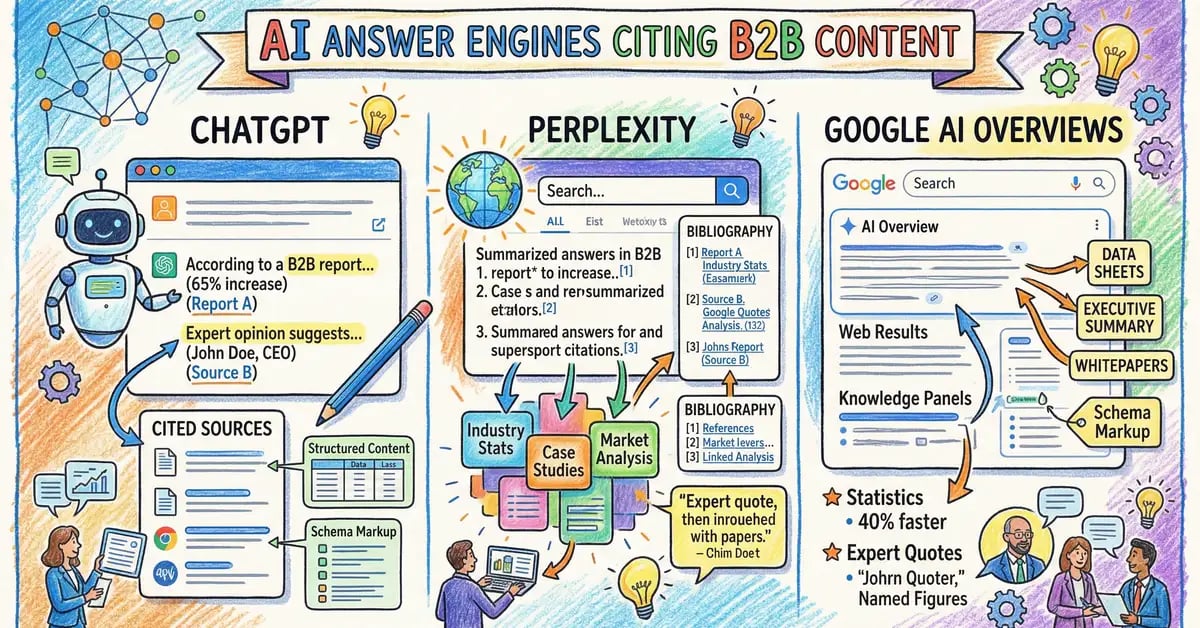
AI-driven search is reshaping how conversion-stage content reaches buyers. Gartner predicts a 25% drop in traditional search volume by 2026. ChatGPT now has 800 million weekly active users and drives 87.4% of all AI referrals. The critical finding: LLM visitors convert 4.4× better than organic search visitors.
The Princeton/Georgia Tech GEO study found adding statistics, citing credible sources, and including expert quotations can boost AI visibility by up to 40%. Schema markup provides a measurable boost — sites with structured data see up to 30% higher visibility in AI Overviews, and FAQPage schema delivers a 3.2× citation boost.
| AI Platform | Content Preference | Citation Rate |
|---|---|---|
| ChatGPT | Comparison matrices | 63% |
| Perplexity | Industry benchmarks | 59% |
| Claude | Comprehensive guides | 69% |
| Google AI Overviews | FAQ content with schema | 71% |
the bottom line
Gated content is cited 64–94% less often by AI engines than freely accessible resources.
The recommended approach is hybrid gating: offer 30–40% of content freely with semantically complete summaries and gate deeper content behind forms.
76% of B2B companies now use hybrid gating to balance AI visibility with lead capture.
Alternative Conversion Mechanisms Outperforming Traditional Forms
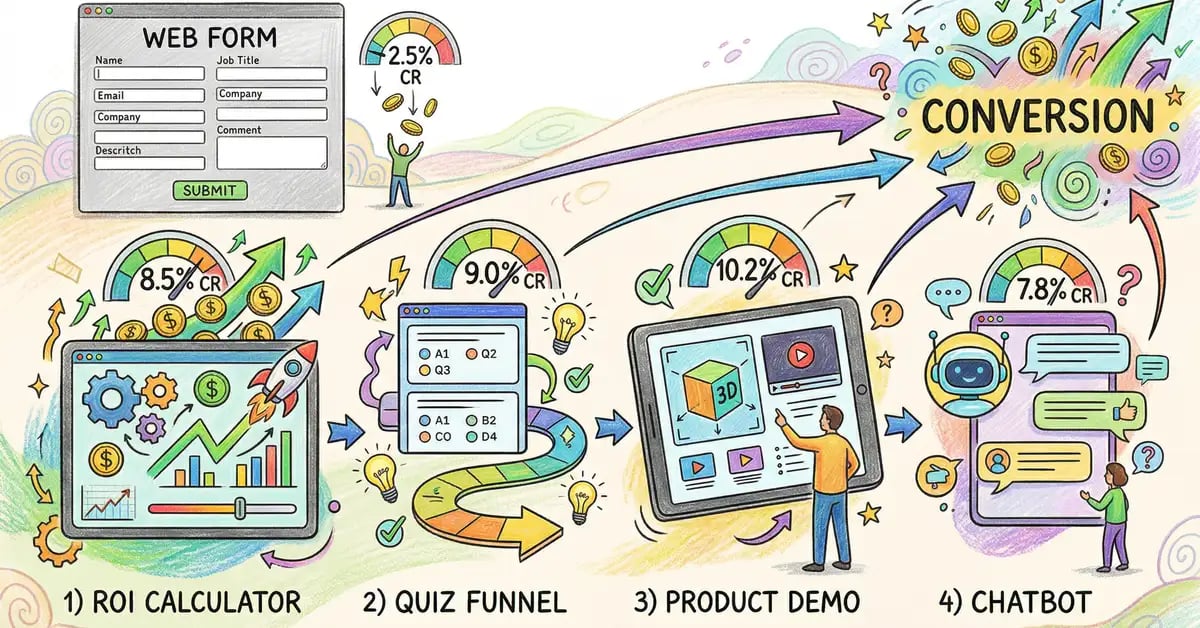
Interactive calculators deliver 2.3× higher conversion than static content — a 7.4% conversion rate versus 3.2% for static content with 4:27 average engagement time. Gartner reports interactive tools shorten B2B sales cycles by 28% on average.
Conversational marketing has reached 44.6% adoption with 28% year-over-year growth. Drift has shortened sales cycles by 20% and moved qualified leads through pipeline 3× faster. Quiz funnels report 30–50% conversion rates — dramatically higher than traditional PDF downloads. Interactive product demos are the fastest-growing category: 18% of B2B SaaS websites now feature an interactive demo CTA, with product-qualified leads converting 5–8× better than traditional MQLs.
Speed-to-lead is the highest-leverage post-form variable. Response within one hour yields 53% conversion; after 24 hours, it drops to 17%. Leads contacted within five minutes are 21× more likely to qualify than after 30 minutes. Yet only 8% of top B2B SaaS companies have instant scheduling on their websites.
Sources: HubSpot Form Field Analysis, Formstack 2025 B2B Decision-Maker Study, Venture Harbour Multi-Step Form Testing, 6sense 2025 Buyer Experience Report, Princeton/Georgia Tech GEO Study, Content Marketing Institute 2025 B2B Benchmark, Unbounce Landing Page Conversion Benchmark (41,000 pages)
Frequently Asked Questions
How many form fields should a B2B lead capture form have?
Research shows 3–5 fields is the sweet spot for top-of-funnel B2B offers. Each field beyond five costs approximately 4.1% in conversion rate. Forms exceeding seven fields hit a 67.8% abandonment rate according to Formstack's 2025 study.
Do multi-step forms really convert better than single-step forms?
Yes — multi-step forms deliver up to 300% higher conversion than single-step equivalents. The psychology works through commitment bias after step one, progress indicators creating momentum, and each step feeling cognitively manageable.
What is HubSpot Breeze Intelligence form shortening?
Breeze Intelligence checks a visitor's email against 200M+ buyer profiles and dynamically hides fields that can be auto-filled. A seven-field form can shrink to a single email input whilst generating a complete firmographic profile with 40+ attributes on the backend.
How do AI answer engines affect B2B conversion strategy?
LLM visitors convert 4.4x better than organic search visitors, but gated content is cited 64–94% less often by AI engines. The recommended approach is hybrid gating: offer 30–40% freely for AI citation and gate deeper content behind forms.
What conversion rate should B2B landing pages achieve?
The median landing page conversion rate across all industries is 6.6%. Good is 10%, excellent is 15%+. B2B SaaS significantly underperforms at 3.8%, whilst professional services overperform at up to 12.3%.
Clwyd Probert
Managing Director, Whitehat
Clwyd Probert is Managing Director of Whitehat, a London-based SEO and inbound marketing agency and HubSpot Diamond Partner. With over 14 years helping B2B companies connect marketing to revenue, Clwyd leads the largest London HubSpot User Group and specialises in AI-enhanced search strategies.
Ready to Modernise Your Conversion Architecture?
Whitehat is a HubSpot Diamond Partner helping mid-market B2B companies replace outdated forms with AI-powered conversion systems. Book a free strategy call to audit your current convert-stage performance.