
Whitehat SEO • Updated 20 March 2026 | Explore our digital marketing FAQs
Key Takeaway
Personalised CTAs convert 202% better than generic defaults. AI-driven personalisation, interactive formats, and strategic placement now define high-converting CTA strategy. Master these principles to unlock 25–40% annual improvement.
Personalised CTAs convert 202% better than generic defaults, according to HubSpot's landmark study of 330,000+ calls-to-action. This remains the single most important benchmark for B2B marketers in 2026. What's changed is the tooling: platforms like HubSpot Breeze AI, Mutiny, and Webflow Optimize now generate, test, and adapt CTA copy and design in real time, whilst interactive formats—quizzes, calculators, video CTAs, and conversational chatbots—are rewriting what a "call to action" even looks like.
CTA Best Practices for 2026 That Actually Convert
Personalised, AI-driven CTAs now convert at roughly three times the rate of static defaults—making generic "Learn More" buttons an increasingly expensive missed opportunity.
At Whitehat, we've implemented these strategies across dozens of B2B HubSpot deployments. This guide compiles the latest statistics, platform capabilities, design principles, and strategic frameworks you need to optimise CTAs across the full buyer journey—with practical implementation guidance for HubSpot users.
Key Benchmarks for 2026
- 202% higher conversion for personalised vs generic CTAs (HubSpot)
- 4.23% average CTA click-through rate; top 10% achieve 11.5%+
- 371% more clicks from single-CTA emails vs multi-CTA
- 3× better conversion from conversational CTAs vs standard forms
- 40.1% average conversion rate for interactive quizzes
202%
Personalisation Lift
vs generic CTAs (HubSpot study)
4.23%
Average CTA CTR
Top 10% exceed 11.5%
371%
Single-CTA Advantage
vs emails with multiple CTAs
40.1%
Quiz Conversion Rate
Interactive format benchmark
Conversion benchmarks by channel, device, and industry
The average website CTA click-through rate sits at 4.23% across all formats, though performance varies dramatically by type, industry, and optimisation level. The top 10% of websites achieve conversion rates above 11.5%, whilst the median hovers around 2.4–2.9%. Understanding these benchmarks helps B2B marketing teams set realistic targets and identify improvement opportunities.
Landing pages with a single CTA convert at 13.5% on average. Add a second or third CTA and that drops to 11.9%, then 10.5% with five or more. The lesson is blunt: focus beats choice. This aligns with research showing that reducing cognitive load consistently improves conversion rates—a principle that extends across landing page design and email marketing alike.
B2B and SaaS benchmarks
B2B SaaS websites typically convert at 1–3%, whilst professional services pages can reach 10% when well-optimised. Google Ads CTR for SaaS averages roughly 1.91%, and B2B email campaigns see a 3.2% average CTR. The gap between average and top performers is enormous—systematic CRO programmes that include CTA testing deliver cumulative annual improvements of 25–40%.
| Metric | Benchmark | Top Performers |
|---|---|---|
| Website CTA CTR | 4.23% | 11.5%+ |
| Single-CTA landing page | 13.5% | 20%+ |
| B2B SaaS website | 1–3% | 5–7% |
| B2B email CTR | 3.2% | 5–7% |
| Mobile conversion rate | 1.6–2.9% | 4%+ |
Sources: HubSpot Personalisation Report 2025, Unbounce Conversion Benchmark Report 2024, Segment State of Personalisation Report 2025
Mobile versus desktop performance
Desktop visitors convert at roughly 4.3–5.1% compared to mobile's 1.6–2.9%—a near 2× gap. Yet mobile accounts for 68% of email opens and the majority of initial website visits. Optimising CTAs specifically for mobile closes this gap meaningfully: mobile-optimised sites convert 30–45% higher than non-optimised ones, and CTA buttons outperform text links by 200% on mobile.
Sticky bottom CTAs improve mobile conversions by 12–27%, and floating checkout buttons on e-commerce sites have delivered a 37% increase in checkout starts. The minimum touch target should be 48×48 pixels (per Google Material Design and WCAG 2.2 guidelines) with at least 8px spacing between interactive elements—mobile UX issues account for 48% of user drop-offs.
Email CTA performance
Emails with a single CTA generate 371% more clicks and 1,617% more sales than multi-CTA emails. Personalised automated emails achieve 5–7% CTR versus the 2–3% industry average. Only 43% of marketers currently limit themselves to one CTA per email, suggesting substantial untapped improvement for the majority. For teams using HubSpot, this single-CTA discipline pairs well with the platform's A/B testing capabilities to continuously optimise email performance.
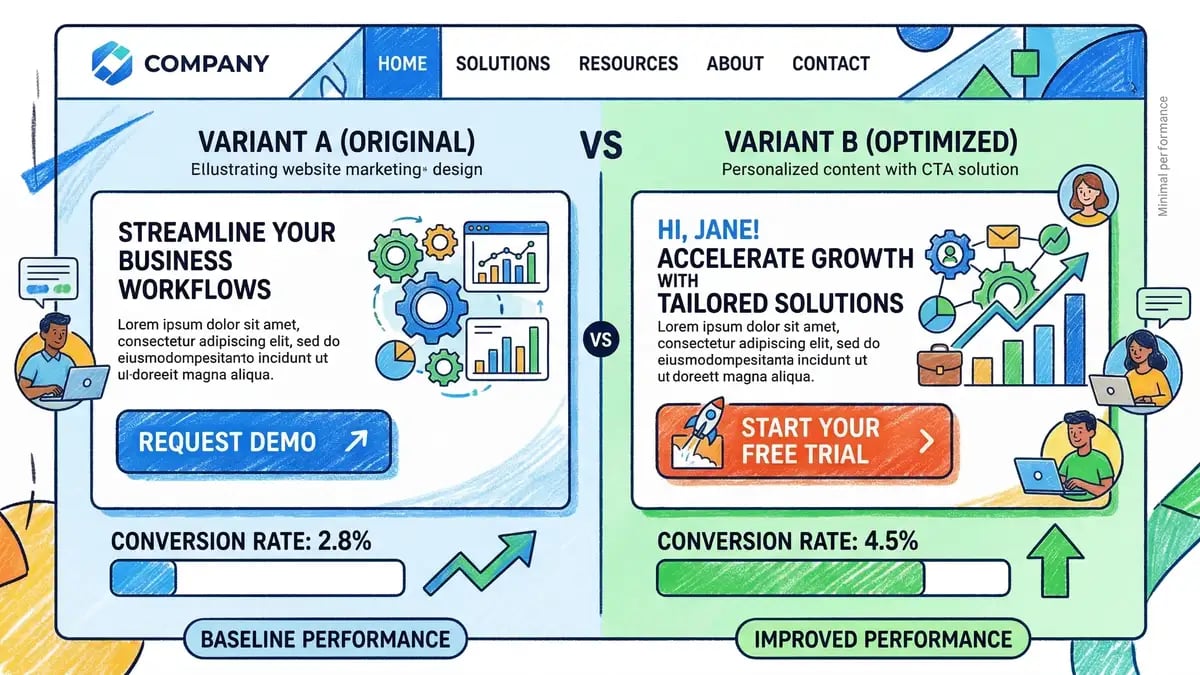
The 202% personalisation advantage and how AI scales it
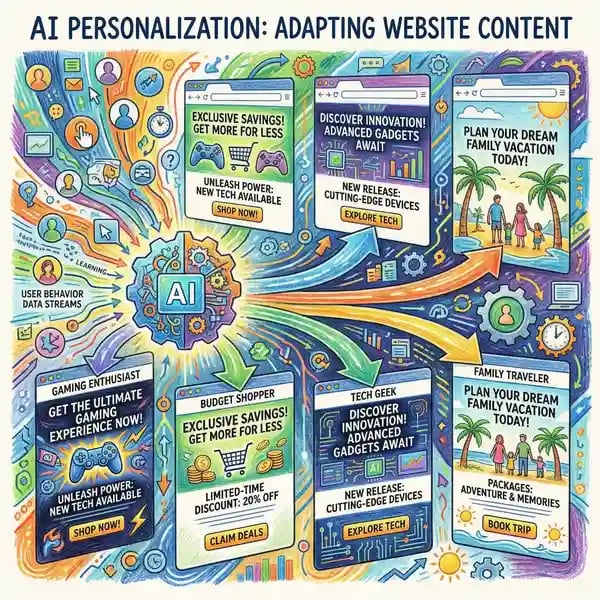
HubSpot's finding that personalised CTAs convert 202% better than generic defaults has been reaffirmed across 2025 research without a competing study of comparable scale. Supporting data reinforces the pattern: AI-powered dynamic CTAs boost conversions by up to 44% (Segment 2025 Report), list-based personalisation increases conversion rates by up to 42% (DemandGen Report), and 71% of consumers now expect personalised interactions—with 76% expressing frustration when they don't receive them.
What's changed is the sophistication of delivery. The trajectory is clear: CTA personalisation is shifting from manual rule-based segmentation to predictive, AI-driven adaptation that adjusts copy, design, placement, and offers in real time based on behavioural signals, intent data, and machine learning models that improve with every interaction. This is why AI personalisation techniques have become central to modern marketing strategy.
Platform performance examples
- Mutiny: Notion achieved 60% signup increase in under three weeks; Contractbook saw 971% SQL conversion increase
- Webflow Optimize: 53% lift for Sumo Logic; $2.8 million incremental revenue for Drift
- Persado Motivation AI: Outperforms human copy 96% of the time with 41% average conversion lift
- Air Canada: AI-recommended shift from "book now" to "see deals" produced 220% more click-throughs
HubSpot Breeze AI capabilities
HubSpot Breeze AI now generates complete CTAs from text descriptions—copy, images, and layout—directly within the CTA editor. The Breeze Assistant refines existing CTA text with slash commands (rewrite, expand, shorten, change tone), and an AI-generated performance summary analyses each CTA's metrics with follow-up question capability.
The Personalisation Agent, launched at INBOUND 2025, identifies which audience segments respond best to specific content and automatically generates tailored CTA variants without requiring duplicate builds—a significant efficiency gain for teams managing multiple segments. As a HubSpot Diamond Partner, Whitehat has found that successful Breeze implementations require proper foundation work: configuring Brand Identity settings before enabling Content Agents, establishing clean CRM data before activating personalisation features, and integrating with your broader SEO strategy.
Design and UX principles for high-converting CTAs
Button design centres on contrast, not colour dogma. There is no universally "best" CTA colour—context determines effectiveness. An analysis of 90 high-converting CTAs found orange particularly effective because it stands out on both light and dark backgrounds. The operative principle is to reserve your brand's accent colour exclusively for primary CTAs, creating instant visual recognition.
Changing button colour alone can boost conversions by 21%, but the mechanism is contrast against the surrounding page, not the colour itself. High-contrast buttons improve visibility by 50% (Adobe), and WCAG 2.2 requires a 4.5:1 contrast ratio for button text against button background, with 3:1 minimum for the button against the page. For more on how colour impacts conversion, see our guide to colour psychology for website design.
Shape, animation, and micro-interactions
Rounded rectangles remain the standard shape—they signal approachability whilst being universally recognised as clickable. Subtle shadows or slight elevation reinforce "clickability," especially in 2026's neumorphism-lite aesthetic. Micro-animations are making a significant comeback: well-designed hover effects can increase clickability by up to 30%, with 150–300ms transitions striking the right balance between responsiveness and subtlety. Morphing buttons that transform into loading spinners on click provide immediate feedback that reduces uncertainty.
Strategic placement
Placement strategy requires nuance rather than rigid rules. CTAs above the fold outperform those below by up to 304% in aggregate data, but controlled experiments show the opposite when the content above the fold hasn't adequately conveyed the value proposition—one test saw below-fold CTA placement improve conversions by 220% when paired with better storytelling.
The most reliable pattern is multiple placements: pages with CTAs at both top and bottom convert 25% better than single-placement pages. Inline CTAs embedded within content deliver 121% higher CTR than sidebar CTAs. Centred CTAs receive 682% more clicks than left-aligned versions. Placing CTAs directly after testimonials or social proof increases conversions by 25–68%.
Dark mode and accessibility considerations
For dark mode—now the default for a growing share of users—use dark greys (#121212 to #1E1E1E) instead of pure black, desaturate CTA colours by approximately 20 points compared to light mode, and test rendering across platforms. Gmail and Outlook.com can auto-invert button colours in email, making tools like Litmus essential for QA.
Accessibility is both a legal requirement and a conversion lever—colour contrast violations affect 83.6% of websites. Beyond contrast ratios, CTAs must use semantic HTML (<button> for actions, <a> for navigation), include descriptive aria-label attributes, provide visible focus indicators with at least 3:1 contrast, and support full keyboard navigation.
Optimise your CTA strategy with HubSpot's native smart content and AI-driven personalisation. Our marketing services help B2B teams implement these techniques at scale.
Explore Our Marketing ServicesPsychology and copy: the words that drive action
The single most impactful CTA copywriting insight remains the first-person framing effect. ContentVerve's A/B test found "Start my free 30-day trial" outperformed "Start your free trial" by 90% in CTR. Copyblogger's replication confirmed a 24% advantage for first-person button text. The psychology is straightforward: "my" triggers the endowment effect, making users feel ownership of the action.
Best practice is to use "you/your" in body copy to address readers directly, then switch to "I/my" in button text to transfer ownership at the conversion point. This technique applies equally to HubSpot CTA creation and broader marketing campaigns.
Action verbs and specificity
Action verbs should lead every CTA. The highest-performing verbs include Get, Start, Try, Join, Discover, Download, Book, Claim, and Unlock. CTAs with action words increase conversions by up to 20%, and specificity amplifies this: "Get 3 Free Templates" vastly outperforms "Download," and PartnerStack's shift from "Book a Demo" to "Get Started" produced a 111.55% conversion increase. The optimal word count is 2–5 words for button copy, with most high-converters landing at four words.
Ethical urgency and value proposition framing
Ethical urgency works when authentic. Adding genuine time-sensitivity to CTAs increases conversion rates by up to 332%, though this figure represents best-case scenarios with real scarcity. Countdown timers add roughly 9% to conversion rates. The ethical line is clear: never fabricate scarcity. Words like "now" and "today" provide implied urgency without hard deadlines, raising conversions by 14% in controlled tests. Reserve countdown timers and "only X left" messaging for genuinely limited offers—false scarcity damages credibility and can trigger regulatory action.
Value proposition framing follows a simple formula: state the benefit, remove the risk, create action. Netflix's pairing of "Get Started" with "Cancel anytime" exemplifies this—addressing doubt alongside the CTA has been shown to increase conversions by 124%. Trust badges near CTAs add 7–12% to conversion rates, and placing testimonials directly adjacent to CTAs increases conversions by 34%. Social proof integrated into CTA copy ("Join 10,000+ marketers") leverages conformity bias, with specific numbers (5,432 rather than "5,000+") adding credibility.
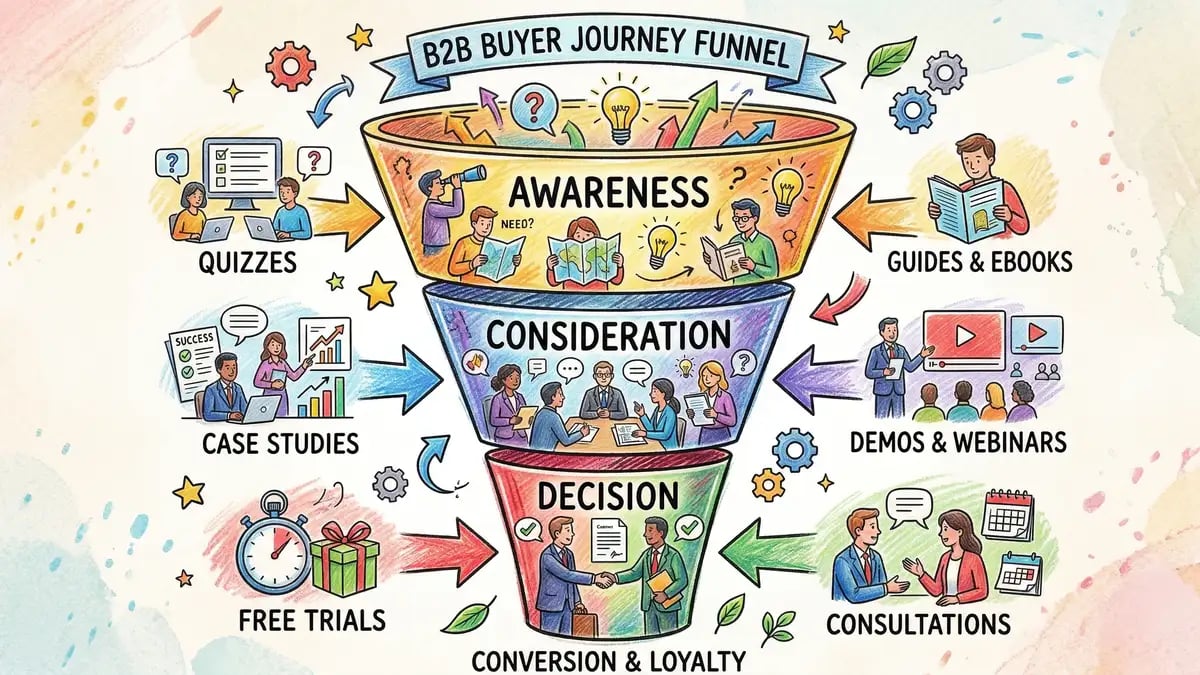
Matching CTAs to the buyer journey
Effective CTA strategy requires alignment with where prospects are in their decision process. What converts at awareness stage will fall flat at decision stage, and vice versa. This journey-based approach is central to the inbound marketing methodology and directly impacts conversion rates at every stage.
Awareness stage
Awareness stage CTAs must prioritise education over sales. Interactive quizzes achieve an average 40.1% conversion rate from start to lead capture, making them the highest-performing awareness format. VenturePact's mobile app cost calculator generated 87,381 qualified leads with a 40% form conversion rate. Other effective awareness CTAs include free guides, newsletter subscriptions, and blog subscriptions. The critical rule: never deploy "Buy Now," "Request a Quote," or other bottom-of-funnel language on awareness content. Keep forms ultra-short—email plus one field maximum.
Consideration stage
Consideration stage CTAs shift toward evaluation support. ROI calculators, comparison tools, case studies, and on-demand webinars help prospects assess fit. The Demand Gen Report's 2025 B2B Buyer Survey found that content allowing customisation, exploration, or simulation has measurably higher impact during research stages. Effective consideration CTAs include "Calculate Your Potential ROI," "Read the Case Study," and "Compare Our Plans." Social proof becomes increasingly important here—customer logos, industry awards, and specific results figures should appear near every consideration-stage CTA.
Decision stage
Decision stage CTAs must eliminate friction and create urgency. Free trials, consultations, live demos, and pricing transparency are the primary conversion drivers. Sticky CTAs on pricing pages increase cart additions by 33%. Every decision-stage CTA should include "doubt removers"—micro-copy like "No credit card required," "Cancel anytime," or "30-day money-back guarantee" positioned directly below the button.
B2B-specific considerations
B2B requires a distinct approach because of longer sales cycles, multiple stakeholders, and higher form resistance. Only 17% of B2B buyers' time is spent meeting suppliers, and 81% of tech buyers refuse to fill out forms for gated content. Conversational CTAs (chatbots) address this—they achieve 35–40% response rates compared to forms' 7% average.
B2B teams should map CTAs to stakeholder roles: technical evaluators need "See Technical Specifications," financial decision-makers need "Calculate Your ROI," and executive sponsors need "Read the Executive Summary." Progressive profiling—showing only 2 fields per interaction—doubles conversion rates compared to 4-field forms whilst building richer contact profiles over time. Learn more about implementing these techniques with HubSpot's smart content capabilities.
| Stage | CTA Priority | Effective CTA Examples |
|---|---|---|
| Awareness | Education over sales | Get Free Guide, Try Quiz, Subscribe to Newsletter |
| Consideration | Evaluation support | Calculate ROI, Read Case Study, Compare Plans, Watch Demo |
| Decision | Friction removal | Start Free Trial, Schedule Demo, Request Quote |
Source: Demand Gen Report 2025 B2B Buyer Survey

Emerging formats reshaping what CTAs can be
Conversational CTAs
Conversational CTAs are the single biggest format shift. Chat-based CTAs convert 3× better than standard forms, and chatbot lead conversion rates can exceed 40%. Gartner predicts conversational AI will cut contact centre labour costs by $80 billion in 2026. Platforms like Qualified (which helped Bitly increase pipeline 6×) and Landbot (conversational landing pages that triple or quadruple conversion rates) are making this accessible beyond enterprise budgets.
The integration pattern is increasingly sophisticated: AI chatbots recognise target accounts via reverse IP, qualify leads through natural conversation, and schedule meetings—functioning as dynamic, context-aware CTAs rather than static page elements.
Video CTAs
Video CTAs deliver outsized performance—in-video CTAs increase conversions by 380% compared to sidebar placements. Shoppable video drives 9× higher engagement than traditional video ads with a 30% increase in conversion rates. TikTok Shop, Instagram Product Tags, and YouTube Shopping have made shoppable overlays mainstream. For B2B, platforms like Wistia enable mid-video CTA gates and end-screen conversion points.
Gamified and interactive CTAs
Gamified CTAs produce 9× more CTR than regular CTAs in aggregate data, with users spending 7.8–10.2 seconds engaging with gamified creatives versus 2.5 seconds for static banners. Spin-to-win wheels, scratch-off reveals, and progress bars create participatory moments that dramatically increase engagement. Interactive quiz and calculator CTAs—built on platforms like Outgrow, Interact, and Typeform—blend gamification with practical value, achieving the highest conversion rates of any content format.
Voice-activated CTAs
Voice-activated CTAs remain nascent but are gaining traction through platforms like Respond Fast, which bridges offline media (direct mail, TV, print) with smart speaker responses. The USPS now offers postage discounts for mailers incorporating voice assistant integration, signalling institutional adoption.
HubSpot's CTA toolkit: capabilities and implementation
HubSpot's new CTA editor (CTA 2.0) replaced the legacy tool for accounts created after March 2025, though the legacy editor's sunset has been postponed indefinitely as of August 2025. The new editor offers a significant capability upgrade: full drag-and-drop editing with modules for images, text, forms, videos, countdown timers, and meeting links. CTA types now include pop-up boxes, banners, slide-ins, embedded buttons, embedded images, and custom HTML—a major expansion from the legacy tool's button-only format.
Smart CTA targeting
Smart CTA targeting in the new tool operates at two levels. Pop-ups, banners, and slide-ins have a dedicated Targeting tab supporting website URL rules, activation triggers (page scroll percentage, exit intent, inactivity timer, button click), and visitor information filters (list membership, device type, session count, pages visited, referral URL, and known versus unknown visitor status).
Within any CTA module, smart content rules can vary display by country, device, referral source, preferred language, contact list membership, and lifecycle stage. The AND/OR logic between filter groups enables sophisticated targeting without code. For more on maximising these capabilities, explore how smart CTAs supercharge inbound marketing.
A/B testing and analytics
A/B testing entered public beta in early 2026 (Marketing Hub Professional/Enterprise). The current implementation supports two variants with a 50/50 traffic split, with manual winner selection after reviewing click rate, views, and submission data. This is a step down from the legacy tool's 30-variant multivariate capability, so teams running sophisticated testing programmes should be aware of this limitation.
Analytics include aggregate reporting filtered by campaign, CTA type, and date range, with metrics covering views, clicks, click rate, form submissions, submission rate, and attributed submissions (form completions on redirect pages). Breeze AI generates performance summaries for individual CTAs with follow-up question capability. One notable gap: new CTA reports cannot yet be added to HubSpot dashboards directly—a frequently requested feature under active development. For comprehensive guidance on attribution reporting, see our detailed guide.
HubSpot CTA Implementation Best Practices
- Deploy smart CTAs on high-traffic pages like the homepage with lifecycle-stage-based messaging
- Limit each page to one primary CTA to avoid decision paralysis
- Associate every CTA with a campaign for proper attribution
- Use Breeze AI for rapid CTA prototyping, then refine manually
- Leverage the Personalisation Agent to automatically generate segment-specific variants from a single CTA asset
What separates average CTAs from exceptional ones
The data converges on a small number of high-impact principles. Personalisation delivers the largest single uplift—the 202% improvement from smart CTAs dwarfs gains from colour changes (21%), button redesigns (6%), or even copy rewrites (12%). Teams that deploy AI-driven personalisation platforms alongside HubSpot's native smart CTA capabilities are compounding these advantages.
Format innovation is equally powerful: interactive quizzes (40.1% conversion), conversational chatbots (3× form conversion), and in-video CTAs (380% versus sidebar) represent structural performance advantages, not incremental tweaks.
The most actionable insight for 2026 may be the simplest: reduce rather than add. A single CTA per email increases clicks by 371%. A single CTA per landing page converts 32% better than multiple options. Reducing form fields from four to two doubles conversion rates. In a landscape of increasingly sophisticated AI and personalisation tools, the discipline of simplicity—one clear, personalised, well-placed CTA with friction removed—remains the highest-leverage move available.
At Whitehat, we help B2B companies implement these CTA strategies within HubSpot environments where results connect directly to pipeline and revenue. As a HubSpot Diamond Partner, we've seen firsthand how systematic CTA optimisation compounds over time—typically delivering 25–40% annual improvement for teams that commit to continuous testing.
Frequently asked questions
What is a good CTA conversion rate for B2B websites?
The average B2B SaaS website converts at 1–3%, whilst professional services pages can reach 10% when well-optimised. Top performers (10th percentile) achieve conversion rates above 11.5%. For landing pages specifically, the median is 6.6%, but top performers reach 15–20%. Your target should be 25–50% above your current baseline, with systematic testing to drive continuous improvement.
How many CTAs should be on a landing page?
Research consistently shows that landing pages with a single CTA convert at 13.5% on average, compared to 10.5% for pages with five or more CTAs. The 32% improvement from single-CTA focus applies across most contexts. You can place the same CTA multiple times (top and bottom), but avoid competing offers that create decision paralysis.
Do HubSpot smart CTAs really convert 202% better?
Yes—HubSpot's study of 330,000+ CTAs found personalised smart CTAs convert 202% better than generic defaults. This benchmark has been reaffirmed by subsequent research, including Segment's 2025 report showing AI-powered dynamic CTAs boost conversions by up to 44% beyond baseline personalisation. The key is proper implementation: clean CRM data, meaningful segmentation criteria, and regular performance review.
What CTA button colour converts best?
There is no universally best CTA colour—contrast determines effectiveness, not the colour itself. The principle is to reserve your brand's accent colour exclusively for primary CTAs, ensuring they stand out from surrounding content. Button colour changes can boost conversions by 21%, but only when the change improves contrast. Focus on WCAG 2.2 compliance (4.5:1 contrast ratio for text) rather than colour trends.
Should I use first-person or second-person copy in CTAs?
Use both strategically. Write body copy in second person ("You'll discover...") to address readers directly, then switch to first person in button text ("Start My Free Trial") to trigger the endowment effect. ContentVerve found this approach delivers 90% higher CTR than second-person button copy alone. The psychological shift creates ownership at the moment of conversion.
Ready to unlock CTA conversion improvement?
Whitehat combines strategic CTA design, HubSpot implementation, and continuous testing to deliver measurable conversion gains. Most teams see 25–40% annual improvement through systematic optimisation.
References and sources
- HubSpot: Personalized CTAs Convert 202% Better Than Generic
- Unbounce Conversion Benchmark Report 2024
- WordStream: Call to Action Examples and Best Practices
- Segment: State of Personalization Report 2025
- Demand Gen Report: 2025 B2B Buyer Survey
- Gartner: AI in Marketing Research
- McKinsey: The Value of Getting Personalization Right
- W3C: WCAG 2.2 Quick Reference
- HubSpot Knowledge Base: New CTA Editor
- Nielsen Norman Group: Call-to-Action Buttons
Clwyd Probert
Managing Director, Whitehat SEO
Clwyd is a HubSpot Diamond Partner and SEO strategist specialising in inbound marketing implementation for B2B SaaS companies. He leads Whitehat's approach to CTA optimisation and conversion rate strategy across HubSpot deployments, with a focus on connecting every campaign to measurable revenue impact.