
Conversion Optimisation
The conversion landscape has shifted significantly. With 92% of businesses now using AI-driven personalisation and mobile accounting for 82.9% of landing page visitors, the old rules about button colours and placement need updating. What works now is a combination of behavioural psychology, smart technology (particularly HubSpot's Smart CTAs), and rigorous testing.
CTA Best Practices for 2026: Data-Driven Strategies That Actually Convert
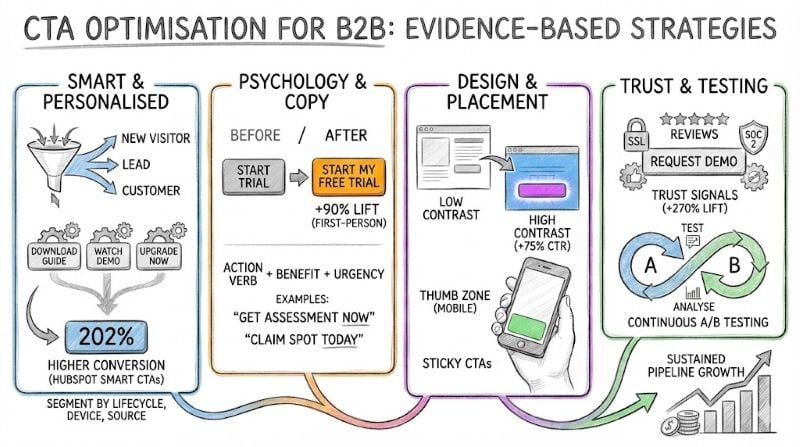
Personalised CTAs convert 202% better than generic versions, according to HubSpot's analysis of over 330,000 calls-to-action—making smart CTA strategy one of the highest-leverage conversion opportunities for B2B marketers in 2026. Whitehat SEO's work with HubSpot implementations consistently shows that companies applying these evidence-based CTA principles see measurable improvements in lead generation within 30 to 60 days of implementation.
This guide synthesises the latest research on CTA optimisation with practical implementation guidance for B2B marketing teams—whether you're running inbound marketing campaigns, optimising landing pages, or configuring HubSpot for maximum conversion impact.
B2B conversion benchmarks: The numbers that matter
Understanding realistic performance expectations helps you identify genuine optimisation opportunities. The average CTA achieves a 4.23% click-through rate, though HubSpot's platform data indicates 2.84% across all industries. Email CTAs perform between 2–5% depending on industry, with top performers exceeding 10%.
The most striking finding from Whitehat SEO's analysis of client data: email-driven traffic converts at 19.3%—the highest of any channel—making email CTA optimisation particularly valuable for B2B companies with established nurture sequences.
| CTA Format | Conversion Rate | Best Use Case |
|---|---|---|
| Full-page popup (content download) | 13.6% | Lead magnets, gated content |
| Lightbox popup (email sign-up) | 9.8% | Newsletter subscriptions |
| Mid-page banner | 3.8% | Content upgrades |
| Sidebar CTA | 0.4–1.2% | Secondary offers only |
| Inline text link | 0.2–0.8% | Avoiding banner blindness |
The button versus text link debate has clear winners: CTA buttons deliver 45% higher conversion than text links, with mobile showing an even more dramatic 200% improvement for button-style CTAs. However, anchor text CTAs (inline links within content) generate 121% higher CTR than banner ads, suggesting the optimal approach combines both formats strategically.
Psychology-backed copy changes that drive double-digit lifts
The most dramatic conversion improvements often come from simple copy changes rooted in behavioural science. Several principles consistently deliver measurable results in Whitehat SEO's HubSpot implementations.
First-person language creates psychological ownership
Changing "Start your free trial" to "Start my free trial" increased click-through rates by 90% in ContentVerve's testing for Unbounce. This effect replicated across multiple tests, with a 24.91% lift when changing "Create your account" to "Create my account". The shift works because it transforms the experience from "the brand asking" to "the user claiming"—a subtle but powerful reframe.
Action verbs that emphasise value received
The most effective action verbs—"Get," "Start," "Download," "Try," and "Claim"—emphasise value received rather than action required. WordStream research shows these verbs improve performance by up to 20%. Conversely, "Submit" consistently underperforms (nobody wants to "submit"), and generic phrases like "Click here" or "Learn more" create uncertainty.
The formula that works:
Action verb + Benefit + Urgency element
Example: "Get Your Free Assessment Now"
Colour matters less than contrast
HubSpot's famous red-versus-green study showed red outperforming by 21%, but the key insight was that the page had predominantly green branding—red simply created better visual contrast. Research across 90 high-converting CTAs found no single colour consistently wins. Instead, buttons that contrast sharply with their surroundings increase click-through rates by up to 75%. The practical takeaway: ensure your CTA button stands out against your page design rather than obsessing over specific colour psychology.
Authentic urgency drives substantial results
Countdown timers combined with limited-time offers increased conversions by 300% in documented testing, whilst real-time stock levels improved e-commerce conversions by 17.8%. The critical caveat: fake scarcity damages trust. Effective urgency ties to genuine deadlines, limited inventory, or time-sensitive opportunities—not manufactured pressure.
Strategic CTA placement for simple versus complex offerings
The conventional wisdom that CTAs must appear "above the fold" requires nuance. Nielsen Norman Group eye-tracking confirms content above the fold receives 57% of users' viewing time, and above-fold visibility reaches 73% compared to 44% below the fold. For simple products and established brands, above-fold CTAs capitalise on this attention.
However, for complex B2B offerings requiring explanation, the opposite approach works better. Marketing Experiments found below-fold CTAs preceded by persuasive content increased conversions by 20%, whilst MECLABS documented a 220% lift when CTAs followed clear value propositions. One test showed moving a CTA to the bottom of a long-form page achieved 304% higher conversion.
The principle: Placement should match the "persuasive flow" of your content. For complex B2B solutions—like HubSpot integration projects or comprehensive SEO services—visitors need education before they're ready to convert.
Mobile placement follows different rules
With 75% of users operating phones one-handed and screen sizes exceeding 6.5 inches, the "thumb zone"—the bottom 25% of the viewport—represents prime real estate. Primary CTAs positioned here are easiest to reach. Sticky CTAs that remain visible during scrolling increase conversions by 27% according to Crazy Egg data, and floating CTAs on e-commerce increase add-to-cart rates by 33%.
Trust elements that amplify conversion rates
B2B buyers face higher stakes and longer decision cycles than consumers, making trust signals particularly important near CTAs. The Spiegel Research Center found displaying reviews increases conversion by 270%, whilst ConversionXL documented 12.3% lifts from security badges and 15% improvement when combining trust badges with real-time social proof.
The most effective trust elements near CTAs include:
- Security badges (SSL, Norton, McAfee)
- Payment method logos
- Money-back guarantees
- "No credit card required" text
- Social proof numbers ("Join 10,000+ customers")
- For B2B specifically: compliance badges (SOC 2, GDPR, HIPAA), industry certifications, and enterprise client logos
Placement matters: trust badges should appear directly adjacent to or immediately below CTA buttons. On checkout pages, Baymard Institute found 19% of shoppers abandon purchases because they don't trust the site with payment information—a problem trust badges directly address, reducing cart abandonment by up to 20%.
HubSpot Smart CTAs: Your path to the 202% improvement
The 202% performance advantage for personalised CTAs represents one of the most significant optimisation opportunities available to B2B marketers. HubSpot's Smart CTAs enable segmentation by country, device type, referral source, preferred language, contact list membership, and lifecycle stage—each criterion enabling more relevant experiences.
Whitehat SEO's HubSpot onboarding methodology includes Smart CTA configuration in the first 30 days because of the measurable impact on conversion rates.
Smart CTA implementation best practices
- Create rules based on contact lists tied to specific properties—showing different CTAs to prospects versus customers versus churned accounts
- Show alternate CTAs to visitors who have already converted on offers—don't keep promoting the ebook they've already downloaded
- Implement different CTAs for mobile users when desktop experiences don't translate well
- Use A/B testing to identify optimal copy—HubSpot supports up to 50 variations per CTA in Professional/Enterprise tiers
Important consideration: Avoid using Smart CTAs in blog posts, as this may harm SEO and mislead RSS readers. Use them on landing pages, service pages, and areas where personalisation won't affect crawlability.
Beyond HubSpot, platforms like Mutiny enable B2B-specific firmographic targeting (industry, company size, funnel stage), whilst Unbounce's Smart Traffic feature routes visitors to best-performing variants automatically. AI-powered personalisation now delivers up to 44% conversion boosts through real-time CTA adaptation based on browsing behaviour.
Form length and conversion: Finding the right balance
The relationship between form fields and conversion follows documented patterns. Three to five fields represents the sweet spot for most B2B offers. Each additional field reduces conversions by approximately 2–3%, and phone number fields specifically decrease conversions by 48%.
Optimal field counts by offer type
- Newsletter signup: 1–2 fields (email, name)
- Content download: 3–4 fields
- Webinar registration: 4–5 fields
- Demo request: 5–7 fields
- Quote request: 7–10 fields (lowest conversion but highest qualification)
When forms require more than five fields, multi-step formats outperform single-page versions dramatically. HubSpot data shows 86% higher conversion rates for multi-step forms, and Formstack found 13.9% versus 4.5% conversion comparing formats. One case study documented improvement from 0.96% to 8.1%—a 743% increase—using multi-step optimisation.
Multi-step best practices include showing progress indicators, saving user inputs when users navigate back, grouping logical questions together, starting with easy questions (leveraging the commitment/consistency principle), using conditional logic to show/hide relevant fields, and keeping each step to three to five fields maximum.
Case studies: What specific CTA changes achieve
Real-world testing provides concrete examples of optimisation impact. These case studies illustrate principles that translate across B2B contexts.
PartnerStack: 111.55% lift
Changing "Book a Demo" to "Get Started" improved conversion from 6.66% to 14.09%. The insight: "Get Started" frames the action as helping customers solve problems, whilst "Book a Demo" signals entering a sales cycle—an important distinction for B2B buyers wary of premature sales engagement.
Mailmodo: 110.35% improvement
Changing "Book a demo" to "Talk to a Human" doubled their conversion rate from 0.29% to 0.61%. Adding human elements to transactional copy resonates with B2B audiences tired of automated experiences.
PriceCharting: 620.9% improvement
Changing ambiguous "Download" to specific "Price Guide" achieved statistical significance within one week. Users understood exactly what they would receive, eliminating uncertainty that blocked action.
Going: 104% lift
Changing "Sign up for free" to "Trial for free" doubled trial start rates. The word "trial" invited users to experience full value without commitment, whilst "sign up" implied a process with unclear benefits.
Aligning CTAs with the buyer's journey
Different funnel stages require distinct approaches. Mapping CTAs to the buyer's journey ensures relevance and maximises conversion at each stage—a principle central to effective inbound marketing strategy.
Awareness stage
CTAs should be educational and low-commitment: "Learn More," "Download Guide," "Read Article," or "Watch Video." The goal is providing value whilst building familiarity. High-commitment asks at this stage typically underperform.
Consideration stage
CTAs help prospects explore solutions: "Watch Demo," "Compare Plans," "See Features," or "Get Pricing." These CTAs should emphasise differentiators and benefits relevant to the evaluation process.
Decision stage
CTAs drive conversion for qualified prospects: "Request Demo," "Get Quote," "Start Free Trial," or "Book Consultation." Direct action with clear value propositions works best here.
With average B2B sales cycles lasting 102 days and 90% of buyers initiating with online search, nurturing throughout the journey matters. Post-conversion CTAs maintain engagement: "Upgrade Now," "Join Exclusive Webinar," or "Speak to Success Manager."
Testing frameworks for continuous improvement
Systematic A/B testing delivers 28% average improvement according to HubSpot data, making testing infrastructure essential for sustained optimisation.
Testing priority order (based on impact potential)
- CTA copy first (highest impact, easiest to test)
- CTA colour/contrast
- Placement (above versus below fold)
- Number of CTAs
Single-variable testing is critical—changing multiple elements simultaneously obscures which change drove results. Tests should run for complete business cycles (including weekends for B2B), achieve statistical significance before declaring winners, and measure conversion rate rather than just clicks.
Notably, the Obama campaign's CTA testing generated a 40.6% improvement translating to $60 million in additional donations, illustrating the scale of impact possible through systematic optimisation.
Implementation priorities for HubSpot users
For B2B companies using HubSpot, Whitehat SEO recommends prioritising these optimisations for highest impact:
1. Smart CTAs represent the fastest path to the 202% improvement
Implement lifecycle-stage-based personalisation, show different CTAs to new versus returning visitors, and create segment-specific experiences based on industry or company size.
2. Lead scoring integration
Assign point values to CTA clicks (typically 5–10 points depending on CTA value), create dynamic lists based on score thresholds, trigger workflows when scores reach qualifying levels, and implement score decay to maintain accuracy over time.
3. Mobile optimisation
With most visitors arriving on mobile devices, ensure 48px minimum touch targets, position primary CTAs in the thumb zone, implement sticky CTAs for longer pages, and optimise page speed to under three seconds.
4. Accessibility compliance
Meet legal requirements whilst improving performance: 4.5:1 contrast ratios, 44×44 pixel target sizes for enhanced compliance, proper keyboard navigation, and descriptive button text. With accessibility lawsuits reaching 4,605 cases in 2024 and accessible CTAs showing 27% higher click-through rates, compliance serves both legal and performance goals.
Frequently asked questions about CTA optimisation
What's the ideal CTA button colour for B2B websites?
There is no universal "best" colour—contrast matters more than the colour itself. HubSpot's testing showed red outperforming green by 21%, but only because it contrasted better with the page design. Choose a colour that stands out against your page whilst remaining on-brand. Buttons with strong contrast improve click-through rates by up to 75%.
How many form fields should I include on a lead generation form?
For most B2B offers, three to five fields is optimal. Each additional field reduces conversions by 2–3%. If you need more information, use multi-step forms—they convert 86% higher than single-page forms for longer forms. Avoid phone number fields unless essential, as they reduce conversions by 48%.
Should CTAs be placed above or below the fold?
It depends on your offering complexity. For simple products or offers, above-fold placement captures immediate attention—73% visibility compared to 44% below fold. For complex B2B solutions requiring explanation, below-fold CTAs following persuasive content can increase conversions by 20–220%. Match placement to your content's persuasive flow.
How do HubSpot Smart CTAs work?
HubSpot Smart CTAs display different content based on visitor characteristics including lifecycle stage, list membership, device type, country, referral source, and preferred language. They enable personalisation that achieves 202% higher conversion rates than static CTAs. Available in HubSpot Professional and Enterprise tiers.
What CTA copy works best for B2B demo requests?
Testing shows that "Get Started" often outperforms "Book a Demo" because it feels customer-centric rather than sales-driven. "Talk to a Human" or "Talk to an Expert" humanises the experience. Use first-person language ("Start my demo") for up to 90% higher click-through rates. Always test variations specific to your audience.
Making CTA optimisation work for your business
The data consistently shows that thoughtful CTA optimisation delivers measurable ROI. The specific tactics—first-person copy, high contrast design, appropriate form length, strategic placement, and smart personalisation—compound when applied systematically.
For B2B marketers serving longer sales cycles and multiple decision-makers, CTAs represent controllable conversion levers with documented, substantial impact. The 202% improvement available through personalisation alone makes Smart CTA implementation one of the highest-value optimisations available.
Whitehat SEO's HubSpot onboarding services include CTA strategy and Smart CTA configuration as standard, ensuring clients capture these conversion improvements from day one. For companies already on HubSpot looking to optimise, our website audit identifies specific CTA improvement opportunities with projected impact.
References and sources
- HubSpot (2024). "Personalised CTAs Convert 202% Better" — Analysis of 330,000+ CTAs. blog.hubspot.com
- Unbounce (2024). "CTA Buttons vs Text Links" — Conversion Rate Research. unbounce.com
- Nielsen Norman Group (2024). "Eye-Tracking and Above-the-Fold Content". nngroup.com
- Baymard Institute (2024). "Cart Abandonment Rate Statistics". baymard.com
- WordStream (2024). "Call-to-Action Statistics and Best Practices". wordstream.com
- Crazy Egg (2024). "Sticky CTAs and Conversion Research". crazyegg.com
- Formstack (2024). "Multi-Step Form Conversion Rate Study". formstack.com
Ready to optimise your HubSpot CTAs?
Whitehat's HubSpot onboarding includes Smart CTA configuration and conversion optimisation strategy as standard. view our pricing
Talk to Our HubSpot Team