
Business Strategy
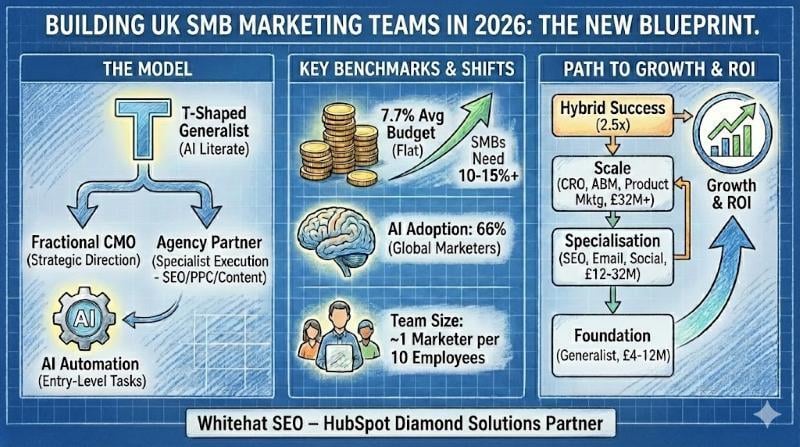
The optimal marketing team for UK SMBs in 2026 combines one T-shaped marketing generalist with AI literacy, supported by either a fractional CMO for strategic direction or an agency partner like Whitehat SEO for specialist execution. Marketing budgets have flatlined at 7.7% of revenue according to Gartner's 2025 CMO Spend Survey, while AI adoption among marketers has reached 66% globally. This convergence means businesses allocating £100k–£500k to marketing face a fundamentally different hiring landscape than even two years ago.
Building Marketing Teams in 2026: What UK Businesses Need to Know
The optimal marketing team structure has fundamentally changed. Here's what the research reveals—and how to build a team that actually delivers.
The fractional CMO boom, shifting agency economics, and AI automation are reshaping what constitutes an effective marketing function. UK businesses that understand these dynamics will build leaner, more effective teams. Those that don't will waste budget on structures that no longer make sense.
The 7.7% benchmark—and why SMBs should spend more
Marketing budgets have stabilised at 7.7% of company revenue according to both the Gartner CMO Spend Survey (May 2025, 402 CMOs surveyed) and the CMO Survey from Duke and Deloitte. This marks a significant decline from the 11% pre-pandemic average, with 64% of CMOs reporting insufficient budget to execute their strategy.
However, this benchmark skews heavily toward enterprises. For SMBs specifically, the research suggests higher allocations drive better results:
Recommended marketing spend by revenue:
- Businesses under £10M revenue: 15.6%
- Businesses £10-25M revenue: 12.2%
- Growing small businesses: 7-10% baseline
- Aggressive growth companies: 10-20%
Within that marketing budget, Gartner's 2025 data shows current allocation trends: 30.6% to paid media (up 11% year-on-year), 22-23.8% to marketing technology (declining—lowest in a decade), 22% to labour, and 21% to agencies (with 39% of CMOs planning further cuts).
For a £200k budget, this translates to roughly £60k for paid media, £45k for MarTech, £44k for team costs, and £42k for agency fees. Whitehat SEO's website audit services can help identify where your current spend delivers the strongest returns.
Team size benchmarks that actually matter
The SimpleTexting 2024 Survey found most small businesses operate with 3-5 marketing employees. A practical rule of thumb: approximately one marketer per 10 employees delivers effective coverage for companies with strong marketing functions.
ROI confidence correlates directly with team size. Companies with 10+ marketing employees report 75% confidence in positive ROI, while those with no dedicated marketing staff show only 6% confidence. The message is clear: marketing requires dedicated resources to deliver measurable returns.
For companies in the £100k-£500k budget range, Whitehat SEO recommends these practical team structures:
| Budget Range | Recommended Structure |
|---|---|
| £100k-£200k | One Marketing Manager/Generalist (£45-55k fully loaded), agency retainer for SEO/PPC/content (£24-60k/year), plus freelance support as needed |
| £200k-£350k | Fractional CMO (1-2 days/week, £30-50k/year), 1-2 Marketing Coordinators (£30-45k each), plus specialist agency support |
| £350k-£500k | Head of Marketing (£60-80k), Digital Marketing Specialist (£35-50k), Content/Social Media Manager (£30-45k), with selective outsourcing for specialist campaigns |
How AI has transformed the hiring equation
The adoption numbers are striking: 66% of marketers globally now use AI in their roles according to HubSpot's State of AI 2025 report, while 91% of marketing leaders say their teams use AI to assist work. Salesforce reports 75% of marketers are either experimenting with or have fully implemented AI.
This adoption is reshaping team requirements. The World Economic Forum's Future of Jobs 2025 report found 41% of employers plan workforce reductions due to AI automation within five years. Entry-level marketing positions face the highest displacement risk—jobs like junior copywriting, basic reporting, social media scheduling, and keyword research are being automated fastest.
The roles most protected from AI displacement include strategic marketing leadership (only 9-21% automation risk for managerial roles), creative direction, brand strategy, and cross-functional collaboration positions. As HubSpot's SVP of Marketing Kieran Flanagan noted: "A lot of the science of marketing will get automated by AI, leaving marketers more time for craft."
Skills in demand—the numbers:
- Creative Execution: 443% increase in demand
- Artificial Intelligence skills: 392% increase
- Marketing Technology: 351% increase
- Collaborative Problem-Solving: 138% growth since 2021 (LinkedIn's "skill of the year")
New roles are emerging rapidly. Job postings requiring AI skills jumped 73% from 2023 to 2024, then surged another 109% from 2024 to 2025 according to Lightcast data. Two-thirds of leaders now say they wouldn't hire someone without AI skills—yet only 39% of workers have received AI training from their employers.
Whitehat SEO's AI consultancy services help businesses navigate this transition, identifying which marketing tasks to automate and which require human strategic oversight.
The fractional CMO explosion
The fractional executive market has become a defining trend of 2025. The number of fractional leaders doubled from 60,000 in 2022 to 120,000 in 2024, with the global market topping £4.5 billion and growing at 14% annually. LinkedIn profiles mentioning "fractional" roles exploded from 2,000 in 2022 to 110,000 by early 2024.
The economics are compelling. A full-time CMO costs £130,000-£220,000 annually in the UK. A fractional CMO delivers 80-90% of strategic value for £36,000-£180,000 annually depending on engagement level. Firms replacing ad-hoc tactics with strategic fractional leadership see 25-35% higher marketing ROI within 12 months according to Forbes analysis.
When fractional CMO makes sense:
- Annual marketing spend above £500k needing C-level planning but less than 40 hours weekly of work
- Rising customer acquisition costs for three or more consecutive quarters
- Need for strategic direction but not full-time execution capacity
- Transition periods between full-time marketing leaders
Current adoption is significant: one in four US businesses already uses fractional leaders, projected to reach 35% by 2025. The UK market is following the same trajectory, with professional services and B2B technology sectors leading adoption.
In-house versus agency versus hybrid models
UK data from the LOCALiQ State of Digital Marketing Report 2026 shows 67% of businesses manage SEO in-house while 33% use agencies. Crucially, businesses that blend in-house marketing with external support are 2.5 times more likely to rate their marketing as successful than those relying solely on internal staff.
The ROI comparison depends on timeframe. Agencies typically outperform in the first 6-12 months due to existing frameworks and cross-client insights, with AI-driven agencies delivering 15-20% faster turnaround and 10-15% lower costs than static internal setups. However, in-house teams build compounding efficiency once systems mature, typically gaining advantage after 12+ months.
UK agency pricing has increased significantly—rates climbed 62% on average compared to 2024. Current benchmarks:
- SEO retainers: £750-£1,200/month
- PPC management: £500-£15,000/month (typically 10-20% of ad spend)
- Full-service retainers: £3,500-£16,750/month
- London agency premiums: 30-50% above regional competitors
The hybrid model consensus: keep brand strategy, core messaging, and community management in-house. Outsource technical execution (SEO, PPC), specialist campaigns, and functions used occasionally that require expertise not worth hiring full-time.
As a HubSpot Diamond Partner, Whitehat SEO works as an extension of clients' internal teams—providing the specialist expertise for SEO, PPC, and platform implementation while supporting in-house strategic direction.
The right hiring sequence for small businesses
HubSpot's comprehensive scaling framework recommends a phased approach. The T-shaped marketer model—broad knowledge across disciplines with deep expertise in 1-3 areas—remains the consensus recommendation for small businesses building their first marketing function.
Phase 1: Foundation (5-10 people, approximately £4-12M revenue)
Your first hire should be a Marketing Generalist capable of executing across content, social, basic SEO, and email. The sequence continues with VP/Director of Marketing, Content Marketing Manager, Demand Generation Manager, then Graphic Designer.
The rationale: generalists establish systems that specialists build upon later. Keep hierarchy flat initially with all team members reporting to the marketing leader, maintaining roughly a 1:5-6 leader-to-contributor ratio.
Phase 2: Specialisation (11-17 people, £12-32M revenue)
Specialists should be introduced once core channels are validated. This includes SEO Specialist, Email Marketing Manager, and Social Media Manager.
Phase 3: Scale (18+ people, £32M+ revenue)
Scale-stage roles include Product Marketing Director, ABM Manager, and CRO Manager.
For businesses building from scratch, establish tools and systems first—CRM, email marketing software, and CMS should be in place before scaling team. Those inheriting teams should assess current capabilities, identify gaps across marketing strategy, performance measurement, tech-enabled marketing, and operating model, then establish clear governance.
UK salary benchmarks for 2025
Marketing salaries increased 7.7% on average over the past 12 months according to 3Search's 2025 Salary Guide. The highest-paid marketing sectors are automotive (£67,850 mean) and consumer electronics (£67,750 mean).
| Role | Salary Range |
|---|---|
| Chief Marketing Officer | £130,000-£220,000 |
| Head of Marketing | £60,000-£90,000 |
| Digital Marketing Manager | £45,000-£70,000 (£50,000-£65,000 London) |
| Marketing Manager | £40,000-£60,000 |
| Digital Marketing Executive | £30,000-£45,000 |
| Marketing Assistant | £22,000-£30,000 |
The bottom line: Your minimum viable marketing team in 2026
The research points to a fundamental shift in what constitutes effective small business marketing. For companies with £100k-£500k budgets, the minimum viable team combines:
- One T-shaped marketing generalist with AI literacy
- Either a fractional CMO for strategic direction or an agency partner for specialist execution
- Clear governance on what stays in-house versus what gets outsourced
AI hasn't eliminated the need for marketing teams—it has raised the bar for individual capability while changing which roles deliver value. Entry-level execution is increasingly automated, while strategic thinking, creative direction, and cross-functional collaboration command premium value.
Frequently asked questions
What percentage of revenue should a UK SMB spend on marketing?
While the average across all businesses is 7.7% of revenue, SMBs typically need higher allocations to drive growth. Businesses under £10M revenue should target 15.6%, those between £10-25M should aim for 12.2%, and growing companies in aggressive expansion mode may need 10-20% of revenue allocated to marketing.
Is it better to hire in-house marketers or use an agency?
The hybrid model consistently outperforms pure in-house or pure outsourced approaches. Businesses using both are 2.5 times more likely to rate their marketing as successful. Keep brand strategy and community management in-house while outsourcing technical execution like SEO and PPC to specialists.
When should a business consider a fractional CMO?
Fractional CMOs make sense when you have annual marketing spend above £500k requiring C-level strategic planning, but don't need 40+ hours weekly of executive time. They're also valuable during transitions between full-time marketing leaders or when experiencing rising customer acquisition costs over multiple quarters.
What marketing roles are most at risk from AI automation?
Entry-level positions face the highest displacement risk. Jobs like junior copywriting, basic reporting, social media scheduling, and keyword research are being automated fastest. Strategic roles, creative direction, and cross-functional collaboration positions show only 9-21% automation risk.
Who should be the first marketing hire for a small business?
Your first hire should be a T-shaped marketing generalist capable of executing across content, social media, basic SEO, and email marketing. This person establishes systems and processes that specialists can build upon later. Look for someone with AI literacy and at least 3-5 years of broad marketing experience.
Need help building your marketing team?
Whitehat SEO works as an extension of your internal team, providing the specialist expertise you need without the overhead of full-time hires. As a HubSpot Diamond Partner, we help UK businesses build sustainable marketing functions that deliver measurable ROI.
References and sources
- Gartner 2025 CMO Spend Survey – Marketing budget benchmarks and allocation trends
- HubSpot State of AI 2025 Report – AI adoption rates among marketers
- HubSpot State of Marketing 2025 – Marketing trends and team structures
- Frak Conference State of Fractional Industry Report 2024 – Fractional executive market data
- Great Entrepreneurs: The Rise of Fractional Senior Roles – LinkedIn fractional role growth data
- World Economic Forum Future of Jobs Report 2025 – AI automation impact on employment