
Last Updated: February 2026
Buyer Persona Template: The Complete B2B Guide for UK Marketers
A buyer persona template is a structured framework that guides B2B marketers through documenting their ideal customers' goals, challenges, decision criteria, and buying behaviours. The most effective templates combine demographic data with buying insights, including priority triggers, success factors, perceived barriers, and the full buying committee, then activate these profiles through CRM tools like HubSpot for measurable pipeline impact.
If you have ever felt that your marketing speaks to everyone and resonates with no one, buyer personas are the fix. Research from Cintell found that 71% of companies exceeding revenue and lead goals have documented buyer personas, compared with just 26% of those missing targets. The difference is not subtle. This guide gives you a proven, research-backed template you can download and start using today, built specifically for B2B organisations operating in the UK market.
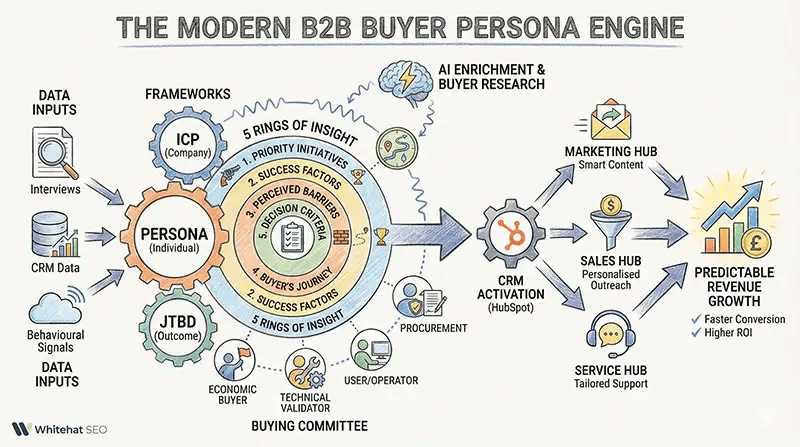
At Whitehat SEO, as a HubSpot Diamond Solutions Partner working with UK B2B companies for over 14 years, we have seen first-hand how properly built personas transform marketing from guesswork into a predictable pipeline. This guide distils everything we have learned into a practical resource you can act on immediately.
Why B2B Buyer Personas Drive Revenue Growth
Buyer personas are not a "nice-to-have" branding exercise. They are a revenue lever. When Thomson Reuters implemented structured buyer personas across their marketing operations, they achieved a 175% increase in marketing-attributed revenue and a 72% reduction in lead conversion time (DemandGen Report). These are not marginal gains.
The evidence extends across multiple studies. Aberdeen Research found that marketers who combine personas with buyer journey mapping achieve 73% higher conversion rates, with MQL rates climbing from 12% to 20%. Persona-driven email campaigns generate twice the open rates and five times the click-through rates of generic sends (MLT Creative). HubSpot's own data shows that personalised calls-to-action deliver 42% higher submission rates than untargeted alternatives.
For UK B2B marketers specifically, the opportunity is significant. Pipeline360's 2025 research found that 56% of UK and EU marketers view content personalisation as a major opportunity, substantially higher than the 47% figure in the US. Yet only 12% of UK marketers rate their current strategy as "exceptional." The gap between aspiration and execution is where buyer personas create the most value.
McKinsey's personalisation research reinforces the financial case: companies that invest in persona-driven personalisation reduce marketing costs by 10 to 20% while lifting revenues by 5 to 15%. Forrester's CX Index found that customer-obsessed organisations experience 41% faster revenue growth and 49% faster profit growth than their peers.
ICP, Buyer Persona, and Jobs-to-Be-Done: How the Three Frameworks Fit Together
One of the most common points of confusion in B2B marketing is the relationship between Ideal Customer Profiles (ICP), buyer personas, and the Jobs-to-Be-Done (JTBD) framework. The short answer: they are complementary tools that operate at different levels, not competing alternatives.
| Framework | Level | Key Question |
|---|---|---|
| ICP | Company / Account | Which companies should we target? |
| Buyer Persona | Individual / Role | Who decides, and how do they buy? |
| JTBD | Motivation / Outcome | What outcome are they trying to achieve? |
Tony Ulwick, the pioneer of Jobs-to-Be-Done theory, warns against relying solely on demographic personas. As he explains, companies go wrong when they assume "because they are different types of users with different demographics and attitudes, they have different unmet needs." Best practice in 2026 is to define your ICP first, create personas for the key decision-makers within those accounts, then layer JTBD insights onto each persona. This produces what Whitehat SEO calls "JTBD-infused personas" that capture both the who and the why.
B2B International's research supports this integrated approach, finding that demographic criteria are relevant for only approximately 15% of B2B purchasing decisions. The buying motivation, evaluation process, and perceived barriers matter far more for effective content marketing strategies and sales enablement.
The 5 Rings of Buying Insight: A Research-Backed Persona Framework
Adele Revella, founder of the Buyer Persona Institute and author of Buyer Personas (named one of Fortune Magazine's "Top 5 Business Books" in 2015), developed the most rigorous persona methodology in use today. Her 5 Rings of Buying Insight framework is used by three of the five largest software companies globally, and it forms the backbone of the buyer persona template Whitehat SEO recommends for B2B organisations.
Revella draws a sharp distinction between shallow profiles and genuine personas. As she puts it, "a buyer profile is more like a dating profile while a buyer persona is more like a full psychological assessment. A persona has to answer the question: what does this person need to know about your solution before they buy?"
The five rings are:
- Priority Initiatives - The triggers that cause someone to invest time and budget in solving a problem. What changed in their world that made the status quo unacceptable?
- Success Factors - The tangible outcomes the buyer expects. Not vague improvements, but specific, measurable results they would report to their leadership team.
- Perceived Barriers - The concerns that could prevent the buyer from choosing your solution. These include internal resistance, implementation fears, budget justification challenges, and past failures.
- Buyer's Journey - The evaluation process they follow, the resources they consult, and the stakeholders they involve at each stage. With Gartner reporting that B2B buyers spend only 17% of their buying time meeting with potential vendors, understanding this self-directed journey is critical.
- Decision Criteria - The specific attributes buyers use to compare competing solutions. These are rarely what vendors assume they are.
Revella's recommended research methodology is straightforward: conduct 30 interviews of 30 minutes each. For homogeneous market segments, eight to ten interviews typically reveal the core patterns. Importantly, geography is not an effective segmentation variable for personas. What matters is buying behaviour, not location.
Building Personas for the Full Buying Committee
The single biggest gap in most persona templates is that they model individual buyers in isolation. Modern B2B purchasing does not work that way. Gartner's 2024 research shows that a typical B2B buying group includes six to ten decision-makers, each conducting four to five pieces of independent research. Forrester's State of Business Buying report puts the average even higher at 13 stakeholders across multiple departments.
Gartner analyst Delainey Kirkwood explains the challenge: "Buying groups are more diverse than ever, ranging from five to 16 people across as many as four functions. Each member may have differing priorities and opinions." Her research found that 74% of buying teams demonstrate what Gartner calls "unhealthy conflict" during the decision process, while consensus-oriented groups are 2.5 times more likely to report high-quality deals.
This is why Whitehat SEO's recommended persona template includes a Buying Committee Map alongside individual personas. For each purchase decision, you should create role-specific profiles for:
- The Champion - the internal advocate who drives the project forward and sells the solution internally
- The Economic Buyer - the budget holder (often CFO or Finance Director) who must approve the investment
- The Technical Validator - the IT or operations lead who assesses implementation feasibility
- The User/Operator - the team members who will use the solution daily and whose adoption determines ROI
- The Procurement Gatekeeper - the compliance, legal, or procurement professional who evaluates risk
Each role has different priority initiatives, success factors, and perceived barriers. Your inbound marketing content must address all of them if you want to facilitate the buying committee's journey toward consensus.
A Step-by-Step B2B Buyer Persona Template
The following template combines Revella's 5 Rings methodology with JTBD principles and buying committee mapping. Unlike most templates that stop at demographics, this structure captures the buying insights that actually drive marketing and sales performance. Whitehat SEO uses this framework with UK B2B clients across SaaS, professional services, biotech, and multi-location businesses.
Buyer Persona Template: Core Fields
Section 1: Identity and Context
Persona name, job title (use UK conventions, e.g., Managing Director not CEO for SMEs), company size, industry sector, reporting line, team size managed, years of experience, and relevant professional qualifications.
Section 2: Priority Initiatives (Triggers)
What changed in their world that triggered this buying process? Document up to three trigger scenarios with specific language your sales team hears in discovery calls.
Section 3: Success Factors (Outcomes)
What measurable results would this person report to their board or leadership team? Think beyond "better marketing" to specifics like "reduce cost per lead by 30%" or "generate 50 qualified leads per month."
Section 4: Perceived Barriers
What concerns could prevent this buyer from choosing your solution? Include internal politics, past failures with similar tools, budget justification challenges, and implementation fears.
Section 5: Buyer's Journey and Research Behaviour
How do they research solutions? Which publications, communities, and platforms do they consult? With 90% of B2B buyers now using generative AI for vendor research (Forrester, 2024), document their AI search behaviour alongside traditional channels.
Section 6: Decision Criteria
What specific attributes do they use to compare solutions? Price, implementation speed, integration capabilities, references from their industry, and UK data residency requirements are common B2B criteria.
Section 7: Jobs to Be Done
Functional job (the practical task), emotional job (how they want to feel), and social job (how they want to be perceived). For example: "Demonstrate to the board that our marketing spend is generating measurable pipeline" (functional + social).
Section 8: Buying Committee Role
Which role does this persona typically play in the buying committee? Champion, Economic Buyer, Technical Validator, User/Operator, or Procurement Gatekeeper? Document their influence level, objections, and the content formats they prefer.
Madison Marketing's research confirms that three to four personas typically account for over 90% of a company's sales. Start with your highest-value segment. Build one detailed persona using this template, validate it with real customer data, then expand to cover the remaining buying committee roles and segments.
How AI Is Changing Persona Development in 2026
AI has transformed persona development at three distinct levels. First, AI accelerates the research and analysis phase. Tools like Delve AI generate data-driven personas from website analytics and CRM data, while ChatGPT and custom GPTs can synthesise interview transcripts and identify patterns across hundreds of customer conversations. Orbit Media's Andy Crestodina recommends creating "synthetic AI personas" as custom GPTs that marketing teams can query for guidance on messaging, content angles, and campaign ideas.
Second, AI enriches persona data at scale. HubSpot's Breeze Intelligence enriches contact records from over 200 million buyer and company profiles, providing intent signals, firmographic data, and form-shortening auto-fill that reduces friction for prospects. The Spring 2025 update introduced Selling Profiles within Breeze Prospecting Agent, enabling persona-specific outreach at scale.
Third, and most importantly for marketers building personas today, AI is fundamentally changing how buyers research and evaluate vendors. Forrester's 2024 Buyers' Journey Survey found that 90% of B2B buyers now use generative AI to research, evaluate, and shortlist potential vendors. This means persona templates must capture new data points: how buyers interact with AI search tools, what prompts they use, and how AI-surfaced content influences their shortlists. Businesses that optimise for answer engine optimisation can gain a significant first-mover advantage in AI-driven discovery.
A critical caveat from Ardath Albee, a 30-year B2B persona expert: AI should augment human insight, not replace it. The consensus best practice is AI-assisted drafting, followed by human validation through real customer interviews, followed by iterative refinement as new data emerges.
Activating Personas in HubSpot Across Every Hub
A persona that lives in a slide deck but never reaches your CRM delivers zero value. The Cintell Benchmark Study found that 93% of companies exceeding lead and revenue goals actively segment their database by persona. Here is how Whitehat SEO recommends activating personas across HubSpot's platform, based on our experience as a Diamond Solutions Partner.
| HubSpot Hub | Persona Application |
|---|---|
| Marketing Hub | Smart content on pages and emails, persona-based workflow triggers, segmented active lists for targeted campaigns |
| Sales Hub | Breeze Prospecting Agent with Selling Profiles, persona-weighted lead scoring, personalised sequences per persona type |
| Content Hub | Smart content delivery per persona, content remixing for different audiences, persona-informed blog strategy |
| Service Hub | Personalised support based on persona context, targeted satisfaction surveys by persona |
| Breeze AI | Intelligence data enrichment from 200M+ profiles, persona-specific prospecting, AI content generation informed by persona data |
The recommended implementation approach: design your persona assignment rules before you touch HubSpot. Define criteria such as "Persona A = SaaS industry + 50 to 250 employees + Marketing Director role." Then use Breeze Intelligence or third-party enrichment tools to populate the signal properties, create workflows to auto-assign personas based on combined signals, and build reporting dashboards that show conversion rates, deal velocity, and revenue attribution by persona.
For a detailed walkthrough of HubSpot persona configuration, including property setup and workflow automation, see Whitehat SEO's companion guide on how to create buyer personas in HubSpot.
UK Compliance: GDPR and Persona Research Data
A question UK marketers frequently ask is whether buyer persona development creates data protection obligations. The answer requires a practical distinction. The finished persona itself, a semi-fictional composite profile, is not personal data under UK GDPR. However, the underlying research data used to build that persona absolutely is. Interview transcripts, CRM records, behavioural tracking data, and enriched contact profiles all fall within scope.
The ICO's guidance on B2B marketing confirms that inferred characteristics appended to names and contact details constitute personal data. For most B2B persona research, legitimate interest is the appropriate lawful basis for processing, but organisations should document a Legitimate Interest Assessment (LIA) before collecting interview data or enriching CRM records.
Practical steps for compliance: obtain informed consent for customer interviews and record the purpose, anonymise individual responses before sharing across teams, apply data minimisation principles when building enrichment workflows, and review your processing activities against the Data (Use and Access) Act that came into UK law on 19 June 2025. If you work with a marketing agency on persona research, ensure your data processing agreement covers this activity.
No competing buyer persona guide currently addresses UK GDPR compliance for persona research. This is a significant oversight, particularly for regulated sectors such as biotech, medtech, and financial services where data handling is subject to additional scrutiny.
Validating and Refreshing Personas With Real Data
A buyer persona is only as good as the data behind it. Whitehat SEO recommends a structured validation approach that triangulates at least three data sources before finalising any persona. Start with CRM data: analyse deal history, win/loss patterns, and conversion rates by segment. Then conduct qualitative customer interviews, eight to ten per persona segment is sufficient to identify core patterns, according to Adele Revella's methodology. Finally, layer in behavioural data from web analytics, email engagement, and content consumption patterns.
Validation should actively challenge your assumptions. If your persona says "our buyers care most about price," but your CRM shows that 70% of closed-won deals involved prospects who engaged with technical content first, you have a disconnect. The Cintell study found that only 32% of B2B companies systematically validate their personas with real data, which partly explains why so many personas end up gathering dust in a shared drive.
The refresh cycle matters equally. Markets shift, buying committees change, and new competitors emerge. Companies exceeding their revenue goals are 7.4 times more likely to have refreshed their personas in the last six months (Cintell). Whitehat SEO recommends building a quarterly review trigger: at minimum, revisit personas whenever you launch a new product or service, enter a new market segment, experience a significant shift in win/loss ratios, or see changes in content engagement patterns. AI personalisation techniques can accelerate this process by automatically surfacing behavioural shifts across your contact database.
Seven Common Persona Mistakes That Waste Budget
Whitehat SEO's experience across hundreds of B2B marketing programmes has identified recurring persona mistakes that directly undermine marketing ROI. The Cintell study provides hard benchmarks: companies that exceed their revenue goals are 7.4 times more likely to have updated their personas in the last six months compared with those missing targets.
- Building from assumptions, not data. Only 32% of B2B companies systematically validate their personas with real customer research. If your persona is based on what the marketing team "thinks" customers want, it is probably wrong.
- Creating personas once and never updating them. Among top-performing teams, 83% update personas at least every six months. Among lower performers, only 24% do. Markets shift, buying behaviours change, and stale personas produce stale marketing.
- Ignoring the buying committee. Roughly 70% of companies missing their revenue goals do not account for all decision-makers in their persona work. With six to 13 stakeholders involved in the average B2B purchase, a single-persona approach misses too much of the picture.
- Over-indexing on demographics. B2B International's research found that demographic criteria are relevant for only about 15% of B2B purchasing decisions. Job title and age are far less predictive than buying triggers and perceived barriers.
- Creating too many personas. Three to four personas account for over 90% of sales for most B2B companies. Spreading your focus across ten or more dilutes content quality and fragments your marketing budget.
- Failing to activate personas in your CRM. Personas that never get translated into HubSpot properties, workflow triggers, smart content rules, and lead scoring criteria deliver no measurable value. The marketing discovery phase should always include CRM activation planning.
- Skipping negative personas. Defining who you should not target is equally valuable. Students, competitors researching your site, companies below your minimum deal size, and prospects in industries you cannot serve should all be documented as negative personas to prevent wasted spend.
Getting Started: Your Next Steps
Building effective buyer personas does not require months of research or a six-figure consulting engagement. Start with the template framework in this guide, validate it against your CRM data and three to five customer interviews, then activate it in HubSpot to start measuring impact.
If you want to accelerate the process, Whitehat SEO's inbound marketing services include structured persona development workshops, HubSpot persona configuration, and content strategy aligned to each persona's buying journey. As the organisers of the world's largest HubSpot User Group in London, we see what works across hundreds of businesses, not just yours. Book a discovery call to discuss how persona-driven marketing could strengthen your pipeline.
Frequently Asked Questions
How many buyer personas should a B2B company have?
Most B2B companies need three to five core buyer personas. Research from Madison Marketing shows that three to four personas typically account for over 90% of a company's sales. Start with the persona representing your highest-value segment, validate it thoroughly, then expand to cover additional buying committee roles.
What is the difference between a buyer persona, an ICP, and jobs-to-be-done?
An Ideal Customer Profile (ICP) defines the type of company you should target. A buyer persona describes the individual decision-makers within those companies and how they buy. Jobs-to-Be-Done (JTBD) captures the underlying motivation driving the purchase. Use all three together for the most effective B2B targeting.
Can AI create buyer personas?
AI accelerates persona research by synthesising CRM data, interview transcripts, and analytics at scale. HubSpot's Breeze Intelligence enriches profiles from over 200 million buyer records. However, AI-generated personas should always be validated through real customer interviews. The recommended approach is AI-assisted drafting followed by human validation.
How often should buyer personas be updated?
Update buyer personas every six to 12 months at minimum. The Cintell Benchmark Study found that companies exceeding their revenue goals are 7.4 times more likely to have refreshed their personas within the last six months. Market shifts, new competitors, and changing buyer behaviours all require regular persona reviews.
What data do I need to create a buyer persona?
Combine at least three data sources for reliable personas: CRM data (deal history, demographics, win/loss patterns), qualitative customer interviews (eight to ten per segment), web analytics (content engagement, conversion paths), sales team feedback (common objections, qualifying questions), and intent data from tools like HubSpot Breeze Intelligence.
Do buyer personas actually improve marketing results?
Yes. Thomson Reuters achieved a 175% increase in marketing-attributed revenue and 72% faster lead conversion after implementing buyer personas. Aberdeen Research found 73% higher conversion rates when personas are combined with journey mapping. HubSpot reports that personalised CTAs achieve 42% higher submission rates than generic alternatives.
How do I use buyer personas in HubSpot?
HubSpot personas integrate across all Hubs. In Marketing Hub, use persona-based smart content and workflow triggers. In Sales Hub, configure Breeze Selling Profiles for persona-specific outreach and lead scoring. In Content Hub, deliver tailored content per persona. Create automated workflows to assign personas based on enrichment data and behavioural signals.
Are buyer personas still relevant in 2026?
Buyer personas are more important than ever. With B2B buying committees averaging six to 13 stakeholders (Gartner, Forrester) and 90% of buyers using generative AI for vendor research, persona-driven content is essential for visibility in both traditional and AI-powered search. Companies without documented personas are increasingly invisible to modern buyers. view our pricing
References and Sources
- Cintell, "High-Performing Buyer Personas Benchmark Study," 2016
- Gartner, "74% of B2B Buyer Teams Demonstrate Unhealthy Conflict," May 2025
- Forrester, "The State of Business Buying," 2024
- McKinsey, "Unlocking the Next Frontier of Personalized Marketing," 2021 (updated 2024)
- HubSpot, "Spring 2025 Spotlight: Breeze Agents," 2025
- HubSpot, "Buyer Persona Research Guide," 2024
- Buyer Persona Institute, "5 Rings of Buying Insight," ongoing
- Adele Revella on Klue Blindspots Podcast, 2023
- Tony Ulwick on Intercom Podcast, "Jobs to Be Done," 2018
- Gartner, "Improve B2B Lead Generation with Enterprise Personas," 2024
- Pipeline360 via LBB Online, "UK B2B Marketers Face Critical Disconnect," 2025
- B2B International, "B2B Buyer Personas," 2022
- Delve AI, "Buyer Persona Statistics," 2024
- ICO, "Business to Business Marketing Guidance," ongoing
- Forrester, "Predictions 2025: B2B Marketing and Sales," October 2024
- 6sense, "UK B2B Buyer Experience Study," 2025
- Orbit Media, "AI Marketing Personas," 2024
- HubSpot Knowledge Base, "Create and Edit Personas," ongoing