
Published: 20 January 2026 | Last Updated: 20 January 2026
Author: Clwyd Probert, CEO & Founder, Whitehat SEO Ltd
What Is a Marketing Discovery Phase? The Complete UK Agency Guide for 2026
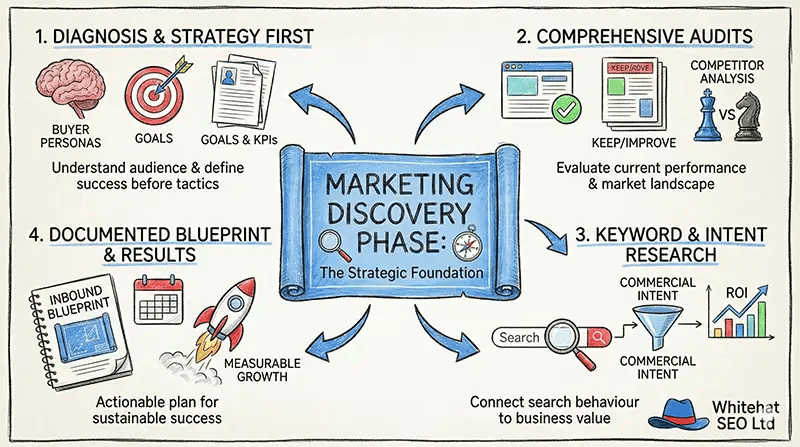
A marketing discovery phase is a structured 8–12 week process where agencies gather comprehensive intelligence about your business, customers, and competitive landscape before executing any tactics. This strategic foundation includes buyer persona development, content audits, competitor analysis, and goal setting. Companies with documented marketing strategies are 397% more likely to report success than those without, according to SmartInsights' 2025 research. At Whitehat, our HubSpot onboarding process integrates discovery as the essential first step.
Too many B2B companies leap straight into marketing tactics—launching campaigns, publishing content, and spending budget—without first understanding who they're targeting, what their customers actually need, or how they compare to competitors. The result? Wasted resources, misaligned messaging, and campaigns that generate activity but not results.
Marketing professor Mark Ritson estimates that 90% of marketers never develop a proper marketing strategy—and most don't even realise anything is missing. His framework of Diagnosis → Strategy → Tactics provides the antidote: thorough research and segmentation first, then targeting and positioning, then execution.
This guide explains exactly what a marketing discovery phase includes, why UK B2B companies need one before engaging any agency, and the specific documents you should expect to receive. Whether you're evaluating Whitehat or another partner, understanding discovery helps you select an agency that will deliver strategic value rather than just tactical output.
Why Marketing Discovery Phases Deliver Measurable ROI

The business case for investing in discovery before tactics is compelling. Research consistently shows that companies taking a strategy-first approach significantly outperform those rushing to execution.
According to the Content Marketing Institute's 2025 B2B research, 64% of the most successful B2B marketers have a documented content marketing strategy, compared with only 40% of all B2B marketers. The gap between top performers and average performers? Documentation and planning.
Client retention data reinforces this point. Agencies that invest in thorough discovery and onboarding see retainer clients staying an average of 56 months versus just 24 months for project-based relationships—a 2.3× difference. Annual churn drops from 42% for project-based agencies to 18% for those with structured retainer programmes built on strategic foundations.
For UK businesses specifically, the IPA's Marketing Effectiveness Roadmap research found that agencies implementing structured effectiveness strategies score 19% higher for effectiveness culture and achieve a 32% uplift in focus. The percentage of agencies with clear effectiveness strategies increased from 29% to 75% after adopting formal planning processes.
Buyer Personas: The Foundation of Targeted Marketing
Buyer personas are detailed, research-backed profiles of your ideal customers. Unlike vague target market descriptions, personas capture the specific motivations, challenges, and decision-making processes of the people who actually buy from you.
The evidence for persona-driven marketing is substantial. Companies that exceed their lead and revenue goals are 71% more likely to have documented personas, according to Cintell research—and these companies are 4× more likely to use personas for demand generation. Persona-based email campaigns achieve 2× higher open rates and 5× higher click-through rates compared with generic campaigns.
The most successful B2B companies maintain 4.2 active buyer personas on average, according to SiriusDecisions. This typically covers the primary decision-maker, the technical evaluator, the financial approver, and the end user—reflecting the reality that B2B buying committees now average 6–10 people.
A comprehensive persona document should include demographic information, job responsibilities, key challenges and pain points, information sources and content preferences, buying triggers and objections, and decision-making criteria. At Whitehat, our persona documents go further—mapping the complete buyer's journey from awareness through consideration to decision for each persona type.
UK GDPR consideration: When developing personas using customer data, ensure compliance with data protection requirements. The ICO confirms that inferred characteristics appended to names and addresses constitute personal data under UK GDPR. Use aggregated, anonymised data where possible, and document your lawful basis—typically legitimate interests with a documented Legitimate Interests Assessment for B2B marketing purposes.

Content Audits Reveal Hidden Opportunities and Gaps
A content audit systematically evaluates every piece of existing content—website pages, blog posts, downloadable resources, videos, and social content—to identify what's working, what's underperforming, and where gaps exist.
The ROI from content auditing is well-documented. Intero Digital's 2024 research found that organic traffic grows up to 106% after updating and republishing old posts. Oakland Community College saw conversions increase by 250% within five weeks after implementing audit findings, according to Stamats' case study research.
Our website audit service examines content through multiple lenses: technical performance (page speed, mobile responsiveness, crawlability), SEO effectiveness (keyword targeting, internal linking, metadata), content quality (accuracy, depth, relevance), and conversion optimisation (calls-to-action, user journey, lead capture).
A thorough content audit should categorise every piece of content as keep (performing well), improve (good foundation but needs updates), consolidate (merge similar pieces), or remove (outdated, thin, or redundant). This inventory becomes the foundation for your content marketing strategy and editorial calendar.
Digital Competitor Analysis Identifies Your Strategic Gaps
Understanding your competitive landscape isn't optional—it's essential for positioning and differentiation. A digital competitor audit examines what rivals are doing well, where they're vulnerable, and how you can carve out distinctive positioning.
Effective competitor analysis covers three dimensions: digital presence (website structure, content depth, technical performance), SEO positioning (keyword rankings, backlink profiles, content gaps), and marketing activities (social presence, advertising, thought leadership). The goal isn't to copy competitors but to identify opportunities they've missed.
For UK B2B companies, competitor analysis should also examine partner ecosystems. If you're a HubSpot user competing against companies using different platforms, understanding those technology stacks informs both positioning and integration requirements. Our SEO services include competitive gap analysis as a core component of discovery work.
Keyword Research Connects Content to Commercial Intent

Keyword research identifies the specific terms your target audience uses when searching for solutions like yours. It's not about finding high-volume keywords—it's about finding terms that indicate commercial intent and align with your buyer personas' journey stages.
The stakes are significant. Position 1 in Google receives 27.6% of clicks versus just 2.6% for position 10—a 10× difference, according to Backlinko's 2025 click-through rate study. SEO delivers £22.24 ROI for every pound spent, with B2B SaaS companies seeing average ROI of 702%, according to FirstPageSage research.
A comprehensive keyword analysis document should prioritise terms by difficulty, volume, and commercial value. Each relevant keyword gets rated for ranking potential and mapped to specific content pieces in your editorial calendar. This prevents the common mistake of creating content without a clear keyword strategy—or worse, creating multiple pages competing for the same terms.
Goals and KPIs Create Accountability and Focus
Discovery isn't complete without documenting specific, measurable goals tied to business outcomes. Too many marketing programmes track vanity metrics (page views, social followers) rather than commercial results (qualified leads, pipeline contribution, revenue attribution).
Goal setting during discovery should establish baseline metrics, define success criteria, and create the dashboard structure for ongoing measurement. This typically includes marketing-sourced pipeline targets, lead quality benchmarks (MQL-to-SQL conversion rates), content performance thresholds, and SEO ranking objectives.
The IPA Bellwether Q4 2024 report shows that 25.6% of UK companies expect to increase 2025/26 marketing budgets, with growth concentrating in measurable, ROI-proven formats. Establishing clear measurement frameworks during discovery ensures you can demonstrate that ROI when budget conversations happen.
What Documents Should You Receive From Discovery?
A comprehensive marketing discovery phase should produce a suite of documented deliverables that serve as the foundation for all subsequent marketing activities. At Whitehat, our discovery process typically produces 10–12 distinct documents:
- Buyer Personas (3–5 profiles): Detailed profiles of your ideal customers with journey mapping
- Goals and KPI Framework: Measurable objectives tied to business outcomes
- Content Audit Report: Comprehensive inventory with improvement recommendations
- Digital Competitor Analysis: Competitive positioning and gap identification
- Keyword Research Document: Prioritised keyword opportunities with content mapping
- Long-term Content Plan: Editorial calendar aligned with buyer journey stages
- Social Media Calendar: Channel strategy and posting framework
- Brand Guidelines: Voice, tone, and visual identity documentation
- Performance Dashboard: Tracking framework for ongoing measurement
- Inbound Blueprint: Master strategy document consolidating all elements
Joe Pulizzi, founder of the Content Marketing Institute, puts it simply: "If you're not writing down your strategy, it doesn't exist." These documents transform verbal agreements and vague intentions into actionable, measurable plans that both agency and client can execute against. Our Inbound Blueprint approach consolidates all discovery findings into a single reference document.
How Long Does Marketing Discovery Take?
A thorough marketing discovery phase typically takes 8–12 weeks, depending on organisational complexity. This includes stakeholder interviews, data gathering, competitive research, document creation, and client reviews. Rushing discovery to start tactical execution faster almost always backfires—you end up spending more time later correcting misaligned campaigns.
The timeline breaks down roughly as follows: weeks 1–3 for stakeholder interviews and data gathering, weeks 4–6 for research and analysis, weeks 7–9 for document development, and weeks 10–12 for review, refinement, and handover. Throughout this process, regular check-ins ensure alignment and surface any issues early.
Ann Handley, Chief Content Officer at MarketingProfs, advises that hiring a strategist before a writer is now essential: "The first thing I would do is hire a strategist, someone who can set the course for the content marketing programme. Five years ago I would have said start with a writer... but I don't think we can do that anymore." Discovery is that strategic foundation.
UK B2B Marketing Context: Why Discovery Matters More Than Ever
The UK B2B marketing landscape presents specific challenges that make structured discovery essential. The B2B Marketing UK Agencies Benchmarking Report 2024 found that 84% of agencies cite pressure on client budgets as their top challenge, while average pitch win rates have dropped to 52.4%—down 8% from the prior year.
Meanwhile, 50% of UK B2B companies now outsource marketing, with outsourcing rates 25% higher than B2C. This creates both opportunity and scrutiny—agencies must demonstrate strategic value quickly or risk being replaced in the next budget review.
For businesses working with marketing agencies, thorough discovery provides the measurement framework needed to justify continued investment. When 78% of marketers plan an agency review in 2025 according to Ravetree research, agencies that can prove strategic contribution—documented during discovery—retain clients while tactical-only providers churn.
Need Help With Your Discovery Phase?
As a HubSpot Platinum Partner since 2016, we've refined our discovery process through hundreds of B2B engagements. Get a structured foundation that connects marketing to revenue.
Book a Discovery CallFrequently Asked Questions
How much does a marketing discovery phase cost?
Marketing discovery phases typically cost £5,000–£25,000 depending on organisational complexity and scope. Basic discovery for smaller companies starts around £5,000–£8,000. Comprehensive enterprise discovery with multiple stakeholder groups, technical audits, and detailed persona development ranges from £15,000–£25,000. The investment pays back through improved campaign effectiveness and reduced wasted spend.
What should a marketing audit include?
A comprehensive marketing audit examines your current marketing environment, objectives, strategies, and activities. This includes content inventory and performance analysis, technical SEO assessment, competitive positioning review, customer journey mapping, channel effectiveness evaluation, and measurement framework audit. The goal is identifying problems and opportunities before committing resources to tactics.
How do I prepare my company for agency discovery?
Prepare by gathering existing marketing materials, analytics access credentials, previous campaign reports, and sales data. Identify key stakeholders who should participate in interviews. Document known customer pain points and competitive concerns. Having this information ready accelerates the discovery timeline and improves output quality.
How often should buyer personas be updated?
Buyer personas should be reviewed every 6–12 months and updated when you observe significant changes in customer behaviour, market conditions, or business strategy. Signs that personas need updating include declining conversion rates, sales feedback about misaligned leads, new competitor entry, or changes to your product offering. Treat personas as living documents, not one-time deliverables.
Can we skip discovery if we already have buyer personas?
Existing personas can accelerate discovery but shouldn't eliminate it. Many organisations have outdated or underutilised personas that need validation and enhancement. Discovery also covers competitor analysis, content auditing, keyword research, and goal setting—elements beyond persona development. A condensed discovery phase can leverage existing work while filling gaps.
Clwyd Probert
Founder, Whitehat SEO
Clwyd Probert is the founder of Whitehat, a London-based SEO and inbound marketing agency and HubSpot Platinum Partner since 2016. He runs the largest London HubSpot User Group and advises B2B companies on connecting marketing to revenue.
Ready to Grow Your Organic Pipeline?
Get a free audit and 90-day action plan from our team.
Get Your Free AuditReferences & Citations
- Content Marketing Institute (2025). B2B Content Marketing Research. contentmarketinginstitute.com
- Gartner (2024). Improve B2B Lead Generation With Enterprise Personas. gartner.com
- IPA (2025). Bellwether Report Q4 2024. ipa.co.uk
- Marketing Week (2023). Mark Ritson: Tactics Without Strategy Is Dumbing Down Our Discipline. marketingweek.com
- B2B Marketing (2024). The State of Marketing Agencies in the UK. b2bmarketing.net
- HubSpot (2025). State of Marketing Report. blog.hubspot.com