
Published: January 2026 | Last Updated: January 2026
Meta Advertising for B2B: The UK Guide to Facebook and Instagram Ads in 2026
By Clwyd Probert, CEO at Whitehat SEO Ltd
Meta advertising delivers 60% lower cost-per-lead than Google Ads, making it a powerful but underutilised channel for B2B marketers in 2026. With 55.9 million UK users and AI-powered targeting improvements through Advantage+ campaigns, Facebook and Instagram now offer cost-efficient top-of-funnel reach that complements LinkedIn's precision targeting—particularly for UK B2B companies seeking budget-efficient awareness campaigns or HubSpot-integrated attribution.
If you're a B2B marketing director or demand generation leader, you've probably dismissed Facebook advertising as "not for us." After all, LinkedIn is where the decision-makers are, right?
The data tells a different story. According to WordStream's 2025 benchmarks, Facebook's average cost-per-lead of £22 is less than half Google's £56 and roughly one-third of LinkedIn's typical B2B rates. Meanwhile, 83% of B2B marketers already use Facebook for content marketing, and Gartner research shows 70% of B2B buyers use Facebook during their purchase research.
The question isn't whether Meta advertising works for B2B—it's whether you're using it strategically. This guide covers how UK B2B companies can leverage Meta's platforms effectively in 2026, from platform updates and cost benchmarks to HubSpot integration strategies that connect ad spend to pipeline.
The UK Meta Advertising Landscape in 2026
Meta's UK advertising reach stands at 55.9 million users—representing 80.1% of the population. UK users spend an average of 42 minutes daily on Facebook, higher than the global average, with the platform capturing 66.54% of all social network visits. The 25-34 age cohort represents the largest segment at 13.8 million users, followed closely by 35-44 year-olds—precisely the demographic most B2B companies need to reach.
For B2B marketers, one statistic matters more than any other: B2B decision-makers spend 74% more time on Facebook than average users. They're scrolling during commutes, evenings, and weekends—times when they're not in "work mode" but still receptive to the brands building mental availability for future purchases.
This aligns with what the Ehrenberg-Bass Institute calls the 95-5 rule: only 5% of B2B buyers are in-market at any time. The remaining 95% aren't ready to buy today but will be eventually. Meta's cost-efficient reach makes it ideal for building brand awareness with this majority—the prospects who'll remember you when they do enter the market.
B2B Meta Advertising Cost Benchmarks for 2026
Understanding cost benchmarks helps set realistic expectations and measure performance. WordStream's 2025 analysis of over 1,000 campaigns reveals favourable economics for B2B advertisers on Meta platforms.
| Metric | Facebook Ads | Google Ads | LinkedIn Ads |
|---|---|---|---|
| Average CPC | £0.56–£1.53 | £4.20 | £1.60–£6.40+ |
| Average CPL | £22 | £56 | £64–£96 |
| B2B Conversion Rate | 10.63% | 6.96% | 2.74% |
| Best Use Case | Awareness, retargeting | High-intent search | Precision B2B targeting |
B2B SaaS companies report even stronger results: average CPC of £0.66 and CPA of £15.74 on Meta platforms. However, cost alone doesn't tell the full story. Dreamdata's B2B attribution research found Meta's ROAS at 29% compared to LinkedIn's 113%—suggesting that while Meta delivers volume, LinkedIn often delivers higher-quality conversions.
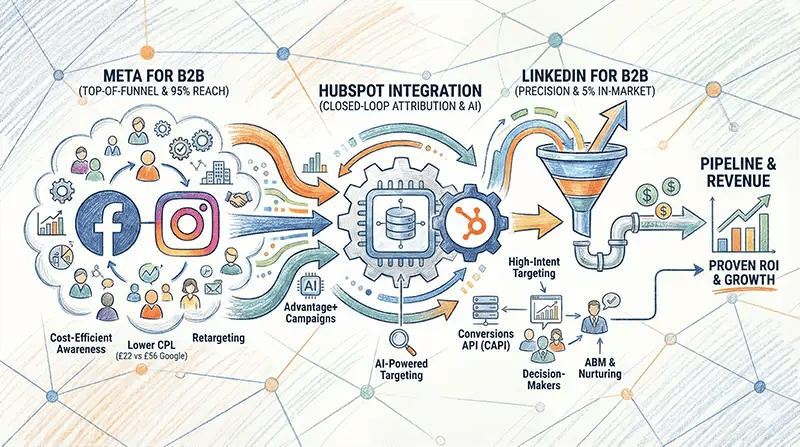
The strategic implication? Use Meta for cost-efficient top-of-funnel awareness and retargeting, LinkedIn for precision targeting and late-stage nurturing. Whitehat's PPC management services integrate both platforms with HubSpot for closed-loop attribution that reveals true channel value.
Meta Platform Updates That Matter for B2B in 2026
Meta's advertising platform has evolved significantly, with AI-powered features that change how B2B marketers should approach campaign management.
Advantage+ Campaigns Expand Beyond E-commerce
Meta's February 2025 rebrand from "Advantage+ Shopping" to "Advantage+ Sales Campaigns" signals broader applicability—these AI-powered campaigns now support lead generation, not just e-commerce. Advertisers using Advantage+ tools report £3.62 revenue for every £1 spent, representing a 22% improvement over standard campaigns.
The new Advantage+ Leads Campaigns, launched globally in February 2025, specifically address B2B needs with 10% lower lead costs and lead verification tools including SMS verification and work email validation. For B2B marketers concerned about lead quality from Meta campaigns, these verification features represent significant progress.
The Andromeda Algorithm Changes Targeting Dynamics
Meta's Andromeda algorithm, fully deployed in early 2025, fundamentally shifts how targeting works. Powered by NVIDIA's GH200 chip, Andromeda processes 100x faster and handles 10,000x more ad variants simultaneously. The practical implication: creative now functions as the primary targeting signal, making manual audience selection less relevant.
This shift means B2B marketers must prioritise creative velocity—refreshing ads 2-4 times monthly minimum—and creative diversity, testing multiple messaging angles rather than relying on narrow audience targeting. Meta's testing shows broad targeting combined with strong first-party signals now cuts CPA by 32%.
Conversions API Is Now Essential
The post-iOS 14.5 landscape in 2026 demands server-side tracking. Meta's data shows over 50% of browser-side conversions go untracked due to privacy restrictions. Conversions API (CAPI) implementation, running alongside Meta Pixel, recovers up to 15% of lost attribution signal.
For B2B companies, CAPI's ability to connect CRM data—including offline conversions like closed deals—to ad performance is transformative. This enables optimising for pipeline value rather than just lead volume, addressing B2B's fundamental attribution challenge. Whitehat's HubSpot onboarding includes CAPI configuration as standard for clients running Meta campaigns.
B2B Audience Targeting Strategies That Work
Meta's native B2B targeting options are limited compared to LinkedIn, but effective strategies exist for reaching business decision-makers.
Custom Audiences From First-Party Data
Custom audiences built from first-party data consistently outperform interest-based targeting for B2B. Effective sources include customer lists (expect 60-80% match rates, lower for B2B contacts), website traffic segmented by high-intent pages, and engagement audiences from video viewers and lead form interactions.
For HubSpot users, the native Meta integration enables automatic audience sync based on contact lists and lifecycle stages. This means you can target "all MQLs who haven't converted in 30 days" or "all customers eligible for upsell" directly through Meta campaigns.
Lookalike Audiences Require Quality Seeds
Lookalike audiences remain valuable when built from quality seed data. Meta recommends 1,000-5,000 people for optimal lookalike creation, with 1% lookalikes for highest similarity and 2-5% for broader reach.
One counterintuitive best practice from Metadata.io: create a 1% lookalike of your worst customers or unqualified leads—and exclude them from your targeting. This negative audience approach can significantly improve lead quality.
Interest Layering for B2B
Interest-based targeting for B2B requires layering strategies. Search Engine Journal advises targeting medium and large B2B employee segments and layering on Information Technology and Management interests to reach IT decision-makers. Facebook's native job title targeting remains limited compared to LinkedIn, making first-party data and lookalike audiences more reliable for B2B precision.
HubSpot Integration for Closed-Loop Attribution
The fundamental challenge with B2B Meta advertising isn't generating leads—it's knowing which campaigns generate revenue. With average B2B sales cycles of 6+ months and 6-10 stakeholders involved in buying decisions, Meta's default 30-day attribution window misses most of the picture.
HubSpot's native Meta integration solves this by enabling closed-loop attribution. When configured properly, you can trace a closed deal back to the specific campaign, ad set, and creative that generated the original lead—even if that first touch was eight months ago.
Key Integration Capabilities
- Automatic lead import: Facebook Lead Ads sync directly into HubSpot CRM within seconds of submission
- Custom audience sync: Create Meta audiences from HubSpot lists, enabling lifecycle-based targeting
- Conversions API: Server-side tracking recovers attribution lost to browser privacy restrictions
- Revenue attribution: Compare ad spend against actual closed revenue, not just lead counts
As a HubSpot Diamond Solutions Partner, Whitehat configures Meta-HubSpot integration as part of our standard onboarding process. This includes CAPI setup, custom audience configuration, and attribution dashboard creation—ensuring you can answer the question "what did this campaign actually produce?"
Meta vs LinkedIn: Strategic Budget Allocation for B2B
The expert consensus advises using both platforms strategically rather than choosing one. RevSure's research describes a channel sequencing approach: Meta builds early- and mid-funnel engagement with cost-efficient reach, feeding awareness and intent signals into your CRM. LinkedIn reinforces credibility and nurtures account-level influence in late-stage cycles where title precision matters.
Choose Meta When:
- Budget is limited and cost-per-lead matters more than precision targeting
- Targeting SMEs or broader professional audiences (not enterprise-only)
- Seeking cost-effective top-of-funnel brand awareness
- Retargeting website visitors through the buyer journey
- Testing creative messaging at scale before investing in LinkedIn
- Building first-party data audiences from lead form submissions
Choose LinkedIn When:
- Precise job title, company size, or industry targeting is essential
- Running account-based marketing (ABM) campaigns
- Targeting enterprise decision-makers specifically
- Thought leadership and credibility-building are key objectives
- Budget allows for higher CPCs with higher-quality lead expectations
RevSure recommends allocating 10-15% of paid social spend to Meta under a structured test-and-learn programme for B2B companies new to the platform. KLIQ Interactive's omnichannel research found that combining LinkedIn's intent-based targeting with Meta's retargeting capabilities delivers a 50% increase in sales conversions compared to single-channel efforts.
UK Regulatory Compliance for Meta Advertising
UK B2B marketers must navigate ASA advertising requirements and GDPR consent regulations when running Meta campaigns.
ASA Disclosure Requirements
The Advertising Standards Authority requires all paid or sponsored content to be "obviously identifiable as advertising" using clear labels like #ad. Labels like #spon, #gifted, or #affiliate are explicitly not considered adequate disclosure. ASA's 2024 monitoring found only 57% of social content adequately disclosed advertising status—meaning non-compliance remains widespread.
GDPR and Cookie Consent
Meta's September 2025 implementation of a "consent or pay" model in the UK marked a significant shift. The ICO welcomed the decision, noting the previous approach of targeting ads via terms and conditions was "not in line with UK law."
For advertisers, website operators bear primary responsibility for Meta Pixel and CAPI tracking compliance. Cookie consent requirements mandate explicit, informed consent for tracking cookies, with equal "Accept" and "Reject" buttons. However, the UK Data (Use and Access) Act 2025 introduced exceptions for low-risk cookies—the ICO is consulting on potential relaxation for low-risk advertising cookies, with final guidance expected early 2026.
Getting Started With B2B Meta Advertising
If you're evaluating Meta advertising for your B2B company, start with these implementation priorities:
- Implement Conversions API: Over 50% of browser-side conversions now go untracked. CAPI is no longer optional for accurate attribution.
- Connect your CRM: Whether you use HubSpot, Salesforce, or another platform, closed-loop attribution separates strategic Meta advertising from wasted budget.
- Build first-party audiences: Customer lists, website visitors, and lead form responders provide better targeting than interest-based approaches.
- Test Advantage+ Leads Campaigns: The new lead verification features address B2B's historical concern about Meta lead quality.
- Create mobile-first video creative: Reels ads deliver 50% higher conversions than static content. Hooks in the first 3 seconds, captions on every frame.
- Allocate strategically: 10-15% of paid social spend to Meta under structured testing, measuring pipeline contribution rather than just lead volume.
For UK B2B companies targeting SMEs, Meta offers the scale and cost efficiency to reach decision-makers that LinkedIn's premium pricing makes difficult. The 25-54 demographic commanding Facebook's largest UK segments represents precisely the B2B buyer persona most companies need to reach.
Need Help With Your Meta Advertising Strategy?
Whitehat's PPC management services integrate Meta campaigns with HubSpot for closed-loop attribution. We'll show you exactly which campaigns generate pipeline—not just clicks.
Frequently Asked Questions
Is Facebook advertising worth it for B2B companies in 2026?
Yes, when used strategically. Facebook delivers 60% lower cost-per-lead than Google Ads, and 83% of B2B marketers already use it for content marketing. The key is using Meta for cost-efficient awareness and retargeting whilst reserving LinkedIn for precision targeting. B2B decision-makers spend 74% more time on Facebook than average users—they're reachable there.
How much should UK B2B companies budget for Meta advertising?
RevSure recommends allocating 10-15% of your paid social budget to Meta under structured testing. Meta requires at least 50 conversions per week per ad set to exit learning phase, so budget accordingly—typically £50-100 per day minimum for B2B lead campaigns. UK-specific CPM averages £19, though B2B campaigns often achieve £15-22 CPL with proper optimisation.
What's the best Facebook ad format for B2B lead generation?
Facebook Lead Ads convert at 12.5%, outperforming landing page campaigns by 2.07×. For B2B, the new Advantage+ Leads Campaigns with lead verification features deliver 10% lower costs whilst filtering out low-quality submissions. Video creative in Reels format delivers 50% higher conversions than static images—use hooks in the first 3 seconds with captions throughout.
How do I target B2B decision-makers on Facebook?
Facebook's native B2B targeting is limited compared to LinkedIn. Effective strategies include custom audiences from customer lists (60-80% match rates), lookalike audiences built from your best customers, and interest layering combining employee size segments with management and industry interests. First-party data consistently outperforms interest-based targeting for B2B precision.
Can I integrate Facebook Ads with HubSpot?
Yes, HubSpot offers native Meta integration that syncs leads automatically, creates custom audiences from contact lists, and connects Conversions API for server-side tracking. This enables closed-loop attribution—comparing ad spend against actual closed revenue rather than just lead counts. Whitehat's HubSpot onboarding includes Meta integration configuration as standard.
Should I choose Facebook Ads or LinkedIn Ads for B2B?
Use both strategically. Meta excels at cost-efficient top-of-funnel awareness and retargeting, whilst LinkedIn delivers precision targeting for ABM and late-stage nurturing. Research shows combining both platforms delivers 50% higher sales conversions than single-channel approaches. Meta's CPL of £22 versus LinkedIn's £64-96 makes it ideal for volume; LinkedIn's 113% ROAS versus Meta's 29% makes it better for quality.
What UK regulations apply to Meta advertising?
UK Meta advertisers must comply with ASA disclosure requirements (using #ad for any paid content) and GDPR consent regulations for tracking. Meta's "consent or pay" model launched in September 2025, and website operators bear responsibility for Pixel and CAPI compliance. The ICO requires explicit consent with equal Accept/Reject options, though guidance on low-risk advertising cookies may relax in early 2026.
How quickly will I see results from B2B Facebook advertising?
Meta campaigns can generate traffic and leads within days, but meaningful B2B results require 4-8 weeks as campaigns exit the learning phase. With B2B sales cycles averaging 6+ months, true ROI measurement requires CRM integration and extended attribution windows. Expect early indicators (engagement, lead volume, cost metrics) within 2-4 weeks, with pipeline impact visible at 3-6 months.
References and Sources
- WordStream (2025). Facebook Ads Benchmarks 2025: NEW Data, Trends, & Insights for Your Industry. wordstream.com
- DemandSage (2026). Facebook Users Statistics: Global Data & Growth Trends. demandsage.com
- NapoleonCat (2025). Facebook Users in United Kingdom – January 2025. napoleoncat.com
- Powered by Search (2024). B2B SaaS Meta Facebook Ads Stats & Benchmarks for 2024. poweredbysearch.com
- Dreamdata (2024). B2B Facebook Ads Benchmarks 2024. dreamdata.io
- RevSure (2025). Meta Ads in 2025: What B2B Teams Should Know. revsure.ai
- Social Media Examiner (2025). Facebook Ad Algorithm Changes for 2026: What Marketers Need to Know. socialmediaexaminer.com
- Search Engine Journal (2024). B2B Targeting on Facebook: Audiences & Tactics That Work. searchenginejournal.com
- Hootsuite Blog (2024). How to Use Facebook Lookalike Audiences. hootsuite.com
- LeadsBridge (2024). How to Use HubSpot with Facebook Ads. leadsbridge.com
About the Author
Clwyd Probert is CEO of Whitehat SEO Ltd, a London-based HubSpot Diamond Solutions Partner specialising in B2B marketing, SEO, and paid media. Clwyd is a guest lecturer at UCL and leads the world's largest HubSpot User Group. Whitehat has helped UK businesses connect their marketing to revenue since 2011.
Contact Whitehat | Read More Articles marketing services view our pricing